

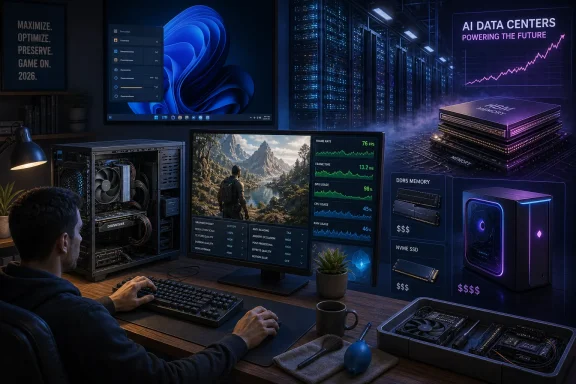
PC gaming in 2026 has produced a striking contradiction: this is one of the worst periods in years to buy a new gaming computer, yet one of the better periods to keep playing on an existing one. AI data-center demand has distorted the memory market, pushed component costs upward, and undermined the traditional expectation that yesterday’s premium hardware becomes tomorrow’s affordable mainstream option. At the same time, several major PC releases have demonstrated unusually broad scalability, giving owners of older graphics cards, modest processors, and handheld PCs more room to postpone an increasingly painful upgrade.
PC gaming has always depended on a cycle of technological escalation. New graphics cards introduce more rendering capacity, developers build games around that capacity, and older features eventually move into less expensive hardware.
That cycle has never been perfectly predictable. Cryptocurrency mining, pandemic-era production disruptions, logistics bottlenecks, and semiconductor shortages have all temporarily broken the relationship between performance and price. The difference in 2026 is that the disruption is not limited to one desirable GPU model or one manufacturing process.
Memory manufacturers naturally favor products with the strongest margins and the most committed buyers. Hyperscale data-center operators can sign enormous contracts, plan deployments years in advance, and tolerate prices that would be unacceptable in the consumer market.
That makes the present shortage structurally different from a brief retail run on graphics cards. PC gamers are competing indirectly with some of the world’s wealthiest companies for access to the semiconductor supply chain.
AI infrastructure is a more durable source of demand. Data centers require not only accelerators but also vast quantities of memory, storage, networking equipment, power-delivery hardware, and server processors. Expanding production also takes years, meaning a decision to build more fabrication capacity in 2026 cannot immediately reduce the cost of a gaming PC.
Anyone shopping for a complete system faces inflated component costs and weaker value than the market offered before the latest memory shock. Anyone who already owns a capable computer, however, possesses an increasingly valuable asset whose practical usefulness may be improving.
Retailers and system builders may still be selling inventory acquired under older agreements. Once that stock disappears, replacement units can arrive with materially higher costs attached.
The resulting process generally unfolds in stages:
That strategy is less effective when several categories rise together. A platform upgrade may require a new processor, motherboard, and memory kit, while a larger SSD can no longer be assumed to offer cheap capacity. Even buyers keeping their existing GPU can encounter an unexpectedly expensive project.
The familiar advice to “wait six months” also becomes difficult when the market lacks a clear normalization point. Waiting remains sensible for many users, but it is no longer a guarantee of substantially lower prices.
AI accelerators depend on high-bandwidth memory, or HBM, which uses vertically stacked memory dies and advanced packaging to deliver enormous bandwidth close to the processor. HBM is technically and economically different from conventional desktop DRAM, yet it draws from overlapping industrial resources.
That shift can restrict the growth of conventional DRAM output. Older DDR3 and DDR4 products are particularly vulnerable because manufacturers do not want to devote valuable production capacity to lower-margin technologies indefinitely.
The result can be painful at both ends of the market. New systems need DDR5, while businesses and consumers maintaining older machines may still require DDR4 or even DDR3. Reduced legacy production can make supposedly outdated memory surprisingly expensive.
Enterprise buyers also purchase at a scale that consumer demand cannot easily match. Suppliers can therefore prioritize data-center products or redirect investment toward higher-margin NAND configurations.
For gamers, this arrives at an especially awkward moment. Modern releases routinely require more than 100GB, while Forza Horizon 6 lists approximately 167GB of available storage as part of its PC requirements. An expensive SSD market makes game-library management a practical part of PC ownership again.
The price is not merely a Valve problem. It is a signal that the console-like PC category is colliding with an unfavorable component market.
Valve also cannot subsidize hardware in exactly the same way that a conventional console manufacturer might. Although Steam generates software revenue, a Steam Machine remains an open PC whose owner can install other operating systems and stores.
At more than $1,000, however, buyers expect either exceptional performance or an unusually polished experience. Entry-level specifications become much harder to defend when the asking price approaches that of traditionally powerful desktop builds.
That would invert the normal trajectory of consumer electronics. Consoles and fixed-specification devices typically become cheaper to manufacture as components mature. A prolonged semiconductor imbalance could instead force manufacturers to preserve prices, reduce storage, remove accessories, or introduce more expensive revisions.
For Windows enthusiasts, the Steam Machine also highlights the importance of software efficiency. SteamOS can reduce some operating-system overhead, but Windows remains essential for broad compatibility, productivity, modding tools, peripheral software, and games with restrictive anti-cheat implementations. Competition between the platforms will increasingly focus on how efficiently each uses hardware that owners can no longer afford to replace casually.
That insulation is weakening. The same memory and storage increases affecting PCs eventually reach Xbox, PlayStation, and other fixed platforms.
That does not mean an Xbox will automatically cost five times as much at retail. Components represent only part of the total product cost, and Microsoft can respond through contract negotiations, redesigns, reduced margins, or changes to storage capacity.
It does mean that traditional console economics are under severe strain. An Xbox Series X configuration that has already reached $800 in the United States has less room to absorb another major increase without damaging demand.
Microsoft’s multiplatform strategy further complicates the calculation. If Xbox games are available across Windows PCs and competing consoles, Microsoft has less incentive to absorb a large loss merely to place a proprietary box under the television.
Higher costs may produce several responses:
A system with 16GB or 32GB of memory, a reasonably modern six- or eight-core processor, an SSD, and a midrange GPU may be more economically valuable in 2026 than its resale price suggests.
Current consoles remain an important reference point. Most major publishers still need their games to function on the Xbox Series S, Xbox Series X, and PlayStation 5 generation. PC versions can demand more memory or shader performance, but developers cannot entirely abandon the performance envelope of the installed console base.
As that console generation ages, PC owners with hardware at or above its practical capabilities may continue receiving playable releases. A 2020-to-2023 midrange PC could therefore remain useful longer than buyers originally expected.
Owners should prioritize several basic tasks:
IGN highlights Crimson Desert, Pragmata, Forza Horizon 6, and Assassin’s Creed Black Flag Resynced as examples of games that can deliver acceptable experiences on lower-end systems after sensible adjustment.
The recommended specification—roughly a Core i5-12400F or Ryzen 5 5600X paired with an RTX 3060 Ti, RX 6700 XT, or Arc A580—also sits within reach of many established gaming PCs. Independent performance analysis has found that the game generally aligns with those published targets, although CPU demand and ray tracing can complicate higher settings.
This is what useful optimization looks like. The lowest preset does not need to resemble the maximum preset, but it must preserve the visual information, responsiveness, and stability required to enjoy the game.
Engine maturity does not guarantee perfection. Path tracing, high-resolution reflections, and other premium effects can still overwhelm ordinary GPUs. The difference is that they can remain optional rather than becoming an unofficial admission requirement.
A strong PC release should offer a solid rasterized foundation and then layer expensive effects above it. That approach respects both enthusiasts with flagship hardware and players still using mainstream cards.
Compatibility is part of optimization. A game that runs well on two GPU brands but fails on the third has not delivered a universally strong PC version.
Pearl Abyss subsequently worked on Intel compatibility, but the episode demonstrates why broad hardware testing must happen before launch. Intel remains the smallest discrete GPU participant, yet dismissing its users weakens competition precisely when gamers need more hardware choices.
A console usually offers a small number of predefined modes. A PC version can let users trade shadows, reflections, volumetrics, geometry, texture quality, resolution, and frame rate according to the strengths of their particular system.
Windows gamers trying to extend older hardware should generally adjust settings in a deliberate order:
However, upscaling quality depends on the source resolution, motion vectors, game integration, and reconstruction model. Aggressive modes at 1080p may produce unstable edges, visible disocclusion, or excessive softness.
Frame generation has similar limitations. It can improve apparent fluidity but does not eliminate the latency or simulation constraints of a low base frame rate. A game producing 25 real frames per second will not suddenly feel like a native 60fps experience merely because generated frames raise the output counter.
These tools are most effective when treated as part of a balanced settings strategy rather than a substitute for optimization.
The danger lies in assuming that every optimization guide or registry tweak is beneficial.
Resizable BAR or Smart Access Memory should also be enabled when the motherboard, processor, and graphics card support it. DirectStorage-compatible games benefit from an NVMe SSD, but storage speed cannot compensate for insufficient RAM or VRAM.
Users should verify refresh rate, variable refresh rate, HDR, and display resolution after driver updates. Windows can occasionally revert display settings, leaving a high-refresh monitor operating at 60Hz or changing color behavior without an obvious warning.
Debloating scripts also carry risk because Windows changes over time. A script written for an earlier build may remove components needed by Microsoft Store games, Xbox services, anti-cheat systems, Bluetooth devices, or future updates.
The safest approach is straightforward:
The market also rewards patience in software purchasing. Games receive patches, graphics drivers mature, shader-compilation behavior improves, and community settings guides identify wasteful options.
Older games also run exceptionally well on modern or semi-modern PCs. A system that struggles with maximum settings in a 2026 blockbuster may deliver high-refresh-rate performance in titles released only a few years earlier.
This is not merely settling for less. PC gaming’s enormous library is one of its strongest advantages, and hardware inflation makes that historical catalog even more relevant.
Used hardware may offer the best value, but it demands careful inspection. Buyers should verify component models, temperatures, storage health, physical condition, warranty status, and whether a suspiciously cheap GPU has been modified or heavily used.
Prebuilt systems can still make sense when large manufacturers hold favorable component contracts. Buyers must nevertheless examine the power supply, cooling, motherboard limitations, memory configuration, and proprietary parts rather than judging the system only by its GPU label.
Businesses can delay replacement, but aging hardware creates support, security, reliability, and productivity costs that home users may tolerate more easily.
Standardization becomes more valuable when parts are expensive. Maintaining a limited number of approved configurations allows IT teams to reuse memory, docks, chargers, storage devices, and replacement units more efficiently.
Enterprises should also distinguish between employees who need higher performance and those whose workloads remain light. A developer compiling large projects or a designer working with high-resolution assets may justify an expensive refresh, while an office user may gain little from replacing a healthy machine.
For occasional high-performance tasks, renting capacity can be sensible. For constant daily use, local hardware may remain less expensive over its lifetime, even at inflated acquisition prices.
Organizations should therefore model total cost rather than react to retail sticker shock. The correct answer may differ substantially between departments.
Valve’s handling of the Steam Machine will be especially informative. A price increase, revised configuration, or constrained supply would support warnings that conditions remain worse behind the scenes than they appear at retail.
Reviewers should pay particular attention to minimum-spec performance rather than testing only premium systems. Frame-time consistency, traversal stutter, shader compilation, VRAM behavior, and image quality at reduced settings matter more to the installed base than a flagship GPU’s maximum frame rate.
The key question is where new output will go. Additional capacity aimed primarily at HBM and enterprise products may support AI growth without restoring inexpensive consumer memory.
Watch for concrete increases in conventional DRAM and client NAND supply, not only large headline investment totals. Capacity that does not serve PCs, consoles, and mobile devices will not necessarily lower gaming hardware prices.
Past DRAM cases make the allegations difficult to dismiss casually, but litigation operates slowly. Discovery, class certification, appeals, settlements, and regulatory responses can take years.
Gamers should not delay an essential purchase on the assumption that a lawsuit will soon reduce prices. Its more immediate effect may be to force greater transparency around production decisions and market concentration.
PC gaming in 2026 is great only under a crucial condition: the player must already possess the hardware needed to participate. For those users, mature consoles, scalable engines, extensive graphics controls, and reconstruction technologies can turn an older PC into a capable machine for several more years. The smartest upgrade may therefore be no upgrade at all—just careful maintenance, realistic settings, disciplined Windows configuration, and a renewed appreciation for the enormous library that existing hardware can already run.
 Background
PC gaming has always depended on a cycle of technological escalation. New graphics cards introduce more rendering capacity, developers build games around that capacity, and older features eventually move into less expensive hardware.That cycle has never been perfectly predictable. Cryptocurrency mining, pandemic-era production disruptions, logistics bottlenecks, and semiconductor shortages have all temporarily broken the relationship between performance and price. The difference in 2026 is that the disruption is not limited to one desirable GPU model or one manufacturing process.
From GPU shortage to system-wide pressure
The current problem reaches across RAM, storage, processors, graphics cards, consoles, handhelds, and complete systems. High-bandwidth memory for AI accelerators does not directly replace the DDR5 module in a gaming PC, but both ultimately compete for investment, manufacturing attention, packaging capacity, materials, and supplier priorities.Memory manufacturers naturally favor products with the strongest margins and the most committed buyers. Hyperscale data-center operators can sign enormous contracts, plan deployments years in advance, and tolerate prices that would be unacceptable in the consumer market.
That makes the present shortage structurally different from a brief retail run on graphics cards. PC gamers are competing indirectly with some of the world’s wealthiest companies for access to the semiconductor supply chain.
Why earlier shortages eventually ended
Previous component crises encouraged buyers to wait because manufacturers had a strong incentive to restore consumer supply. When cryptocurrency demand collapsed or logistics improved, GPUs and other components could return to gaming channels, sometimes rapidly.AI infrastructure is a more durable source of demand. Data centers require not only accelerators but also vast quantities of memory, storage, networking equipment, power-delivery hardware, and server processors. Expanding production also takes years, meaning a decision to build more fabrication capacity in 2026 cannot immediately reduce the cost of a gaming PC.
The Hardware Market Has Changed
IGN Southeast Asia’s central argument is persuasive because it separates the experience of buying a PC from the experience of using one. Those activities were once closely connected, but they now tell very different stories.Anyone shopping for a complete system faces inflated component costs and weaker value than the market offered before the latest memory shock. Anyone who already owns a capable computer, however, possesses an increasingly valuable asset whose practical usefulness may be improving.
Retail prices are a delayed indicator
Valve engineer Yazan Aldehayyat reportedly warned that prices visible on retail shelves can lag bulk-supply conditions by three to six months. That distinction matters because consumers often interpret a few stable retail listings as evidence that the market has reached its ceiling.Retailers and system builders may still be selling inventory acquired under older agreements. Once that stock disappears, replacement units can arrive with materially higher costs attached.
The resulting process generally unfolds in stages:
- Memory and storage suppliers raise contract prices for manufacturers and large buyers.
- Device makers consume components acquired under older contracts.
- Retail prices initially remain stable or rise only modestly.
- New production batches arrive with higher bill-of-materials costs.
- Consumers finally see the full increase in laptops, consoles, handhelds, and desktop components.
The old upgrade ladder is breaking
PC builders traditionally responded to expensive GPUs by upgrading something else. A new SSD, more memory, a better processor cooler, or a platform refresh could improve the machine while the buyer waited for graphics prices to normalize.That strategy is less effective when several categories rise together. A platform upgrade may require a new processor, motherboard, and memory kit, while a larger SSD can no longer be assumed to offer cheap capacity. Even buyers keeping their existing GPU can encounter an unexpectedly expensive project.
The familiar advice to “wait six months” also becomes difficult when the market lacks a clear normalization point. Waiting remains sensible for many users, but it is no longer a guarantee of substantially lower prices.
Why AI Demand Is Hitting Gaming PCs
The phrase “AI-caused RAM crisis” can sound overly simplistic. The connection is real, but the mechanism involves more than data centers purchasing ordinary desktop memory modules from store shelves.AI accelerators depend on high-bandwidth memory, or HBM, which uses vertically stacked memory dies and advanced packaging to deliver enormous bandwidth close to the processor. HBM is technically and economically different from conventional desktop DRAM, yet it draws from overlapping industrial resources.
Production capacity follows profitability
Manufacturers decide how to allocate wafers, engineering talent, capital spending, packaging resources, and long-term capacity. When HBM commands substantially higher margins and comes with immense demand from AI customers, it becomes rational to prioritize it.That shift can restrict the growth of conventional DRAM output. Older DDR3 and DDR4 products are particularly vulnerable because manufacturers do not want to devote valuable production capacity to lower-margin technologies indefinitely.
The result can be painful at both ends of the market. New systems need DDR5, while businesses and consumers maintaining older machines may still require DDR4 or even DDR3. Reduced legacy production can make supposedly outdated memory surprisingly expensive.
NAND and SSDs face related pressure
Storage has its own production chain, but it is exposed to many of the same economic forces. AI infrastructure requires high-capacity enterprise storage for model training, data preparation, checkpoints, vector databases, and inference workloads.Enterprise buyers also purchase at a scale that consumer demand cannot easily match. Suppliers can therefore prioritize data-center products or redirect investment toward higher-margin NAND configurations.
For gamers, this arrives at an especially awkward moment. Modern releases routinely require more than 100GB, while Forza Horizon 6 lists approximately 167GB of available storage as part of its PC requirements. An expensive SSD market makes game-library management a practical part of PC ownership again.
Valve’s Steam Machine Becomes a Warning
Valve’s new Steam Machine illustrates how even a company with enormous platform influence cannot escape the bill of materials. The compact SteamOS system reportedly launched at $1,049 without a controller, an uncomfortable price for hardware positioned as an accessible route into living-room PC gaming.The price is not merely a Valve problem. It is a signal that the console-like PC category is colliding with an unfavorable component market.
A difficult value proposition
A compact gaming system has costs that a conventional desktop can sometimes avoid. It needs a carefully engineered enclosure, specialized cooling, integrated wireless hardware, a suitably efficient power supply, and components selected around thermal and spatial limits.Valve also cannot subsidize hardware in exactly the same way that a conventional console manufacturer might. Although Steam generates software revenue, a Steam Machine remains an open PC whose owner can install other operating systems and stores.
At more than $1,000, however, buyers expect either exceptional performance or an unusually polished experience. Entry-level specifications become much harder to defend when the asking price approaches that of traditionally powerful desktop builds.
The price may age better than expected
The disturbing possibility is that the Steam Machine’s launch price could eventually appear less outrageous, not because the product becomes cheaper, but because competing hardware becomes more expensive. If memory and storage costs continue filtering into retail channels, today’s overpriced system can become tomorrow’s baseline.That would invert the normal trajectory of consumer electronics. Consoles and fixed-specification devices typically become cheaper to manufacture as components mature. A prolonged semiconductor imbalance could instead force manufacturers to preserve prices, reduce storage, remove accessories, or introduce more expensive revisions.
For Windows enthusiasts, the Steam Machine also highlights the importance of software efficiency. SteamOS can reduce some operating-system overhead, but Windows remains essential for broad compatibility, productivity, modding tools, peripheral software, and games with restrictive anti-cheat implementations. Competition between the platforms will increasingly focus on how efficiently each uses hardware that owners can no longer afford to replace casually.
Consoles Are No Longer Insulated
Console hardware once provided a dependable escape from PC component volatility. A platform holder negotiated massive supply contracts, standardized one configuration, and could subsidize the device through software, subscriptions, accessories, and licensing revenue.That insulation is weakening. The same memory and storage increases affecting PCs eventually reach Xbox, PlayStation, and other fixed platforms.
Xbox demonstrates the scale of the problem
Xbox chief executive Asha Sharma has reportedly described dramatic increases in the prices Microsoft expects to pay for console storage components, with costs potentially exceeding five times their earlier level by the 2027 holiday period. Memory prices were said to be following a broadly similar direction.That does not mean an Xbox will automatically cost five times as much at retail. Components represent only part of the total product cost, and Microsoft can respond through contract negotiations, redesigns, reduced margins, or changes to storage capacity.
It does mean that traditional console economics are under severe strain. An Xbox Series X configuration that has already reached $800 in the United States has less room to absorb another major increase without damaging demand.
Subsidies have practical limits
Platform holders can sell hardware at low margins when each console creates a long-term customer for games and services. That model becomes less attractive if users buy fewer full-price games, subscribe intermittently, or purchase software on competing storefronts.Microsoft’s multiplatform strategy further complicates the calculation. If Xbox games are available across Windows PCs and competing consoles, Microsoft has less incentive to absorb a large loss merely to place a proprietary box under the television.
Higher costs may produce several responses:
- Console generations may last longer because replacing installed hardware becomes more expensive.
- Entry models may ship with less storage or fewer accessories.
- Platform holders may place greater emphasis on cloud gaming and cross-device subscriptions.
- Mid-generation upgrades may target affluent enthusiasts rather than mainstream households.
- Windows-based partner devices may take a larger role in Microsoft’s gaming strategy.
Existing Gaming PCs Have Gained Strategic Value
A functioning gaming PC is no longer just depreciating electronics. In the present market, it is also a stockpile of components purchased before the latest price escalation fully took hold.A system with 16GB or 32GB of memory, a reasonably modern six- or eight-core processor, an SSD, and a midrange GPU may be more economically valuable in 2026 than its resale price suggests.
Performance does not expire on a schedule
Hardware marketing encourages owners to treat every new generation as a deadline. Yet a PC does not become slower when a successor launches. Its capabilities change only when software requirements move beyond them or when the hardware physically deteriorates.Current consoles remain an important reference point. Most major publishers still need their games to function on the Xbox Series S, Xbox Series X, and PlayStation 5 generation. PC versions can demand more memory or shader performance, but developers cannot entirely abandon the performance envelope of the installed console base.
As that console generation ages, PC owners with hardware at or above its practical capabilities may continue receiving playable releases. A 2020-to-2023 midrange PC could therefore remain useful longer than buyers originally expected.
Maintenance becomes an upgrade
When replacement parts are cheap, maintenance can feel secondary. When they are expensive, preventing failure delivers a measurable financial return.Owners should prioritize several basic tasks:
- Remove dust from intake filters, heatsinks, and fans without allowing fans to spin uncontrollably.
- Monitor CPU, GPU, and SSD temperatures for signs of degraded cooling or restricted airflow.
- Replace failing fans before they create heat-related instability elsewhere in the system.
- Maintain adequate free SSD space so the operating system, updates, and shader caches can function properly.
- Keep graphics, chipset, firmware, and Windows updates current, while avoiding unnecessary beta software.
- Back up save files, configuration files, and irreplaceable personal data to a separate device or service.
- Use a quality surge protector or uninterruptible power supply where unreliable electricity presents a risk.
Better Optimization Is Extending Hardware Life
The optimistic side of 2026 is that several visually ambitious PC games have scaled better than their appearance might suggest. This does not erase launch bugs or compatibility failures, but it indicates that developers are paying closer attention to the installed base.IGN highlights Crimson Desert, Pragmata, Forza Horizon 6, and Assassin’s Creed Black Flag Resynced as examples of games that can deliver acceptable experiences on lower-end systems after sensible adjustment.
Forza Horizon 6 provides a useful baseline
Forza Horizon 6 lists a Core i5-8400 or Ryzen 5 1600, 16GB of RAM, and a GeForce GTX 1650, Radeon RX 6500 XT, or Intel Arc A380 as minimum hardware. Those components are modest by 2026 standards, even though the game’s 167GB storage requirement is substantial.The recommended specification—roughly a Core i5-12400F or Ryzen 5 5600X paired with an RTX 3060 Ti, RX 6700 XT, or Arc A580—also sits within reach of many established gaming PCs. Independent performance analysis has found that the game generally aligns with those published targets, although CPU demand and ray tracing can complicate higher settings.
This is what useful optimization looks like. The lowest preset does not need to resemble the maximum preset, but it must preserve the visual information, responsiveness, and stability required to enjoy the game.
Pragmata shows the value of mature engines
Capcom’s Pragmata benefits from the company’s increasingly mature RE Engine pipeline. Mature technology allows developers to understand where performance is being spent, how effects scale, and which settings can be reduced without destroying the artistic presentation.Engine maturity does not guarantee perfection. Path tracing, high-resolution reflections, and other premium effects can still overwhelm ordinary GPUs. The difference is that they can remain optional rather than becoming an unofficial admission requirement.
A strong PC release should offer a solid rasterized foundation and then layer expensive effects above it. That approach respects both enthusiasts with flagship hardware and players still using mainstream cards.
Crimson Desert is also a cautionary tale
Crimson Desert reportedly performed smoothly across a range of supported hardware, but its launch treatment of Intel Arc exposed a different form of optimization failure. The game initially lacked proper support for Intel’s discrete graphics cards, leaving owners unable to play regardless of the theoretical performance available.Compatibility is part of optimization. A game that runs well on two GPU brands but fails on the third has not delivered a universally strong PC version.
Pearl Abyss subsequently worked on Intel compatibility, but the episode demonstrates why broad hardware testing must happen before launch. Intel remains the smallest discrete GPU participant, yet dismissing its users weakens competition precisely when gamers need more hardware choices.
Graphics Settings Matter More Than Ever
PC gaming’s complexity is often portrayed as a disadvantage. In 2026, the ability to alter settings independently has become one of the platform’s greatest protections against rising hardware costs.A console usually offers a small number of predefined modes. A PC version can let users trade shadows, reflections, volumetrics, geometry, texture quality, resolution, and frame rate according to the strengths of their particular system.
Not every setting deserves the same priority
The maximum preset is rarely an efficient target. Ultra settings can consume a disproportionate amount of performance for changes that are difficult to notice during normal play.Windows gamers trying to extend older hardware should generally adjust settings in a deliberate order:
- Establish the desired frame-rate target before changing image quality.
- Disable path tracing and reduce ray tracing if frame rates remain unstable.
- Lower volumetric effects, shadow quality, reflection quality, and crowd density one step at a time.
- Keep textures as high as available VRAM safely permits, because texture reductions can noticeably damage image quality.
- Use a quality upscaling mode before dropping to aggressive performance modes.
- Apply frame generation only after achieving a stable native or upscaled base frame rate.
- Use a frame-rate cap to improve consistency, thermals, and power consumption.
- Test demanding gameplay scenes rather than relying exclusively on built-in benchmarks.
Upscaling is useful, but not free performance
DLSS, FSR, XeSS, and related technologies allow games to render internally at a lower resolution and reconstruct a higher-resolution image. They can materially extend GPU life, particularly at 1440p and 4K.However, upscaling quality depends on the source resolution, motion vectors, game integration, and reconstruction model. Aggressive modes at 1080p may produce unstable edges, visible disocclusion, or excessive softness.
Frame generation has similar limitations. It can improve apparent fluidity but does not eliminate the latency or simulation constraints of a low base frame rate. A game producing 25 real frames per second will not suddenly feel like a native 60fps experience merely because generated frames raise the output counter.
These tools are most effective when treated as part of a balanced settings strategy rather than a substitute for optimization.
Windows 11 Can Help or Hurt
The operating system sits between the game and the hardware, making Windows configuration increasingly important for systems operating close to their limits. A clean, well-maintained installation cannot transform an old GPU into a new one, but it can prevent avoidable stutter and background contention.The danger lies in assuming that every optimization guide or registry tweak is beneficial.
Start with supported features
Game Mode should generally remain enabled because it helps Windows prioritize gaming workloads and limit disruptive background activity. Hardware-accelerated GPU scheduling may improve performance or latency in some configurations, although results can vary by driver and game.Resizable BAR or Smart Access Memory should also be enabled when the motherboard, processor, and graphics card support it. DirectStorage-compatible games benefit from an NVMe SSD, but storage speed cannot compensate for insufficient RAM or VRAM.
Users should verify refresh rate, variable refresh rate, HDR, and display resolution after driver updates. Windows can occasionally revert display settings, leaving a high-refresh monitor operating at 60Hz or changing color behavior without an obvious warning.
Avoid optimization folklore
Disabling security services, modifying undocumented scheduler values, and installing “RAM cleaner” utilities can create more problems than they solve. Memory that appears occupied is not necessarily wasted; Windows uses available RAM for caching and releases it as applications require capacity.Debloating scripts also carry risk because Windows changes over time. A script written for an earlier build may remove components needed by Microsoft Store games, Xbox services, anti-cheat systems, Bluetooth devices, or future updates.
The safest approach is straightforward:
- Remove applications that are genuinely unnecessary.
- Limit unneeded startup programs through supported Windows controls.
- Keep sufficient storage free for updates and caches.
- Use official drivers from the hardware manufacturer.
- Investigate measurable problems instead of applying random tweaks pre-emptively.
Consumer Impact
For existing PC gamers, the most rational response is often to change expectations rather than hardware. A stable 60fps experience at high settings can be more satisfying than chasing ultra settings, path tracing, and triple-digit frame rates through an overpriced upgrade.The market also rewards patience in software purchasing. Games receive patches, graphics drivers mature, shader-compilation behavior improves, and community settings guides identify wasteful options.
Buying games instead of components
A gamer who postpones a $1,000 platform or GPU upgrade can redirect a small fraction of that money toward software. Discounted back catalogs, indie releases, subscription libraries, and well-supported multiplayer games can provide hundreds of hours without demanding the latest hardware.Older games also run exceptionally well on modern or semi-modern PCs. A system that struggles with maximum settings in a 2026 blockbuster may deliver high-refresh-rate performance in titles released only a few years earlier.
This is not merely settling for less. PC gaming’s enormous library is one of its strongest advantages, and hardware inflation makes that historical catalog even more relevant.
Newcomers face a harsher decision
The picture is less encouraging for someone without any suitable hardware. A new buyer must decide between an expensive desktop, a gaming laptop with limited upgradeability, a handheld, a console, or a used system.Used hardware may offer the best value, but it demands careful inspection. Buyers should verify component models, temperatures, storage health, physical condition, warranty status, and whether a suspiciously cheap GPU has been modified or heavily used.
Prebuilt systems can still make sense when large manufacturers hold favorable component contracts. Buyers must nevertheless examine the power supply, cooling, motherboard limitations, memory configuration, and proprietary parts rather than judging the system only by its GPU label.
Enterprise and Small-Business Impact
The same forces affecting gamers also matter to organizations managing Windows workstations. Memory and storage increases can inflate fleet-refresh budgets, particularly for engineering, media, development, simulation, and AI-assisted workloads.Businesses can delay replacement, but aging hardware creates support, security, reliability, and productivity costs that home users may tolerate more easily.
Longer refresh cycles require better management
An organization extending a three-year replacement cycle to four or five years should treat the decision as an operational program, not a simple purchasing delay. Systems need health monitoring, spare components, warranty planning, battery replacement policies, and performance baselines.Standardization becomes more valuable when parts are expensive. Maintaining a limited number of approved configurations allows IT teams to reuse memory, docks, chargers, storage devices, and replacement units more efficiently.
Enterprises should also distinguish between employees who need higher performance and those whose workloads remain light. A developer compiling large projects or a designer working with high-resolution assets may justify an expensive refresh, while an office user may gain little from replacing a healthy machine.
Virtualization and cloud services are not automatic bargains
Cloud desktops and rented GPU resources can reduce upfront purchasing, but they convert hardware costs into recurring operating expenses. Performance depends on network quality, data locality, licensing, and workload duration.For occasional high-performance tasks, renting capacity can be sensible. For constant daily use, local hardware may remain less expensive over its lifetime, even at inflated acquisition prices.
Organizations should therefore model total cost rather than react to retail sticker shock. The correct answer may differ substantially between departments.
Strengths and Opportunities
The hardware crisis creates genuine difficulties, but it may also push PC gaming toward healthier software and ownership practices.- Developers have a stronger commercial incentive to support older GPUs and processors because fewer customers can afford rapid upgrades.
- Longer console generations can stabilize performance targets and give PC hardware a longer useful life.
- More granular graphics menus allow users to spend performance on the visual features they actually value.
- Upscaling, dynamic resolution, shader improvements, and engine maturity can preserve acceptable performance without mandatory new hardware.
- Intel, AMD, Nvidia, Valve, Microsoft, and handheld manufacturers have an opportunity to compete on efficiency instead of raw power alone.
- Repairability and replaceable storage or memory can become meaningful selling points rather than enthusiast-only concerns.
- The used market can keep capable systems in service, reducing both expenditure and electronic waste.
- Players may rediscover older releases, independent games, and less hardware-intensive genres instead of treating every new blockbuster as a benchmark.
Risks and Concerns
The optimistic case depends on software continuing to scale and hardware remaining reliable. Neither outcome is guaranteed.- A major release with steep minimum requirements could expose the limits of older 8GB GPUs, four-core processors, or 16GB systems.
- Developers may use upscaling and frame generation to disguise weak optimization rather than enhance a solid base implementation.
- Rising storage requirements can force upgrades even when CPU and GPU performance remain adequate.
- Older hardware may lose driver support, security updates, anti-cheat compatibility, or access to new rendering features.
- Extended ownership increases the likelihood of fan, SSD, power-supply, battery, and thermal-interface failures.
- High retail prices can shrink the PC audience, eventually making ambitious PC ports less attractive to publishers.
- Hardware concentration could worsen if smaller competitors cannot secure sufficient memory or manufacturing capacity.
- Consumers may overpay for used components as scarcity drives second-hand prices upward.
- Antitrust litigation against memory manufacturers may take years and may not produce lower prices even if plaintiffs succeed.
What to Watch Next
The second half of 2026 will reveal whether today’s retail market has fully absorbed upstream memory costs. Pricing on DDR5 kits, high-capacity SSDs, gaming laptops, handhelds, consoles, and complete desktops will provide a clearer signal than any single GPU launch.Valve’s handling of the Steam Machine will be especially informative. A price increase, revised configuration, or constrained supply would support warnings that conditions remain worse behind the scenes than they appear at retail.
Game requirements will test the optimistic thesis
Upcoming games with demanding specifications, including The Blood of Dawnwalker and the anticipated Metro 2039, may test how far developers can scale current technology. Published requirements should not be treated as final performance judgments, but they can reveal whether 8GB graphics cards and older CPUs are approaching a harder boundary.Reviewers should pay particular attention to minimum-spec performance rather than testing only premium systems. Frame-time consistency, traversal stutter, shader compilation, VRAM behavior, and image quality at reduced settings matter more to the installed base than a flagship GPU’s maximum frame rate.
Supply investments will take time
Memory manufacturers are considering or constructing additional capacity, but fabrication plants, packaging facilities, equipment installation, and product qualification do not happen quickly. Even aggressive investment may provide little immediate relief.The key question is where new output will go. Additional capacity aimed primarily at HBM and enterprise products may support AI growth without restoring inexpensive consumer memory.
Watch for concrete increases in conventional DRAM and client NAND supply, not only large headline investment totals. Capacity that does not serve PCs, consoles, and mobile devices will not necessarily lower gaming hardware prices.
Legal pressure remains uncertain
The California class-action lawsuit accusing Samsung, SK hynix, and Micron of restricting conventional DRAM supply adds political and legal scrutiny to the market. The companies deny or are expected to contest allegations of coordination, and a production shift toward more profitable AI memory is not itself proof of illegal price fixing.Past DRAM cases make the allegations difficult to dismiss casually, but litigation operates slowly. Discovery, class certification, appeals, settlements, and regulatory responses can take years.
Gamers should not delay an essential purchase on the assumption that a lawsuit will soon reduce prices. Its more immediate effect may be to force greater transparency around production decisions and market concentration.
PC gaming in 2026 is great only under a crucial condition: the player must already possess the hardware needed to participate. For those users, mature consoles, scalable engines, extensive graphics controls, and reconstruction technologies can turn an older PC into a capable machine for several more years. The smartest upgrade may therefore be no upgrade at all—just careful maintenance, realistic settings, disciplined Windows configuration, and a renewed appreciation for the enormous library that existing hardware can already run.
References
- Primary source: IGN Southeast Asia
Published: 2026-07-21T19:16:13+00:00
Loading…
sea.ign.com