

Elon Musk has set an extraordinary deadline for Grok Imagine: create a full-length, AI-generated adaptation of The Odyssey by December 31, 2026—one he says will be “historically accurate” and faithful to the art of Homer. The promise arrives less than a week after Christopher Nolan’s The Odyssey opened in theaters on July 17, 2026, turning an ancient Greek epic into the latest front in a far more modern argument about generative AI, artistic authorship, historical representation, and the future of filmmaking.
Musk’s claim is simple enough to repeat but difficult to unpack. Grok Imagine, the image and video generation platform attached to xAI’s Grok ecosystem, is being positioned as the engine for a feature-length retelling of Homer’s story before the end of the calendar year.
That deadline leaves barely more than five months to produce something that audiences would normally recognize as a complete film: a coherent narrative, sustained characters, consistent environments, intelligible dialogue, music, sound design, editing, pacing, and a delivery format suitable for viewing beyond a social-media clip.
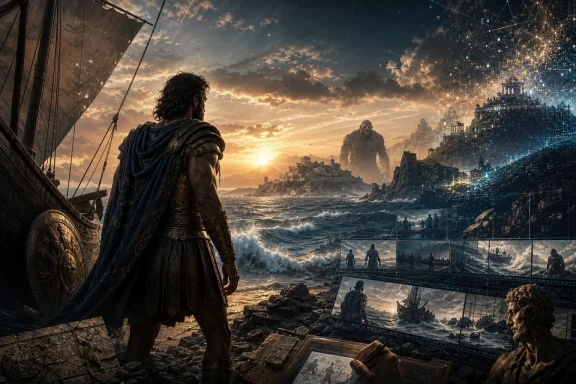
The announcement was accompanied by an AI-generated Odyssey-inspired short film circulated on X. It provided a glimpse of the kind of visual direction Musk appears to have in mind: polished, dramatic imagery of ancient warriors, ships, palaces, storms, and mythic grandeur. It also sharpened public skepticism about whether a few minutes of attractive generated footage can translate into a satisfying feature film.
For Windows users, creators, and AI enthusiasts, this story matters because it is not merely another celebrity prediction. It is a high-profile stress test for consumer-facing generative video tools. If Grok Imagine can deliver a genuinely watchable long-form movie on schedule, it would mark a major inflection point for AI video production. If it cannot, the episode may become another demonstration of the gulf between short-form AI spectacle and traditional filmmaking.
“Full-length” generally implies a feature running at least 70 to 90 minutes, though theatrical expectations often begin closer to two hours for an epic adventure. A feature is not simply a collection of clips assembled into a playlist. It requires continuity across hundreds or thousands of shots, repeated character appearances, evolving relationships, controlled pacing, and visual logic that does not collapse under scrutiny.
“Historically accurate” is even more complicated. Homer’s Odyssey is an ancient epic poem, not a historical chronicle. Its world contains gods, monsters, transformations, prophecies, enchantments, and supernatural interventions. Odysseus encounters the Cyclops Polyphemus, navigates dangers associated with Scylla and Charybdis, survives the Sirens, and spends years stranded far from Ithaca under conditions no conventional historical reconstruction can prove.
The more charitable interpretation is that Musk means historically grounded in the material culture and social world of the Late Bronze Age or early Greek tradition: plausible ships, weapons, armor, architecture, clothing, geography, food, politics, and maritime life. That would be a defensible creative goal.
But the phrase remains ambiguous. The poem was composed from oral traditions and later written down in a cultural environment far removed from the events it claims to remember. The historical period associated with a possible Trojan War is itself debated, while the poem’s version of Greek society blends different eras, inherited traditions, and imaginative storytelling.
An AI film could therefore be historically researched in its production design while still being fundamentally mythological. Calling it historically accurate without defining the historical target risks turning a complicated scholarly question into a marketing slogan.
Nolan’s version features an ensemble that includes Matt Damon, Tom Holland, Anne Hathaway, Robert Pattinson, Lupita Nyong’o, Zendaya, and Charlize Theron. It has already launched strongly at the global box office, indicating that the appeal of Homer’s journey remains intact even in an entertainment landscape crowded by established franchises, sequels, reboots, and superhero properties.
That commercial success matters because it gives Musk’s proposed AI film a ready-made cultural reference point. The project does not need to introduce The Odyssey to mainstream audiences; Nolan’s film has already made the story one of the defining cinematic conversations of the summer.
At the same time, Musk’s phrasing makes the Grok Imagine project sound less like a neutral technical demonstration and more like an alternative adaptation. By promising a version “true to the art of Homer,” he implicitly invites comparisons with Nolan’s interpretation.
That is a familiar pattern in entertainment culture. One adaptation becomes a lightning rod for debates about source material, casting, authenticity, and creative liberties. A rival version then presents itself as the corrective. What makes this case different is that the would-be rival is not another studio-backed production led by a director and cast. It is an AI-generated film proposed by the owner of a major AI platform and social network.
However, current published limits around individual video generation remain measured in seconds, not scenes or sequences. Video clips can be generated at lengths up to roughly 15 seconds, with extension workflows enabling creators to continue short material.
That is useful technology. It is also a world away from autonomously generating a 100-minute film.
A 90-minute movie contains 5,400 seconds of screen time. Even using 15-second clips, a production would require at least 360 generated segments before accounting for rejections, variations, alternate takes, cutaways, title cards, transitions, and revisions. In real production terms, the number of generated assets could climb into the thousands.
The essential problem is not arithmetic. It is continuity.
A filmmaking system must maintain the same protagonist through different ages, costumes, emotional states, weather conditions, locations, camera angles, and lighting setups. It must track whether a sword is in the left hand or right hand, whether an injury remains visible, whether a ship has previously been damaged, and whether a supporting character is present in the correct sequence of events.
Human viewers notice these details immediately, often subconsciously. A film can survive a small continuity error. It cannot survive a constant stream of changing faces, inconsistent costumes, shifting accents, disappearing objects, and locations that reset themselves between shots.
Yet a feature needs more than visual spectacle. It needs characters who remain recognizable.
Odysseus must be Odysseus from the opening aftermath of Troy through the long journey home. Penelope must feel like the same person across scenes of waiting, pressure, intelligence, restraint, and confrontation. Telemachus must develop as a character rather than appearing as a sequence of visually similar but subtly different people.
If Grok Imagine is used as a production tool under intensive human supervision, this hurdle may be partly manageable. Artists can create reference images, lock approved designs, curate outputs, make selective corrections, composite shots, and discard thousands of failed generations.
If the implication is that Grok will independently generate the entire film from high-level prompts, the challenge becomes much harder. A feature-length movie requires an extraordinary amount of human judgment even when the visuals are produced by software.
An AI-generated Odyssey would need dialogue that fits each character, an appropriate vocal performance, clean lip synchronization, stable emotional delivery, background ambience, battle sounds, sea effects, musical transitions, and final mixing. In a mythic epic, sound is not an accessory. The roar of the sea, the creaking of a ship, the quiet tension of Penelope’s hall, and the unnatural presence of gods and monsters all depend on carefully shaped audio.
AI voice systems are increasingly capable, but long-form dramatic acting remains difficult. A compelling performance relies on small changes in tempo, breath, emphasis, silence, and emotional continuity. The actor playing Odysseus cannot sound as though every line was generated in isolation.
There is also the question of language. A production claiming to honor Homer may choose modern English, reconstructed ancient Greek, stylized Greek-inflected dialogue, or a multilingual approach. Each direction would create a different film. Each would also require editorial control far beyond simple text-to-speech generation.
A literal adaptation would be long, episodic, and often deliberately repetitive. It would include extensive hospitality rituals, lineage references, formal speeches, digressions, divine councils, and moral assumptions that do not map neatly onto contemporary blockbuster storytelling.
Every adaptation must choose what to emphasize.
One version may focus on Odysseus as a warrior trying to return from war. Another may foreground Penelope’s endurance and intelligence in Ithaca. Another may treat the gods as literal characters, psychological symbolism, or an ambiguous force. A more historically oriented production may reduce overt supernatural elements. A more mythic approach may embrace them.
None of those choices are automatically more faithful than the others.
The phrase “true to Homer” can mean fidelity to plot points, emotional themes, oral-poetic tone, ancient social customs, or the moral complexity of the original. It can also become an empty claim used to suggest that a particular adaptation is more legitimate than all competing interpretations.
The Late Bronze Age Aegean world offers rich cinematic material: fortified settlements, maritime exchange, palace economies, elite warfare, bronze weapons, ritual life, and regional power struggles. But it does not provide a verified visual record of Odysseus himself, the Cyclops, Circe, or the Sirens.
A responsible film can depict historically plausible ships without pretending the voyage’s geography is settled fact. It can create authentic-feeling armor while acknowledging that ancient epic poetry is not a costume catalogue. It can depict gods as part of the poem’s reality without presenting mythology as documentary history.
That distinction is especially important in an AI context. Generative systems are highly skilled at producing images that look authoritative. A bronze shield, weathered stone temple, or ancient harbor can seem convincing even when details are anachronistic or invented.
The danger is not that AI uses creative license. Every filmmaker does. The danger is that generated confidence may be mistaken for historical evidence.
Those comments have caused some observers to interpret “historically accurate” as coded language rather than a narrowly archaeological or literary goal. The AI-generated short Musk shared, which appeared to feature an overwhelmingly white cast, intensified that interpretation.
This is a sensitive issue, and it requires precision. Ancient Greece was not culturally isolated, and the Mediterranean world was shaped by travel, migration, trade, conquest, slavery, diplomacy, and contact among peoples from Europe, North Africa, Western Asia, and beyond. Modern racial categories also cannot be cleanly projected backward onto the ancient world.
At the same time, historical representation in fiction is not resolved by simply declaring one casting philosophy “accurate.” The available evidence varies by location, era, social class, and subject. Homeric tradition itself comes from a poetic culture, not a census report.
The more useful standard is whether a production treats the past with intellectual honesty. That means resisting simplistic racial myths, avoiding the false certainty of “authenticity” branding, and recognizing that adaptations are works of interpretation.
An AI film marketed as historically faithful would be judged heavily on this point. Its creators would need to articulate a research methodology, identify the period and region being depicted, and explain how visual decisions were made. Without that transparency, “historical accuracy” risks becoming a rhetorical shield for aesthetic preferences.
That does not mean every creative risk disappears.
The key issue is whether an AI project merely adapts Homer or recreates the distinctive expression of modern works. A production based on the ancient poem has a far stronger legal foundation than one that appears to imitate Christopher Nolan’s specific visual designs, screenplay decisions, promotional imagery, performances, or production choices.
The same concern applies to training data and generated output more broadly. The AI industry remains entangled in major disputes over how models are trained, whether copyrighted works can be used without permission, and what rights creators should have when their work informs commercially valuable systems.
A high-profile Grok Imagine film would bring these questions into sharper focus. If it uses designs that closely resemble a current Hollywood adaptation, it could attract serious scrutiny. If it attempts a wholly separate visual identity, it may avoid some obvious comparisons while still facing wider concerns about the provenance of AI-generated imagery, voices, music, and performances.
There is also a practical question of credit. A conventional film can list a director, writers, cinematographers, editors, costume designers, production designers, performers, composers, sound teams, visual-effects artists, and hundreds of crew members. An AI-made film may still rely on many of those roles, but their contributions can become harder to see.
That opacity would be a loss. A movie is not just the final pixels on a screen; it is a record of creative labor and decision-making.
In that version, Grok Imagine is not treated as a magical replacement for filmmaking but as a powerful new production environment. A small team of filmmakers, classicists, historians, artists, editors, voice performers, sound designers, and AI specialists could use the system to create a stylized feature at a scale that would previously have been financially impossible.
The strongest version of an AI-assisted Odyssey would likely include:
AI is already useful in previsualization, concept art, animatics, localization, asset iteration, and independent production. Its real value may be in lowering the barrier to experimentation rather than in eliminating human authorship.
A generated movie can look expensive without being coherent. It can contain detailed ships, dramatic storms, beautiful faces, and elaborate ancient cities while lacking the basic cause-and-effect storytelling that holds an audience’s attention.
There are several risks to watch.
A character may arrive somewhere before they leave the previous location. A costume or injury may vanish. A relationship may change without emotional setup. These are not minor technical bugs when they happen repeatedly; they break the illusion of a designed world.
That visual vocabulary can be striking in a trailer. Over 90 minutes, it can become monotonous. Homer’s world needs contrast: domestic spaces, tense conversations, dangerous seas, strange islands, battle trauma, humor, deception, grief, and revelation.
A system can produce armor that combines centuries of design history, architecture that fuses Greek, Roman, Egyptian, and fantasy influences, or ships that look believable but make little engineering sense. Without rigorous review, the confidence of the image can overwhelm the uncertainty of the evidence.
The question is not whether humans will be involved. The question is whether their contributions will be credited, compensated, and treated as essential rather than invisible.
By December 31, 2026, Grok Imagine will either have released a complete Odyssey film that meets a meaningful definition of feature-length storytelling, or the claim will have to be reevaluated against what was actually delivered. A trailer, a proof-of-concept sequence, a collection of episodic vignettes, or a narrated slideshow would demonstrate progress, but none would fully satisfy the original promise.
The distinction will matter because generative AI is increasingly evaluated through viral examples rather than sustained works. A ten-second clip can be remarkable. A three-minute short can be persuasive. A feature demands a different level of reliability.
That does not make the goal impossible. It makes the standard much higher.
The most significant outcome may not be whether Grok Imagine can generate an entire movie without human intervention. That framing is too narrow and, frankly, not very useful. The more important question is whether AI tools can help create long-form cinema that audiences find coherent, moving, visually distinctive, ethically made, and worth revisiting.
Christopher Nolan’s The Odyssey demonstrates the continuing appeal of large-scale human filmmaking built around a classic narrative. Musk’s proposed Grok Imagine version could demonstrate the potential of a radically different production model. But it will need more than spectacle, more than speed, and more than a provocative claim of historical accuracy.
Homer’s epic has survived for millennia because it is not merely a tale of monsters and shipwrecks. It is a story about endurance, identity, memory, homecoming, temptation, grief, intelligence, and the cost of returning from war. Any AI-generated Odyssey that hopes to stand beside that tradition will need to prove that it understands the difference between generating images of an epic and telling one.
 Overview
Musk’s claim is simple enough to repeat but difficult to unpack. Grok Imagine, the image and video generation platform attached to xAI’s Grok ecosystem, is being positioned as the engine for a feature-length retelling of Homer’s story before the end of the calendar year.That deadline leaves barely more than five months to produce something that audiences would normally recognize as a complete film: a coherent narrative, sustained characters, consistent environments, intelligible dialogue, music, sound design, editing, pacing, and a delivery format suitable for viewing beyond a social-media clip.
The announcement was accompanied by an AI-generated Odyssey-inspired short film circulated on X. It provided a glimpse of the kind of visual direction Musk appears to have in mind: polished, dramatic imagery of ancient warriors, ships, palaces, storms, and mythic grandeur. It also sharpened public skepticism about whether a few minutes of attractive generated footage can translate into a satisfying feature film.
For Windows users, creators, and AI enthusiasts, this story matters because it is not merely another celebrity prediction. It is a high-profile stress test for consumer-facing generative video tools. If Grok Imagine can deliver a genuinely watchable long-form movie on schedule, it would mark a major inflection point for AI video production. If it cannot, the episode may become another demonstration of the gulf between short-form AI spectacle and traditional filmmaking.
The Claim: A Full-Length AI Movie in 2026
Musk’s commitment rests on two distinct promises:- Grok Imagine will create a full-length version of The Odyssey.
- The result will be historically accurate and true to the art of Homer.
“Full-length” generally implies a feature running at least 70 to 90 minutes, though theatrical expectations often begin closer to two hours for an epic adventure. A feature is not simply a collection of clips assembled into a playlist. It requires continuity across hundreds or thousands of shots, repeated character appearances, evolving relationships, controlled pacing, and visual logic that does not collapse under scrutiny.
“Historically accurate” is even more complicated. Homer’s Odyssey is an ancient epic poem, not a historical chronicle. Its world contains gods, monsters, transformations, prophecies, enchantments, and supernatural interventions. Odysseus encounters the Cyclops Polyphemus, navigates dangers associated with Scylla and Charybdis, survives the Sirens, and spends years stranded far from Ithaca under conditions no conventional historical reconstruction can prove.
The more charitable interpretation is that Musk means historically grounded in the material culture and social world of the Late Bronze Age or early Greek tradition: plausible ships, weapons, armor, architecture, clothing, geography, food, politics, and maritime life. That would be a defensible creative goal.
But the phrase remains ambiguous. The poem was composed from oral traditions and later written down in a cultural environment far removed from the events it claims to remember. The historical period associated with a possible Trojan War is itself debated, while the poem’s version of Greek society blends different eras, inherited traditions, and imaginative storytelling.
An AI film could therefore be historically researched in its production design while still being fundamentally mythological. Calling it historically accurate without defining the historical target risks turning a complicated scholarly question into a marketing slogan.
Why Christopher Nolan’s Film Is Central to the Moment
The timing is inseparable from Christopher Nolan’s newly released The Odyssey. Universal’s production reached theaters on July 17, 2026, as a major large-format event film, made with IMAX technology and framed as a monumental adaptation of Homer’s foundational epic.Nolan’s version features an ensemble that includes Matt Damon, Tom Holland, Anne Hathaway, Robert Pattinson, Lupita Nyong’o, Zendaya, and Charlize Theron. It has already launched strongly at the global box office, indicating that the appeal of Homer’s journey remains intact even in an entertainment landscape crowded by established franchises, sequels, reboots, and superhero properties.
That commercial success matters because it gives Musk’s proposed AI film a ready-made cultural reference point. The project does not need to introduce The Odyssey to mainstream audiences; Nolan’s film has already made the story one of the defining cinematic conversations of the summer.
At the same time, Musk’s phrasing makes the Grok Imagine project sound less like a neutral technical demonstration and more like an alternative adaptation. By promising a version “true to the art of Homer,” he implicitly invites comparisons with Nolan’s interpretation.
That is a familiar pattern in entertainment culture. One adaptation becomes a lightning rod for debates about source material, casting, authenticity, and creative liberties. A rival version then presents itself as the corrective. What makes this case different is that the would-be rival is not another studio-backed production led by a director and cast. It is an AI-generated film proposed by the owner of a major AI platform and social network.
The Technical Reality of Grok Imagine
Short Clips Are Not Feature Films
Grok Imagine has evolved beyond basic still-image generation. It can create images, edit reference imagery, generate video from text prompts or images, and support video extensions. That makes it a credible participant in the fast-moving AI video market.However, current published limits around individual video generation remain measured in seconds, not scenes or sequences. Video clips can be generated at lengths up to roughly 15 seconds, with extension workflows enabling creators to continue short material.
That is useful technology. It is also a world away from autonomously generating a 100-minute film.
A 90-minute movie contains 5,400 seconds of screen time. Even using 15-second clips, a production would require at least 360 generated segments before accounting for rejections, variations, alternate takes, cutaways, title cards, transitions, and revisions. In real production terms, the number of generated assets could climb into the thousands.
The essential problem is not arithmetic. It is continuity.
A filmmaking system must maintain the same protagonist through different ages, costumes, emotional states, weather conditions, locations, camera angles, and lighting setups. It must track whether a sword is in the left hand or right hand, whether an injury remains visible, whether a ship has previously been damaged, and whether a supporting character is present in the correct sequence of events.
Human viewers notice these details immediately, often subconsciously. A film can survive a small continuity error. It cannot survive a constant stream of changing faces, inconsistent costumes, shifting accents, disappearing objects, and locations that reset themselves between shots.
The Character Consistency Problem
This is where AI video has historically struggled. Modern generators can produce astonishing individual shots, particularly when the prompt is specific and the clip duration is short. They can create cinematic lighting, textured landscapes, physically impressive action, and visual styles that would have required a substantial effects team only a few years ago.Yet a feature needs more than visual spectacle. It needs characters who remain recognizable.
Odysseus must be Odysseus from the opening aftermath of Troy through the long journey home. Penelope must feel like the same person across scenes of waiting, pressure, intelligence, restraint, and confrontation. Telemachus must develop as a character rather than appearing as a sequence of visually similar but subtly different people.
If Grok Imagine is used as a production tool under intensive human supervision, this hurdle may be partly manageable. Artists can create reference images, lock approved designs, curate outputs, make selective corrections, composite shots, and discard thousands of failed generations.
If the implication is that Grok will independently generate the entire film from high-level prompts, the challenge becomes much harder. A feature-length movie requires an extraordinary amount of human judgment even when the visuals are produced by software.
Audio, Dialogue, and Performance
The visual side is only one half of the problem. A movie needs sound.An AI-generated Odyssey would need dialogue that fits each character, an appropriate vocal performance, clean lip synchronization, stable emotional delivery, background ambience, battle sounds, sea effects, musical transitions, and final mixing. In a mythic epic, sound is not an accessory. The roar of the sea, the creaking of a ship, the quiet tension of Penelope’s hall, and the unnatural presence of gods and monsters all depend on carefully shaped audio.
AI voice systems are increasingly capable, but long-form dramatic acting remains difficult. A compelling performance relies on small changes in tempo, breath, emphasis, silence, and emotional continuity. The actor playing Odysseus cannot sound as though every line was generated in isolation.
There is also the question of language. A production claiming to honor Homer may choose modern English, reconstructed ancient Greek, stylized Greek-inflected dialogue, or a multilingual approach. Each direction would create a different film. Each would also require editorial control far beyond simple text-to-speech generation.
What “True to Homer” Actually Means
Homer Is Not a Screenplay
The Odyssey is structured around oral-poetic traditions, repeated phrases, embedded stories, nonlinear revelations, and a worldview that is both heroic and strange to modern audiences. It is not a ready-made shooting script.A literal adaptation would be long, episodic, and often deliberately repetitive. It would include extensive hospitality rituals, lineage references, formal speeches, digressions, divine councils, and moral assumptions that do not map neatly onto contemporary blockbuster storytelling.
Every adaptation must choose what to emphasize.
One version may focus on Odysseus as a warrior trying to return from war. Another may foreground Penelope’s endurance and intelligence in Ithaca. Another may treat the gods as literal characters, psychological symbolism, or an ambiguous force. A more historically oriented production may reduce overt supernatural elements. A more mythic approach may embrace them.
None of those choices are automatically more faithful than the others.
The phrase “true to Homer” can mean fidelity to plot points, emotional themes, oral-poetic tone, ancient social customs, or the moral complexity of the original. It can also become an empty claim used to suggest that a particular adaptation is more legitimate than all competing interpretations.
Myth, Memory, and Material Culture
A historically grounded Odyssey could be fascinating if it clearly separates what is known, what is debated, and what is imaginative reconstruction.The Late Bronze Age Aegean world offers rich cinematic material: fortified settlements, maritime exchange, palace economies, elite warfare, bronze weapons, ritual life, and regional power struggles. But it does not provide a verified visual record of Odysseus himself, the Cyclops, Circe, or the Sirens.
A responsible film can depict historically plausible ships without pretending the voyage’s geography is settled fact. It can create authentic-feeling armor while acknowledging that ancient epic poetry is not a costume catalogue. It can depict gods as part of the poem’s reality without presenting mythology as documentary history.
That distinction is especially important in an AI context. Generative systems are highly skilled at producing images that look authoritative. A bronze shield, weathered stone temple, or ancient harbor can seem convincing even when details are anachronistic or invented.
The danger is not that AI uses creative license. Every filmmaker does. The danger is that generated confidence may be mistaken for historical evidence.
The Casting and Representation Controversy
Musk’s announcement did not emerge in a vacuum. Before Nolan’s film opened, he publicly criticized aspects of its casting, including Lupita Nyong’o’s role, and participated in broader online arguments involving Elliot Page’s casting in the production.Those comments have caused some observers to interpret “historically accurate” as coded language rather than a narrowly archaeological or literary goal. The AI-generated short Musk shared, which appeared to feature an overwhelmingly white cast, intensified that interpretation.
This is a sensitive issue, and it requires precision. Ancient Greece was not culturally isolated, and the Mediterranean world was shaped by travel, migration, trade, conquest, slavery, diplomacy, and contact among peoples from Europe, North Africa, Western Asia, and beyond. Modern racial categories also cannot be cleanly projected backward onto the ancient world.
At the same time, historical representation in fiction is not resolved by simply declaring one casting philosophy “accurate.” The available evidence varies by location, era, social class, and subject. Homeric tradition itself comes from a poetic culture, not a census report.
The more useful standard is whether a production treats the past with intellectual honesty. That means resisting simplistic racial myths, avoiding the false certainty of “authenticity” branding, and recognizing that adaptations are works of interpretation.
An AI film marketed as historically faithful would be judged heavily on this point. Its creators would need to articulate a research methodology, identify the period and region being depicted, and explain how visual decisions were made. Without that transparency, “historical accuracy” risks becoming a rhetorical shield for aesthetic preferences.
Copyright Is Less Simple Than the Public-Domain Argument
At first glance, The Odyssey looks like the ideal AI adaptation because Homer’s poem is in the public domain. No contemporary studio owns the underlying ancient story. Odysseus, Penelope, Telemachus, Circe, Polyphemus, and Ithaca have been adapted countless times.That does not mean every creative risk disappears.
The key issue is whether an AI project merely adapts Homer or recreates the distinctive expression of modern works. A production based on the ancient poem has a far stronger legal foundation than one that appears to imitate Christopher Nolan’s specific visual designs, screenplay decisions, promotional imagery, performances, or production choices.
The same concern applies to training data and generated output more broadly. The AI industry remains entangled in major disputes over how models are trained, whether copyrighted works can be used without permission, and what rights creators should have when their work informs commercially valuable systems.
A high-profile Grok Imagine film would bring these questions into sharper focus. If it uses designs that closely resemble a current Hollywood adaptation, it could attract serious scrutiny. If it attempts a wholly separate visual identity, it may avoid some obvious comparisons while still facing wider concerns about the provenance of AI-generated imagery, voices, music, and performances.
There is also a practical question of credit. A conventional film can list a director, writers, cinematographers, editors, costume designers, production designers, performers, composers, sound teams, visual-effects artists, and hundreds of crew members. An AI-made film may still rely on many of those roles, but their contributions can become harder to see.
That opacity would be a loss. A movie is not just the final pixels on a screen; it is a record of creative labor and decision-making.
The Best-Case Version of the Project
There is a constructive scenario in which Musk’s announcement becomes more than a publicity stunt.In that version, Grok Imagine is not treated as a magical replacement for filmmaking but as a powerful new production environment. A small team of filmmakers, classicists, historians, artists, editors, voice performers, sound designers, and AI specialists could use the system to create a stylized feature at a scale that would previously have been financially impossible.
The strongest version of an AI-assisted Odyssey would likely include:
- A clearly stated adaptation strategy rather than vague promises of literal fidelity.
- Transparent research into Bronze Age and archaic Greek material culture.
- Original visual design that does not mimic a contemporary studio production.
- Carefully controlled character reference materials.
- Human-written or heavily human-edited dialogue.
- Real creative direction over editing, pacing, sound, and performance.
- Clear disclosure of how generative tools were used.
- A deliberate artistic style that works with AI’s strengths rather than hiding its limitations.
AI is already useful in previsualization, concept art, animatics, localization, asset iteration, and independent production. Its real value may be in lowering the barrier to experimentation rather than in eliminating human authorship.
The Risks of Overpromising
The less promising scenario is equally easy to imagine: a sequence of technically impressive but emotionally hollow clips edited into a nominal feature, accompanied by a marketing campaign that treats duration as proof of artistic achievement.A generated movie can look expensive without being coherent. It can contain detailed ships, dramatic storms, beautiful faces, and elaborate ancient cities while lacking the basic cause-and-effect storytelling that holds an audience’s attention.
There are several risks to watch.
Narrative Drift
Generative systems can lose track of story facts across long sequences. In a film with gods, disguises, monsters, travel, flashbacks, and multiple locations, the possibility of narrative contradictions is especially high.A character may arrive somewhere before they leave the previous location. A costume or injury may vanish. A relationship may change without emotional setup. These are not minor technical bugs when they happen repeatedly; they break the illusion of a designed world.
Visual Sameness
AI video is often drawn toward a particular polished look: slow-motion movement, amber lighting, misty landscapes, exaggerated depth of field, symmetrical faces, and camera movements that signal “cinematic” without serving the scene.That visual vocabulary can be striking in a trailer. Over 90 minutes, it can become monotonous. Homer’s world needs contrast: domestic spaces, tense conversations, dangerous seas, strange islands, battle trauma, humor, deception, grief, and revelation.
False Authority
The label “historically accurate” may cause viewers to assume that an AI-generated visual decision is based on historical fact. It may not be.A system can produce armor that combines centuries of design history, architecture that fuses Greek, Roman, Egyptian, and fantasy influences, or ships that look believable but make little engineering sense. Without rigorous review, the confidence of the image can overwhelm the uncertainty of the evidence.
Human Labor Hidden Behind the Machine
Even if the finished movie is marketed as “made by Grok,” it will almost certainly require substantial human input to become coherent. Prompting, selection, editing, correction, dialogue work, sound design, legal review, and quality assurance are creative labor.The question is not whether humans will be involved. The question is whether their contributions will be credited, compensated, and treated as essential rather than invisible.
A Deadline That Will Define the Experiment
The deadline is now the story.By December 31, 2026, Grok Imagine will either have released a complete Odyssey film that meets a meaningful definition of feature-length storytelling, or the claim will have to be reevaluated against what was actually delivered. A trailer, a proof-of-concept sequence, a collection of episodic vignettes, or a narrated slideshow would demonstrate progress, but none would fully satisfy the original promise.
The distinction will matter because generative AI is increasingly evaluated through viral examples rather than sustained works. A ten-second clip can be remarkable. A three-minute short can be persuasive. A feature demands a different level of reliability.
That does not make the goal impossible. It makes the standard much higher.
The most significant outcome may not be whether Grok Imagine can generate an entire movie without human intervention. That framing is too narrow and, frankly, not very useful. The more important question is whether AI tools can help create long-form cinema that audiences find coherent, moving, visually distinctive, ethically made, and worth revisiting.
Christopher Nolan’s The Odyssey demonstrates the continuing appeal of large-scale human filmmaking built around a classic narrative. Musk’s proposed Grok Imagine version could demonstrate the potential of a radically different production model. But it will need more than spectacle, more than speed, and more than a provocative claim of historical accuracy.
Homer’s epic has survived for millennia because it is not merely a tale of monsters and shipwrecks. It is a story about endurance, identity, memory, homecoming, temptation, grief, intelligence, and the cost of returning from war. Any AI-generated Odyssey that hopes to stand beside that tradition will need to prove that it understands the difference between generating images of an epic and telling one.
References
- Primary source: Comic Basics
Published: 2026-07-22T20:14:02+00:00
Elon Musk Says Grok Will Create an AI-Made Odyssey Film by the End of the Year
Elon Musk is turning his attention toward one of the biggest movies of the year, but not by making a sequel or joining the production. Instead, the techwww.comicbasics.com - Independent coverage: NME
Published: 2026-07-22T19:38:12+00:00
AI will create historically accurate ‘The Odyssey’ by end of 2026, promises Elon Musk
Elon Musk has claimed his Grok AI tool will create a “historically accurate” full-length adaptation of Homer’s Odyssey by the end of 2026. www.nme.com
- Independent coverage: yellow.com
Published: 2026-07-22T18:01:36.179000+00:00
Musk Vows Grok Will Deliver A Historically Accurate Odyssey By 2026 | Yellow
After months attacking Nolan's film, the tech mogul now says xAI's Grok Imagine will produce his own faithful Odyssey by 2026.yellow.com - Independent coverage: Jang
Published: 2026-07-22T15:30:40+00:00
AI-generated 'The Odyssey' in the works as Elon Musk makes bold claims
Elon Musk is not satisfied with Christopher Nolan's re-telling of The Odyssey and wants to make his own version, using artificial intelligence.The Tesla founder, who has not shied away from publicly sharing his disapproval on several casting...jang.com.pk - Independent coverage: sffgazette.com
Published: 2026-07-22T08:30:00+00:00
Elon Musk Says Grok Will Create A "Historically Accurate" AI Version Of The Odyssey By The End Of The Year
Elon Musk has vowed to use his AI tool, Grok, to create a "historically accurate" version of Homer's The Odyssey by the end of the year...sffgazette.com
- Independent coverage: Variety
Published: 2026-07-22T09:07:19+00:00
Elon Musk Says Grok Will Make Historically Accurate AI Odyssey Movie
Elon Musk has again waded into Christopher Nolan's epic The Odyssey, saying Grok will make a historically accurate AI version by the end of the year variety.com