

3M’s new partnership with Microsoft places an industrial conglomerate at an increasingly important choke point in the artificial intelligence infrastructure buildout: the physical connections that allow enormous volumes of data to move reliably inside hyperscale data centers.
The headline is not that 3M is about to challenge semiconductor designers, optical-transceiver vendors, or fiber manufacturers. It is more nuanced—and potentially more significant. Microsoft’s Azure Cloud and AI Infrastructure is set to deploy 3M Expanded Beam Optical (EBO) technology, making Microsoft the first announced hyperscale cloud provider to adopt the system. The move positions 3M as a supplier of the connective hardware that can determine how quickly AI capacity is installed, maintained, and returned to service.
That matters because the AI boom is no longer solely a story about GPUs. The economics of a large AI cluster also depend on power delivery, cooling, rack design, networking switches, fiber-optic cabling, optics, and the labor required to connect and maintain all of it. A single unreliable fiber connection can become a disproportionately costly problem when it interrupts workloads running across thousands of accelerators.
For 3M stock, the Microsoft announcement arrives at an especially favorable moment. The company has reported a stronger-than-expected second quarter, raised its full-year adjusted earnings outlook, and demonstrated that its turnaround is gaining traction beyond cost control alone. The EBO opportunity gives investors a new reason to examine whether 3M can convert decades of materials science and manufacturing expertise into a durable role in AI data center infrastructure.
For Corning (GLW), Coherent (COHR), and Lumentum (LITE), the development is not automatically a threat. Each company operates in a different segment of the optical networking ecosystem. But 3M’s arrival underscores a broader market shift: AI data centers need not only faster components, but also more practical, cleaner, and faster-to-deploy physical interconnects.
Much of the financial market’s AI infrastructure conversation has centered on advanced computing silicon. Nvidia GPUs, custom accelerators, high-bandwidth memory, networking processors, and Ethernet or InfiniBand switches command attention because they are central to AI training and inference performance.
Yet those expensive systems cannot operate efficiently without an equally capable network beneath them. AI workloads require many servers and accelerators to exchange data constantly. Training a frontier model may involve thousands of GPUs working on different portions of the same computational task, with communications moving across rows of racks and, in some cases, across multiple data halls.
This puts intense pressure on the physical network.
The higher the data rates, the less forgiving the optical link can become. Fiber connections must be installed correctly, protected against contaminants, inspected, maintained, and replaced quickly when needed. In a conventional fiber connector, the optical surfaces must align with extraordinary precision. Dust, oil, fingerprints, scratches, and repeated handling can introduce loss or reflections that impair signal quality.
That is an inconvenient reality in any network. Inside a rapidly expanding AI data center, it can become an operational bottleneck.
Hyperscalers are trying to compress construction and deployment schedules while raising rack densities and network speeds. They are simultaneously managing construction crews, cabling specialists, equipment suppliers, commissioning teams, and live production environments. A system that reduces the amount of cleaning, inspection, or delicate handling required at the fiber connection point could have value well beyond the price of the connector itself.
This is the opening 3M is targeting.
EBO takes a different approach.
Rather than relying on direct fiber-to-fiber contact at the connection point, expanded-beam systems use optics to enlarge and guide the light beam through a small gap. By expanding the beam diameter, the connection becomes more tolerant of small contaminants and handling-related imperfections than a direct-contact arrangement.
The result is not magic, nor does it eliminate the need for rigorous data center engineering. Fiber remains a precision technology, and optical links still need to meet strict performance and reliability standards. But the design can make the connector interface more resilient in high-volume deployment environments where dust exposure and routine handling are unavoidable.
That architecture can offer several practical advantages:
In that sense, 3M’s EBO technology addresses a classic data center problem: the gap between a component’s theoretical performance and the real-world conditions under which it must be installed at scale.
That may sound less glamorous than an optical transceiver or accelerator chip. It is also exactly why the opportunity deserves attention.
Data centers rarely fail because an executive forgot that optics exist. They can fail to scale efficiently because mundane physical tasks—routing cables, preparing connectors, tracing faults, replacing links, and controlling contamination—become difficult when multiplied across enormous facilities.
3M is attempting to turn that operational pain point into a differentiated product category.
The partnership indicates that EBO has crossed an important threshold from technical concept to commercial infrastructure deployment.
Microsoft has described the technology as a way to improve the installation and maintenance of fiber connections in AI data centers. The company’s early use of the system has indicated the potential to reduce network deployment timelines in some environments while maintaining strong optical signal performance under real-world data center conditions.
That is a meaningful distinction.
Many technologies can demonstrate impressive performance in controlled testing. The AI data center market rewards solutions that can hold up when technicians are working under time pressure, construction activity generates particulate matter, and massive installation programs introduce inevitable variation.
Microsoft is the first announced hyperscale cloud provider to deploy 3M’s technology. The partnership does not disclose a total contract value, rollout schedule, unit volume, or the exact percentage of Azure facilities that will use EBO. It also does not establish that every AI data center, network topology, or optical speed will be equally well suited to this architecture.
Those limitations are important for investors and technology buyers alike.
Still, securing Microsoft as an announced hyperscale deployment partner is much more consequential than a small pilot project. It provides a demanding real-world environment in which 3M can validate manufacturing quality, installation processes, reliability, ecosystem compatibility, and support requirements.
If EBO performs as intended at Azure scale, other cloud operators, colocation providers, telecom companies, enterprise data centers, and AI infrastructure builders may take a much closer look.
A web application can often tolerate some distribution of workload across systems and locations. Large-scale AI training is less forgiving. Accelerators must coordinate constantly, and the networking fabric has a direct effect on overall utilization. If communication slows, costly GPUs can spend more time waiting instead of computing.
The challenge is not only bandwidth. It is also deployment speed and operational resilience.
That creates a series of compounding challenges:
Corning is closely associated with fiber, cable, connectivity infrastructure, and the physical pathways that carry optical communications through data centers, telecom networks, and broader digital infrastructure. As AI construction accelerates, demand for advanced fiber management and high-density cabling systems remains a major theme.
Coherent operates across lasers, optical components, transceivers, and related photonics technologies. Its role is more closely tied to generating, transmitting, and processing the optical signals that move through the network.
Lumentum supplies optical and photonic products, including technologies used in high-speed communications and data center interconnect applications. Its exposure is linked to the ongoing push for faster optical links and the components needed to support them.
3M occupies a different part of the stack. It is focused on making the fiber interconnection itself more manageable at scale.
A functioning AI network may require all of the following:
That said, any architecture change creates competitive pressure. If expanded-beam technology gains broader adoption, incumbent connector suppliers will need to evaluate their own product roadmaps. Cable and transceiver vendors may also need to ensure compatibility with the interfaces and standards that hyperscale customers choose.
For EBO to evolve from a compelling product into a major data center platform, the industry will need confidence in:
3M reported $6.5 billion in second-quarter sales, with adjusted organic growth of 5.4% year over year. Adjusted earnings per share reached $2.40, up 11% from the prior year period. The company also reported adjusted operating margin of 24.9%, reflecting a meaningful improvement in profitability even as it continues to invest in growth initiatives.
The company raised its full-year adjusted EPS outlook to $8.80 to $8.95, up from a prior range of $8.50 to $8.70.
Those numbers matter because they show that the 3M story is not resting exclusively on an AI-adjacent product announcement. The company is presenting evidence of broader operational improvement through organic growth, margin discipline, free cash flow generation, and an increased emphasis on product innovation.
Management is now placing innovation at the center of its turnaround effort.
The company has said it is on track to nearly triple the number of new products introduced compared with three years ago, while targeting more than 1,000 product launches by 2027 and shortening development cycle times. Those figures should be judged over time, not accepted as proof of future success on their own.
But EBO offers a useful example of what a more focused 3M could look like. It applies existing technical strengths to an expanding market with a clear customer problem and a prominent deployment partner.
That forecast supports the idea that expanded-beam systems could become a meaningful category. It does not prove that 3M will control the market, nor does it establish how much EBO revenue could contribute to 3M’s overall sales and earnings.
3M is a large, diversified enterprise. Even a successful connector platform may take time to move the needle at the consolidated company level.
That is a more credible proposition—and potentially a more durable one.
A hyperscale deployment can expose weaknesses that smaller programs do not. Variations in tooling, materials, assembly, testing, logistics, or field installation can become magnified at volume.
If the technology carries a higher upfront cost, customers will need confidence that deployment speed, reduced labor, fewer connection failures, and improved operational resilience offset that premium. The strongest value proposition will be one supported by measurable field outcomes, not just engineering theory.
That includes the ability to support changing connector densities, new transceiver form factors, different fiber configurations, and increasingly demanding performance requirements.
This is not merely a story about “picks and shovels.” It is a story about industrial execution.
The companies that benefit from AI may include manufacturers that can make data centers faster to construct, more power-efficient, easier to maintain, and more reliable under relentless operational pressure. In many cases, the winning technology will not be the most publicized component. It will be the one that removes a recurring constraint.
For Corning, Coherent, and Lumentum, the implication is clear: the AI fiber-optics boom is broadening. The growth opportunity is not limited to the glass fiber, the laser, or the transceiver. It includes every layer needed to transform optical bandwidth into a working, maintainable, high-volume network.
For 3M, the challenge is equally clear. The company now has a valuable proof point, a high-profile customer relationship, and a technology that aligns with one of the largest infrastructure spending cycles in the market. It must turn those advantages into repeatable commercial adoption.
Microsoft Azure’s planned deployment gives the technology significant credibility, particularly because hyperscale operators demand reliability, scale, and supply-chain discipline. Combined with stronger second-quarter performance and higher full-year earnings guidance, the partnership adds substance to the argument that 3M’s turnaround is beginning to generate new growth avenues.
The opportunity should still be viewed with discipline. EBO has not yet proven itself as a universal industry standard, and the financial contribution to 3M remains uncertain without disclosed deployment volumes or contract economics. Scaling production, achieving interoperability, demonstrating total-cost advantages, and winning additional customers will determine whether the technology becomes a niche product or a meaningful AI infrastructure platform.
Still, the core message is difficult to ignore. As artificial intelligence pushes data centers toward greater speed, density, and complexity, the companies that make physical networks easier to deploy may become as strategically relevant as the companies that make the networks faster.
The headline is not that 3M is about to challenge semiconductor designers, optical-transceiver vendors, or fiber manufacturers. It is more nuanced—and potentially more significant. Microsoft’s Azure Cloud and AI Infrastructure is set to deploy 3M Expanded Beam Optical (EBO) technology, making Microsoft the first announced hyperscale cloud provider to adopt the system. The move positions 3M as a supplier of the connective hardware that can determine how quickly AI capacity is installed, maintained, and returned to service.
That matters because the AI boom is no longer solely a story about GPUs. The economics of a large AI cluster also depend on power delivery, cooling, rack design, networking switches, fiber-optic cabling, optics, and the labor required to connect and maintain all of it. A single unreliable fiber connection can become a disproportionately costly problem when it interrupts workloads running across thousands of accelerators.
For 3M stock, the Microsoft announcement arrives at an especially favorable moment. The company has reported a stronger-than-expected second quarter, raised its full-year adjusted earnings outlook, and demonstrated that its turnaround is gaining traction beyond cost control alone. The EBO opportunity gives investors a new reason to examine whether 3M can convert decades of materials science and manufacturing expertise into a durable role in AI data center infrastructure.
For Corning (GLW), Coherent (COHR), and Lumentum (LITE), the development is not automatically a threat. Each company operates in a different segment of the optical networking ecosystem. But 3M’s arrival underscores a broader market shift: AI data centers need not only faster components, but also more practical, cleaner, and faster-to-deploy physical interconnects.
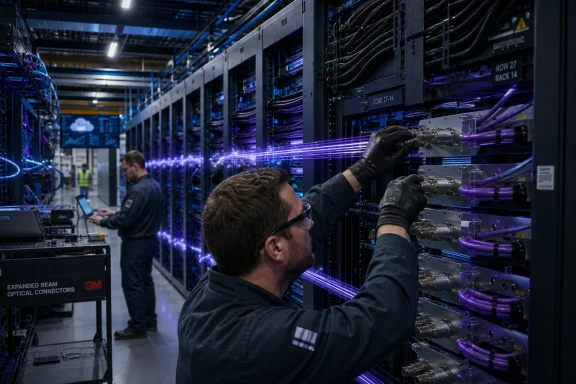 The Overlooked AI Infrastructure Bottleneck
Much of the financial market’s AI infrastructure conversation has centered on advanced computing silicon. Nvidia GPUs, custom accelerators, high-bandwidth memory, networking processors, and Ethernet or InfiniBand switches command attention because they are central to AI training and inference performance.Yet those expensive systems cannot operate efficiently without an equally capable network beneath them. AI workloads require many servers and accelerators to exchange data constantly. Training a frontier model may involve thousands of GPUs working on different portions of the same computational task, with communications moving across rows of racks and, in some cases, across multiple data halls.
This puts intense pressure on the physical network.
The higher the data rates, the less forgiving the optical link can become. Fiber connections must be installed correctly, protected against contaminants, inspected, maintained, and replaced quickly when needed. In a conventional fiber connector, the optical surfaces must align with extraordinary precision. Dust, oil, fingerprints, scratches, and repeated handling can introduce loss or reflections that impair signal quality.
That is an inconvenient reality in any network. Inside a rapidly expanding AI data center, it can become an operational bottleneck.
Hyperscalers are trying to compress construction and deployment schedules while raising rack densities and network speeds. They are simultaneously managing construction crews, cabling specialists, equipment suppliers, commissioning teams, and live production environments. A system that reduces the amount of cleaning, inspection, or delicate handling required at the fiber connection point could have value well beyond the price of the connector itself.
This is the opening 3M is targeting.
What 3M’s Expanded Beam Optical Technology Actually Does
Expanded Beam Optical technology is designed to change the way an optical signal passes through a connector interface. Traditional fiber connectors generally rely on direct physical contact between extremely small fiber end faces. That approach can deliver excellent optical performance, but it requires clean, well-prepared mating surfaces and careful installation practices.EBO takes a different approach.
Rather than relying on direct fiber-to-fiber contact at the connection point, expanded-beam systems use optics to enlarge and guide the light beam through a small gap. By expanding the beam diameter, the connection becomes more tolerant of small contaminants and handling-related imperfections than a direct-contact arrangement.
The result is not magic, nor does it eliminate the need for rigorous data center engineering. Fiber remains a precision technology, and optical links still need to meet strict performance and reliability standards. But the design can make the connector interface more resilient in high-volume deployment environments where dust exposure and routine handling are unavoidable.
Why the “Expanded” Beam Matters
At a basic level, a larger beam is less vulnerable to an individual dust particle than a very small beam concentrated directly at a fiber end face. The system uses optical elements to shape the light path before it crosses the connector interface, then refocuses the signal into the receiving fiber.That architecture can offer several practical advantages:
- Greater contamination tolerance at the connector mating interface.
- Reduced dependence on repeated cleaning and inspection during installation and maintenance.
- Faster field deployment in environments where thousands or millions of connections may be required.
- Improved durability during handling, especially where connectors are mated and unmated repeatedly.
- Potentially lower operational friction in dense, fast-moving data center buildouts.
- A more practical path to large-scale optical deployment without treating every connection like a cleanroom procedure.
In that sense, 3M’s EBO technology addresses a classic data center problem: the gap between a component’s theoretical performance and the real-world conditions under which it must be installed at scale.
A Passive Component With Active Importance
3M is not supplying the lasers, digital signal processors, switch silicon, or GPU interconnect fabric that dominate AI infrastructure spending. Its opportunity is closer to the physical-link layer—the point at which fiber paths are joined, protected, and made practical for deployment.That may sound less glamorous than an optical transceiver or accelerator chip. It is also exactly why the opportunity deserves attention.
Data centers rarely fail because an executive forgot that optics exist. They can fail to scale efficiently because mundane physical tasks—routing cables, preparing connectors, tracing faults, replacing links, and controlling contamination—become difficult when multiplied across enormous facilities.
3M is attempting to turn that operational pain point into a differentiated product category.
Microsoft Azure Gives EBO a Crucial Validation Event
Microsoft’s planned Azure deployment is important because hyperscale cloud companies are among the most demanding customers in the world. They do not merely evaluate whether a technology works in a laboratory. They assess whether it can be manufactured consistently, installed at volume, supported across changing site conditions, and integrated into a global infrastructure design.The partnership indicates that EBO has crossed an important threshold from technical concept to commercial infrastructure deployment.
Microsoft has described the technology as a way to improve the installation and maintenance of fiber connections in AI data centers. The company’s early use of the system has indicated the potential to reduce network deployment timelines in some environments while maintaining strong optical signal performance under real-world data center conditions.
That is a meaningful distinction.
Many technologies can demonstrate impressive performance in controlled testing. The AI data center market rewards solutions that can hold up when technicians are working under time pressure, construction activity generates particulate matter, and massive installation programs introduce inevitable variation.
The First Announced Hyperscaler, Not a Guaranteed Industry Standard
There is a temptation to treat the Azure deployment as proof that EBO will rapidly become the universal standard for AI data center connectivity. That conclusion would be premature.Microsoft is the first announced hyperscale cloud provider to deploy 3M’s technology. The partnership does not disclose a total contract value, rollout schedule, unit volume, or the exact percentage of Azure facilities that will use EBO. It also does not establish that every AI data center, network topology, or optical speed will be equally well suited to this architecture.
Those limitations are important for investors and technology buyers alike.
Still, securing Microsoft as an announced hyperscale deployment partner is much more consequential than a small pilot project. It provides a demanding real-world environment in which 3M can validate manufacturing quality, installation processes, reliability, ecosystem compatibility, and support requirements.
If EBO performs as intended at Azure scale, other cloud operators, colocation providers, telecom companies, enterprise data centers, and AI infrastructure builders may take a much closer look.
Why AI Data Centers Create a Different Optical Problem
Traditional cloud infrastructure already depends heavily on optical networking. AI data centers amplify the need for connectivity because the compute architecture is more tightly coupled.A web application can often tolerate some distribution of workload across systems and locations. Large-scale AI training is less forgiving. Accelerators must coordinate constantly, and the networking fabric has a direct effect on overall utilization. If communication slows, costly GPUs can spend more time waiting instead of computing.
The challenge is not only bandwidth. It is also deployment speed and operational resilience.
More Connections, More Density, More Handling
The physical scale of an AI data center can be staggering. High-density compute racks require extensive fiber connectivity to support switching fabrics, storage systems, management networks, and inter-rack communications.That creates a series of compounding challenges:
- Installation volume rises rapidly. More racks and more optical links mean more opportunities for contamination or connector damage.
- Network speeds increase. As link speeds advance, performance margins can become tighter and connection quality more important.
- Downtime becomes more expensive. A failed link can affect workloads supported by very costly accelerator hardware.
- Construction schedules matter more. Delayed networking can delay the moment an entire AI cluster begins generating value.
- Maintenance labor becomes a strategic concern. A connector design that reduces repetitive cleaning and inspection could lower friction for operations teams.
3M’s Position Alongside Corning, Coherent, and Lumentum
The AI optical networking market is not a winner-take-all contest. It is a layered value chain in which different companies address different technical needs.Corning is closely associated with fiber, cable, connectivity infrastructure, and the physical pathways that carry optical communications through data centers, telecom networks, and broader digital infrastructure. As AI construction accelerates, demand for advanced fiber management and high-density cabling systems remains a major theme.
Coherent operates across lasers, optical components, transceivers, and related photonics technologies. Its role is more closely tied to generating, transmitting, and processing the optical signals that move through the network.
Lumentum supplies optical and photonic products, including technologies used in high-speed communications and data center interconnect applications. Its exposure is linked to the ongoing push for faster optical links and the components needed to support them.
3M occupies a different part of the stack. It is focused on making the fiber interconnection itself more manageable at scale.
Complementary Technology, Not Direct Substitution
It would be inaccurate to frame 3M’s EBO strategy as a direct replacement for Corning’s fiber business or for the active optical technologies sold by Coherent and Lumentum.A functioning AI network may require all of the following:
- Fiber and cable infrastructure.
- High-density cable management systems.
- Optical transceivers and laser technology.
- Switching hardware and networking silicon.
- Connectors, ferrules, receptacles, and physical interconnect hardware.
- Test, inspection, cleaning, and maintenance systems.
- Power, thermal management, racks, and facility infrastructure.
That said, any architecture change creates competitive pressure. If expanded-beam technology gains broader adoption, incumbent connector suppliers will need to evaluate their own product roadmaps. Cable and transceiver vendors may also need to ensure compatibility with the interfaces and standards that hyperscale customers choose.
Standardization Will Be Critical
One of the most important aspects of 3M’s strategy is its involvement in broader standardization efforts around expanded-beam connectivity. Proprietary technology can create an early advantage, but hyperscalers generally resist becoming dependent on a single supplier for a critical infrastructure component.For EBO to evolve from a compelling product into a major data center platform, the industry will need confidence in:
- Multi-vendor availability.
- Interoperable mechanical and optical specifications.
- Consistent performance requirements.
- Long-term support and supply continuity.
- Compatibility with evolving fiber and transceiver designs.
- Clear installation, testing, and maintenance procedures.
Strong Second-Quarter Results Reinforce the Turnaround Narrative
The Microsoft partnership would have attracted attention under almost any circumstances. Its timing alongside 3M’s second-quarter results gives the story additional force.3M reported $6.5 billion in second-quarter sales, with adjusted organic growth of 5.4% year over year. Adjusted earnings per share reached $2.40, up 11% from the prior year period. The company also reported adjusted operating margin of 24.9%, reflecting a meaningful improvement in profitability even as it continues to invest in growth initiatives.
The company raised its full-year adjusted EPS outlook to $8.80 to $8.95, up from a prior range of $8.50 to $8.70.
Those numbers matter because they show that the 3M story is not resting exclusively on an AI-adjacent product announcement. The company is presenting evidence of broader operational improvement through organic growth, margin discipline, free cash flow generation, and an increased emphasis on product innovation.
Innovation Is Becoming Central to the 3M Investment Case
For years, 3M’s reputation was built on a broad portfolio of technical products and a culture of research-driven innovation. The company’s more recent challenges, including portfolio complexity, legal liabilities, and uneven execution, made investors question whether that innovation engine could translate into reliable financial progress.Management is now placing innovation at the center of its turnaround effort.
The company has said it is on track to nearly triple the number of new products introduced compared with three years ago, while targeting more than 1,000 product launches by 2027 and shortening development cycle times. Those figures should be judged over time, not accepted as proof of future success on their own.
But EBO offers a useful example of what a more focused 3M could look like. It applies existing technical strengths to an expanding market with a clear customer problem and a prominent deployment partner.
The Financial Opportunity Is Real, but It Should Not Be Overstated
The expanded beam connector market is projected to grow materially through the next decade, driven by demand across data centers, telecommunications, industrial automation, aerospace, defense, and other demanding environments. One industry estimate places the market at $4.13 billion by 2034, up from approximately $2.27 billion in 2025.That forecast supports the idea that expanded-beam systems could become a meaningful category. It does not prove that 3M will control the market, nor does it establish how much EBO revenue could contribute to 3M’s overall sales and earnings.
3M is a large, diversified enterprise. Even a successful connector platform may take time to move the needle at the consolidated company level.
The Case for Patience
There are several reasons investors should avoid treating the Azure announcement as an immediate revenue windfall:- No contract value has been disclosed.
- The deployment timeline has not been specified publicly.
- Production scaling can introduce execution risk.
- AI infrastructure spending can be volatile, even when long-term demand remains strong.
- Other connector technologies may compete effectively in specific use cases.
- Standardization may expand the market but attract more competitors.
- Hyperscaler qualification does not automatically translate into broad enterprise adoption.
That is a more credible proposition—and potentially a more durable one.
Risks 3M Must Manage
The benefits of EBO are intuitive, but broad adoption will depend on consistently meeting performance, cost, supply, and interoperability expectations.Scaling Production Without Sacrificing Precision
3M has said it is rapidly expanding EBO production capacity internally and externally. That is encouraging, but scaling a precision optical interconnect platform is not a trivial exercise. The company must preserve manufacturing quality, ensure supplier reliability, and avoid bottlenecks as customer demand increases.A hyperscale deployment can expose weaknesses that smaller programs do not. Variations in tooling, materials, assembly, testing, logistics, or field installation can become magnified at volume.
Cost Must Match Operational Savings
EBO may reduce cleaning, inspection, and maintenance requirements, but data center buyers will evaluate total cost of ownership rather than connector specifications alone.If the technology carries a higher upfront cost, customers will need confidence that deployment speed, reduced labor, fewer connection failures, and improved operational resilience offset that premium. The strongest value proposition will be one supported by measurable field outcomes, not just engineering theory.
Optical Networking Does Not Stand Still
AI networking architectures are evolving rapidly. Data rates are increasing, fiber counts are rising, and new approaches to optical interconnects continue to emerge. 3M must keep EBO compatible with future network designs rather than solving only the problems of the current generation.That includes the ability to support changing connector densities, new transceiver form factors, different fiber configurations, and increasingly demanding performance requirements.
What the Microsoft Deal Signals for the AI Supply Chain
The most important takeaway from the 3M-Microsoft partnership is that AI infrastructure investment is spreading outward from chips and servers into the less visible layers of the data center.This is not merely a story about “picks and shovels.” It is a story about industrial execution.
The companies that benefit from AI may include manufacturers that can make data centers faster to construct, more power-efficient, easier to maintain, and more reliable under relentless operational pressure. In many cases, the winning technology will not be the most publicized component. It will be the one that removes a recurring constraint.
For Corning, Coherent, and Lumentum, the implication is clear: the AI fiber-optics boom is broadening. The growth opportunity is not limited to the glass fiber, the laser, or the transceiver. It includes every layer needed to transform optical bandwidth into a working, maintainable, high-volume network.
For 3M, the challenge is equally clear. The company now has a valuable proof point, a high-profile customer relationship, and a technology that aligns with one of the largest infrastructure spending cycles in the market. It must turn those advantages into repeatable commercial adoption.
Conclusion
3M’s move into AI data center connectivity is a notable development because it demonstrates how the AI boom is creating opportunities well beyond the semiconductor industry. Expanded Beam Optical technology targets a practical and expensive problem: making fiber-optic connections more resilient to contamination, easier to install, and less burdensome to maintain in massive computing facilities.Microsoft Azure’s planned deployment gives the technology significant credibility, particularly because hyperscale operators demand reliability, scale, and supply-chain discipline. Combined with stronger second-quarter performance and higher full-year earnings guidance, the partnership adds substance to the argument that 3M’s turnaround is beginning to generate new growth avenues.
The opportunity should still be viewed with discipline. EBO has not yet proven itself as a universal industry standard, and the financial contribution to 3M remains uncertain without disclosed deployment volumes or contract economics. Scaling production, achieving interoperability, demonstrating total-cost advantages, and winning additional customers will determine whether the technology becomes a niche product or a meaningful AI infrastructure platform.
Still, the core message is difficult to ignore. As artificial intelligence pushes data centers toward greater speed, density, and complexity, the companies that make physical networks easier to deploy may become as strategically relevant as the companies that make the networks faster.
References
- Primary source: TradingView
Published: 2026-07-22T09:20:09+00:00
Industrials Heavyweight 3M Wants A Piece Of The AI Fiber Optics Boom — GLW, COHR, LITE Should Take Note — Noticias de TradingView
3M Co. (MMM) is emerging as an unexpected beneficiary of artificial intelligence as Microsoft Azure deploys its Expanded Beam Optical (EBO) fiber-optic technology to ease connectivity bottlenecks in hyperscale data centers, positioning the industrial conglomerate to capitalize on surging demand for…es.tradingview.com