

Apple’s next Mac refresh may be less a single launch event than a carefully staggered reset of the entire lineup, beginning with iterative Apple silicon updates this fall and extending into a far more consequential MacBook Pro redesign. The emerging picture points to updated laptops and desktops across virtually every category, but it also reveals an unusually complicated chip strategy in which M5, M6, and M7 could coexist in products aimed at very different buyers.
For Windows users watching Apple’s hardware moves from the other side of the platform divide, the story matters for more than competitive curiosity. A broader Mac refresh affects the premium PC market, the direction of on-device AI hardware, the pressure on Windows laptop makers to improve battery life and build quality, and the increasingly direct competition between Apple’s unified-memory systems and high-end Windows workstations powered by discrete GPUs.
The key caution is straightforward: none of the unannounced products, specifications, model identifiers, release windows, or pricing details should be treated as confirmed until Apple introduces them. Even so, multiple reports now point to a multi-stage Mac roadmap that is broad enough to merit close attention.
The most important detail is the scale of the reported plan. Rather than refreshing one or two flagship systems, Apple is said to be preparing updates across MacBook Pro, MacBook Air, iMac, Mac mini, Mac Studio, and MacBook Neo.
That does not mean every Mac will receive a new chassis, display, or dramatic feature upgrade. In fact, the opposite is likely for many models. Apple’s pattern has long been to alternate between relatively quiet processor revisions and less frequent industrial-design changes.
The rumored roadmap appears to follow that logic:
That is not the clean, generation-by-generation product ladder buyers normally expect. But it would fit an Apple strategy focused on shipping products when their hardware, displays, memory configurations, and supply chains are ready rather than waiting for every model to align under a single chip-family label.
For the base 14-inch MacBook Pro, a chip-first update would make practical sense. Apple has already established a lower-cost professional laptop tier below the 14-inch and 16-inch models equipped with Pro and Max chips. A standard M6 version could preserve that entry point while offering an easier upgrade path for users coming from M1, M2, or Intel-era machines.
The iMac is a similarly logical candidate. Its existing design remains visually distinctive, but it has become one of Apple’s least frequently revised product families. A processor update could improve longevity and improve performance without requiring Apple to re-engineer its ultra-thin all-in-one enclosure.
Still, a new chip alone may not satisfy buyers who have waited years for meaningful iMac changes. The current colorful 24-inch concept has been in place since 2021, and it remains unclear whether Apple intends to offer a larger iMac again or simply continue refining the same compact all-in-one model.
A move like this could have several motivations:
That situation is not unheard of in computing. Intel’s product stack regularly forced consumers to compare different Core i5, Core i7, and Core Ultra generations with varying core counts and power targets. Windows buyers are accustomed to it. But Apple has benefited from a relatively easy-to-understand hierarchy, and a discontinuity in the M-series roadmap could weaken that advantage.
A future redesign reportedly targets the high-end 14-inch and 16-inch models and may add two long-requested features:
However, OLED could deliver several meaningful advantages:
Apple has extensive experience managing OLED on iPhone, Apple Watch, and iPad Pro hardware. Even so, a MacBook Pro is used in ways that can be harsher on an OLED panel: code editors open all day, persistent menus, window chrome, timelines, tool palettes, and bright desktop applications.
A premium OLED MacBook Pro would therefore need robust panel protection, careful power tuning, and a long-term durability story convincing enough for creative professionals who retain systems for years.
A touch-enabled MacBook Pro would not necessarily mean Apple is adopting the full Windows 2-in-1 approach. There is no clear indication that Apple plans to create a folding, detachable, or 360-degree-hinge MacBook. The more likely scenario is a conventional clamshell notebook with touch as an additional interaction method.
That distinction matters. Windows touchscreens are at their best on devices designed around versatility: tablet mode, pen input, portrait orientation, detachable keyboards, and flexible hinge designs. Adding touch to a traditional laptop can be useful for quick gestures, scrolling, editing, annotation, and accessibility, but it does not automatically transform the operating system.
Apple’s most difficult task would be software design. macOS relies heavily on small controls, menu bars, close buttons, dense application interfaces, and cursor precision. A successful touchscreen Mac would require Apple to improve hit targets, gesture behavior, app consistency, and perhaps some elements of window management without compromising the desktop workflows that define the Mac.
Yet the decision could be strategically coherent.
Apple’s latest M5 Pro and M5 Max systems already push hard on local AI processing, GPU acceleration, memory bandwidth, SSD performance, and pro application performance. A redesigned MacBook Pro with those chips could still represent a meaningful leap because its selling point would be the display, touch experience, mobility, thermals, and industrial design—not simply a benchmark increase.
For buyers, though, that would create a difficult decision. Purchasing an expensive OLED touchscreen MacBook Pro equipped with an M5-class chip could feel risky if M7 models appear not long afterward. Apple may be counting on the physical redesign being compelling enough to outweigh concerns about buying into a chip generation that is no longer technically newest.
An M6 MacBook Air would likely focus on improvements that are subtle individually but meaningful in combination:
An updated model reportedly could move to an A19 Pro chip and include more memory. That would signal Apple’s commitment to the concept: a Mac for web browsing, education, streaming, documents, light media work, and basic AI-enabled applications, delivered at a more attainable price.
For Windows PC makers, the MacBook Neo is a warning shot. The entry-level laptop category has often involved compromises in build quality, screen quality, storage, battery life, or software support. Apple is attempting to establish a different proposition: a lower-priced Mac that still feels like an Apple product, even if it is clearly less capable than a MacBook Air.
Its success will hinge on several questions:
Unlike many Windows desktops and workstations, Macs do not offer straightforward post-purchase memory upgrades. Buyers must choose their configuration at the time of purchase, often paying a significant premium for higher memory tiers.
For typical home, office, and development use, a base M6 Mac mini could be highly attractive. It would likely offer excellent efficiency, quiet operation, and strong single-threaded performance in a remarkably small enclosure.
But the M5 Pro version could remain the better machine for users who need:
Reported M5 Max and M5 Ultra versions would be important primarily because the Mac Studio has become one of Apple’s strongest platforms for local AI workloads. Large unified-memory pools allow certain models to run locally that would otherwise require expensive discrete GPUs, multi-GPU systems, or cloud services.
This does not mean the Mac Studio will replace a high-end Windows workstation with NVIDIA RTX hardware. It will not. Windows workstations remain stronger choices for CUDA-dependent workflows, many professional GPU renderers, advanced AI training pipelines, broader hardware expansion, and users who need to upgrade memory or graphics cards over time.
But for users working in Apple-native creative apps, machine learning experimentation, local inference, video production, audio work, or portable desktop setups, the Mac Studio’s balance of power, noise, footprint, and power efficiency remains compelling.
If memory costs rise or supply tightens, Apple faces an uncomfortable choice: absorb the cost, reduce configuration availability, or increase pricing. Each option would undermine part of the Mac Studio’s appeal.
That includes:
The touchscreen MacBook Pro rumor is especially notable because it suggests Apple may finally be willing to borrow selectively from the Windows laptop playbook. Microsoft, Lenovo, HP, Dell, ASUS, and Samsung have spent years demonstrating that touch can be useful on clamshell PCs, even if not every user wants it.
Apple’s likely approach would be more conservative. It probably would not try to replicate the Surface Pro or Lenovo Yoga experience. Instead, it could make touch a premium convenience feature layered on top of the Mac’s established trackpad-first interaction model.
That would be an admission that the old Mac-versus-PC distinction is becoming less rigid. Windows laptops are becoming better at efficiency and integrated AI. Macs may become more flexible in how users interact with the display.
This is particularly serious for MacBook Pro buyers. A customer considering a current M5 Pro or M5 Max machine may wonder whether to wait for M6, the OLED touchscreen redesign, or M7. The answer will vary by need, but the roadmap uncertainty makes immediate buying decisions harder.
A touchscreen OLED MacBook Pro may be technologically impressive but still face resistance if the entry price rises beyond what freelancers, students, developers, and small businesses can justify. Windows buyers have more flexibility at the high end, including machines with replaceable SSDs, upgradeable memory, and a broad range of GPU options.
Apple has a chance to make touch feel deliberate rather than bolted on. But that would demand more than hardware. It would require a thoughtful evolution of macOS interfaces, developer guidance, and perhaps new conventions for multitasking and pro applications.
The near-term M6 updates may be important, particularly for mainstream MacBook Pro, MacBook Air, iMac, and Mac mini buyers. But they are unlikely to be the defining story. The real inflection point would be a redesigned MacBook Pro that combines a new display architecture, direct touch input, and a more ambitious hardware platform.
Apple’s challenge is to avoid turning that transition into a confusing overlap of M5, M6, and M7 systems that makes buyers feel they are always one launch away from an obsolete purchase. Its opportunity is equally clear: prove that the Mac can evolve beyond its long-standing design assumptions without losing the strengths that made Apple silicon laptops so disruptive in the first place.
If the roadmap materializes as described, the next Mac cycle will not simply be about faster processors. It will be about whether Apple can redefine the premium laptop again while Windows PC makers are closing the gap faster than ever.
For Windows users watching Apple’s hardware moves from the other side of the platform divide, the story matters for more than competitive curiosity. A broader Mac refresh affects the premium PC market, the direction of on-device AI hardware, the pressure on Windows laptop makers to improve battery life and build quality, and the increasingly direct competition between Apple’s unified-memory systems and high-end Windows workstations powered by discrete GPUs.
The key caution is straightforward: none of the unannounced products, specifications, model identifiers, release windows, or pricing details should be treated as confirmed until Apple introduces them. Even so, multiple reports now point to a multi-stage Mac roadmap that is broad enough to merit close attention.
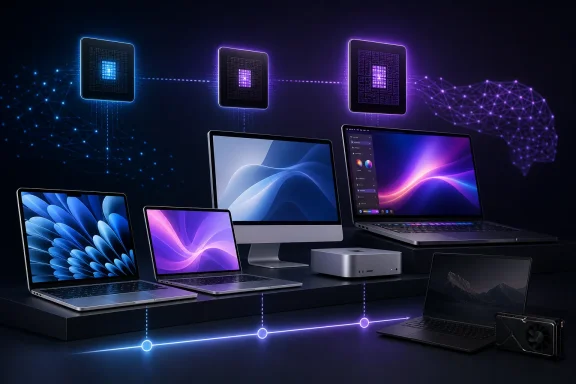 A Mac Overhaul Built Around Several Waves
The most important detail is the scale of the reported plan. Rather than refreshing one or two flagship systems, Apple is said to be preparing updates across MacBook Pro, MacBook Air, iMac, Mac mini, Mac Studio, and MacBook Neo.That does not mean every Mac will receive a new chassis, display, or dramatic feature upgrade. In fact, the opposite is likely for many models. Apple’s pattern has long been to alternate between relatively quiet processor revisions and less frequent industrial-design changes.
The rumored roadmap appears to follow that logic:
- Fall: a possible M6-based refresh for the entry-oriented 14-inch MacBook Pro and iMac.
- Early next year: updated MacBook Air models and a second-generation MacBook Neo.
- An uncertain later window: new Mac mini and Mac Studio configurations.
- Late next year or 2027: a much more ambitious MacBook Pro redesign, potentially incorporating OLED displays and touch input.
- Beyond that: the broader M7 generation, particularly for higher-performance professional systems.
That is not the clean, generation-by-generation product ladder buyers normally expect. But it would fit an Apple strategy focused on shipping products when their hardware, displays, memory configurations, and supply chains are ready rather than waiting for every model to align under a single chip-family label.
Why the M6 Transition Could Be Unusually Messy
The most intriguing part of the rumored roadmap is not the expected arrival of another Apple silicon generation. It is the possibility that Apple may treat M6 as a transitional platform rather than a full family with familiar Pro, Max, and Ultra tiers.A Base M6 May Lead the First Wave
The 14-inch MacBook Pro and iMac are reportedly among the systems being evaluated with M6 silicon. If that holds, it would suggest Apple wants to advance its mainstream CPU and GPU architecture quickly, perhaps with gains in efficiency, graphics capability, memory bandwidth, or local AI acceleration.For the base 14-inch MacBook Pro, a chip-first update would make practical sense. Apple has already established a lower-cost professional laptop tier below the 14-inch and 16-inch models equipped with Pro and Max chips. A standard M6 version could preserve that entry point while offering an easier upgrade path for users coming from M1, M2, or Intel-era machines.
The iMac is a similarly logical candidate. Its existing design remains visually distinctive, but it has become one of Apple’s least frequently revised product families. A processor update could improve longevity and improve performance without requiring Apple to re-engineer its ultra-thin all-in-one enclosure.
Still, a new chip alone may not satisfy buyers who have waited years for meaningful iMac changes. The current colorful 24-inch concept has been in place since 2021, and it remains unclear whether Apple intends to offer a larger iMac again or simply continue refining the same compact all-in-one model.
Skipping M6 Pro and M6 Max Would Be a Major Departure
Reports have suggested Apple may bypass M6 Pro and M6 Max variants, moving instead from base M6 chips to a more capable M7 professional family. If accurate, that would represent a notable break from the Apple silicon cadence established since the M1 era.A move like this could have several motivations:
- Apple may want to accelerate a new architecture designed around on-device AI workloads.
- It may be prioritizing chip resources for future M7 Pro, M7 Max, and M7 Ultra designs.
- The company could be attempting to avoid a short-lived professional tier whose performance lifespan would be limited.
- A new display platform or MacBook Pro chassis may be timed around later silicon rather than M6-class Pro chips.
- Supply constraints, particularly around advanced memory, could be shaping which high-end configurations can launch economically.
That situation is not unheard of in computing. Intel’s product stack regularly forced consumers to compare different Core i5, Core i7, and Core Ultra generations with varying core counts and power targets. Windows buyers are accustomed to it. But Apple has benefited from a relatively easy-to-understand hierarchy, and a discontinuity in the M-series roadmap could weaken that advantage.
MacBook Pro: The Big Redesign May Not Arrive With the Newest Chip
The flagship development is still the rumored MacBook Pro redesign. Apple has maintained its current 14-inch and 16-inch MacBook Pro design language for several years, refining it with new ports, displays, and Apple silicon rather than replacing the enclosure itself.A future redesign reportedly targets the high-end 14-inch and 16-inch models and may add two long-requested features:
- OLED display technology
- Touchscreen input
OLED Would Be More Than a Cosmetic Upgrade
Apple’s current high-end MacBook Pro panels are already among the strongest laptop displays available, using mini-LED backlighting, high brightness, HDR support, and ProMotion adaptive refresh technology. OLED would not automatically make every aspect of the experience better.However, OLED could deliver several meaningful advantages:
- Near-perfect black levels and extremely high contrast.
- Greater pixel-level lighting control than mini-LED.
- Potentially thinner display assemblies.
- Improved perceived quality in dark user interfaces, video work, and HDR material.
- More refined motion and image presentation where response times matter.
Apple has extensive experience managing OLED on iPhone, Apple Watch, and iPad Pro hardware. Even so, a MacBook Pro is used in ways that can be harsher on an OLED panel: code editors open all day, persistent menus, window chrome, timelines, tool palettes, and bright desktop applications.
A premium OLED MacBook Pro would therefore need robust panel protection, careful power tuning, and a long-term durability story convincing enough for creative professionals who retain systems for years.
A Touchscreen Mac Would End a Longstanding Apple Distinction
The prospect of a touchscreen MacBook Pro is even more consequential. Apple has traditionally argued that macOS works best with a keyboard, trackpad, and pointer, while iPadOS is optimized for direct touch. Windows, by contrast, has spent more than a decade pursuing a hybrid model across laptops, convertibles, tablets, and all-in-one PCs.A touch-enabled MacBook Pro would not necessarily mean Apple is adopting the full Windows 2-in-1 approach. There is no clear indication that Apple plans to create a folding, detachable, or 360-degree-hinge MacBook. The more likely scenario is a conventional clamshell notebook with touch as an additional interaction method.
That distinction matters. Windows touchscreens are at their best on devices designed around versatility: tablet mode, pen input, portrait orientation, detachable keyboards, and flexible hinge designs. Adding touch to a traditional laptop can be useful for quick gestures, scrolling, editing, annotation, and accessibility, but it does not automatically transform the operating system.
Apple’s most difficult task would be software design. macOS relies heavily on small controls, menu bars, close buttons, dense application interfaces, and cursor precision. A successful touchscreen Mac would require Apple to improve hit targets, gesture behavior, app consistency, and perhaps some elements of window management without compromising the desktop workflows that define the Mac.
An M5-Powered Redesign Would Be a Strange but Plausible Choice
One reported twist is that the first redesigned touchscreen OLED MacBook Pros could use M5 Pro and M5 Max chips rather than M6-derived silicon. At first glance, that seems counterintuitive. Consumers generally expect a dramatic chassis redesign to debut alongside a new processor generation.Yet the decision could be strategically coherent.
Apple’s latest M5 Pro and M5 Max systems already push hard on local AI processing, GPU acceleration, memory bandwidth, SSD performance, and pro application performance. A redesigned MacBook Pro with those chips could still represent a meaningful leap because its selling point would be the display, touch experience, mobility, thermals, and industrial design—not simply a benchmark increase.
For buyers, though, that would create a difficult decision. Purchasing an expensive OLED touchscreen MacBook Pro equipped with an M5-class chip could feel risky if M7 models appear not long afterward. Apple may be counting on the physical redesign being compelling enough to outweigh concerns about buying into a chip generation that is no longer technically newest.
MacBook Air and MacBook Neo: The Mainstream Story
The MacBook Air remains Apple’s volume laptop, and its eventual move to M6 would be a predictable but important part of the refresh cycle. The Air’s role is not to chase workstation-class performance; it is to balance battery life, portability, silence, design, and adequate power for the broadest possible audience.An M6 MacBook Air would likely focus on improvements that are subtle individually but meaningful in combination:
- Faster everyday application performance.
- Better graphics performance for light creative work.
- Improved efficiency and battery endurance.
- More capable local AI processing.
- Potentially higher memory ceilings or improved memory bandwidth.
- Better support for external displays and newer connectivity standards.
MacBook Neo Could Define Apple’s Low-End Strategy
The second-generation MacBook Neo may be one of the most strategically interesting devices in the roadmap. The first model introduced a lower-cost entry point into the Mac ecosystem using an A-series iPhone-class processor rather than a traditional M-series chip.An updated model reportedly could move to an A19 Pro chip and include more memory. That would signal Apple’s commitment to the concept: a Mac for web browsing, education, streaming, documents, light media work, and basic AI-enabled applications, delivered at a more attainable price.
For Windows PC makers, the MacBook Neo is a warning shot. The entry-level laptop category has often involved compromises in build quality, screen quality, storage, battery life, or software support. Apple is attempting to establish a different proposition: a lower-priced Mac that still feels like an Apple product, even if it is clearly less capable than a MacBook Air.
Its success will hinge on several questions:
- How much RAM will the next model include?
- Will the storage configuration remain restrictive?
- Can A-series performance meet the expectations of desktop-class macOS use?
- Will external display support, ports, and multitasking feel sufficiently capable?
- How aggressive will Apple be on price?
Desktop Macs Face a Different Challenge: Memory and Supply
The Mac mini and Mac Studio reportedly remain in development with upgraded chip options, but timing may depend on memory supply conditions. That is a particularly important detail because modern Apple silicon systems rely on unified memory, where memory capacity and bandwidth are fundamental to CPU, GPU, and AI performance.Unlike many Windows desktops and workstations, Macs do not offer straightforward post-purchase memory upgrades. Buyers must choose their configuration at the time of purchase, often paying a significant premium for higher memory tiers.
The Mac Mini Could Become a Confusing Performance Crossroad
A future Mac mini may reportedly pair a base M6 option with an M5 Pro configuration. Again, this would create a split between chip generation and system class.For typical home, office, and development use, a base M6 Mac mini could be highly attractive. It would likely offer excellent efficiency, quiet operation, and strong single-threaded performance in a remarkably small enclosure.
But the M5 Pro version could remain the better machine for users who need:
- More unified memory.
- Wider memory bandwidth.
- Greater GPU throughput.
- More ports or faster I/O.
- Improved multi-display capability.
- Higher performance in compiled workloads, video production, and local models.
Mac Studio Is Where Apple’s AI Ambitions Become Most Visible
The Mac Studio currently occupies a specialized role between the Mac mini and Mac Pro, serving creative professionals, developers, engineers, and users who need enormous unified memory capacity in a compact desktop system.Reported M5 Max and M5 Ultra versions would be important primarily because the Mac Studio has become one of Apple’s strongest platforms for local AI workloads. Large unified-memory pools allow certain models to run locally that would otherwise require expensive discrete GPUs, multi-GPU systems, or cloud services.
This does not mean the Mac Studio will replace a high-end Windows workstation with NVIDIA RTX hardware. It will not. Windows workstations remain stronger choices for CUDA-dependent workflows, many professional GPU renderers, advanced AI training pipelines, broader hardware expansion, and users who need to upgrade memory or graphics cards over time.
But for users working in Apple-native creative apps, machine learning experimentation, local inference, video production, audio work, or portable desktop setups, the Mac Studio’s balance of power, noise, footprint, and power efficiency remains compelling.
If memory costs rise or supply tightens, Apple faces an uncomfortable choice: absorb the cost, reduce configuration availability, or increase pricing. Each option would undermine part of the Mac Studio’s appeal.
What This Means for Windows Users and the PC Market
Apple’s Mac roadmap should not be read merely as a product-calendar rumor. It is part of a larger competitive shift in which premium laptops are being judged less by raw processor speed and more by the full hardware platform.That includes:
- Battery life under real workloads.
- Display technology and HDR quality.
- Local AI performance.
- Thermals and fan noise.
- Memory capacity and bandwidth.
- Build quality and portability.
- Connectivity and external-display support.
- The ability to run demanding applications without sacrificing mobility.
The touchscreen MacBook Pro rumor is especially notable because it suggests Apple may finally be willing to borrow selectively from the Windows laptop playbook. Microsoft, Lenovo, HP, Dell, ASUS, and Samsung have spent years demonstrating that touch can be useful on clamshell PCs, even if not every user wants it.
Apple’s likely approach would be more conservative. It probably would not try to replicate the Surface Pro or Lenovo Yoga experience. Instead, it could make touch a premium convenience feature layered on top of the Mac’s established trackpad-first interaction model.
That would be an admission that the old Mac-versus-PC distinction is becoming less rigid. Windows laptops are becoming better at efficiency and integrated AI. Macs may become more flexible in how users interact with the display.
The Biggest Risks for Apple
A sweeping Mac refresh can generate excitement, but it also creates several risks.Buyers Could Be Frozen by Too Many “Wait” Signals
A rumored M6 MacBook Pro, redesigned OLED touchscreen models, M7 systems, and possible M5-based premium machines could produce a classic Osborne effect among informed buyers. When consumers believe something substantially better is just around the corner, they may delay purchasing the products currently available.This is particularly serious for MacBook Pro buyers. A customer considering a current M5 Pro or M5 Max machine may wonder whether to wait for M6, the OLED touchscreen redesign, or M7. The answer will vary by need, but the roadmap uncertainty makes immediate buying decisions harder.
Pricing Could Become the Main Story
Apple’s professional Macs are already expensive, especially once memory and storage upgrades are added. OLED panels, touchscreen hardware, redesigned enclosures, higher-capacity unified memory, and advanced silicon could push premium MacBook Pro pricing even higher.A touchscreen OLED MacBook Pro may be technologically impressive but still face resistance if the entry price rises beyond what freelancers, students, developers, and small businesses can justify. Windows buyers have more flexibility at the high end, including machines with replaceable SSDs, upgradeable memory, and a broad range of GPU options.
Touch Support Must Be Executed Properly
A poorly integrated touchscreen Mac could create more confusion than value. If macOS applications retain tiny controls and inconsistent touch behavior, the feature may feel like an expensive novelty rather than a genuine productivity enhancement.Apple has a chance to make touch feel deliberate rather than bolted on. But that would demand more than hardware. It would require a thoughtful evolution of macOS interfaces, developer guidance, and perhaps new conventions for multitasking and pro applications.
A Strategic Reset, Not Just Another Chip Refresh
The reported Mac roadmap points to a company preparing two different kinds of update. First comes the familiar annual progression of faster chips and refreshed configurations. Then comes the more significant change: a reconsideration of what the MacBook Pro should be in an era of OLED displays, local AI workloads, and increasingly capable Windows hardware.The near-term M6 updates may be important, particularly for mainstream MacBook Pro, MacBook Air, iMac, and Mac mini buyers. But they are unlikely to be the defining story. The real inflection point would be a redesigned MacBook Pro that combines a new display architecture, direct touch input, and a more ambitious hardware platform.
Apple’s challenge is to avoid turning that transition into a confusing overlap of M5, M6, and M7 systems that makes buyers feel they are always one launch away from an obsolete purchase. Its opportunity is equally clear: prove that the Mac can evolve beyond its long-standing design assumptions without losing the strengths that made Apple silicon laptops so disruptive in the first place.
If the roadmap materializes as described, the next Mac cycle will not simply be about faster processors. It will be about whether Apple can redefine the premium laptop again while Windows PC makers are closing the gap faster than ever.