

Microsoft’s decision to expand AI-driven vulnerability management across Windows is already reshaping the practical meaning of Patch Tuesday: security teams must prepare for a future in which more flaws are found, more fixes arrive, and the gap between discovery and exploitation becomes far less forgiving.
On July 9, Microsoft detailed how it is applying artificial intelligence throughout the Windows vulnerability-management lifecycle, from early discovery and engineering remediation through validation and customer guidance. Less than a week later, the company’s July security release became the clearest evidence yet of the strategy’s operational impact, with reporting counts ranging from 570 newly released Microsoft fixes to 622 total Microsoft CVEs when earlier-month disclosures are included.
The difference in those figures is important rather than contradictory. It reflects differing methodologies for counting the July 2026 security workload. The larger message is unmistakable: Microsoft has delivered its largest Patch Tuesday security release to date, and it has explicitly warned customers that AI-assisted discovery will drive higher vulnerability volumes in future releases.
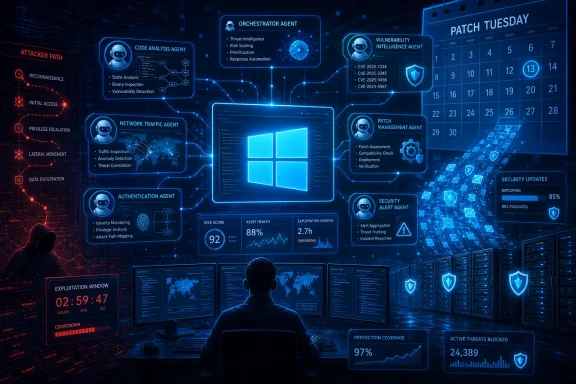
At the center of that shift is MDASH, short for multi-model agentic scanning harness. Microsoft describes it as a system that coordinates multiple AI models and specialized security agents to inspect software, debate suspected findings, and validate whether a bug is genuinely exploitable before it reaches Windows engineering teams. The goal is not merely to scan more code. It is to make deep security research operate at Windows scale.
That is a meaningful change for everyone who runs Windows, manages Windows Server, maintains enterprise application fleets, or relies on Microsoft’s broader ecosystem. AI is not replacing human security researchers or eliminating the need for disciplined patch testing. Instead, it is raising the number of issues that defenders can see—and therefore the number of decisions IT organizations need to make.
For decades, operating system security has been constrained by a basic capacity problem. Modern platforms contain millions of lines of code, countless hardware combinations, legacy compatibility layers, network protocols, drivers, services, and integrations. Human researchers can inspect only a finite slice of that surface area at any one time.
This limitation traditionally gave attackers an advantage. A determined adversary needed to find just one useful weakness in a heavily exposed component. Defenders, by contrast, needed to identify, understand, prioritize, fix, test, and deploy remediation for every meaningful flaw they discovered.
AI changes that arithmetic.
Microsoft’s July 9 announcement frames Windows security as an effort to reduce the time between a vulnerability existing and a customer receiving protection. The company is expanding its capability in four connected areas:
Still, even with humans retained as the final gate, the increase in machine-assisted analysis can fundamentally expand the pool of bugs that reach that gate.
That multi-model design is significant because AI systems can be extremely capable at recognizing suspicious patterns while still producing incorrect conclusions. A model may see a dangerous-looking pointer operation, authentication flow, or boundary check and infer exploitability where none exists. By having agents analyze, challenge, and verify candidate findings, Microsoft aims to reduce the volume of low-confidence results passed to engineers.
MDASH is intended to do the opposite. Its usefulness depends on triage quality—finding more meaningful vulnerabilities while filtering out enough noise that engineers can concentrate on real security exposure.
In a security setting, this resembles a structured code review conducted by specialists with different perspectives. The difference is speed and scale. Instead of a limited number of researchers working through a narrow set of hypotheses, AI agents can rapidly explore alternative interpretations and challenge each other’s assessments.
That does not make MDASH infallible. It does, however, make the system potentially more resilient than a workflow that trusts one model’s output without an adversarial verification stage.
Several of those vulnerabilities were categorized as Critical remote code execution flaws, which underlines why this work matters. Network-facing and authentication components are especially valuable targets because weaknesses in them can affect systems before a user consciously opens a file or launches an application.
The company has also reported strong results in its own internal and public benchmark testing. Those figures should be read carefully: benchmarks are useful indicators of potential capability, but they do not prove that a system will catch every important flaw in every real-world Windows component. Nevertheless, they suggest that Microsoft has moved beyond a purely experimental AI security project and is deploying a serious research-and-engineering capability.
The reported totals differ depending on whether counts include only fixes released on Patch Tuesday or Microsoft CVEs fixed at other points during the month. But both accounting methods reveal an extraordinary volume:
For IT leaders, the key operational question is not whether the headline total is 570 or 622. It is:
A high count can reflect several factors at once:
The risk lies in the period between patch availability and successful deployment. A vulnerability that is fixed but not installed remains an exposure.
If offensive capabilities improve while defensive research remains manual and slow, the imbalance grows. Microsoft’s MDASH strategy is an attempt to narrow that gap by accelerating the defensive side of the equation.
Finding vulnerabilities earlier offers several benefits:
However, automatically proposed code changes must be treated with caution. Security patches are often made in complicated, performance-sensitive, compatibility-sensitive code. A technically valid fix may have hidden effects on drivers, enterprise applications, protocols, devices, or legacy deployments. Human code review and broad validation remain non-negotiable.
Microsoft has plainly signaled that customers should expect a higher volume of security updates as AI increases the rate of vulnerability discovery. That requires organizations to rethink patch management as a continuous security function rather than a monthly maintenance task.
This tension becomes more difficult when releases are larger and more frequent. Security teams must process more CVEs, application owners must provide faster compatibility feedback, and endpoint teams must manage broader deployment rings.
The July Windows update cycle also demonstrated why caution is still warranted. Microsoft acknowledged a limited availability issue involving some Dell devices with Intel processors, where a Windows 11 security update could contribute to unexpected shutdowns, performance problems, increased heat, and battery drain. The presence of such issues does not negate the value of urgent patching, but it reinforces the importance of structured rollout and monitoring.
Microsoft says Windows updates continue to undergo testing across multiple environments, including the Security Update Validation Program and internal validation intended to identify compatibility, reliability, and real-world usage concerns. That is the correct approach. A security update that protects systems but causes widespread outages can create a different kind of operational security risk.
Organizations should resist two equally flawed extremes:
A mature Windows patch-management program should include the following practices.
The logic is simple: more discovered flaws mean more patches, and systems that cannot receive or safely deploy those patches become increasingly attractive targets. Modernization is not merely about new features. It is a security control.
Real-world vulnerabilities can depend on obscure device states, timing conditions, unusual protocol sequences, third-party extensions, undocumented behavior, or chains involving multiple products. AI may excel at recurring vulnerability patterns while missing novel logic flaws or weaknesses rooted in business processes and deployment choices.
The appropriate conclusion is not that MDASH will find everything. It is that it can broaden and accelerate the set of flaws defenders are able to find.
That makes speed essential. If vendors find more vulnerabilities faster but customers cannot deploy patches quickly enough, the net benefit may be diminished. Public patch releases can also encourage adversaries to reverse-engineer changes and identify vulnerable systems that have not yet updated.
This is why automation must extend beyond code scanning. Enterprises need accurate asset data, update compliance reporting, exposure prioritization, endpoint management, and clear executive accountability for unresolved critical vulnerabilities.
MDASH’s multi-model approach, proof-oriented validation pipeline, and retention of human engineering review are sensible design choices for a high-stakes environment. The discovery of 16 new Windows vulnerabilities in networking and authentication components illustrates that the system is already producing consequential results. The massive July 2026 Patch Tuesday release demonstrates what happens when AI-assisted discovery begins to influence the patch pipeline at scale.
For Windows users, the benefit is clear: more vulnerabilities can be found and addressed before attackers gain the upper hand. For enterprises, the obligation is equally clear: faster discovery requires faster, smarter patching.
The coming challenge is not merely keeping up with a growing list of Microsoft security updates. It is building an operational model capable of distinguishing urgent exposure from routine maintenance, validating updates without unnecessary delay, and ensuring that critical Windows systems do not remain vulnerable simply because the patch workload has become too large to manage manually.
AI may be accelerating the discovery of Windows security flaws, but the ultimate measure of success will be whether customers can convert that discovery into protection before attackers do.
On July 9, Microsoft detailed how it is applying artificial intelligence throughout the Windows vulnerability-management lifecycle, from early discovery and engineering remediation through validation and customer guidance. Less than a week later, the company’s July security release became the clearest evidence yet of the strategy’s operational impact, with reporting counts ranging from 570 newly released Microsoft fixes to 622 total Microsoft CVEs when earlier-month disclosures are included.
The difference in those figures is important rather than contradictory. It reflects differing methodologies for counting the July 2026 security workload. The larger message is unmistakable: Microsoft has delivered its largest Patch Tuesday security release to date, and it has explicitly warned customers that AI-assisted discovery will drive higher vulnerability volumes in future releases.
At the center of that shift is MDASH, short for multi-model agentic scanning harness. Microsoft describes it as a system that coordinates multiple AI models and specialized security agents to inspect software, debate suspected findings, and validate whether a bug is genuinely exploitable before it reaches Windows engineering teams. The goal is not merely to scan more code. It is to make deep security research operate at Windows scale.
That is a meaningful change for everyone who runs Windows, manages Windows Server, maintains enterprise application fleets, or relies on Microsoft’s broader ecosystem. AI is not replacing human security researchers or eliminating the need for disciplined patch testing. Instead, it is raising the number of issues that defenders can see—and therefore the number of decisions IT organizations need to make.
 A New Reality for Windows Vulnerability Management
For decades, operating system security has been constrained by a basic capacity problem. Modern platforms contain millions of lines of code, countless hardware combinations, legacy compatibility layers, network protocols, drivers, services, and integrations. Human researchers can inspect only a finite slice of that surface area at any one time.This limitation traditionally gave attackers an advantage. A determined adversary needed to find just one useful weakness in a heavily exposed component. Defenders, by contrast, needed to identify, understand, prioritize, fix, test, and deploy remediation for every meaningful flaw they discovered.
AI changes that arithmetic.
Microsoft’s July 9 announcement frames Windows security as an effort to reduce the time between a vulnerability existing and a customer receiving protection. The company is expanding its capability in four connected areas:
- Discovery, to identify suspicious code patterns and attack paths earlier.
- Remediation, to help engineers understand failures and develop appropriate fixes.
- Validation, to test patches for security effectiveness, compatibility, and regressions.
- Customer guidance, to help organizations assess risk and deploy updates in a prioritized way.
Still, even with humans retained as the final gate, the increase in machine-assisted analysis can fundamentally expand the pool of bugs that reach that gate.
MDASH: What Microsoft’s AI Security System Actually Does
MDASH is more than a conventional static-analysis tool with a generative AI interface. Microsoft characterizes it as a multi-model agentic system built to discover, evaluate, and help prove potential vulnerabilities. Rather than placing all responsibility on a single model, it uses multiple models and agents with distinct roles.That multi-model design is significant because AI systems can be extremely capable at recognizing suspicious patterns while still producing incorrect conclusions. A model may see a dangerous-looking pointer operation, authentication flow, or boundary check and infer exploitability where none exists. By having agents analyze, challenge, and verify candidate findings, Microsoft aims to reduce the volume of low-confidence results passed to engineers.
From a Suspicious Pattern to a Validated Finding
Microsoft’s stated workflow has several layers:- Critical binaries and infrastructure are scanned for patterns associated with security weaknesses.
- Multiple models assess candidate vulnerabilities, rather than relying on a single AI-generated conclusion.
- A multi-model “debate” process tests whether the candidate is credible and whether a realistic exploit path exists.
- The highest-confidence findings proceed to a Windows-specific proof pipeline.
- Findings that survive this process are routed to engineering teams for investigation, remediation, and testing.
- Human experts review the security significance, patch approach, release priority, and quality of the final fix.
MDASH is intended to do the opposite. Its usefulness depends on triage quality—finding more meaningful vulnerabilities while filtering out enough noise that engineers can concentrate on real security exposure.
Why Multiple Models Matter
A single AI model may have blind spots shaped by its training data, its reasoning style, its context window, or the assumptions built into its prompts. Multiple models can produce diversity of analysis. One agent may be effective at reconstructing data flow; another may be better at identifying privilege boundaries; another may focus on exploit preconditions or the impact of malformed network traffic.In a security setting, this resembles a structured code review conducted by specialists with different perspectives. The difference is speed and scale. Instead of a limited number of researchers working through a narrow set of hypotheses, AI agents can rapidly explore alternative interpretations and challenge each other’s assessments.
That does not make MDASH infallible. It does, however, make the system potentially more resilient than a workflow that trusts one model’s output without an adversarial verification stage.
Early Windows Findings Are Not Trivial
Microsoft has said its AI-assisted security research identified 16 new vulnerabilities across Windows networking and authentication components. The affected areas included deeply security-sensitive parts of the platform such as the Windows kernel TCP/IP stack and the IKEv2 service used in IPsec-related authentication and secure networking scenarios.Several of those vulnerabilities were categorized as Critical remote code execution flaws, which underlines why this work matters. Network-facing and authentication components are especially valuable targets because weaknesses in them can affect systems before a user consciously opens a file or launches an application.
The company has also reported strong results in its own internal and public benchmark testing. Those figures should be read carefully: benchmarks are useful indicators of potential capability, but they do not prove that a system will catch every important flaw in every real-world Windows component. Nevertheless, they suggest that Microsoft has moved beyond a purely experimental AI security project and is deploying a serious research-and-engineering capability.
July Patch Tuesday Shows the Scale of the Change
The July 2026 Patch Tuesday cycle made the implications of AI-accelerated vulnerability discovery concrete. Microsoft’s scheduled release addressed a record number of security issues across Windows, Office, server products, identity services, and other product lines.The reported totals differ depending on whether counts include only fixes released on Patch Tuesday or Microsoft CVEs fixed at other points during the month. But both accounting methods reveal an extraordinary volume:
- 570 vulnerabilities were widely counted as the Patch Tuesday release itself.
- 622 Microsoft CVEs were reported in broader July tallies that included additional disclosures and fixes.
- The release included dozens of Critical vulnerabilities.
- It included three zero-day vulnerabilities, with two reported as actively exploited before patches were available.
The 570-versus-622 Question Explained
Security reporting often treats vulnerability counts as a single definitive number, but the accounting is more complicated. Vendors can release fixes outside their scheduled monthly cadence. They can patch cloud services, browser components, security products, and online services on separate timetables. A single vulnerability can also affect multiple products and generate multiple update packages.For IT leaders, the key operational question is not whether the headline total is 570 or 622. It is:
That is the right lens for interpreting this record-breaking month. Raw CVE volume provides context. Exposure, exploitability, asset criticality, internet reachability, and available mitigations determine urgency.Which vulnerabilities affect our environment, are any already exploited, and how quickly can we deploy validated mitigation?
More Patches Do Not Automatically Mean Windows Is Less Secure
A large vulnerability total can trigger an understandable negative reaction. It may appear to suggest that the platform has become more fragile or that engineering quality is declining. That conclusion would be too simplistic.A high count can reflect several factors at once:
- More intensive testing and code review.
- Better vulnerability discovery tooling.
- More comprehensive disclosure practices.
- Increased attention to older or less frequently examined components.
- Faster escalation of internally discovered issues into the patch pipeline.
- A genuine increase in exploitable weaknesses.
The risk lies in the period between patch availability and successful deployment. A vulnerability that is fixed but not installed remains an exposure.
The Security Benefit: Shrinking the Attacker’s Window
The strongest argument for AI-assisted vulnerability discovery is straightforward: attackers are also using automation and AI to speed up reconnaissance, code analysis, phishing, exploit development, and target selection.If offensive capabilities improve while defensive research remains manual and slow, the imbalance grows. Microsoft’s MDASH strategy is an attempt to narrow that gap by accelerating the defensive side of the equation.
Earlier Discovery Changes the Economics of Exploitation
A vulnerability is most dangerous when it is unknown to defenders and reachable by attackers. If a flaw remains hidden in code for years, adversaries can potentially discover it independently, develop an exploit, and use it against organizations that have no patch available.Finding vulnerabilities earlier offers several benefits:
- More time to engineer a durable fix before attacks emerge.
- Reduced likelihood of long-lived latent defects in widely deployed Windows components.
- Faster analysis of related code paths, potentially uncovering families of similar bugs.
- Better regression testing, because AI can help identify the components most likely to be affected by a change.
- Improved prioritization, if researchers can more quickly establish whether a candidate is exploitable and impactful.
AI Can Help With Remediation, Not Just Detection
Microsoft’s announcement is notable because it extends beyond finding bugs. The company says it is integrating AI into the engineering process to help developers:- Understand how a failure occurred.
- Propose candidate fixes that fit surrounding code.
- Search for related defects elsewhere in the codebase.
- Identify regression tests likely to be affected by a patch.
However, automatically proposed code changes must be treated with caution. Security patches are often made in complicated, performance-sensitive, compatibility-sensitive code. A technically valid fix may have hidden effects on drivers, enterprise applications, protocols, devices, or legacy deployments. Human code review and broad validation remain non-negotiable.
The Operational Risk: Patch Management Becomes More Demanding
For Windows administrators, the most immediate consequence of MDASH may not be a visible AI feature in Windows 11. It may be the steadily rising burden of patch evaluation and deployment.Microsoft has plainly signaled that customers should expect a higher volume of security updates as AI increases the rate of vulnerability discovery. That requires organizations to rethink patch management as a continuous security function rather than a monthly maintenance task.
Why Larger Patch Cycles Create Real Pressure
Every update introduces a familiar tension. Deploy too slowly, and known vulnerabilities remain available to attackers. Deploy too quickly without testing, and an update may disrupt a business-critical application, device driver, authentication workflow, or specialized hardware environment.This tension becomes more difficult when releases are larger and more frequent. Security teams must process more CVEs, application owners must provide faster compatibility feedback, and endpoint teams must manage broader deployment rings.
The July Windows update cycle also demonstrated why caution is still warranted. Microsoft acknowledged a limited availability issue involving some Dell devices with Intel processors, where a Windows 11 security update could contribute to unexpected shutdowns, performance problems, increased heat, and battery drain. The presence of such issues does not negate the value of urgent patching, but it reinforces the importance of structured rollout and monitoring.
Patch Quality Still Matters as Much as Patch Speed
The core promise of AI-driven vulnerability management is not “patch everything immediately.” It is find issues faster while preserving engineering quality.Microsoft says Windows updates continue to undergo testing across multiple environments, including the Security Update Validation Program and internal validation intended to identify compatibility, reliability, and real-world usage concerns. That is the correct approach. A security update that protects systems but causes widespread outages can create a different kind of operational security risk.
Organizations should resist two equally flawed extremes:
- Treating every large patch release as too risky to deploy promptly.
- Treating every security update as safe to install everywhere with no staged validation.
What Enterprises Should Change Now
The era of AI-assisted vulnerability discovery makes passive patching increasingly untenable. Organizations cannot wait for quarterly maintenance windows to address remotely exploitable issues in internet-facing, identity, or collaboration systems.A mature Windows patch-management program should include the following practices.
1. Build a Real Asset and Exposure Inventory
It is impossible to prioritize security updates without knowing where affected products are running. Organizations need an accurate view of:- Windows client and server versions.
- Unsupported or end-of-life systems.
- Internet-facing servers and remote-access services.
- Identity infrastructure, including Active Directory Federation Services.
- Collaboration platforms such as SharePoint Server.
- Privileged workstations and administrator endpoints.
- Systems with strict uptime, regulatory, manufacturing, or clinical requirements.
2. Prioritize by Exploitation and Business Context
A vulnerability’s severity score is useful, but it is not enough on its own. Organizations should elevate patches when they involve:- Known or suspected active exploitation.
- Remote code execution.
- Elevation of privilege on identity infrastructure.
- Internet-facing or externally reachable services.
- High-value data repositories.
- Systems used to manage other systems.
- Weaknesses with public proof-of-concept exploit code.
- Vulnerabilities that enable lateral movement or credential theft.
3. Use Deployment Rings Without Creating Delay by Default
A staged rollout remains essential, especially in diverse Windows estates. A practical structure may include:- Canary devices run by IT and security teams.
- Early-adopter groups representing common hardware and applications.
- Broad user deployment after initial telemetry and support checks.
- Specialized or high-risk devices handled through approved maintenance procedures.
4. Monitor Update Health After Deployment
Patch management cannot end with a successful installation report. IT teams should watch for:- Boot and shutdown failures.
- Authentication problems.
- Network connectivity regressions.
- Application crashes and performance degradation.
- Driver conflicts.
- Battery, thermal, and hardware-management anomalies.
- Increased help desk ticket volume.
- Endpoint detection alerts tied to attempted exploitation.
5. Reduce Reliance on Unsupported Windows Builds
Older Windows versions and poorly maintained server workloads become progressively riskier as vulnerability discovery accelerates. Even where extended support or compensating controls exist, organizations should treat outdated builds as strategic risk debt.The logic is simple: more discovered flaws mean more patches, and systems that cannot receive or safely deploy those patches become increasingly attractive targets. Modernization is not merely about new features. It is a security control.
The Limits of the AI Security Narrative
Microsoft’s MDASH strategy is promising, but it deserves measured scrutiny. AI can improve security research, yet it also introduces new dependencies and potential failure modes.Benchmark Success Is Not the Same as Universal Coverage
Microsoft has reported impressive MDASH benchmark results and historical rediscovery rates in selected Windows components. Those results provide useful evidence of capability, but no benchmark can fully represent the complexity of production software.Real-world vulnerabilities can depend on obscure device states, timing conditions, unusual protocol sequences, third-party extensions, undocumented behavior, or chains involving multiple products. AI may excel at recurring vulnerability patterns while missing novel logic flaws or weaknesses rooted in business processes and deployment choices.
The appropriate conclusion is not that MDASH will find everything. It is that it can broaden and accelerate the set of flaws defenders are able to find.
AI Can Also Empower Attackers
The same basic technology that helps defenders inspect code can help attackers understand code, analyze patches, search for weaknesses, and build convincing social-engineering campaigns. AI does not permanently shift the advantage to either side.That makes speed essential. If vendors find more vulnerabilities faster but customers cannot deploy patches quickly enough, the net benefit may be diminished. Public patch releases can also encourage adversaries to reverse-engineer changes and identify vulnerable systems that have not yet updated.
More Findings Can Create Alert Fatigue
A successful AI discovery system may generate a paradox: better detection can overwhelm teams that lack strong vulnerability-management processes. Microsoft can filter candidates internally, but customers still face larger release notes, more CVEs, more rollout decisions, and more exceptions to document.This is why automation must extend beyond code scanning. Enterprises need accurate asset data, update compliance reporting, exposure prioritization, endpoint management, and clear executive accountability for unresolved critical vulnerabilities.
A Security Strategy That Demands Better IT Operations
Microsoft’s expansion of Windows AI security is not simply an announcement about a research tool. It is a signal that vulnerability discovery is becoming faster, more systematic, and more deeply embedded in the software development process.MDASH’s multi-model approach, proof-oriented validation pipeline, and retention of human engineering review are sensible design choices for a high-stakes environment. The discovery of 16 new Windows vulnerabilities in networking and authentication components illustrates that the system is already producing consequential results. The massive July 2026 Patch Tuesday release demonstrates what happens when AI-assisted discovery begins to influence the patch pipeline at scale.
For Windows users, the benefit is clear: more vulnerabilities can be found and addressed before attackers gain the upper hand. For enterprises, the obligation is equally clear: faster discovery requires faster, smarter patching.
The coming challenge is not merely keeping up with a growing list of Microsoft security updates. It is building an operational model capable of distinguishing urgent exposure from routine maintenance, validating updates without unnecessary delay, and ensuring that critical Windows systems do not remain vulnerable simply because the patch workload has become too large to manage manually.
AI may be accelerating the discovery of Windows security flaws, but the ultimate measure of success will be whether customers can convert that discovery into protection before attackers do.
References
- Primary source: iNews Zoombangla
Published: 2026-07-23T12:40:55+00:00
Loading…
inews.zoombangla.com - Related coverage: windowscentral.com
Windows 11’s massive July 2026 update fixes 570 vulnerabilities and shows how AI is quietly reshaping Patch Tuesday itself | Windows Central
Microsoft says AI is reshaping Windows security, and the July 2026 Patch Tuesday update is the first major sign of what's coming.www.windowscentral.com - Official source: learn.microsoft.com
Release notes - Microsoft Security Exposure Management | Microsoft Learn
This page is updated frequently with the latest updates in Microsoft Security Exposure Management.learn.microsoft.com - Official source: microsoft.com
Defense at AI speed: Microsoft’s new multi-model agentic security system tops leading industry benchmark | Microsoft Security Blog
Today Microsoft is announcing a major step forward in AI-powered cyber defense: a new multi-model agentic scanning harness (codenamed MDASH).www.microsoft.com - Official source: news.microsoft.com
마이크로소프트, AI 기반 에이전틱 보안 시스템 ‘MDASH’ 공개 - Source Asia
 news.microsoft.com
- Related coverage: windowsforum.com
Loading…
windowsforum.com