

AI Search Engineers has introduced the AI Search Visibility Score, a 100-point framework intended to give professional service firms a more disciplined way to evaluate how visible and credible they appear across AI-powered discovery platforms. The announcement targets a growing problem for law firms, financial advisors, medical practices, and B2B consulting organizations: conventional rankings alone no longer capture whether a business is being surfaced, cited, or described accurately in answers generated by ChatGPT, Google Gemini, Microsoft Copilot, Perplexity, and Grok.
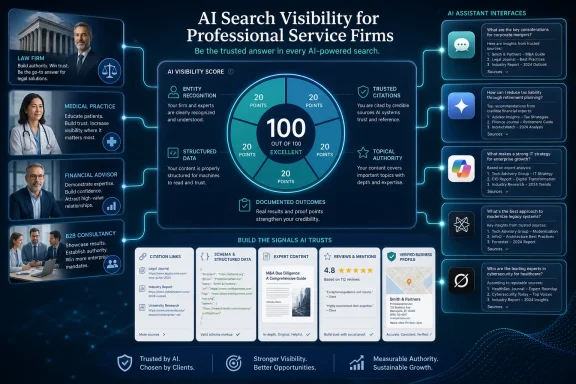
The framework divides AI search visibility into five equal categories: entity recognition, structured data, trusted source citations, topical authority, and documented outcomes. Each category is worth up to 20 points, producing a single score out of 100. In principle, that simplicity is the product’s strongest idea. Businesses that have been told vaguely to “optimize for AI search” need a baseline, not another collection of abstract recommendations.
Still, the claims surrounding the framework require close reading. The score is based on the company’s internal analysis of more than 50 AI visibility audits, while the stated before-and-after benchmarks rely on internal reporting from a limited set of completed engagements. Those figures have not been independently audited or validated. Likewise, the company’s description of itself as the “#1 AI Certified Agency in the United States” is self-conferred under its own proprietary standard rather than awarded by an independent certification body.
That does not automatically make the score unhelpful. It does mean firms should treat it as an operational measurement model, not as a platform-certified ranking system or a guaranteed predictor of mentions in any particular AI answer.
The shift from classic search results to conversational answers is changing how people research professional services. A prospective client may no longer begin with “best estate planning lawyer near me” and browse ten blue links. Instead, they may ask an AI assistant to explain local options, compare credentials, identify questions to ask, or recommend the right type of specialist for a complex situation.
For professional service organizations, that change has major implications. These are industries in which trust, expertise, location, reputation, and documented experience matter more than simple brand awareness. A financial planning practice needs to be clearly distinguished from a wealth manager with a similar name. A medical group needs accurate provider, location, specialty, and insurance information. A law firm needs to demonstrate credible expertise without publishing promotional claims that overstate outcomes.
AI systems do not operate as a single uniform search engine. Their answers can draw on different combinations of crawled web pages, search indexes, knowledge graphs, licensed material, user context, and real-time retrieval systems. Visibility can therefore vary by platform, query wording, location, and the freshness of the underlying information.
That is the central challenge for answer engine optimization, often shortened to AEO. The discipline is not simply about producing content that includes AI-related keywords. It is about making a business understandable, verifiable, crawlable, and useful across an increasingly fragmented discovery environment.
A scorecard can help translate that broad objective into practical work. The danger comes when a scorecard is treated as proof that a business will be recommended by every AI platform. No agency, audit, schema implementation, directory listing, or content campaign can honestly guarantee that outcome.
This category addresses a problem that is especially common among multi-location firms, practices that have changed names, organizations created through mergers, and businesses with professionals who maintain separate personal brands. If names, addresses, phone numbers, business descriptions, service areas, leadership information, and branding differ across key sources, systems may struggle to connect the dots.
A strong entity-recognition program typically looks for:
For Windows users and IT administrators responsible for corporate web properties, this category also highlights a governance issue. A website, CRM, directory profile, social account, local listing platform, and staff bio database should not behave as isolated systems. Inconsistent data published from different internal tools can steadily erode the organization’s public identity.
Structured data gives machines explicit context about information already visible on a page. Proper markup can clarify whether a page represents a business, an individual professional, an office, a service, a review, a frequently asked question, or a contact method. It can make an organization easier for search systems to interpret and disambiguate.
That said, structured data is often misunderstood. It is not a magic “AI optimization” tag, and valid markup does not guarantee a rich result, a citation, inclusion in an AI answer, or a higher conventional ranking. Search platforms still evaluate the content itself, technical accessibility, overall quality, relevance, and policy compliance.
The framework is on firmer ground when it treats schema as a clarity and validation layer rather than a shortcut to visibility. Organizations should focus on markup that is accurate, relevant to the actual page, and maintained when business details change.
The most important implementation rules are straightforward:
That makes the content itself more valuable than the markup alone. A strong FAQ page should answer genuine client questions clearly, accurately, and in language that a human reader can understand.
For a law firm, relevant third-party evidence might include state bar listings, court-related materials, reputable legal publications, professional association profiles, and credible news coverage. For a physician or practice, authoritative sources may include hospital affiliations, licensing databases, specialty boards, medical directories, and peer-reviewed contributions. For financial professionals, the focus may fall on regulator records, recognized industry organizations, professional credentials, and credible publications.
The critical distinction is between earned authority and merely purchased placement. An organization can pay for a directory profile, sponsor an event, or distribute a press release. Those activities may create discoverable pages, but they do not automatically establish the same level of trust as an independently written profile, credible editorial mention, recognized professional credential, or well-documented institutional affiliation.
A sensible audit should assess not just volume, but quality:
Professional service firms gain little from filling a blog with superficial posts that repeat basic definitions. A law firm writing about employment law, for example, should explain real decision points, process stages, timing issues, jurisdictional distinctions, risks, and practical next steps. A medical practice should prioritize medically responsible, reviewed, patient-friendly content. A financial advisor should explain concepts without drifting into individualized or unsubstantiated advice.
Effective topical authority content tends to share several qualities:
A firm should not write solely for AI systems. Search platforms continue to prioritize helpful, reliable, people-first content, especially in areas that can influence health, financial stability, legal rights, or personal safety. Content designed purely to manipulate automated visibility can become a liability, both for search performance and for professional reputation.
However, it is also the category that demands the greatest restraint. Professional service businesses operate under ethical, legal, privacy, advertising, and industry-specific rules. A lawyer may be restricted in how case outcomes are presented. A medical provider must protect patient privacy and avoid misleading claims. A financial advisor must ensure that testimonials, performance references, and marketing communications comply with applicable regulation.
Documented outcomes should therefore be treated as evidence, not hype. Strong materials can include carefully approved case studies, anonymized engagement summaries, independently collected reviews, representative testimonials where permitted, credentialed experience, published research, and transparent process descriptions.
A robust evaluation should ask:
Those findings are plausible as a directional picture. Many professional service businesses do have inconsistent listings, incomplete markup, thin service pages, scattered third-party references, and underdeveloped evidence of results. In particular, structured data and documented outcomes are often neglected because they require technical coordination and governance rather than a simple editorial calendar.
The agency also reports that nine completed client engagements moved from an average score of 31 to 74 over approximately 90 days. That is a substantial reported improvement, but it should not be generalized without qualification.
The sample is small, the score originates from the same organization conducting the work, and the measurement methodology has not been independently audited. It is also unclear how the score weights individual sub-signals inside each category, how consistency is maintained between auditors, whether the nine engagements began from comparable baselines, or whether the score changes correlated with verified business outcomes such as qualified leads, consultations, revenue, or client acquisition.
In other words, the figure may demonstrate that a focused remediation program can improve performance against this framework. It does not establish that every business can expect a comparable increase, that a higher score guarantees visibility in every AI platform, or that the score itself is a universal industry benchmark.
Its main strengths include:
Those are valuable questions whether the visitor arrives through Google Search, Microsoft Copilot, ChatGPT search, a traditional directory, or a direct referral.
A second issue is platform variability. ChatGPT, Gemini, Copilot, Perplexity, and Grok do not publish a shared scoring formula for organizational authority. They evolve independently, retrieve information differently, and may generate different answers to the same query. A framework can assess widely useful fundamentals, but it cannot claim to measure the hidden ranking mechanics of every assistant.
Third, a score should not be confused with a reputation. A firm can implement technically correct schema, publish extensive FAQs, and maintain perfect listing consistency while still lacking the genuine expertise, client service, or independent credibility needed to earn trust. Conversely, a highly respected local specialist may have strong real-world standing but a modest score because its digital infrastructure has not caught up.
Fourth, the review and outcomes category could encourage risky behavior if agencies or businesses become too focused on points. Incentivized reviews, exaggerated success stories, undisclosed testimonials, and misleading outcome claims can create serious compliance consequences. In regulated industries, legal and ethical oversight must outrank any visibility objective.
Finally, organizations should avoid treating AI visibility as separate from conventional SEO. Many of the same requirements remain essential: crawlable pages, accurate metadata, well-structured content, clear internal linking, trustworthy information, accessible site architecture, and a technically sound web presence. AI search has changed the presentation layer of discovery, but it has not eliminated the need for foundational search quality.
A responsible implementation process should include the following steps:
Its value will depend on how transparently and rigorously it is applied. The reported benchmark figures and improvement claims should be viewed as internal, limited-sample observations rather than independently verified industry standards. The self-conferred agency designation should likewise be separated from the practical merits of the measurement framework itself.
For law firms, financial advisors, medical practices, and B2B consultants, the most important lesson is not to chase a perfect score. It is to ensure that the organization’s online presence makes the same case that a trusted human professional would make: this is who we are, this is what we do, this is why our information is reliable, and this is the evidence behind our claims.
The framework divides AI search visibility into five equal categories: entity recognition, structured data, trusted source citations, topical authority, and documented outcomes. Each category is worth up to 20 points, producing a single score out of 100. In principle, that simplicity is the product’s strongest idea. Businesses that have been told vaguely to “optimize for AI search” need a baseline, not another collection of abstract recommendations.
Still, the claims surrounding the framework require close reading. The score is based on the company’s internal analysis of more than 50 AI visibility audits, while the stated before-and-after benchmarks rely on internal reporting from a limited set of completed engagements. Those figures have not been independently audited or validated. Likewise, the company’s description of itself as the “#1 AI Certified Agency in the United States” is self-conferred under its own proprietary standard rather than awarded by an independent certification body.
That does not automatically make the score unhelpful. It does mean firms should treat it as an operational measurement model, not as a platform-certified ranking system or a guaranteed predictor of mentions in any particular AI answer.
 Why AI Search Visibility Has Become a Business Priority
The shift from classic search results to conversational answers is changing how people research professional services. A prospective client may no longer begin with “best estate planning lawyer near me” and browse ten blue links. Instead, they may ask an AI assistant to explain local options, compare credentials, identify questions to ask, or recommend the right type of specialist for a complex situation.For professional service organizations, that change has major implications. These are industries in which trust, expertise, location, reputation, and documented experience matter more than simple brand awareness. A financial planning practice needs to be clearly distinguished from a wealth manager with a similar name. A medical group needs accurate provider, location, specialty, and insurance information. A law firm needs to demonstrate credible expertise without publishing promotional claims that overstate outcomes.
AI systems do not operate as a single uniform search engine. Their answers can draw on different combinations of crawled web pages, search indexes, knowledge graphs, licensed material, user context, and real-time retrieval systems. Visibility can therefore vary by platform, query wording, location, and the freshness of the underlying information.
That is the central challenge for answer engine optimization, often shortened to AEO. The discipline is not simply about producing content that includes AI-related keywords. It is about making a business understandable, verifiable, crawlable, and useful across an increasingly fragmented discovery environment.
A scorecard can help translate that broad objective into practical work. The danger comes when a scorecard is treated as proof that a business will be recommended by every AI platform. No agency, audit, schema implementation, directory listing, or content campaign can honestly guarantee that outcome.
What the AI Search Visibility Score Measures
AI Search Engineers’ framework assigns 20 points each to five categories. The resulting total provides a snapshot of how well an organization has addressed foundational signals associated with online authority and machine-readable business information.1. Entity Recognition: 20 Points
Entity recognition measures whether a business is consistently represented as the same real-world organization across its digital footprint. That includes the company website, Google Business Profile, LinkedIn, industry directories, Wikidata, structured entity markup, and other relevant sources.This category addresses a problem that is especially common among multi-location firms, practices that have changed names, organizations created through mergers, and businesses with professionals who maintain separate personal brands. If names, addresses, phone numbers, business descriptions, service areas, leadership information, and branding differ across key sources, systems may struggle to connect the dots.
A strong entity-recognition program typically looks for:
- Consistent legal and public-facing business names
- Accurate local office addresses and phone numbers
- Correct business-category and service descriptions
- Clear professional biographies and leadership pages
- Alignment between website details and directory profiles
- Distinct identity signals for individual practitioners
- Machine-readable organization and location information
- Resolution of outdated listings, duplicate profiles, and former branding
For Windows users and IT administrators responsible for corporate web properties, this category also highlights a governance issue. A website, CRM, directory profile, social account, local listing platform, and staff bio database should not behave as isolated systems. Inconsistent data published from different internal tools can steadily erode the organization’s public identity.
2. Structured Data: 20 Points
The second category measures the implementation of structured data, including Schema.org types such asOrganization, FAQPage, Review, AggregateRating, LegalService, FinancialService, MedicalOrganization, LocalBusiness, Person, and ContactPoint.Structured data gives machines explicit context about information already visible on a page. Proper markup can clarify whether a page represents a business, an individual professional, an office, a service, a review, a frequently asked question, or a contact method. It can make an organization easier for search systems to interpret and disambiguate.
That said, structured data is often misunderstood. It is not a magic “AI optimization” tag, and valid markup does not guarantee a rich result, a citation, inclusion in an AI answer, or a higher conventional ranking. Search platforms still evaluate the content itself, technical accessibility, overall quality, relevance, and policy compliance.
The framework is on firmer ground when it treats schema as a clarity and validation layer rather than a shortcut to visibility. Organizations should focus on markup that is accurate, relevant to the actual page, and maintained when business details change.
The most important implementation rules are straightforward:
- Mark up information that users can actually see on the page.
- Use the most specific appropriate business or professional type.
- Keep names, addresses, phone numbers, and URLs consistent with visible content.
- Validate the code before deployment.
- Avoid copying schema templates blindly across unrelated pages.
- Review markup whenever a location, professional, service offering, or brand identity changes.
- Do not use ratings or review markup to manufacture social proof.
FAQPage markup. FAQ content can be useful for visitors and may help systems understand a page’s question-and-answer structure. But businesses should not assume that FAQ markup will reliably create prominent Google search features. Google has substantially limited FAQ rich-result treatment for most commercial websites, concentrating it mainly on well-known government and health sites.That makes the content itself more valuable than the markup alone. A strong FAQ page should answer genuine client questions clearly, accurately, and in language that a human reader can understand.
3. Trusted Source Citations: 20 Points
The trusted source citations category measures references from recognized publications, industry directories, and relevant third-party sources. This is arguably one of the most consequential elements of the framework because AI systems often need corroborating signals when evaluating whether a business is a credible authority.For a law firm, relevant third-party evidence might include state bar listings, court-related materials, reputable legal publications, professional association profiles, and credible news coverage. For a physician or practice, authoritative sources may include hospital affiliations, licensing databases, specialty boards, medical directories, and peer-reviewed contributions. For financial professionals, the focus may fall on regulator records, recognized industry organizations, professional credentials, and credible publications.
The critical distinction is between earned authority and merely purchased placement. An organization can pay for a directory profile, sponsor an event, or distribute a press release. Those activities may create discoverable pages, but they do not automatically establish the same level of trust as an independently written profile, credible editorial mention, recognized professional credential, or well-documented institutional affiliation.
A sensible audit should assess not just volume, but quality:
- Is the publication or directory genuinely relevant to the field?
- Is the information current and accurate?
- Does the source independently confirm the organization’s role, expertise, or affiliation?
- Is the mention surrounded by meaningful context?
- Are citations distributed across credible sources rather than concentrated in low-quality networks?
- Do third-party claims align with the business’s own website?
4. Topical Authority: 20 Points
Topical authority measures the depth and consistency of answer-focused content addressing common client questions. This is the area most likely to be associated with content marketing, but it should not become an excuse for publishing high volumes of generic AI-generated articles.Professional service firms gain little from filling a blog with superficial posts that repeat basic definitions. A law firm writing about employment law, for example, should explain real decision points, process stages, timing issues, jurisdictional distinctions, risks, and practical next steps. A medical practice should prioritize medically responsible, reviewed, patient-friendly content. A financial advisor should explain concepts without drifting into individualized or unsubstantiated advice.
Effective topical authority content tends to share several qualities:
- It is written by, reviewed by, or transparently connected to qualified experts.
- It answers specific questions that prospective clients actually ask.
- It is organized around genuine service areas rather than keyword variations.
- It explains limitations and uncertainty where appropriate.
- It is updated when law, regulations, medical guidance, or market conditions change.
- It links logically to professional biographies, services, locations, and supporting resources.
- It adds original insight rather than rewriting what every competitor already says.
A firm should not write solely for AI systems. Search platforms continue to prioritize helpful, reliable, people-first content, especially in areas that can influence health, financial stability, legal rights, or personal safety. Content designed purely to manipulate automated visibility can become a liability, both for search performance and for professional reputation.
5. Documented Outcomes: 20 Points
The final category evaluates the availability of documented client outcomes, review content, and structured review-related schema. This is a logical inclusion because prospective clients frequently seek evidence that a firm has delivered meaningful results.However, it is also the category that demands the greatest restraint. Professional service businesses operate under ethical, legal, privacy, advertising, and industry-specific rules. A lawyer may be restricted in how case outcomes are presented. A medical provider must protect patient privacy and avoid misleading claims. A financial advisor must ensure that testimonials, performance references, and marketing communications comply with applicable regulation.
Documented outcomes should therefore be treated as evidence, not hype. Strong materials can include carefully approved case studies, anonymized engagement summaries, independently collected reviews, representative testimonials where permitted, credentialed experience, published research, and transparent process descriptions.
A robust evaluation should ask:
- Is the outcome claim verifiable and appropriately qualified?
- Does it disclose material context or limitations?
- Is the client review authentic and accurately represented?
- Is review markup consistent with platform guidelines and visible page content?
- Does the organization have permission to publish the material?
- Could the presentation create unrealistic expectations?
- Has legal, compliance, or professional-review approval been obtained?
The Reported Benchmark Results Need Context
AI Search Engineers reports that the average pre-engagement score from its internal analysis of more than 50 audits was 31 out of 100. The category averages were reported as 8 out of 20 for entity recognition, 6 for structured data, 5 for trusted source citations, 7 for topical authority, and 5 for documented outcomes.Those findings are plausible as a directional picture. Many professional service businesses do have inconsistent listings, incomplete markup, thin service pages, scattered third-party references, and underdeveloped evidence of results. In particular, structured data and documented outcomes are often neglected because they require technical coordination and governance rather than a simple editorial calendar.
The agency also reports that nine completed client engagements moved from an average score of 31 to 74 over approximately 90 days. That is a substantial reported improvement, but it should not be generalized without qualification.
The sample is small, the score originates from the same organization conducting the work, and the measurement methodology has not been independently audited. It is also unclear how the score weights individual sub-signals inside each category, how consistency is maintained between auditors, whether the nine engagements began from comparable baselines, or whether the score changes correlated with verified business outcomes such as qualified leads, consultations, revenue, or client acquisition.
In other words, the figure may demonstrate that a focused remediation program can improve performance against this framework. It does not establish that every business can expect a comparable increase, that a higher score guarantees visibility in every AI platform, or that the score itself is a universal industry benchmark.
The Strength of a Standardized AI Visibility Framework
Despite those limitations, the framework responds to a real market need. AI search optimization has become crowded with opaque claims, vague audits, and platform-specific advice that is difficult for business leaders to compare. A 100-point system offers a simple common language for discussing the work.Its main strengths include:
- Clear prioritization: Five categories prevent teams from focusing only on content or only on technical SEO.
- Cross-functional usefulness: Marketing, web development, compliance, reputation management, and business leadership can each see their role.
- Baseline measurement: A score can make it easier to document conditions before a remediation project begins.
- Repeatability: Using the same framework over time can identify progress, regression, and maintenance gaps.
- Professional-service relevance: The emphasis on entity consistency, third-party validation, expertise, and outcomes fits industries where trust is central.
- Practical accessibility: A 100-point score is easier for nontechnical decision-makers to understand than a lengthy technical audit.
Those are valuable questions whether the visitor arrives through Google Search, Microsoft Copilot, ChatGPT search, a traditional directory, or a direct referral.
Where the Framework Can Mislead If Used Carelessly
The most important risk is false precision. A score of 74 may appear objectively superior to a score of 63, but that difference may not translate into a meaningful difference in AI citations, traffic, client inquiries, or revenue. Scores are only as reliable as their definitions, data collection, weighting logic, and auditor consistency.A second issue is platform variability. ChatGPT, Gemini, Copilot, Perplexity, and Grok do not publish a shared scoring formula for organizational authority. They evolve independently, retrieve information differently, and may generate different answers to the same query. A framework can assess widely useful fundamentals, but it cannot claim to measure the hidden ranking mechanics of every assistant.
Third, a score should not be confused with a reputation. A firm can implement technically correct schema, publish extensive FAQs, and maintain perfect listing consistency while still lacking the genuine expertise, client service, or independent credibility needed to earn trust. Conversely, a highly respected local specialist may have strong real-world standing but a modest score because its digital infrastructure has not caught up.
Fourth, the review and outcomes category could encourage risky behavior if agencies or businesses become too focused on points. Incentivized reviews, exaggerated success stories, undisclosed testimonials, and misleading outcome claims can create serious compliance consequences. In regulated industries, legal and ethical oversight must outrank any visibility objective.
Finally, organizations should avoid treating AI visibility as separate from conventional SEO. Many of the same requirements remain essential: crawlable pages, accurate metadata, well-structured content, clear internal linking, trustworthy information, accessible site architecture, and a technically sound web presence. AI search has changed the presentation layer of discovery, but it has not eliminated the need for foundational search quality.
How Professional Firms Should Use the Score Responsibly
The most productive use of an AI Search Visibility Score is as a diagnostic dashboard, not a vanity metric. Firms should request a written explanation for every point awarded or withheld, including the URLs, profiles, missing data, technical defects, content gaps, and third-party sources involved.A responsible implementation process should include the following steps:
- Establish the baseline. Document the score, individual category results, audit criteria, and supporting evidence before changes begin.
- Validate business facts. Confirm names, locations, phone numbers, licenses, services, biographies, and organization details across owned and third-party properties.
- Fix technical accessibility. Ensure key pages can be crawled, are not accidentally blocked by robots directives, security tools, login requirements, or broken rendering, and are represented in current sitemaps.
- Implement accurate structured data. Use relevant Schema.org markup that corresponds to visible on-page information, then test it and maintain it.
- Build useful expert content. Prioritize content that answers genuine client questions with depth, precision, and appropriate review by qualified professionals.
- Strengthen independent evidence. Improve credible listings, industry profiles, institutional affiliations, editorial coverage, and other third-party confirmation without resorting to manipulative link schemes.
- Review compliance safeguards. Put approval processes around testimonials, case studies, review responses, medical information, legal claims, and financial content.
- Measure real outcomes alongside the score. Track search visibility, citation frequency where platform tools make that available, referral traffic, qualified inquiries, booked consultations, lead quality, and conversion rates.
- Reassess periodically. AI search visibility is not a one-time project. Business details change, platform behavior shifts, content ages, and external profiles drift.
The Bottom Line
The AI Search Visibility Score is a sensible attempt to bring structure to the rapidly expanding field of AI search optimization for professional services. Its five categories cover many of the foundations that genuinely matter: a coherent business identity, accurate structured data, credible third-party signals, authoritative content, and defensible proof of experience.Its value will depend on how transparently and rigorously it is applied. The reported benchmark figures and improvement claims should be viewed as internal, limited-sample observations rather than independently verified industry standards. The self-conferred agency designation should likewise be separated from the practical merits of the measurement framework itself.
For law firms, financial advisors, medical practices, and B2B consultants, the most important lesson is not to chase a perfect score. It is to ensure that the organization’s online presence makes the same case that a trusted human professional would make: this is who we are, this is what we do, this is why our information is reliable, and this is the evidence behind our claims.
References
- Primary source: Morningstar
Published: 2026-07-23T15:00:00+00:00
- Official source: developers.google.com
Organization Schema Markup | Google Search Central | Documentation | Google for Developers
You can use Organization markup to let Google know administrative details about your organization, for example, address, contact information, and business identifiers. developers.google.com
- Official source: help.openai.com
ChatGPT Search | OpenAI Help Center
Learn how ChatGPT search works, including location-based results and restaurant results. help.openai.com
