

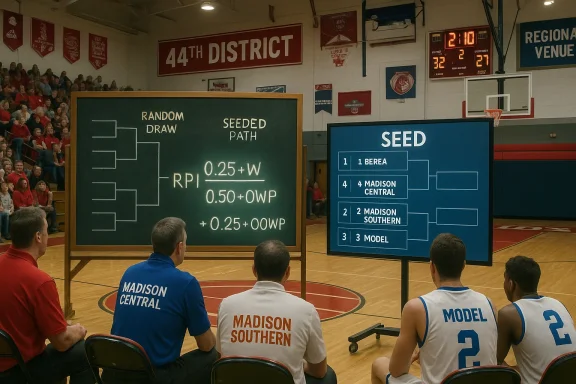
The debate over whether the 44th District basketball tournament should be seeded or remain a random draw has resurfaced with predictable ferocity — and this time artificial intelligence has been pressed into service as an impartial sounding board. Three popular chatbots gave three short, different prescriptions: two recommended seeding, one suggested alternating formats. Those quick answers capture the core split: reward regular-season performance versus preserve randomness and equal-chance drama. But sport governance, local tradition, and fairness are rarely resolved by a single slogan. This feature examines the facts, weighs the trade-offs, evaluates practical alternatives (including RPI-style metrics), and proposes a transparent path forward that respects competition, community, and the rules that govern Kentucky high school basketball.
The 44th District sits inside the 11th Region and includes familiar local powers such as Berea, Madison Central, Madison Southern, and Model. Those teams, and the communities that follow them, typically play district tournament games at regional sites such as Eastern Kentucky University’s Alumni Coliseum during the postseason. Local previews and game reports confirm the district’s place on the annual Kentucky postseason map.
Kentucky high school postseason rules are governed by the Kentucky High School Athletic Association (KHSAA), which publishes official information about postseason metrics and tools it offers or recognizes, including the Ratings Percentage Index (RPI). The KHSAA maintains an RPI resource and uses standardized calculations as an available method for ranking teams and resolving postseason seeding and tiebreak procedures when associations elect to use them.
For readers new to this debate: a “random draw” (sometimes called a “blind draw”) means first-round matchups are determined by chance rather than by ranking teams by record or by a rating. A “seeded” tournament orders teams (1–4, 1–8, etc.) so higher-performing teams in the regular season are matched against lower-performing ones in opening rounds, theoretically increasing the chance the best teams advance to the finals.
For many fans and older locals, the draw is part of the fabric: it gives smaller programs the hope that luck can create a manageable early matchup, and it keeps the tournament unpredictable and social. That unpredictability can boost ticket sales and local engagement, especially in small towns where any chance at an easier path is embraced.
These arguments underpin the short, punchy answers many AI assistants gave in favor of seeding: it’s fairer to teams that performed best across the season. But fairness can be defined differently, and operational fairness must coexist with local culture.
RPI’s advantages:
A transparent, deliberative process helps. That should include:
If the district chooses to change, doing so with clarity, published calculations, and a defined review period will earn credibility. If the district keeps the draw, it should still publish the rationale and keep an open evaluation mechanism so the decision remains accountable to the community.
The AI responses you saw — seed it, seed it, rotate it — are shorthand. The real work is civic: bring stakeholders together, define what “fair” means for your community, and adopt a clear, auditable process that serves players first. That will produce the fairest — and most defensible — outcome for the 44th District and the fans who make high school basketball a regional heartbeat.
Source: wbontv.com AI gives us options on what to do with the 44th District Tournament Draw - WBONTV Local News for Richmond KY
 Background / Overview
The 44th District sits inside the 11th Region and includes familiar local powers such as Berea, Madison Central, Madison Southern, and Model. Those teams, and the communities that follow them, typically play district tournament games at regional sites such as Eastern Kentucky University’s Alumni Coliseum during the postseason. Local previews and game reports confirm the district’s place on the annual Kentucky postseason map. Kentucky high school postseason rules are governed by the Kentucky High School Athletic Association (KHSAA), which publishes official information about postseason metrics and tools it offers or recognizes, including the Ratings Percentage Index (RPI). The KHSAA maintains an RPI resource and uses standardized calculations as an available method for ranking teams and resolving postseason seeding and tiebreak procedures when associations elect to use them.
For readers new to this debate: a “random draw” (sometimes called a “blind draw”) means first-round matchups are determined by chance rather than by ranking teams by record or by a rating. A “seeded” tournament orders teams (1–4, 1–8, etc.) so higher-performing teams in the regular season are matched against lower-performing ones in opening rounds, theoretically increasing the chance the best teams advance to the finals.
Why the draw persists: tradition, equality, and the appeal of unpredictability
Tradition and community identity
Random draws are not merely an administrative quirk; they are often embedded in local practice. Some regions and tournaments across the country use blind draws for semifinal matchups or other rounds as part of long-standing procedural choices. The KHSAA itself has used blind-draw mechanisms in certain contexts historically, which reinforces how common the practice can be in amateur sports administration.For many fans and older locals, the draw is part of the fabric: it gives smaller programs the hope that luck can create a manageable early matchup, and it keeps the tournament unpredictable and social. That unpredictability can boost ticket sales and local engagement, especially in small towns where any chance at an easier path is embraced.
Equity and competitive variety
Proponents of the draw argue it is egalitarian: every qualifying team gets the same basic chance, regardless of scheduling quirks, league imbalance, or mid-season injuries that skew records. For communities that face unequal resource distribution, travel, or scheduling advantages, the draw can be framed as leveling the playing field. The argument is especially resonant when teams have played vastly different non-conference opponents or when a single play-breaking injury reshapes a roster late in the season.The romance of upset stories
Upsets are part of why we watch. A draw increases the frequency of marquee David-vs-Goliath stories because top programs can be knocked out early against other top programs — or conversely, top teams can be spared an early clash and allowed an easier route. For some communities, the chance for a Cinderella run is a feature, not a bug.Why many experts and both ChatGPT and Microsoft Copilot say: seed it
Rewarding performance and season-long work
Seeding recognizes regular-season accomplishments. The primary fairness argument for seeding is straightforward: teams and coaches should earn any competitive advantage in postseason matchups by demonstrating consistency over months of games. This aligns incentives — it discourages resting starters and pushes teams to treat every regular-season contest as meaningful.Competitive integrity and better championship matchups
Seeding reduces the probability that the two best teams eliminate each other prematurely, increasing the likelihood of a high-quality final and arguably producing a more reliable regional representative for the next level of competition. From a sporting governance perspective, that predictable path often matches stakeholder expectations for a championship tournament.Operational predictability
Seeding simplifies scheduling and resource planning. Tournament directors can plan for attendance patterns, staffing, and broadcast windows more reliably when higher-ranked teams are less likely to be eliminated in unpredictable ways. Coaches prefer clarity in bracket paths for scouting and preparation.These arguments underpin the short, punchy answers many AI assistants gave in favor of seeding: it’s fairer to teams that performed best across the season. But fairness can be defined differently, and operational fairness must coexist with local culture.
The middle ground: metrics, RPI, NET, and hybrid models
What is RPI and can it help?
The Ratings Percentage Index (RPI) is a mathematical metric that combines a team’s winning percentage with the winning percentage of its opponents and the opponents’ opponents. Historically used in college athletics, RPI has been adapted by many high school associations as a transparent, formulaic tiebreaker or seeding aid. The KHSAA maintains RPI materials and uses it in postseason systems when associations decide to adopt these methods.RPI’s advantages:
- Objectivity: a fixed formula reduces subjective committee decisions.
- Strength-of-schedule adjustment: teams that beat stronger opponents rank higher than teams with padded records.
- Verifiability: numbers can be published and audited.
- It can reward schedule quirks (for example, losing to strong teams may sometimes improve relative metrics), and — by design — it focuses on results over margin and context.
- At the NCAA level, RPI has been replaced by the NET system, which integrates additional analytics (efficiency, scoring margin caps, home/away adjustments). NET is more complex and data-hungry than most high school associations can sustain.
Hybrid ideas that work in practice
Several pragmatic hybrid models can combine the best of both worlds:- Seed by record but resolve ties and borderline placements by RPI (or a simplified SOS metric). This rewards performance while correcting for imbalanced schedules.
- Protect top seeds: seed top two or four teams, and draw the remaining positions. This ensures the strongest teams aren’t paired in the very first round while preserving unpredictability for the rest of the bracket.
- Rotate formats year-to-year: odd years use a draw, even years use seeding. This was the approach suggested by one of the AI assistants (Google Gemini) as a political compromise, and it can be a viable transitional model if the community wants to split the difference between tradition and merit. The rotation idea reduces the immediate stakes of changing tradition and allows assessment over time.
Practical implications of switching: what administrators must consider
Data and calculation infrastructure
If the district moves toward any analytic seeding (RPI or similar), administrators must agree on:- The data source (league and non-league results).
- Whether to include non-varsity or forfeit games.
- How to adjust for home/away advantages (most high school RPIs do not include sophisticated location adjustments).
- How to publish and verify calculations to avoid disputes.
Appeals, transparency, and timelines
- Publish the seeding/tie-break rules before the schedule is set.
- Provide a calculation release window and a short appeals window for schools to flag errors.
- Use neutral administrators or third-party scoreboards to avoid conflicts.
Travel, venue, and fan experience
Seeding can change travel patterns: under a seeded system, teams with stronger records might host more often or travel differently for regionals. District leaders must model how travel logistics, ticket revenue, and venue availability change under different bracket mechanics.Coaching strategy and competitive balance
Seeding changes incentives: teams that previously rested players heading into district play may now treat every regular season game as critical. That can raise the season’s intensity but also increases the load on student-athletes. Administrators need to coordinate with athletic directors on sportsmanship, load management, and academic impacts.Community politics: why the conversation is about more than sport
Local tournaments function as civic rituals. Decisions about format are rarely purely technical; they touch on fairness perceptions, equitable access to opportunity, and the local memory of classic upsets. Any change will attract passionate voices: former players, coaches, parents, and local media.A transparent, deliberative process helps. That should include:
- Public information sessions with clear visuals showing bracket outcomes under both systems.
- A formal vote among district school representatives with a supermajority requirement for procedure changes.
- A multi-year pilot clause so that any format change is evaluated after a predetermined window (e.g., three seasons) and can be adjusted.
My analysis: strengths and risks of each option
Option A — Keep the draw (status quo)
Strengths:- Preserves tradition and community identity.
- Maximizes the chance for surprising, emotionally resonant upsets.
- Simple to administer; minimal data burden.
- Perceived unfairness by teams who dominated the regular season.
- Potential for early elimination of the district’s best teams, reducing the competitive quality of later rounds.
- Coaches and players may feel de-incentivized to maximize regular season effort.
Option B — Seed the tournament (performance-based)
Strengths:- Reward for season-long excellence; clearer competitive meritocracy.
- Likely to produce a stronger championship game and a better regional representative.
- Easier to justify to stakeholders seeking objective fairness.
- Requires data handling and public education.
- May disenfranchise fans who enjoy the randomness.
- Could widen the gap between well-resourced programs and smaller schools if the regular season schedule is already skewed.
Option C — Hybrid or rotate (compromise)
Strengths:- Balances tradition and competitive fairness.
- Provides a pathway to test the impact of a change without permanent commitment.
- Offers a political compromise that can ease community tensions.
- Can be perceived as indecisive.
- Introduces complexity in explaining annual changes.
- If not carefully designed, it may produce inconsistent incentive structures.
Recommended path forward — a practical, staged plan
- Immediate (this season)
- Convene a district rules committee including athletic directors, a coach from each school, at least two parent/community representatives, and a neutral KHSAA liaison.
- Publish a clear problem statement: why the format is under review, and what outcomes the district values (fairness? excitement? maximal attendance? player welfare?).
- Decide whether to pilot a rotational system for the next 2–3 seasons or to trial a hybrid (protect top seeds, draw others).
- Short-term (before next regular season)
- If adopting an analytic tie-breaker (RPI), adopt KHSAA guidance verbatim on RPI calculation and disclosure to avoid local interpretation errors. KHSAA maintains RPI materials that can be used as the official basis for calculations.
- Publish the complete seeding/tie-break algorithm and the data source (scoreboards used) at least 30 days before the first regular-season game.
- Mid-term (after one to three seasons)
- Evaluate with transparent metrics: attendance, game-quality (measured by margin of victory and competitiveness), coach satisfaction (survey), and number of appeals/controversies.
- If rotation was adopted, compare the outcomes of seeded vs draw years to see which better aligns with district values.
- Long-term
- Adopt a permanent format if the pilot demonstrates clear benefits and broad community acceptance.
- Build a standing review committee to revisit the format every four years.
How to implement RPI or a NET-like metric without going overboard
- Start with a simple RPI implementation: winning percentage (WP), opponents’ WP (OWP), and opponents’ opponents’ WP (OOWP) in the conventional proportions used by many associations.
- Do not attempt to replicate NCAA’s NET in full. NET requires advanced stats (efficiency, scoring margin adjustments, etc.) and data capture that is usually beyond the resources of high school programs.
- Avoid giving extra weight to margin-of-victory; this invites running up scores. If any scoring margin metric is used, cap its effect to prevent incentivising unsportsmanlike behavior.
- Publish the exact dataset and calculation spreadsheet so any school can check the math.
Transparency checklist for any change
- Publish the rule change and the vote outcome in advance of the season.
- Provide a sample bracket showing both a seeded and a draw outcome for the same set of teams.
- Release the RPI or seeding calculations publicly one week before the tournament; allow a two-day window for corrections.
- Prohibit last-minute live changes; process changes take effect only after an agreed delay.
Conclusion
The 44th District tournament discussion is a classic instance of local sport governance where values — fairness, tradition, excitement — compete with mechanics — scheduling, metrics, administration. There is no single right answer universally: districts that prioritize rewarding regular-season excellence will likely prefer seeding; those that cherish tradition and the unpredictability of a blind draw will resist. But there is a clear path that bridges both camps: a transparent, staged approach that uses RPI-level metrics for tie-breaks or as part of a hybrid bracket, coupled with a short-term rotational pilot and a formal evaluation timeline.If the district chooses to change, doing so with clarity, published calculations, and a defined review period will earn credibility. If the district keeps the draw, it should still publish the rationale and keep an open evaluation mechanism so the decision remains accountable to the community.
The AI responses you saw — seed it, seed it, rotate it — are shorthand. The real work is civic: bring stakeholders together, define what “fair” means for your community, and adopt a clear, auditable process that serves players first. That will produce the fairest — and most defensible — outcome for the 44th District and the fans who make high school basketball a regional heartbeat.
Source: wbontv.com AI gives us options on what to do with the 44th District Tournament Draw - WBONTV Local News for Richmond KY
