

The data are merciless: an MIT study of enterprise generative-AI efforts found that roughly 95% of pilots and internal projects delivered no measurable P&L impact, and that organisations that did break through overwhelmingly did so by partnering with outside specialists rather than trying to rebuild the stack in-house.
The MIT “GenAI Divide” report — assembled from hundreds of deployment reviews, dozens of executive interviews and employee surveys — casts the problem in blunt terms: high adoption but low transformation. Most firms have experimented with ChatGPT-style assistants and vendor copilots, yet only a tiny fraction achieve sustained business outcomes. The study frames the failure not as a model problem but as an integration and learning problem: organisations are not building systems that learn from workflows or measuring the right business signals. Those headline numbers are shocking, but they match what practitioners see in daily operations: pilots that look impressive in demos but never change how work actually gets done. Internal forum threads among enterprise practitioners repeatedly point to the same root causes — data and cloud foundations, MLOps, governance, and skills — as the gating factors that separate pilots from production.
Microsoft’s Copilot family illustrates this complexity: the product line includes both free ondemand features and paid enterprise offerings priced by seat and by agent/feature. Public pricing and product changes have evolved quickly as Microsoft folded Copilot into multiple SKUs, but the proper takeaway is this — vendor tools vary widely in capability and cost, and their economics are metered in seats, agents and consumption rather than simple license tags. That means costs and lock‑in risks can escalate if you treat Copilot or similar tools like commodity software. Note on specific pricing claims: some popular narratives compress per‑organization totals and per‑user rates into a single dramatic story (for example, quoting a six-figure enterprise bill then comparing it to a per‑user annual fee). Those representations can be misleading unless the base (number of seats, agent consumption) is stated clearly; verify seat counts and billing models before trusting headline pricing anecdotes.
There is a practical path from the 95% failure zone to measurable success. It runs through disciplined engineering, realistic product design (assistive intelligence), and targeted partnerships with expert teams that can accelerate your learning curve. Those who accept the change-management nature of AI and invest early in data, MLOps and governance will convert pilots into durable value — and avoid the expensive lesson of learning everything on the company credit card.
Appendix: quick checklist for an immediate 2‑week recovery sprint
Source: The AI Journal Why Your AI Project Is Failing (And How to Fix It) | The AI Journal
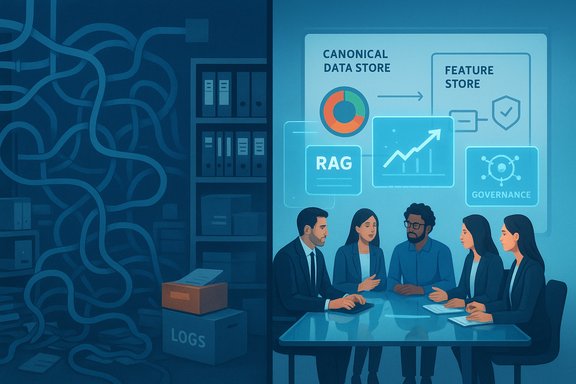 Background
The MIT “GenAI Divide” report — assembled from hundreds of deployment reviews, dozens of executive interviews and employee surveys — casts the problem in blunt terms: high adoption but low transformation. Most firms have experimented with ChatGPT-style assistants and vendor copilots, yet only a tiny fraction achieve sustained business outcomes. The study frames the failure not as a model problem but as an integration and learning problem: organisations are not building systems that learn from workflows or measuring the right business signals. Those headline numbers are shocking, but they match what practitioners see in daily operations: pilots that look impressive in demos but never change how work actually gets done. Internal forum threads among enterprise practitioners repeatedly point to the same root causes — data and cloud foundations, MLOps, governance, and skills — as the gating factors that separate pilots from production.Why so many AI projects fail: three overlapping failures
1) The seduction of “we can build it ourselves”
When ChatGPT made advanced language capabilities accessible via an API and a browser, many leaders concluded the engineering hurdle was low. That impulse — to own the IP and control the tech — is understandable. But experience shows it is often a false economy.- Building a production-grade Retrieval‑Augmented Generation (RAG) pipeline, a document-grounded assistant, or a reliable agent requires disciplined engineering: data pipelines, canonical knowledge stores, retrieval indices, test suites, model selection and monitoring.
- Teams inexperienced with those problems tend to prototype with open-source frameworks and stop at "it kind of works" rather than engineering for repeatability, observability and safety. The result is a brittle system that produces intermittent value and drains resources.
2) Tools designed for traditional software, not ML systems
Many enterprise tools that carry the “AI” label were designed by teams rooted in conventional software engineering and product models. They expose familiar enterprise interfaces but lack primitives for the unique failure modes of generative AI: hallucinations, data drift, provenance, and token-budget economics.Microsoft’s Copilot family illustrates this complexity: the product line includes both free ondemand features and paid enterprise offerings priced by seat and by agent/feature. Public pricing and product changes have evolved quickly as Microsoft folded Copilot into multiple SKUs, but the proper takeaway is this — vendor tools vary widely in capability and cost, and their economics are metered in seats, agents and consumption rather than simple license tags. That means costs and lock‑in risks can escalate if you treat Copilot or similar tools like commodity software. Note on specific pricing claims: some popular narratives compress per‑organization totals and per‑user rates into a single dramatic story (for example, quoting a six-figure enterprise bill then comparing it to a per‑user annual fee). Those representations can be misleading unless the base (number of seats, agent consumption) is stated clearly; verify seat counts and billing models before trusting headline pricing anecdotes.
3) Overconfidence and unrealistic expectations
Executives hear stories of radical productivity gains and assume AI will replace workflows wholesale. That expectation — that models will replace human judgment — is where many projects break.- LLMs are exceptional at assistive tasks: summarisation, search, drafting, triage, and pattern detection across voluminous records.
- They are poor substitutes for delegated decision-making in high-stakes domains without layered guardrails. Hallucinations—confident but false outputs—remain a fundamental model behavior that requires mitigation and human oversight.
The engineering realities: what novices underestimate
Data is the first feature
AI projects are data projects first and models second. If your canonical data sources are fragmented, stale, or undocumented, your model will be brittle.- Firms that treat data readiness as an engineering milestone — canonical keys, feature stores, freshness SLAs, automatic schema checks and lineage — dramatically reduce model surprise and long-term maintenance costs.
Observability, tests and chaos
Unlike traditional software that often fails loudly, AI systems fail silently. A model can return plausible-looking answers that are wrong; without telemetry and business‑level A/B tests you won't notice until the business metrics degrade.- Production systems must include: tracing of inputs/outputs, provenance metadata for RAG responses, continuous evaluation on business‑facing metrics, data‑drift alerts, and rollout gates (shadow mode → human‑in‑the‑loop → graduated privileges).
MLOps and lifecycle engineering are non-negotiable
Deploying a model is a beginning, not an end. You need repeatable CI/CD for models, dataset versioning, artifact registries, and retraining policies tied to measurable drift.- Many failed pilots collapsed because teams treated a single successful demo as “done” and never invested in lifecycle controls.
Hallucinations, RAG and the limits of “just prompt it”
Large language models generate fluent text by predicting likely continuations. That mechanism can — and does — produce fabrications. The research community and leading model vendors agree: hallucinations are an intrinsic model behavior that must be managed, not magically removed. OpenAI’s own analysis explains why hallucinations arise and shows that mitigation requires different evaluation and engineering patterns. Retrieval‑Augmented Generation (RAG) is the most practical, widely adopted guardrail against hallucination for document-grounded tasks:- RAG retrieves relevant source documents, then conditions generation on those documents, producing outputs annotated with provenance and source snippets.
- Good RAG implementations limit the model’s tendency to invent by forcing citation and using deterministic retrieval windows, and they are coupled with fallback circuits (e.g., “I don’t have enough evidence to say that”).
The vendor paradox: why smaller specialists beat big consultancies
MIT’s report — and multiple practitioner surveys — found a striking pattern: smaller specialist vendors and boutique teams often outperform large consulting houses on AI projects. The reasons are practical.- Smaller vendors are typically focused on a narrow set of repeatable solutions, so they’ve already paid the cost of learning the platform and the failure modes.
- They move faster, iterate on real production feedback, and have less organizational overhead.
- Large consultancies may bring scale and client relationships, but they frequently re-learn ML fundamentals on your timetable and budget.
Where the original narrative misleads (and what to watch for)
The original article makes several emphatic claims worth calling out and correcting:- Claim: “Microsoft tried to charge $108,000 per year for Copilot, then cut to $360/year, then gave it away.” This compresses two different pricing lenses (enterprise seat totals vs per‑user fees) into one anecdote and therefore misleads. Microsoft’s Copilot SKUs are priced per user/month in many commercial plans (e.g., $30/user/month for Microsoft 365 Copilot) while Copilot Chat features and studio capacities are metered and offered in different bundles. Organisation-level bills vary with seat counts and agent consumption; always verify the per‑seat and per‑agent metrics before extrapolating to a company-wide tally.
- Claim: “The tool is bad because Microsoft slashed prices dramatically.” Price adjustments and packaging changes do not automatically equal product failure; they often reflect evolving go‑to‑market strategies as vendors figure out which bundles fit which enterprise buying patterns. Treat dramatic pricing stories as procurement red flags to be investigated, not as conclusive product critique.
Practical playbook: seven actions to rescue a doomed AI project
If your AI pilot is stalling, here is a battle-tested, sequential playbook to recover value quickly.- Stop and measure: pause feature development and run a 2‑week audit of objectives, metrics and data readiness. Convert product KPIs into financial terms (time saved × hourly cost, error reductions, churn improvement).
- Bring in a small expert audit team: hire a compact external group with production ML and MLOps experience — not a generalist strategy shop. Ask them to produce a 10‑page remediation plan and a prioritized backlog. Evidence shows outside specialists materially raise the success rate.
- Validate the data layer: create a canonical dataset, implement schema checks, and deploy drift monitoring. If your retrieval index is noisy, fix the index before tuning the model.
- Move to human‑in‑the‑loop: release new capabilities in shadow mode or with mandatory human approval for any high-risk outputs. Use RAG with provenance to ground responses.
- Implement observability and rollback controls: log inputs/outputs, add confidence thresholds, and enforce a simple rollback path. Instrument the business metrics you care about and set alerting on degradations.
- Re-scope to narrow, high-value tasks: stop trying to build a general assistant. Pick a clear, measurable workflow — invoice matching, first‑line support triage, contract summarisation — and iterate until the business KPI moves.
- Define a 90‑day roadmap to either: a) hand the capability to a specialist partner for rapid hardening, b) upskill internal teams via embedded coaching from that partner, or c) transition to vendor SaaS with contractual protections (non‑training clauses, deletion rights, exit portability). The key decision is whether you want to buy a hardened capability or build one with expert guidance.
Governance, risk and procurement: must‑have guardrails
- Require written, auditable non‑training clauses or on‑device guarantees for sensitive data. Do not rely solely on vendor marketing copy.
- Treat prompt logs and generated outputs as potentially discoverable records; define retention, redaction and FOI/DSR handling up front.
- Map consumption and cost KPIs from day one (tokens, inference calls, agent executions) and implement tenant quotas to prevent surprise bills.
Organizational change: align incentives, not just tech
AI isn’t primarily a technology rollout — it’s a change management program. The hard work is aligning KPIs, training frontline managers, and redesigning processes so that an AI suggestion actually changes a decision or a handoff.- Create cross‑functional ownership: data, product, legal, security and the business line should co-own outcomes.
- Reframe rewards: incentivise improved decision outcomes and reduced error rates, not just feature launches.
- Invest in role-based training and a governance cadence (monthly KPIs, quarterly audits).
Where to spend your next dollar
If you want practical ROI, funnel initial investment into these priorities:- Canonical data platform and index hygiene
- A compact expert audit and remediation engagement (2–8 weeks)
- Observability and compliance (prompt logs, provenance capture, DLP)
- One narrow high-impact pilot with human validation
Conclusion: what leadership must accept
The stark MIT statistic is not an indictment of AI’s potential — it is an indictment of common organisational behaviour: overconfidence, poor data foundations, inadequate engineering practices and the refusal to ask for help. The remedy is straightforward in concept though challenging in execution: adopt sober expectations, instrument everything, make the project measurable, and bring on experienced partners who have already paid the tuition of failure.There is a practical path from the 95% failure zone to measurable success. It runs through disciplined engineering, realistic product design (assistive intelligence), and targeted partnerships with expert teams that can accelerate your learning curve. Those who accept the change-management nature of AI and invest early in data, MLOps and governance will convert pilots into durable value — and avoid the expensive lesson of learning everything on the company credit card.
Appendix: quick checklist for an immediate 2‑week recovery sprint
- 1. Inventory: list active pilots, user counts, KPIs, data sources, and total monthly vendor spend.
- 2. Audit: run a 10‑point technical health check (data freshness, retrieval precision, observability, drift alerts, error logs, governance controls, legal risk).
- 3. Partner: contract a 2‑week specialist audit (one senior ML engineer + one MLOps lead) to score risks and recommend the minimal viable remediation.
- 4. Gate: move risky flows to human‑in‑the‑loop and cap agent consumption while you stabilise.
- 5. Measure: publish a single business KPI and track it daily; if it doesn’t improve within 90 days, pivot or pause.
Source: The AI Journal Why Your AI Project Is Failing (And How to Fix It) | The AI Journal
