

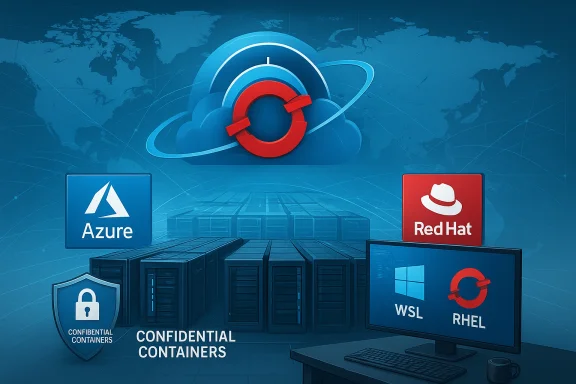
A decade of engineering, co‑development, and commercial cooperation between Microsoft and Red Hat has reshaped the enterprise cloud landscape — turning what began in 2015 as a cautious embrace of Linux on Azure into a full suite of jointly supported, cloud‑native, and hybrid solutions that now include Azure Red Hat OpenShift, OpenShift Virtualization, Confidential Containers, and expanded RHEL options across platforms.
A partnership forged at the intersection of hyperscale cloud and enterprise open source set out with a pragmatic goal: give customers choice, security, and a path to modernize legacy estates without throwing away existing investments. Microsoft and Red Hat began collaborating in earnest in 2015 to make mission‑critical Linux workloads first‑class citizens on Azure; over ten years that cooperation deepened into co‑engineering, jointly supported marketplace offerings, and a set of operational integrations designed for hybrid cloud at scale. This article summarizes the partnership’s key milestones, validates the major technical claims, and provides critical analysis of strengths, gaps, and risks for enterprises considering or already running Red Hat workloads on Azure. Where possible, vendor claims are cross‑checked against independent documentation and product pages to help readers separate promotional language from engineering reality.
Source: Microsoft Azure Celebrating 10 years of Microsoft and Red Hat partnership | Microsoft Azure Blog
 Background
A partnership forged at the intersection of hyperscale cloud and enterprise open source set out with a pragmatic goal: give customers choice, security, and a path to modernize legacy estates without throwing away existing investments. Microsoft and Red Hat began collaborating in earnest in 2015 to make mission‑critical Linux workloads first‑class citizens on Azure; over ten years that cooperation deepened into co‑engineering, jointly supported marketplace offerings, and a set of operational integrations designed for hybrid cloud at scale. This article summarizes the partnership’s key milestones, validates the major technical claims, and provides critical analysis of strengths, gaps, and risks for enterprises considering or already running Red Hat workloads on Azure. Where possible, vendor claims are cross‑checked against independent documentation and product pages to help readers separate promotional language from engineering reality.Partnership timeline and big milestones
1. Early steps: RHEL on Azure and joint support
The partnership started with making Red Hat Enterprise Linux (RHEL) available and supported on Azure. That was a turning point: enterprises that required RHEL compatibility could now consume Azure services while retaining enterprise Linux with official Red Hat support, reducing migration friction. Microsoft’s Azure pages and the decade retrospective summarize that foundation as the initial catalyst for further joint services.2. Azure Red Hat OpenShift (ARO)
Azure Red Hat OpenShift — a jointly engineered, fully managed Red Hat OpenShift service on Azure — became the flagship collaboration. ARO gives teams a co‑managed OpenShift control plane integrated into Azure’s billing, identity, and regional footprint. The Azure product pages and ARO release notes reflect its steady evolution and the addition of enterprise features and region expansions.3. Converging VMs and containers: OpenShift Virtualization
By late 2025, the companies moved to integrate virtualization with containers. OpenShift Virtualization lets organizations run VMs and containers side‑by‑side under the OpenShift/Kubernetes control plane — a strategic bridge for migration of legacy VM workloads into a cloud‑native management model. Public preview was announced earlier in 2025 and the product moved to GA timing announcements at Ignite 2025. Red Hat and Microsoft product pages and community posts document the progression from preview to GA.4. Confidential Containers and confidential computing
Confidential Containers — hardware‑enforced enclaves for protecting data in‑use — reached general availability as part of Azure Red Hat OpenShift, bringing zero‑trust, attestation, and TEE‑backed isolation to containerized workloads. Microsoft’s ARO product pages and Red Hat technical posts detail the attestation model, how CVMs (Confidential VMs) host workloads, and how trustees/attestation services fit into the deployment.5. RHEL for specialized workloads and developer surfaces
The partnership expanded RHEL’s reach into developer surfaces (RHEL on WSL) and specialized workloads (RHEL for HPC), and the companies jointly surfaced cost optimization options such as Azure Hybrid Benefit for RHEL to enable BYOS (bring‑your‑own‑subscription) licensing and pay‑as‑you‑go conversions. Microsoft Learn documentation and Red Hat developer guidance confirm RHEL availability across WSL, BYOS options, and Azure Hybrid Benefit mechanics.What’s in the stack today — technical anatomy
Azure Red Hat OpenShift: what customers actually get
- A jointly supported control plane with SRE operations from both vendors.
- Integrated Azure billing, portal, and regional availability across many Azure regions.
- A full OpenShift stack (Kubernetes, OpenShift components, CI/CD, networking, monitoring) packaged as a managed service so customers avoid managing the control plane themselves.
- OpenShift Virtualization GA: run VMs and containers on the same cluster, accelerate lift‑and‑shift modernization.
- Confidential Containers GA: TEEs and attestation for workloads that must protect data while processing.
RHEL everywhere: from cloud to WSL
- RHEL continues to be available as pay‑as‑you‑go images in Azure Marketplace, with BYOS options via Red Hat Cloud Access.
- RHEL on WSL brings RHEL user space to Windows developer desktops for parity in development environments (Red Hat documents installation and subscription expectations). Note: RHEL on WSL is positioned primarily for development and testing rather than production Windows host workloads.
Cost and licensing: Azure Hybrid Benefit
Azure Hybrid Benefit for Linux is the official Microsoft mechanism that allows qualified Red Hat subscriptions to be used in Azure, converting PAYG images to BYOS to reduce software licensing fees and optimize costs. Microsoft documentation spells out the conversion flows and typical savings when combining with reserved capacity. This is an important lever for cloud TCO planning when migrating RHEL workloads.Real world adoption: customer stories and AI at scale
Microsoft and Red Hat present several customer stories to illustrate value: Teranet, Symend, Western Sydney University, and notably Bradesco. These case studies are not marketing fiction — Microsoft’s customer story pages and Bradesco’s case writeups provide measurable business metrics and architecture patterns that showcase how joint solutions are used in the wild. Bradesco’s “Bridge” platform is a concrete example: it standardizes governance on Azure Red Hat OpenShift while using Azure AI Foundry and Azure OpenAI Service to deliver multi‑agent generative AI at scale for banking workloads, improving resolution rates and accelerating product rollout. The published Bradesco case study provides specifics on architecture, governance, and operational outcomes. Symend’s rapid region launches and modernization examples also illustrate how OpenShift on Azure can accelerate time‑to‑market for customer‑facing services. Those case summaries can be found in the product and customer pages.Cross‑checking vendor claims: validation and caveats
Vendor narratives often contain broad, positive metrics. Independent product pages and technical docs corroborate many engineering claims, but some figures require care:- Claim: ARO reduces development time “by up to 70%.” This is called out on product pages as a vendor‑reported benefit; however, the underlying study or context (workload types, baseline processes) is not always public. Treat percentage reductions as indicative vendor claims rather than universal guarantees.
- Claim: OpenShift Virtualization and Confidential Containers are GA and integrated into ARO. This is validated across Microsoft product pages, Microsoft community posts, and Red Hat documentation describing previews and GA milestones. For technical details, the Microsoft Learn docs and Red Hat blog posts provide step‑by‑step architecture and operator guidance.
- Claim: Azure Hybrid Benefit yields large cost savings (up to 76% cited in some Microsoft community posts). The Hybrid Benefit reduces software licensing fees and can produce strong savings when combined with reservation pricing, but actual savings are case specific and depend on instance type, region, reserved commitment, and existing Red Hat license coverage. Organizations should model conversions in their own environments using Azure pricing tools and Red Hat Cloud Access eligibility checks.
Strengths of the Microsoft–Red Hat partnership
- Operational co‑management reduces friction: ARO’s co‑managed model offloads control‑plane operations while preserving OpenShift semantics; for organizations that want enterprise SLAs without operational overhead, this is a strong value proposition.
- A unified modernization path: OpenShift Virtualization provides a pragmatic migration approach — keep VMs live while modernizing incrementally to containers, minimizing migration risk and business disruption.
- Security and confidential computing integration: Confidential Containers combine OpenShift sandboxing and hardware TEEs, granting organizations an additional layer to meet regulatory and data‑privacy requirements for in‑use data protection. Azure’s confidential computing investments plus OpenShift’s sandbox operators form a cohesive model.
- Developer ergonomics and parity: RHEL on Windows Subsystem for Linux (WSL) and Red Hat tooling availability give developers consistent environments across laptops and cloud, improving reproducibility and reducing “works on my machine” friction. Red Hat documentation outlines supported flows and subscription expectations for WSL.
- Commercial flexibility: Azure Hybrid Benefit, pay‑as‑you‑go, and BYOS options let enterprises choose licensing flows that match procurement realities and optimize spend as migrations proceed.
Material risks and open questions
No technology partnership is risk‑free. The following are practical concerns organizations should analyze before committing large estates:- Operational complexity across vendor boundaries: Co‑management can create friction in operational incident response: which vendor owns a particular failure mode? Joint support reduces ambiguity but does not eliminate the need for precise runbook ownership and escalation paths. Organizations must align SLOs and contact trees with both vendors.
- Cost predictability: Cloud consumption, dual licensing models, and ancillary services (network egress, storage, specialized instances for confidential compute) can create unanticipated bills. Azure Hybrid Benefit helps, but finance teams must model usage, and engineering teams must set governance guardrails (quotas, cluster sizing, autoscaling policies) to control variable spend.
- Tooling and skills gap: Running VMs inside Kubernetes, configuring TEEs, and operating multi‑cluster governance (ACM, Prometheus aggregation, attestation operators) require specialized operational skills. Expect a nontrivial learning curve and plan for staff enablement or managed‑service augmentation.
- Supply‑chain and transparency: Confidential computing and attestation introduce dependencies on hardware vendors, firmware, and attestation services. Organizations with stringent sovereignty requirements must validate root‑of‑trust, attestation endpoints, and audit trails to ensure compliance. Public documentation is good, but sensitive deployments often require customer engagements with vendors for deeper attestations.
- Vendor‑reported metrics require scrutiny: Vendor claims (percent improvements, cost savings) are useful signposts but should be stress‑tested with real‑world PoCs that represent the organization’s specific workloads and traffic patterns.
Practical guidance: how to evaluate and adopt
- Start with a pilot that mirrors production scale and data sensitivity.
- Run a representative subset of workloads on ARO with monitoring and FinOps telemetry in place.
- Use the pilot to validate migration patterns for VMs (MTV) and evaluate performance and cost of Confidential Containers.
- Map licensing and subscription eligibility.
- Inventory existing RHEL subscriptions and verify Red Hat Cloud Access eligibility.
- Model the financial impact of Azure Hybrid Benefit versus PAYG for your instance types and regions.
- Define security and compliance gates.
- For regulated workloads, validate attestation chains, key management, and telemetry/forensics capabilities for confidential compute scenarios.
- Prepare operations and runbooks.
- Align SRE responsibilities, CI/CD gates, rollback procedures, and incident escalation across Microsoft and Red Hat support channels.
- Invest in developer parity and automation.
- Adopt RHEL in development environments (RHEL on WSL where appropriate) to eliminate environmental drift and accelerate CI/CD.
What’s next: open source, AI, and hybrid cloud convergence
Both companies emphasize that openness is core to their joint roadmap: contributions to Kubernetes, container runtimes, and secure computing standards continue. The partnership’s trajectory is clearly aligned with enabling enterprise‑grade AI: Azure OpenAI integrations, Azure AI Foundry architectures, and platformized OpenShift AI stacks enable production‑grade model governance and deployment patterns. Bradesco’s Bridge platform is a public example of an AI production architecture that uses Azure Red Hat OpenShift as the operational backbone for regulated, high‑scale banking workloads. Red Hat’s investment in AI tooling, model optimization acquisitions, and OpenShift AI primitives signal that the platform will increasingly serve as the on‑ramp to responsibly governed ML and generative AI at enterprise scale. Microsoft’s continued work on Foundry and OpenAI integrations complements this by providing hosted models, governance controls, and operational accelerators. Both trajectories point toward an era where hybrid cloud platforms must offer not just compute and orchestration, but full operational governance for AI life cycles.Final analysis and editorial verdict
The Microsoft–Red Hat partnership represents one of the most consequential vendor alliances in the cloud era for customers focused on enterprise open source and hybrid modernization. The technical integration between Azure and Red Hat products — from ARO to OpenShift Virtualization and Confidential Containers — is real, productized, and broadly available. Independent product pages, press releases, and customer case studies corroborate the partnership’s engineering milestones and business outcomes. Strengths:- Clear migration path for legacy workloads.
- Co‑managed operations that reduce control‑plane burden.
- Strong security posture with confidential computing options.
- Commercial flexibility through Azure Hybrid Benefit and BYOS models.
- Operational and financial complexity still require careful governance and proof‑of‑concept validation.
- Vendor metrics should be validated in the customer’s own environment.
- Hardware/attestation supply‑chain and sovereign constraints may need deeper vendor engagement.
Conclusion
Ten years in, the Microsoft–Red Hat relationship has matured from an experimental compatibility story into a full, production‑grade partnership delivering jointly supported, hybrid cloud primitives and enterprise AI foundations. The technical innovations — co‑managed OpenShift, virtualization inside Kubernetes, and confidential computing for containers — are now available and documented. Organizations that pair careful financial modeling, security validation, and operational readiness with these jointly engineered offerings can realize significant agility and modernization benefits. At the same time, prudent pilots and vendor‑validated proofs‑of‑concept remain essential to convert vendor promises into predictable, auditable operational outcomes.Source: Microsoft Azure Celebrating 10 years of Microsoft and Red Hat partnership | Microsoft Azure Blog
