

Microsoft and Red Hat used Red Hat Summit 2026 in Atlanta to recast their 10-year partnership as a unified hybrid cloud strategy, tying Azure Red Hat OpenShift, OpenShift Virtualization, AI governance and regulated enterprise deployment into one platform story. The pitch is not merely that Windows and Linux can coexist. It is that the messy coexistence enterprises already live with has become the product. For IT leaders, the message is blunt: the next phase of cloud modernization will be less about choosing a camp and more about governing the sprawl they already own.
There was a time when Microsoft and Red Hat standing on the same stage felt like an industry peace treaty. Microsoft had spent years defending Windows Server, SQL Server and its proprietary stack against the Linux world; Red Hat had built its enterprise identity around Linux, open source and the belief that infrastructure should not be trapped inside one vendor’s architecture. The alliance was surprising because it appeared to bridge a cultural divide as much as a technical one.
A decade later, the surprise has worn off. Azure is full of Linux workloads, Windows estates are rarely Windows-only, and enterprise architecture diagrams look less like strategic plans than archaeological digs. The Microsoft-Red Hat partnership has survived because it maps to reality: most large organizations are hybrid by accumulation, not by design.
That is why the “open enterprise hybrid cloud” framing matters. It is vendor language, certainly, but it points at a real operational problem. Enterprises are trying to run AI services, legacy applications, regulated workloads, virtual machines, containers, data platforms and identity systems across environments that were never designed to feel like one platform.
The argument from Microsoft and Red Hat is that the answer is not another cloud migration slogan. It is a managed, jointly engineered layer where Azure and OpenShift become less like neighboring countries and more like overlapping jurisdictions. That may sound subtle, but for the administrators who actually run these estates, the difference is enormous.
That assumption has not survived contact with enterprise reality. Data sovereignty rules, latency needs, cost surprises, software licensing constraints, geopolitical risk and plain old application inertia have all kept hybrid infrastructure alive. AI has added another complication: training, inference, governance and sensitive enterprise data do not always belong in the same place.
Red Hat’s position has long been that consistency matters more than location. OpenShift was built to make Kubernetes and application platforms portable across data centers, edge environments and public clouds. Microsoft’s interest is different but complementary: Azure becomes more valuable when it can absorb the complexity of enterprise workloads without forcing customers to abandon the platforms and operating models they already trust.
That is the strategic center of the partnership. Red Hat gives Microsoft credibility in open-source infrastructure and Linux-heavy enterprise environments. Microsoft gives Red Hat a hyperscale cloud anchor, a global managed-service channel and deep ties into identity, security, developer tooling and AI governance.
This is not a romantic open-source story. It is a hard-nosed enterprise platform story. The customers most likely to care are not idealists; they are banks, manufacturers, healthcare systems, retailers, governments and global companies with too many workloads to rewrite and too much risk to tolerate improvisation.
The Banco Bradesco example cited by Microsoft is useful because it avoids the toy-demo trap. The Brazilian banking giant reportedly built an internal generative AI platform on Azure Red Hat OpenShift, with governance and backend services structured so developers could provision models and services inside a controlled operating model. According to the companies, that platform has grown to more than 500 active AI initiatives.
The number matters less than the architecture. In a regulated bank, the hard part is not getting one chatbot to work. The hard part is making hundreds of AI services production-ready, auditable and usable by internal teams without turning every deployment into a bespoke compliance exercise.
That is where Microsoft and Red Hat want to place their joint value proposition. Azure brings AI services, identity integration, policy controls and cloud-scale governance. Red Hat brings OpenShift, Kubernetes discipline, Linux infrastructure and a platform model that can span beyond one cloud region or one deployment pattern.
The result is a pitch that AI should not be treated as a set of disconnected experiments. It should run on a governed platform that already understands enterprise constraints. That is an appealing message because many organizations are discovering that the first wave of AI enthusiasm created a new kind of shadow IT: not just unsanctioned applications, but unsanctioned model usage, data movement and automation.
Containers may dominate conference keynotes, but virtual machines still run vast portions of enterprise IT. Many of those VMs host applications that will not be rewritten soon, if ever. Others are attached to vendor support contracts, legacy databases, brittle dependencies or compliance assumptions that make wholesale modernization unrealistic.
That is why OpenShift Virtualization on Azure Red Hat OpenShift is more than a checkbox feature. Its general availability gives enterprises a way to run VMs and containers on a managed OpenShift platform in Azure, reducing the pressure to choose between “lift and shift” and full application refactoring. It acknowledges that modernization is often partial, uneven and politically constrained.
This is especially relevant in the post-VMware anxiety cycle. Broadcom’s acquisition of VMware and subsequent licensing and packaging changes pushed many infrastructure teams to reassess their virtualization roadmaps. Red Hat has been one of several vendors trying to convert that reassessment into momentum for alternatives, but its Microsoft tie-up gives the OpenShift route a more cloud-native angle.
The pitch is not simply “move your VMs here.” It is “move your VMs into the same operational universe as your containers, policy controls, automation and future application platform.” That distinction is important. A pure hypervisor swap may reduce a licensing headache, but it does not necessarily modernize operations. A VM-and-container platform at least offers the possibility of gradual change.
Still, the trade-off should not be minimized. OpenShift Virtualization is not a magic wand for every vSphere estate. Skills, networking, storage, backup, disaster recovery, performance tuning and operational maturity all matter. The customers who succeed will be the ones that treat virtualization modernization as a platform engineering project, not a procurement protest.
Microsoft did not become more open merely because it became more enlightened. It became more open because Azure needed to be where enterprise workloads actually were. If customers were running Red Hat Enterprise Linux, Kubernetes, Java, PostgreSQL, containers and open-source tooling, Azure had to embrace those ecosystems or concede too much ground.
The Microsoft-Red Hat partnership is therefore a form of cloud realism. Microsoft does not need every workload to become Windows-native. It needs those workloads to be governed, secured, billed, observed and extended through Azure. Red Hat does not need every OpenShift deployment to live outside the hyperscalers. It needs OpenShift to remain the trusted abstraction layer for enterprises that do not want cloud-specific lock-in to become their default architecture.
That creates a productive tension. Microsoft wants Azure to be indispensable. Red Hat wants OpenShift to be portable. Customers want leverage, flexibility and fewer operational seams. The partnership works when those interests overlap, but IT leaders should not pretend the tension disappears.
The “open” in open enterprise hybrid cloud is therefore not absolute freedom. It is constrained portability within a jointly supported enterprise stack. That may disappoint purists, but it may be precisely what large organizations can actually consume.
Red Hat has leaned into this with sovereign support programs, compliance automation and OpenShift capabilities aimed at controlled environments. Microsoft has its own sovereign cloud initiatives and a long-running effort to convince governments that Azure can meet regional and sector-specific requirements. Together, the two companies are trying to make sovereignty another reason for a standardized hybrid platform rather than another source of fragmentation.
The appeal is obvious. If a company can use a common platform across public cloud, private environments and restricted regions, it can reduce the number of bespoke compliance architectures it must maintain. It can also give central IT and security teams a stronger hand in enforcing policy.
The risk is that sovereignty becomes yet another marketing wrapper for complexity. Compliance automation is useful, but it does not eliminate accountability. A platform can generate evidence, enforce controls and standardize deployment patterns, but it cannot decide the legal risk appetite of a multinational bank or a government agency.
For WindowsForum readers, the lesson is familiar from years of Microsoft administration: tooling helps, but governance is a human system. The best hybrid cloud architecture will still fail if ownership, policy and operational discipline remain ambiguous.
Microsoft understood this earlier than some of its old reputation would suggest. The rise of Linux on Azure, Windows Subsystem for Linux on developer machines, SQL Server on Linux, Azure Arc and cross-platform management tooling all reflected the same underlying shift: Microsoft could no longer define enterprise computing as a Windows-only domain.
Red Hat made the complementary move from the other direction. It turned Linux from an operating system into the foundation for a broader platform: RHEL, OpenShift, Ansible and AI infrastructure. The company’s strategic value is no longer just that it sells supported Linux. It sells a way to industrialize open-source infrastructure for organizations that cannot run their business on community enthusiasm alone.
The Microsoft-Red Hat alliance sits directly in the middle of that convergence. It says the future enterprise stack is not Windows versus Linux. It is Windows, Linux, Kubernetes, VMs, identity, policy, AI services and automation under a control plane that hides just enough complexity to keep the business moving.
That will irritate partisans on both sides. But administrators rarely get paid to preserve ideological purity. They get paid to keep systems secure, compliant, available and adaptable.
That is not necessarily bad. Enterprise IT has always depended on vendors, standards, ecosystems and operational conventions. A well-supported managed platform can be safer than a hand-assembled stack of loosely related tools. The question is not whether lock-in exists; it is whether the lock-in buys enough reliability, velocity and governance to justify itself.
Azure Red Hat OpenShift is attractive because Microsoft and Red Hat jointly operate and support it. That reduces friction for customers who do not want to become full-time Kubernetes platform maintainers. But managed convenience also narrows the range of choices. Customers inherit the service’s supported versions, integration patterns, upgrade cadence and boundaries.
OpenShift itself offers portability, but portability is never frictionless. Moving from self-managed OpenShift to Azure Red Hat OpenShift, or from Azure Red Hat OpenShift to another managed OpenShift environment, may be easier than rewriting applications for a proprietary cloud service. It is still not the same as moving a folder.
That nuance matters because “open” is often heard as “easy to leave.” In practice, openness may mean more negotiating power, broader skills availability and fewer proprietary dead ends. It does not mean exit planning becomes optional.
The old model forced those groups into conflict. Developers routed around central IT when platforms were too slow. Operations teams slowed projects when risk was too high. Security teams often entered late, when the architecture was already difficult to govern.
A mature OpenShift-on-Azure strategy tries to move that fight into the platform itself. Developers get standardized services and self-service workflows. Operations gets a consistent substrate. Security gets policy hooks and evidence. The business gets faster delivery without pretending every team should be trusted to invent its own cloud architecture.
This is the real meaning of the Bradesco example. The achievement is not that a bank used AI. Every bank is experimenting with AI. The achievement is that AI services reportedly moved into production at scale under a platform model that could satisfy governance demands.
That is where the Microsoft-Red Hat partnership is strongest. It is not selling novelty. It is selling the ability to make novelty boring enough for enterprise use.
VMware remains deeply embedded in enterprise infrastructure, and many organizations will continue to run it for years. Migration is expensive, operationally risky and full of dependencies that vendors often understate. Even when customers are unhappy with pricing or packaging changes, dissatisfaction does not automatically translate into successful migration.
But the VMware market disruption created a rare opening. Infrastructure teams that might have renewed by habit are now asking broader questions. If they must revisit virtualization economics anyway, they may also revisit whether VMs should remain isolated from container strategy, automation strategy and cloud governance.
Red Hat’s opportunity is to make OpenShift Virtualization the bridge between defensive cost management and offensive modernization. Microsoft’s opportunity is to make Azure the place where that bridge feels enterprise-grade and supported. Together, they can offer a path that is less radical than rewriting everything and more strategic than buying another standalone hypervisor.
The danger is overpromising. VM migration still requires discovery, dependency mapping, performance validation and operational retraining. If Microsoft and Red Hat sell the journey as too easy, they will recreate the credibility problems that have haunted cloud migration campaigns for a decade.
Azure Red Hat OpenShift’s managed-service model helps, but it does not erase shared responsibility. Microsoft operates Azure infrastructure and jointly supports the service with Red Hat. Red Hat brings platform engineering and OpenShift expertise. Customers still own applications, data, access design, workload architecture and much of the operational behavior that determines whether the platform succeeds.
This is where Windows administrators and enterprise architects should be especially skeptical of slogans. A unified hybrid platform is valuable only if it simplifies the things that used to break. Identity integration, logging, backup, network policy, secrets management, vulnerability response and cost attribution are not side quests. They are the platform.
AI makes day-two operations even more demanding. Models change, prompts change, data pipelines drift, agents take actions, and governance policies must evolve. A platform that can deploy AI services quickly but cannot track, secure and audit them over time is not an enterprise platform. It is a liability with a nicer interface.
The better reading is that two of the most important enterprise infrastructure vendors are converging on the same customer truth: hybrid complexity is permanent enough to deserve a first-class platform. That is a more sober claim, and a more useful one.
For IT teams evaluating the Microsoft-Red Hat stack, the practical implications are clear:
The Microsoft-Red Hat alliance has matured because the industry around it has changed: cloud is no longer a destination, Linux is no longer outside Microsoft’s enterprise worldview, Windows is no longer the whole corporate estate, and AI has made governance a competitive requirement rather than an internal hygiene task. The next phase will be decided not by whether the phrase “open enterprise hybrid cloud” catches on, but by whether customers can use this jointly engineered stack to make sprawling infrastructure more governable without surrendering the flexibility that made hybrid cloud necessary in the first place.
Source: SiliconANGLE Open enterprise hybrid cloud with Microsoft - SiliconANGLE
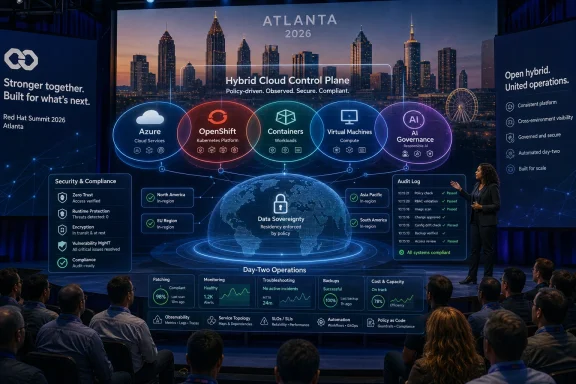 The Alliance That Once Looked Like Diplomacy Now Looks Like Infrastructure
There was a time when Microsoft and Red Hat standing on the same stage felt like an industry peace treaty. Microsoft had spent years defending Windows Server, SQL Server and its proprietary stack against the Linux world; Red Hat had built its enterprise identity around Linux, open source and the belief that infrastructure should not be trapped inside one vendor’s architecture. The alliance was surprising because it appeared to bridge a cultural divide as much as a technical one.A decade later, the surprise has worn off. Azure is full of Linux workloads, Windows estates are rarely Windows-only, and enterprise architecture diagrams look less like strategic plans than archaeological digs. The Microsoft-Red Hat partnership has survived because it maps to reality: most large organizations are hybrid by accumulation, not by design.
That is why the “open enterprise hybrid cloud” framing matters. It is vendor language, certainly, but it points at a real operational problem. Enterprises are trying to run AI services, legacy applications, regulated workloads, virtual machines, containers, data platforms and identity systems across environments that were never designed to feel like one platform.
The argument from Microsoft and Red Hat is that the answer is not another cloud migration slogan. It is a managed, jointly engineered layer where Azure and OpenShift become less like neighboring countries and more like overlapping jurisdictions. That may sound subtle, but for the administrators who actually run these estates, the difference is enormous.
Hybrid Cloud Has Stopped Being a Transitional State
For years, “hybrid cloud” was marketed as a temporary bridge. Enterprises would keep some workloads on-premises while moving strategically toward the public cloud. The assumption was that the destination was clear, even if the migration path was long.That assumption has not survived contact with enterprise reality. Data sovereignty rules, latency needs, cost surprises, software licensing constraints, geopolitical risk and plain old application inertia have all kept hybrid infrastructure alive. AI has added another complication: training, inference, governance and sensitive enterprise data do not always belong in the same place.
Red Hat’s position has long been that consistency matters more than location. OpenShift was built to make Kubernetes and application platforms portable across data centers, edge environments and public clouds. Microsoft’s interest is different but complementary: Azure becomes more valuable when it can absorb the complexity of enterprise workloads without forcing customers to abandon the platforms and operating models they already trust.
That is the strategic center of the partnership. Red Hat gives Microsoft credibility in open-source infrastructure and Linux-heavy enterprise environments. Microsoft gives Red Hat a hyperscale cloud anchor, a global managed-service channel and deep ties into identity, security, developer tooling and AI governance.
This is not a romantic open-source story. It is a hard-nosed enterprise platform story. The customers most likely to care are not idealists; they are banks, manufacturers, healthcare systems, retailers, governments and global companies with too many workloads to rewrite and too much risk to tolerate improvisation.
AI Turns Platform Mess Into Board-Level Risk
The most important change since the early days of the Microsoft-Red Hat alliance is that infrastructure decisions now sit directly underneath AI strategy. Generative AI has made executives newly impatient with fragmented internal platforms. At the same time, it has made security, compliance and auditability harder to fake.The Banco Bradesco example cited by Microsoft is useful because it avoids the toy-demo trap. The Brazilian banking giant reportedly built an internal generative AI platform on Azure Red Hat OpenShift, with governance and backend services structured so developers could provision models and services inside a controlled operating model. According to the companies, that platform has grown to more than 500 active AI initiatives.
The number matters less than the architecture. In a regulated bank, the hard part is not getting one chatbot to work. The hard part is making hundreds of AI services production-ready, auditable and usable by internal teams without turning every deployment into a bespoke compliance exercise.
That is where Microsoft and Red Hat want to place their joint value proposition. Azure brings AI services, identity integration, policy controls and cloud-scale governance. Red Hat brings OpenShift, Kubernetes discipline, Linux infrastructure and a platform model that can span beyond one cloud region or one deployment pattern.
The result is a pitch that AI should not be treated as a set of disconnected experiments. It should run on a governed platform that already understands enterprise constraints. That is an appealing message because many organizations are discovering that the first wave of AI enthusiasm created a new kind of shadow IT: not just unsanctioned applications, but unsanctioned model usage, data movement and automation.
Virtualization Is the Unfashionable Problem That Refuses to Die
The most pragmatic part of the Microsoft-Red Hat story is not AI. It is virtualization.Containers may dominate conference keynotes, but virtual machines still run vast portions of enterprise IT. Many of those VMs host applications that will not be rewritten soon, if ever. Others are attached to vendor support contracts, legacy databases, brittle dependencies or compliance assumptions that make wholesale modernization unrealistic.
That is why OpenShift Virtualization on Azure Red Hat OpenShift is more than a checkbox feature. Its general availability gives enterprises a way to run VMs and containers on a managed OpenShift platform in Azure, reducing the pressure to choose between “lift and shift” and full application refactoring. It acknowledges that modernization is often partial, uneven and politically constrained.
This is especially relevant in the post-VMware anxiety cycle. Broadcom’s acquisition of VMware and subsequent licensing and packaging changes pushed many infrastructure teams to reassess their virtualization roadmaps. Red Hat has been one of several vendors trying to convert that reassessment into momentum for alternatives, but its Microsoft tie-up gives the OpenShift route a more cloud-native angle.
The pitch is not simply “move your VMs here.” It is “move your VMs into the same operational universe as your containers, policy controls, automation and future application platform.” That distinction is important. A pure hypervisor swap may reduce a licensing headache, but it does not necessarily modernize operations. A VM-and-container platform at least offers the possibility of gradual change.
Still, the trade-off should not be minimized. OpenShift Virtualization is not a magic wand for every vSphere estate. Skills, networking, storage, backup, disaster recovery, performance tuning and operational maturity all matter. The customers who succeed will be the ones that treat virtualization modernization as a platform engineering project, not a procurement protest.
Microsoft’s Open Cloud Argument Is Really About Control
Microsoft’s evolution on open source is often told as a redemption arc. The company that once treated Linux as a threat now supports Linux heavily in Azure, contributes to open-source projects and partners deeply with Red Hat. That story is true enough, but it is incomplete.Microsoft did not become more open merely because it became more enlightened. It became more open because Azure needed to be where enterprise workloads actually were. If customers were running Red Hat Enterprise Linux, Kubernetes, Java, PostgreSQL, containers and open-source tooling, Azure had to embrace those ecosystems or concede too much ground.
The Microsoft-Red Hat partnership is therefore a form of cloud realism. Microsoft does not need every workload to become Windows-native. It needs those workloads to be governed, secured, billed, observed and extended through Azure. Red Hat does not need every OpenShift deployment to live outside the hyperscalers. It needs OpenShift to remain the trusted abstraction layer for enterprises that do not want cloud-specific lock-in to become their default architecture.
That creates a productive tension. Microsoft wants Azure to be indispensable. Red Hat wants OpenShift to be portable. Customers want leverage, flexibility and fewer operational seams. The partnership works when those interests overlap, but IT leaders should not pretend the tension disappears.
The “open” in open enterprise hybrid cloud is therefore not absolute freedom. It is constrained portability within a jointly supported enterprise stack. That may disappoint purists, but it may be precisely what large organizations can actually consume.
Sovereignty Makes the Old Cloud Debate Newly Political
Data sovereignty has moved from legal footnote to infrastructure design principle. Governments and regulated industries increasingly care where data resides, who can access it, which support personnel can touch it and whether operational evidence can be produced for auditors. These concerns are not theoretical in Europe, financial services, defense-adjacent industries or public-sector environments.Red Hat has leaned into this with sovereign support programs, compliance automation and OpenShift capabilities aimed at controlled environments. Microsoft has its own sovereign cloud initiatives and a long-running effort to convince governments that Azure can meet regional and sector-specific requirements. Together, the two companies are trying to make sovereignty another reason for a standardized hybrid platform rather than another source of fragmentation.
The appeal is obvious. If a company can use a common platform across public cloud, private environments and restricted regions, it can reduce the number of bespoke compliance architectures it must maintain. It can also give central IT and security teams a stronger hand in enforcing policy.
The risk is that sovereignty becomes yet another marketing wrapper for complexity. Compliance automation is useful, but it does not eliminate accountability. A platform can generate evidence, enforce controls and standardize deployment patterns, but it cannot decide the legal risk appetite of a multinational bank or a government agency.
For WindowsForum readers, the lesson is familiar from years of Microsoft administration: tooling helps, but governance is a human system. The best hybrid cloud architecture will still fail if ownership, policy and operational discipline remain ambiguous.
Windows and Linux Are Now the Same Enterprise Conversation
One reason this partnership matters to a Windows audience is that Windows and Linux can no longer be treated as separate infrastructure tribes. Most serious enterprises run both. Their developers use both. Their security teams monitor both. Their identity, networking and compliance systems increasingly span both.Microsoft understood this earlier than some of its old reputation would suggest. The rise of Linux on Azure, Windows Subsystem for Linux on developer machines, SQL Server on Linux, Azure Arc and cross-platform management tooling all reflected the same underlying shift: Microsoft could no longer define enterprise computing as a Windows-only domain.
Red Hat made the complementary move from the other direction. It turned Linux from an operating system into the foundation for a broader platform: RHEL, OpenShift, Ansible and AI infrastructure. The company’s strategic value is no longer just that it sells supported Linux. It sells a way to industrialize open-source infrastructure for organizations that cannot run their business on community enthusiasm alone.
The Microsoft-Red Hat alliance sits directly in the middle of that convergence. It says the future enterprise stack is not Windows versus Linux. It is Windows, Linux, Kubernetes, VMs, identity, policy, AI services and automation under a control plane that hides just enough complexity to keep the business moving.
That will irritate partisans on both sides. But administrators rarely get paid to preserve ideological purity. They get paid to keep systems secure, compliant, available and adaptable.
The Managed Platform Is the New Lock-In
There is a paradox at the heart of this strategy. The more successful Microsoft and Red Hat become at making hybrid cloud feel unified, the more customers may depend on their particular version of unity.That is not necessarily bad. Enterprise IT has always depended on vendors, standards, ecosystems and operational conventions. A well-supported managed platform can be safer than a hand-assembled stack of loosely related tools. The question is not whether lock-in exists; it is whether the lock-in buys enough reliability, velocity and governance to justify itself.
Azure Red Hat OpenShift is attractive because Microsoft and Red Hat jointly operate and support it. That reduces friction for customers who do not want to become full-time Kubernetes platform maintainers. But managed convenience also narrows the range of choices. Customers inherit the service’s supported versions, integration patterns, upgrade cadence and boundaries.
OpenShift itself offers portability, but portability is never frictionless. Moving from self-managed OpenShift to Azure Red Hat OpenShift, or from Azure Red Hat OpenShift to another managed OpenShift environment, may be easier than rewriting applications for a proprietary cloud service. It is still not the same as moving a folder.
That nuance matters because “open” is often heard as “easy to leave.” In practice, openness may mean more negotiating power, broader skills availability and fewer proprietary dead ends. It does not mean exit planning becomes optional.
Platform Engineering Becomes the Buyer
The enterprise buyer for this story is not only the CIO. It is the platform engineering team caught between developer demands and infrastructure constraints. Developers want fast provisioning, access to AI models, modern deployment workflows and less bureaucracy. Security and operations teams want controls, visibility, patching, auditability and predictable support.The old model forced those groups into conflict. Developers routed around central IT when platforms were too slow. Operations teams slowed projects when risk was too high. Security teams often entered late, when the architecture was already difficult to govern.
A mature OpenShift-on-Azure strategy tries to move that fight into the platform itself. Developers get standardized services and self-service workflows. Operations gets a consistent substrate. Security gets policy hooks and evidence. The business gets faster delivery without pretending every team should be trusted to invent its own cloud architecture.
This is the real meaning of the Bradesco example. The achievement is not that a bank used AI. Every bank is experimenting with AI. The achievement is that AI services reportedly moved into production at scale under a platform model that could satisfy governance demands.
That is where the Microsoft-Red Hat partnership is strongest. It is not selling novelty. It is selling the ability to make novelty boring enough for enterprise use.
The VMware Moment Gives Red Hat an Opening, Not a Victory
It would be easy to frame OpenShift Virtualization as a VMware replacement story. That would be too simple.VMware remains deeply embedded in enterprise infrastructure, and many organizations will continue to run it for years. Migration is expensive, operationally risky and full of dependencies that vendors often understate. Even when customers are unhappy with pricing or packaging changes, dissatisfaction does not automatically translate into successful migration.
But the VMware market disruption created a rare opening. Infrastructure teams that might have renewed by habit are now asking broader questions. If they must revisit virtualization economics anyway, they may also revisit whether VMs should remain isolated from container strategy, automation strategy and cloud governance.
Red Hat’s opportunity is to make OpenShift Virtualization the bridge between defensive cost management and offensive modernization. Microsoft’s opportunity is to make Azure the place where that bridge feels enterprise-grade and supported. Together, they can offer a path that is less radical than rewriting everything and more strategic than buying another standalone hypervisor.
The danger is overpromising. VM migration still requires discovery, dependency mapping, performance validation and operational retraining. If Microsoft and Red Hat sell the journey as too easy, they will recreate the credibility problems that have haunted cloud migration campaigns for a decade.
The Real Test Will Be Day Two
Enterprise infrastructure announcements are usually strongest on day one. The architecture diagram is clean, the keynote demo behaves, and the customer example compresses years of organizational effort into a few polished minutes. The harder question is day two: who patches it, who pays for it, who troubleshoots it at 2 a.m., and who owns the blast radius when something goes wrong?Azure Red Hat OpenShift’s managed-service model helps, but it does not erase shared responsibility. Microsoft operates Azure infrastructure and jointly supports the service with Red Hat. Red Hat brings platform engineering and OpenShift expertise. Customers still own applications, data, access design, workload architecture and much of the operational behavior that determines whether the platform succeeds.
This is where Windows administrators and enterprise architects should be especially skeptical of slogans. A unified hybrid platform is valuable only if it simplifies the things that used to break. Identity integration, logging, backup, network policy, secrets management, vulnerability response and cost attribution are not side quests. They are the platform.
AI makes day-two operations even more demanding. Models change, prompts change, data pipelines drift, agents take actions, and governance policies must evolve. A platform that can deploy AI services quickly but cannot track, secure and audit them over time is not an enterprise platform. It is a liability with a nicer interface.
The Useful Reading of Microsoft and Red Hat’s Pitch
The most concrete way to read this announcement cycle is not as a declaration that Microsoft and Red Hat have solved hybrid cloud. They have not. Nobody has.The better reading is that two of the most important enterprise infrastructure vendors are converging on the same customer truth: hybrid complexity is permanent enough to deserve a first-class platform. That is a more sober claim, and a more useful one.
For IT teams evaluating the Microsoft-Red Hat stack, the practical implications are clear:
- Organizations already invested in Azure and Red Hat should treat Azure Red Hat OpenShift as a serious consolidation path for containers, AI services and selected VM workloads.
- OpenShift Virtualization is most compelling when it is part of a broader modernization plan, not when it is treated as a like-for-like hypervisor escape hatch.
- AI platform projects should be judged less by the number of models deployed and more by governance, auditability, reuse and production operating discipline.
- Data sovereignty requirements strengthen the case for consistent hybrid platforms, but they do not remove the need for legal, security and operational ownership.
- The Microsoft-Red Hat partnership reduces some integration risk, but customers should still plan for skills development, migration complexity and exit strategy.
The Microsoft-Red Hat alliance has matured because the industry around it has changed: cloud is no longer a destination, Linux is no longer outside Microsoft’s enterprise worldview, Windows is no longer the whole corporate estate, and AI has made governance a competitive requirement rather than an internal hygiene task. The next phase will be decided not by whether the phrase “open enterprise hybrid cloud” catches on, but by whether customers can use this jointly engineered stack to make sprawling infrastructure more governable without surrendering the flexibility that made hybrid cloud necessary in the first place.
Source: SiliconANGLE Open enterprise hybrid cloud with Microsoft - SiliconANGLE
