

BitFlow’s Alta-AN analog frame grabbers — two units installed at ETH Zurich — have clocked more than a decade of continuous service in a live atmospheric-research experiment, underscoring how conservative engineering and robust driver support can keep legacy imaging hardware relevant long after its mainstream production run ends.
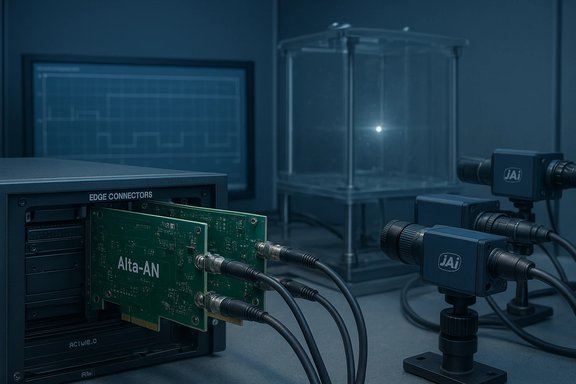
The story centers on a long-running experiment at the Institute for Atmospheric and Climate Science, ETH Zurich, where Dr. Ulrich K. Krieger’s group studies single aerosol particles levitated in an electrodynamic balance (EDB). The experiment demands stable, deterministic image capture of angular light-scattering patterns and other optical diagnostics at micrometer scales. To meet those requirements the group deployed BitFlow Alta-AN analog frame grabbers paired with analog JAI cameras — hardware first acquired in the late 2000s and reportedly running continuously in the critical setup since 2014.
This use case has been publicized via vendor materials and reposts by industry sites, which frame the deployment as an example of exceptional longevity for an analog frame grabber designed in the PCI Express era. The Alta-AN family was introduced by BitFlow in 2007 and later moved to legacy status as the vendor shifted focus to modern digital interfaces such as CoaXPress and CameraLink. BitFlow itself became part of the Advantech group in the company’s recent strategic evolution.
Peer-reviewed publications from the ETH group document the electrodynamic balance technique and single-particle optical diagnostics; the group’s published work confirms the use of scattering and resonance spectroscopy approaches that require controlled, repeatable image acquisition.
Caveat: the continuous-operation claim and Windows 11 migration details are reported through vendor and republished press materials. Independent, granular telemetry from the ETH lab detailing error logs, uptime counters, or maintenance records are not publicly available; therefore those specific longevity metrics should be regarded as vendor-sourced statements corroborated by industry press coverage rather than independently audited facts.
BitFlow’s product strategy shifted accordingly: the company discontinued its analog Alta product line (legacy status) to invest engineering resources into modern digital frame grabbers and CoaXPress interfaces. This mirrors broader industry trends where analog acquisition occupies a shrinking niche but retains relevance in legacy systems and specialized sensors.
At the same time, the imaging industry’s trajectory favors faster, cleaner digital links. CoaXPress, CameraLink, and modern network-vision protocols deliver capacities and deployment flexibilities that analog systems can’t match indefinitely. For lab managers and system architects, the pragmatic approach is a two-track strategy:
For Windows-based imaging teams, the takeaways are tactical and strategic: secure driver and SDK archives, validate OS migrations early, harden hosts running legacy drivers, and plan a staged shift towards modern interfaces when the scientific or operational benefits justify the work. When managed thoughtfully, legacy imaging systems can deliver exceptional value — but they should be part of a broader modernization roadmap rather than an indefinite halt to progress.
Source: AZoOptics BitFlow Alta Frame Grabbers Deliver 11 Years of Uninterrupted Performance in Groundbreaking Atmospheric Research
 Background
The story centers on a long-running experiment at the Institute for Atmospheric and Climate Science, ETH Zurich, where Dr. Ulrich K. Krieger’s group studies single aerosol particles levitated in an electrodynamic balance (EDB). The experiment demands stable, deterministic image capture of angular light-scattering patterns and other optical diagnostics at micrometer scales. To meet those requirements the group deployed BitFlow Alta-AN analog frame grabbers paired with analog JAI cameras — hardware first acquired in the late 2000s and reportedly running continuously in the critical setup since 2014.This use case has been publicized via vendor materials and reposts by industry sites, which frame the deployment as an example of exceptional longevity for an analog frame grabber designed in the PCI Express era. The Alta-AN family was introduced by BitFlow in 2007 and later moved to legacy status as the vendor shifted focus to modern digital interfaces such as CoaXPress and CameraLink. BitFlow itself became part of the Advantech group in the company’s recent strategic evolution.
Overview: Why this matters to Windows and imaging professionals
Legacy imaging hardware still underpins many scientific and industrial systems. The Alta-AN case is relevant for any Windows-based imaging environment because it highlights:- Real-world longevity of PCIe analog acquisition hardware across multiple Windows generations.
- The importance of robust SDKs and driver maintenance for long-term device viability.
- The operational trade-offs between legacy analog flexibility and modern digital performance (bandwidth, noise immunity, cable length).
- Practical migration considerations when platforms advance (e.g., moving to Windows 11, new motherboards, or replacement cameras).
Technical profile: Alta-AN at a glance
Design and capabilities
- The Alta-AN family was engineered as a high-quality, flexible analog frame grabber series built on the PCI Express bus (x4 card configurations common in the lineup).
- The cards were intended to interface with nearly any analog camera type: monochrome asynchronous-reset sensors, interlaced/progressive HDTV sensors, component YPbPr, RGB, and dual-tap designs.
- Typical Alta-AN hardware specs (manufacturer documentation) include a multi-channel analog front-end with per-channel programmable gain/offset, multiple A/D converters per virtual grabber, and acquisition support for resolutions ranging from VGA up to very high formats (manufacturer data cites support up to very large pixel arrays through flexible timing).
- The Alta SDK and driver suite provided APIs for Windows that enabled deterministic memory-mapped capture, low-latency data paths (flowthru approach without large on-board buffers), and integration with common imaging software stacks.
Why analog in a digital era?
Analog acquisition technology was, and sometimes still is, chosen in laboratory environments for several reasons:- Broad compatibility with legacy sensors and specialized detectors (PMTs, custom analog outputs).
- Predictable, simple signal chains that can be precisely characterized and tuned (gain/offset control, strobe timing).
- Deterministic capture paths that simplify certain optical measurement workflows, particularly when custom timing or partial-scan modes are required.
The ETH Zurich deployment: science, constraints, and outcomes
Research context
Dr. Krieger’s research program focuses on single-particle levitation and analysis: levitating an aerosol particle in an electrodynamic balance and probing it with optical diagnostics to retrieve thermodynamic, kinetic, and optical properties that bulk methods cannot access. This line of work relies on precise imaging of scattering patterns and spectral features that are sensitive to sensor timing, analog signal integrity, and stable capture rates.Peer-reviewed publications from the ETH group document the electrodynamic balance technique and single-particle optical diagnostics; the group’s published work confirms the use of scattering and resonance spectroscopy approaches that require controlled, repeatable image acquisition.
System architecture and operational posture
The ETH setup described in vendor communications pairs analog JAI cameras with Alta-AN boards, running as a continuous acquisition node for experiments that may span months or years. Key architectural traits that enabled long-term operation include:- Conservative operating conditions: the platform’s duty cycle and lab environment were likely within nominal design parameters for temperature, power quality, and electrical noise.
- Deterministic software control: the Alta SDK offered low-level access to timing, triggers, and strobe signals — essential for synchronizing laser illumination and camera exposures.
- Hardware-friendly maintenance: a simple, well-documented firmware and software stack made transitions across host PCs possible without redesigning the acquisition path.
Reported outcomes
According to the vendor’s public announcement, two Alta boards have been operating continuously in the ETH experiment since 2014; the first board for that system was purchased in 2008. The vendor also reports a seamless transition of the instrument’s control and capture functions to a modern Windows 11 host platform, signaling continued compatibility between legacy hardware and modern OS releases when driver support is available.Caveat: the continuous-operation claim and Windows 11 migration details are reported through vendor and republished press materials. Independent, granular telemetry from the ETH lab detailing error logs, uptime counters, or maintenance records are not publicly available; therefore those specific longevity metrics should be regarded as vendor-sourced statements corroborated by industry press coverage rather than independently audited facts.
Engineering analysis: what enables 10+ years of service?
Build quality and design conservatism
The Alta’s longevity is not accidental. The board’s analog front-end uses discrete, well-specified A/Ds and PCB designs that emphasize signal integrity. Conservative component selection and a focus on low-level driver determinism reduce the risk of bit-rot due to minor OS or hardware changes.Software and driver continuity
Long product life in imaging largely depends on software support. Key enablers here include:- An SDK that abstracts the low-level PCIe interface while exposing needed timing control.
- Driver updates across Windows releases (the Alta SDK historically supported 32- and 64-bit Windows variants).
- The ability to run on newer Windows hosts with minimal rework provided the vendor maintained backwards-compatible drivers or the team leveraged stable APIs.
Redundancy and maintenance practices
Continuous operation in lab systems is usually supported by good practices: redundant power, UPS protection, temperature control, periodic hardware checks, and conservative operating margins. These procedural controls matter as much as the hardware itself in achieving decade-spanning uptime.Strategic technology evolution: why BitFlow phased out Alta
Market shift toward digital interfaces
Over the last decade and more, machine vision and scientific imaging trends moved decisively to high-speed digital links: CameraLink, CoaXPress, GigE Vision, and now embedded CSI/USB3/10GigE and fiber solutions. Digital interfaces deliver higher bandwidth, longer cable distances, and better noise immunity — attributes that are compelling for industrial automation and high-throughput scientific imaging.BitFlow’s product strategy shifted accordingly: the company discontinued its analog Alta product line (legacy status) to invest engineering resources into modern digital frame grabbers and CoaXPress interfaces. This mirrors broader industry trends where analog acquisition occupies a shrinking niche but retains relevance in legacy systems and specialized sensors.
Corporate transitions and continued support
BitFlow is now integrated into a larger organization that has positioned imaging and AI at its core. Corporate events — including acquisition and consolidation — often change product roadmaps and support models. For users of legacy hardware this means:- Manufacturer-provided end-of-life (EOL) announcements: planned discontinuation schedules and last-time-buy windows.
- Potential continued support within a larger product portfolio or via legacy-support agreements.
- Shifts in R&D focus away from older families, which can decelerate feature updates but sometimes preserve critical bug fixes for a time.
Compatibility and migration: the Windows 11 transition
What made the Windows 11 transfer feasible
Moving an older acquisition card into a modern Windows 11 system is possible when three elements align:- Driver compatibility or updated drivers: either the original vendor updates drivers for the new OS or the driver model remains stable enough that the existing driver can be recompiled or adapted.
- Hardware platform support: modern motherboards with PCIe slots (x4 or better) and BIOS/UEFI settings that allow legacy devices to enumerate correctly.
- Application-level portability: software using the Alta SDK must compile and run on contemporary toolchains or use binary-compatible APIs.
Practical migration patterns for other labs
- Inventory and audit the imaging chain: cameras, cables, cards, drivers, and host OS versions.
- Secure spares & firmware images: preserve drivers, SDK installers, and reference host images in a version-controlled archive.
- Evaluate replacement paths: identify modern interfaces (CoaXPress, CameraLink, GigE Vision) and their trade-offs for bandwidth, latency, and cable runs.
- Plan phased migrations: where possible, migrate non-critical experiments first to validate new hardware/software before full deployment.
Risks, caveats, and long-term concerns
Driver and security risks
Legacy drivers written for older Windows kernels may not follow modern security or driver best practices. Running such drivers on a modern host requires careful vetting:- Ensure drivers are signed and validated to avoid kernel integrity violations.
- Limit network exposure of systems with legacy drivers — apply host isolation to reduce attack surface.
- Maintain a documented rollback plan in case a driver causes system instability.
Component obsolescence and spare availability
As manufacturers wind down production, obtaining replacement boards or parts becomes harder and more expensive. Labs should:- Maintain a small stock of critical spares.
- Budget for eventual migration away from obsolete hardware.
- Explore third-party maintenance or refurbished markets cautiously.
Data integrity risk over long runs
Continuous operation increases the chance of rare hardware faults or software memory leaks. Implement telemetry and watchdog mechanisms:- Periodically log frame error counts, dropped frames, and acquisition latency.
- Use checksums or parity checks for critical data streams to detect silent corruption.
- Build automated alerts for anomalous behavior.
Vendor statements vs. independent verification
Vendor-published longevity anecdotes and customer quotes are valuable, but they are not the same as independent, audited uptime records. Claims such as “continuous operation since 2014” should be qualified when used for procurement or risk assessment because they typically rely on vendor-supplied customer input and press materials.Recommendations for researchers, system integrators, and Windows administrators
- Preserve driver and SDK archives: store installer packages, signed drivers, and documentation in an immutable repository to ease future migrations or re-installs.
- Implement layered redundancy: combine hardware spares with software-level redundancy (hot-swappable nodes where feasible) for critical experiments.
- Plan OS migration tests early: when a new Windows version is released, validate legacy device drivers in a controlled environment rather than waiting until the host hardware must be replaced.
- Assess the migration ROI: migrating to modern digital interfaces often yields higher bandwidth and future-proofing, but costs must be weighed against the disruption and calibration effort required in sensitive experiments.
- Harden legacy systems: limit network exposure, apply host-level security controls, and ensure physical access restrictions for systems running legacy drivers.
- Document everything: configuration files, timing diagrams, capture pipelines, and calibration data are invaluable when moving to new capture hardware.
The broader lesson: design for longevity, but plan for change
The Alta-AN example is a case study in how conservative engineering, disciplined maintenance, and stable driver ecosystems can yield extraordinary operational lifespans for specialized imaging hardware. For scientific groups that prize measurement continuity, the lesson is clear: choose hardware with proven determinism and invest in software continuity.At the same time, the imaging industry’s trajectory favors faster, cleaner digital links. CoaXPress, CameraLink, and modern network-vision protocols deliver capacities and deployment flexibilities that analog systems can’t match indefinitely. For lab managers and system architects, the pragmatic approach is a two-track strategy:
- Use legacy hardware where it provides unique measurement capability and where migration risk is high.
- Simultaneously prototype modern acquisition paths for new experiments and for eventual phased migration of legacy workflows.
Conclusion
The reported 11-year uninterrupted service of BitFlow Alta-AN boards in ETH Zurich’s electrodynamic balance experiments is a powerful reminder that well-designed imaging hardware and disciplined software support can extend a device’s effective life far beyond its market lifecycle. The case highlights both the strengths of legacy analog acquisition — deterministic timing, broad sensor compatibility, and straightforward signal paths — and the practical challenges labs face: driver longevity, spare-part risk, and eventual need to migrate to contemporary digital standards.For Windows-based imaging teams, the takeaways are tactical and strategic: secure driver and SDK archives, validate OS migrations early, harden hosts running legacy drivers, and plan a staged shift towards modern interfaces when the scientific or operational benefits justify the work. When managed thoughtfully, legacy imaging systems can deliver exceptional value — but they should be part of a broader modernization roadmap rather than an indefinite halt to progress.
Source: AZoOptics BitFlow Alta Frame Grabbers Deliver 11 Years of Uninterrupted Performance in Groundbreaking Atmospheric Research
