

AAEON’s new BOXER-6648-ARS lands squarely in the industrial-edge sweet spot: a fanless, rugged box PC that pairs Intel’s Core Ultra (Series 2) processors with broad I/O, wide‑range DC power input and a design hardened for factory, vehicle and kiosk deployments — all while promising the kind of on‑device performance that moves inference-capable silicon out of lab racks and into real-world edge systems.
This article unpacks the BOXER‑6648‑ARS specification and SKU choices, explains what the hardware means in practice for industrial and edge deployments, compares the platform to realistic alternatives, and flags the key operational and procurement risks systems integrators must consider before committing to a fanless Core Ultra–based box PC.
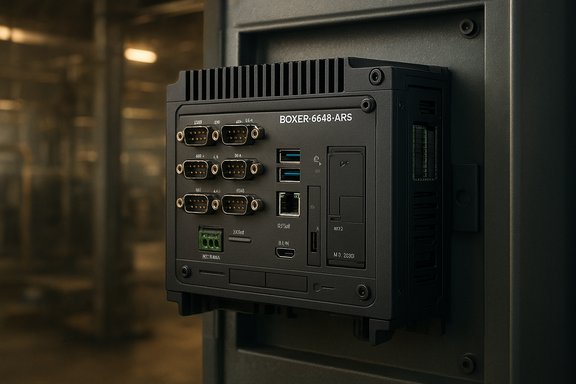
AAEON’s BOXER‑6648‑ARS is a compact, fanless industrial box PC built around Intel’s Core Ultra Series 2 family — selectable as Core Ultra 9, 7 or 5 SKUs — and is offered in two primary platform variants that differ in chipset and I/O bandwidth. The product is explicitly marketed for industrial and edge use, offering wide DC power input (10–35 V), dual 2.5 GbE networking, multiple serial COM ports, two 2.5" SATA bays and an M.2 Gen4 NVMe slot in a 264 × 81 × 156 mm enclosure rated for a broad operating temperature window when paired with wide‑temperature components. AAEON positions the BOXER‑6648‑ARS as a platform for modern edge workloads that require PC‑class CPU performance, legacy peripheral support (RS‑232/422/485), and the resilience demanded by factory floors, vehicle cabins and remote kiosks. The design emphasizes reliability and long‑term deployability rather than user‑serviceable expandability: memory is via two DDR5 SODIMM slots (up to 96 GB), storage includes two internal 2.5” bays plus an M.2 2280 NVMe slot, and I/O covers both contemporary USB3.2 ports and a generous collection of serial and DIO ports.
Why BOXER‑6648‑ARS fits: multiple USB and 2.5GbE ports, local NVMe buffering for images, and COM ports to ganged PLCs make it a strong fit — provided thermal tests validate sustained inference on the chosen Core Ultra SKU.
Why BOXER‑6648‑ARS fits: wide DC input, DIN‑rail/wall mounting flexibility and sealed fanless design reduce maintenance; COM ports and DIO handle legacy vehicle telemetry. Confirm vibration and shock mounting specifics for your vehicle class.
Why BOXER‑6648‑ARS fits: PC‑class CPU and DDR5 headroom enable responsive UIs; Windows IoT support simplifies migration of legacy HMIs. Confirm NPU and audio pipeline performance vis‑à‑vis your speech model requirements.
(Manufacturer product literature and platform specifications referenced throughout this article were verified against AAEON’s product pages and datasheets, reseller technical listings and Intel product documentation to ensure accuracy of chipset, CPU family and I/O claims. Readers should request the specific qualification and performance data for the exact BOXER‑6648‑ARS SKU and CPU configuration intended for purchase before deployment.
Source: TechPowerUp AAEON's BOXER-6648-ARS Delivers Intel Core Ultra Series 2 Power in Rugged Box PC Form | TechPowerUp}
This article unpacks the BOXER‑6648‑ARS specification and SKU choices, explains what the hardware means in practice for industrial and edge deployments, compares the platform to realistic alternatives, and flags the key operational and procurement risks systems integrators must consider before committing to a fanless Core Ultra–based box PC.
 Background / Overview
AAEON’s BOXER‑6648‑ARS is a compact, fanless industrial box PC built around Intel’s Core Ultra Series 2 family — selectable as Core Ultra 9, 7 or 5 SKUs — and is offered in two primary platform variants that differ in chipset and I/O bandwidth. The product is explicitly marketed for industrial and edge use, offering wide DC power input (10–35 V), dual 2.5 GbE networking, multiple serial COM ports, two 2.5" SATA bays and an M.2 Gen4 NVMe slot in a 264 × 81 × 156 mm enclosure rated for a broad operating temperature window when paired with wide‑temperature components. AAEON positions the BOXER‑6648‑ARS as a platform for modern edge workloads that require PC‑class CPU performance, legacy peripheral support (RS‑232/422/485), and the resilience demanded by factory floors, vehicle cabins and remote kiosks. The design emphasizes reliability and long‑term deployability rather than user‑serviceable expandability: memory is via two DDR5 SODIMM slots (up to 96 GB), storage includes two internal 2.5” bays plus an M.2 2280 NVMe slot, and I/O covers both contemporary USB3.2 ports and a generous collection of serial and DIO ports. What’s in the box: core specifications and SKU differences
CPU and platform
- CPU choices: Intel® Core™ Ultra 9 (285/285T), Core™ Ultra 7 (265/265T), Core™ Ultra 5 (225/225T). These are Series 2 Core Ultra parts — modern hybrid CPUs with integrated Xe‑class graphics and on‑package AI/acceleration features depending on the exact silicon SKU.
- Chipset options:
- A1 SKU — Intel H810 chipset (balanced business/embedded feature set).
- A2 SKU — Intel Q870 chipset (adds manageability and expanded I/O options such as Intel AMT on a designated LAN port).
Memory and storage
- Memory: 2 × DDR5 SODIMM sockets, supporting up to 96 GB (vendor specification). This gives real headroom for multi‑threaded edge workloads, VMs and memory‑hungry analytics pipelines.
- Storage:
- 2 × internal 2.5" SATA drive bays for HDD/SSD.
- 1 × M.2 2280 M‑Key slot (PCIe Gen4 x4) for NVMe storage.
- 1 × M.2 2230 E‑Key for wireless or modem modules.
Networking, I/O and industrial interfaces
- Ethernet: 2 × 2.5GbE plus 1 × 1GbE (Intel I226‑LM and I219‑LM listings on product pages). One 2.5GbE on A2 SKU may expose Intel AMT for remote manageability.
- Serial and control I/O:
- 6 × DB‑9 ports supporting RS‑232/422/485.
- 10‑pin terminal block for an 8‑bit DIO channel.
- Mic‑in and Line‑out audio.
- USB:
- A1 SKU: USB3.2 Gen1 Type‑A ×4, USB2.0 ×4.
- A2 SKU: USB3.2 Gen2 Type‑A ×6, USB2.0 ×2.
- Display: 2 × HDMI 2.0 outputs (4K capability at 60 Hz depending on CPU/configuration).
Power, mechanicals and environmental
- Power input: Wide DC input 10–35 V via 4‑pin terminal block (industrial‑friendly).
- Dimensions: 264 × 81 × 156 mm (compact footprint). Weight ~3.9 kg net.
- Operating temperature: rated −25 °C to +60 °C when configured with 65 W TDP CPU and with 0.7 m/s airflow and wide‑temp components. AAEON’s guidance explicitly ties the upper operating bound to a 65 W TDP configuration and modest airflow.
OS support
- Windows 11 Pro, Windows 11 IoT Enterprise LTSC 2024, and Ubuntu 24.04 or later are listed as supported operating systems. This reflects AAEON’s industrial/enterprise target where both Windows IoT and mainstream Ubuntu support are common requirements.
Why the BOXER‑6648‑ARS matters for edge computing
1) Fanless Core Ultra performance in a rugged chassis
Putting Intel’s Core Ultra Series 2 silicon into a fanless, dust‑resistant chassis is a clear response to two market trends: the demand for PC‑class compute at the edge, and the requirement that such compute survive rough environments without active cooling maintenance. For many embedded workloads — HMI stations, local analytics for vision sensors, protocol gateways and on‑site inference for lightweight models — the BOXER‑6648‑ARS offers a straightforward way to migrate from legacy x86 industrial PCs to a contemporary platform with native DDR5, NVMe support and modern I/O.2) I/O breadth for mixed legacy and modern systems
One of the BOXER‑6648‑ARS’s biggest strengths is its I/O mix: multiple COM ports, DIO, plentiful USB and dual 2.5GbE mean integrators can consolidate device gateways, PLC bridging and camera capture nodes onto a single chassis. That reduces BOM complexity and the need for separate protocol conversion appliances.3) Real‑world deployability: DC power and thermal considerations
The 10–35 V input makes the BOXER suitable for vehicle, railway and industrial cabinet power rails without external converters. Combined with wall‑mount and DIN‑rail options, this makes installation flexible in constrained or mobile deployments. However, AAEON’s temperature rating explicitly depends on constrained TDP and modest airflow, which shapes how and where the device should be installed.Technical analysis: performance, thermals and practical limits
CPU capability vs. fanless reality
Intel’s Core Ultra 9/7/5 Series‑2 parts are modern hybrid designs that deliver strong single‑thread bursts, robust multithreaded throughput and on‑package AI/acceleration features on select SKUs. Intel’s official listings and independent CPU databases enumerate peak frequencies, core counts and AI boost metrics for individual parts. That said, a desktop/mobile class CPU rated for 65 W or higher installed in a fanless chassis is subject to thermal throttling without adequate airflow or heat dissipation. The product documentation itself is transparent about this: the listed upper operating bound of +60 °C is specified with a 65 W CPU and 0.7 m/s airflow. Systems integrators must therefore reconcile the device’s fanless promise with practical installation realities — a sealed cabinet with no airflow will reduce sustained performance compared to open or ventilated installations.Integrated graphics and AI acceleration
The Core Ultra family brings Intel Xe‑class graphics and CPU‑side acceleration primitives. These are useful for hardware‑accelerated video decode/encode, UI rendering and certain inferencing workloads using frameworks like OpenVINO, ONNX Runtime or DirectML. But the BOXER‑6648‑ARS does not include a discrete GPU or an external PCIe x16 slot; high‑throughput, multi‑camera deep‑learning inference that requires large models or heavy FP16/FP32 math will still need an external accelerator (via networked nodes or a separate appliance) or rely on quantized NPU runtimes that fit the integrated hardware envelope. The platform’s M.2 slots are more appropriate for NVMe storage and wireless modules than for full‑size accelerators.Storage and expandability tradeoffs
Dual 2.5" bays plus an M.2 Gen4 NVMe slot give good local capacity and caching options (for example, SSDs for local database or video ring buffers). However, the lack of full-size PCIe expansion means compute or specialised expansion must be planned at the system‑level (e.g., networked inference nodes, USB4/Thunderbolt external accelerators where supported by drivers). Integrators should confirm which M.2 module types are supported (network, modem, storage) and whether vendor firmware permits NVMe boot and secure erase workflows in their chosen OS.Operational considerations and procurement checklist
To deploy BOXER‑6648‑ARS systems successfully, consider the following checklist:- Select the correct SKU:
- Choose A1 (H810) or A2 (Q870) based on required USB bandwidth, Intel AMT/manageability needs and chipset features. A2 exposes more USB Gen2 ports and Intel AMT on a 2.5GbE port.
- Establish expected sustained TDP and airflow:
- If your workload requires a 65 W class CPU or sustained multi‑core load, plan for at least modest airflow (AAEON calls out 0.7 m/s) or consider a lower‑TDP CPU to avoid thermal throttling. Validate with in‑situ thermal profiling.
- Memory and storage sizing:
- Use the two DDR5 SODIMMs to provision enough RAM for headroom — since SODIMM slots exist, memory is upgradable; target 32–64 GB or more depending on VM/analytics needs. Confirm the physical 2.5” drive carrier and NVMe compatibility for your chosen SSDs.
- Confirm OS, driver and runtime support:
- AAEON lists Windows 11 IoT LTSC 2024 and Ubuntu 24.04 support; request validated images and driver packages for your chosen CPU SKU and any Ethernet/serial controllers you plan to use. For AI inferencing, verify OpenVINO / ONNX runtimes and any vendor NPU firmware compatibility.
- Manageability and security:
- If remote provisioning and out‑of‑band management are required, prefer the A2/Q870 SKU that supports Intel AMT on a designated port. Validate TPM support, Secure Boot and BIOS update provisioning processes with AAEON for fleet scenarios.
- Environmental deployment:
- The unit’s −25 °C to +60 °C rating is attractive, but is conditional. For vehicle installations or sealed cabinets exposed to solar heating, factor in heat soak and transient peaks. If you expect higher ambient extremes, request thermal qualification data from AAEON.
Strengths: where the BOXER‑6648‑ARS stands out
- Industrial‑grade I/O: Six serial ports, 8‑bit DIO, wide DC range and dual 2.5GbE make the BOXER a true gateway for mixed legacy and modern devices.
- Fanless, compact design with PC‑class CPUs: Enables consolidation of PC‑grade workflows (edge HMI, local analytics) into deployment scenarios that previously required active cooling or larger chassis.
- Flexible storage options: Two internal 2.5" bays plus an M.2 Gen4 NVMe slot allow for high local capacity and performance for logging, local model caches or video storage.
- OS diversity and enterprise OS support: Support for Windows 11 IoT Enterprise LTSC 2024 and Ubuntu 24.04 helps match integrator preferences for managed Windows stacks or open Linux deployments.
Risks and trade‑offs: what to watch
- Thermal headroom and sustained performance: The fanless form factor plus higher‑power Core Ultra SKUs means integrators must validate sustained workload behavior in the actual installation environment. The operating temperature spec is provided with a 65 W TDP caveat and modest airflow; assuming full performance in sealed cabinets is risky.
- No full‑size PCIe expansion: While the box supports M.2 modules and SATA drives, there is no room for discrete PCIe accelerators. If your workload needs a GPU or heavy accelerator, plan externalised compute nodes or cluster architectures.
- Vendor firmware and software lifecycle: Industrial deployments frequently need multi‑year support and security patching. Buyers should secure firmware/driver SLAs, BIOS update channels and validated OS images from AAEON. Ask for extended lifecycle commitments when procuring at scale.
- AI acceleration expectations: The Core Ultra family includes on‑package acceleration on specific SKUs, but AAEON does not publish a generic TOPS figure for the BOXER platform itself. If on‑device LLM or high‑throughput vision inference is a requirement, obtain explicit NPU performance metrics for the specific CPU SKU you plan to use and validate model throughput with representative workloads. Treat general TOPS figures as theoretical peaks unless validated in context.
- Power budget in mobile deployments: While 10–35 V input is vehicle‑friendly, peak power draw under sustained full CPU load can be significant; ensure vehicle power systems and wiring harnesses are rated for worst‑case currents and transient behavior.
Realistic deployment scenarios
1) Conveyor‑line visual inspection node
Use case: attach 1–4 industrial cameras over USB3 or GigE, run lightweight defect‑detection models locally, and stream metadata upstream.Why BOXER‑6648‑ARS fits: multiple USB and 2.5GbE ports, local NVMe buffering for images, and COM ports to ganged PLCs make it a strong fit — provided thermal tests validate sustained inference on the chosen Core Ultra SKU.
2) Mobile data aggregator in vehicles
Use case: vehicle telemetry, CAN/serial aggregation, local map rendering and secure VPN backhaul.Why BOXER‑6648‑ARS fits: wide DC input, DIN‑rail/wall mounting flexibility and sealed fanless design reduce maintenance; COM ports and DIO handle legacy vehicle telemetry. Confirm vibration and shock mounting specifics for your vehicle class.
3) Edge HMI with local AI
Use case: operator panel that also runs local speech recognition or lightweight summarization for alerts.Why BOXER‑6648‑ARS fits: PC‑class CPU and DDR5 headroom enable responsive UIs; Windows IoT support simplifies migration of legacy HMIs. Confirm NPU and audio pipeline performance vis‑à‑vis your speech model requirements.
Buying guidance and recommended configurations
- For general edge compute and light inference: choose a Core Ultra 7 SKU with 32–64 GB RAM, an M.2 Gen4 NVMe drive for OS and caching, and use one 2.5" SSD for local data. Prefer the A2/Q870 SKU if Intel AMT and extra USB Gen2 bandwidth matter.
- For harsher environments or vehicle installations: prioritize wide‑temperature SSDs, wide‑temperature memory modules and confirm the deployment enclosure provides at least the modest airflow AAEON references; consider mounting locations that avoid direct solar heat soak.
- For AI‑heavy use cases: don’t assume integrated NPU will meet larger vision or LLM needs. Conduct a proof‑of‑concept using your exact model and data, or design the architecture so the BOXER handles capture, preprocessing and buffering while inference runs on an adjacent accelerator node.
Conclusion
The AAEON BOXER‑6648‑ARS is a pragmatic and thoughtfully specified industrial box PC that brings modern Intel Core Ultra (Series 2) silicon into a compact, fanless, and I/O‑rich package. It will appeal to systems integrators who need consolidated edge compute with broad legacy connectivity, NVMe‑class storage and flexible power options. The product’s strengths lie in its balanced integration of contemporary CPU capabilities and industrial I/O, its compact rugged design and its support for both Windows IoT and contemporary Linux distributions. That said, buyers should treat the BOXER‑6648‑ARS as an element in a system architecture rather than a one‑size‑fits‑all AI appliance. The fanless format imposes practical thermal limits for high‑TDP sustained workloads, and the lack of full PCIe expansion requires careful planning when heavier accelerators are needed. For most real‑world industrial and edge jobs — HMI, gateway consolidation, video buffering, modest on‑device inference and vehicle installations — the BOXER‑6648‑ARS delivers a compelling mix of performance, connectivity and ruggedness, provided you rigorously validate thermal behavior and secure long‑term firmware and driver support from your vendor.(Manufacturer product literature and platform specifications referenced throughout this article were verified against AAEON’s product pages and datasheets, reseller technical listings and Intel product documentation to ensure accuracy of chipset, CPU family and I/O claims. Readers should request the specific qualification and performance data for the exact BOXER‑6648‑ARS SKU and CPU configuration intended for purchase before deployment.
Source: TechPowerUp AAEON's BOXER-6648-ARS Delivers Intel Core Ultra Series 2 Power in Rugged Box PC Form | TechPowerUp}
