

ABB’s Genix platform, now augmented with Microsoft Azure and Azure OpenAI Service, is pushing a practical wave of generative AI into heavy industry—connecting OT, IT, and ET data to deliver contextualized, real‑time guidance that claims to boost asset reliability, cut energy use, and reduce service costs.
Industrial operators have long struggled to unify data from operational technology (OT)—PLCs, DCSs, sensors—with enterprise information technology (IT) systems and specialized engineering technology (ET) repositories. That fragmentation slows troubleshooting, hides energy inefficiencies, and drives costly expert escalations. ABB’s response is ABB Ability™ Genix, an Industrial IoT and Industrial AI platform designed to ingest, contextualize, and operationalize data across these silos. In collaboration with Microsoft, ABB has added generative AI capabilities—branded as Genix Copilot—using Azure OpenAI Service to let operators query operations in natural language and receive actionable recommendations. Genix is positioned as a hybrid-capable platform that can run in cloud, edge, or on-premises environments, enabling customers to choose deployment models that meet latency, reliability, and data‑residency needs. That flexibility is central to industrial uptake, where connectivity and regulatory constraints vary widely between plants and jurisdictions.
The ABB–Microsoft partnership also underscores another trend: hyperscalers are becoming default partners for industrial AI because they provide scalability, compliance tooling, and enterprise service SLAs that in‑house deployments struggle to match. That brings benefits—but it also creates dependence on cloud vendor roadmaps, pricing, and governance frameworks, which procurement and architecture teams must explicitly plan for.
Source: Microsoft ABB transforms industrial operations with Microsoft Azure and AI-driven insight | Microsoft Customer Stories
 Background
Industrial operators have long struggled to unify data from operational technology (OT)—PLCs, DCSs, sensors—with enterprise information technology (IT) systems and specialized engineering technology (ET) repositories. That fragmentation slows troubleshooting, hides energy inefficiencies, and drives costly expert escalations. ABB’s response is ABB Ability™ Genix, an Industrial IoT and Industrial AI platform designed to ingest, contextualize, and operationalize data across these silos. In collaboration with Microsoft, ABB has added generative AI capabilities—branded as Genix Copilot—using Azure OpenAI Service to let operators query operations in natural language and receive actionable recommendations. Genix is positioned as a hybrid-capable platform that can run in cloud, edge, or on-premises environments, enabling customers to choose deployment models that meet latency, reliability, and data‑residency needs. That flexibility is central to industrial uptake, where connectivity and regulatory constraints vary widely between plants and jurisdictions. What Genix Copilot actually does
From data contextualization to conversational insights
Genix was already designed to perform heavy-duty contextualization: mapping device telemetry, process tags, engineering diagrams, and enterprise metadata to create an operationally meaningful data fabric. Genix Copilot brings a generative layer on top of that fabric so users can ask questions like “Which lines are closest to breaching emissions limits?” or “Why is pump X overheating?” and get concise, prioritized actions rather than raw dashboards. The goal is to reduce the latency between detection and remediation by lowering the need to find specialists to interpret complex telemetry.Typical user journeys
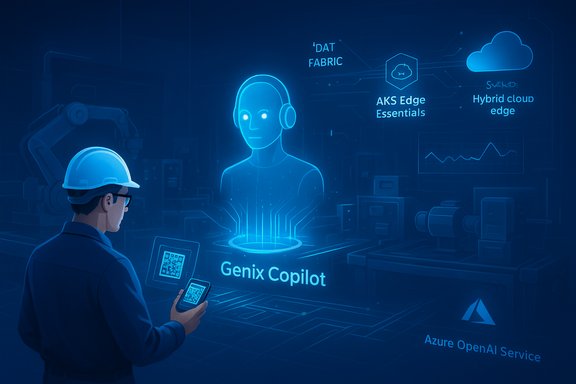
- Operators on the shop floor can scan a QR code on a device to pull live diagnostics and receive step‑by‑step troubleshooting guidance.
- Engineers and reliability teams can ask for root-cause hypotheses or prioritize maintenance tasks based on predicted failure windows.
- Plant managers can query consolidated energy and emissions metrics across multiple sites and get suggested optimization steps.
Architecture and technology stack
Core components
- ABB Ability™ Genix: data ingest, contextualization, analytics, APM capabilities.
- Azure infrastructure: cloud hosting, scalability, identity and network controls, and optional deployment of supporting services like Azure Kubernetes Service (AKS) for edge orchestration.
- Azure OpenAI Service: provides the generative‑AI models and managed inference infrastructure used by Genix Copilot.
Edge and hybrid strategies
ABB has extended Genix capabilities to edge deployments—running analytics on micro‑PCs and orchestrating workloads with AKS Edge Essentials—so condition monitoring and low‑latency decision support can occur even when connectivity to the cloud is intermittent. This is crucial for manufacturing sites, remote mines, and energy installations where connectivity or data locality is a constraint.Data, retrieval, and grounding
To make generative answers trustworthy, Genix uses the contextualized operational data fabric as the grounding layer. That means retrieval‑augmented generation (RAG) patterns are likely in play: the platform pulls relevant time-series, maintenance records, and engineering documents into the prompt context so the LLM provides answers backed by actual plant data rather than hallucinated generalities. ABB and Microsoft both emphasize grounding on contextualized data as the differentiator for industrial use cases.Real-world features and field workflows
QR-code assisted troubleshooting
One of the most tangible features described in ABB’s messaging is a QR‑code workflow: technicians scan a device label, Genix pulls live diagnostics from sensors and analyzers, and Genix Copilot returns immediate remediation steps or escalation guidance. ABB reports that this workflow reduces on‑site travel, speeds mean time to repair, and improves first‑time‑fix rates—important operational metrics for any distributed industrial fleet. Industry‑facing press materials indicate notable time savings and higher first‑time fix performance in pilot customers.My Measurement Assistant+ and AR overlays
ABB has introduced My Measurement Assistant+, which integrates Genix Copilot with augmented‑reality and diagnostic tooling to consolidate device manuals, historical failures, and live telemetry in a single interface. The combined approach—AR + generative guidance—aims to remove friction from field service and shorten time to resolution for measurement device issues. ABB projects substantial improvements in resolution time and first‑visit success.Asset Performance Management (APM) with generative prompts
Genix APM uses Industrial AI models for condition‑based maintenance and predictive failure detection. With generative overlays, APM can now provide narrative explanations of recommended actions, sequence tasks for technicians, and summarize the probable consequences of postponing maintenance. ABB has framed this as improving critical‑asset reliability and extending asset lifespan in customer examples. Reported percentages for these outcomes vary across materials; see the Measurable Outcomes section for a consolidated view.Measurable outcomes: claims, ranges, and verification
ABB and Microsoft have published performance claims tied to Genix Copilot deployments. These include figures for energy optimization, cost and maintenance savings, first‑time‑fix improvements, and asset reliability gains. Claims vary by source and customer context; the most frequently cited figures include:- Up to 35% savings in operations and maintenance and up to 20–25% improvement in energy and emissions optimization in some customer stories.
- ~80% reduction in level‑1/level‑2 service calls for ABB support in deployments where Genix Copilot handles common issues via self‑service.
- ABB marketing materials and press notes suggest possible asset lifespan extensions up to 20% and unplanned downtime reduction up to 60% in some scenarios.
- ABB’s product leaders sometimes cite site‑specific energy optimizations in the mid‑teens (15–18%) for energy‑intensive processes in other statements; the exact numbers depend on the baseline and the industry. This figure appears in certain ABB/Microsoft customer materials and should be treated as a customer‑specific outcome rather than a guaranteed result.
- These benefits are presented as customer results or pilot outcomes rather than audited industry‑wide averages. Independent validation varies by site and sector.
- Reported percentages differ across Microsoft and ABB communications; they are best understood as ranges driven by process complexity, instrumentation quality, and program maturity. Where precise ROI is required, customers should request performance baselines and proof‑of‑value pilots.
How ABB and Microsoft address security, privacy, and compliance
Enterprise controls and data residency
ABB’s use of Azure OpenAI Service brings Azure’s enterprise-grade security controls to Genix Copilot. Microsoft has rolled out features like data zones to keep processing and storage within geographic boundaries, private networking options (Azure Private Link, ExpressRoute), customer‑managed keys, and RBAC integration via Microsoft Entra ID. These capabilities enable industrial customers to meet strict data‑residency and regulatory requirements.Responsible AI and governance
Microsoft emphasizes content‑safety layers, prompt shields, and groundedness detection for enterprise generative use cases, while Microsoft Purview and related compliance tooling can provide auditing, retention, and eDiscovery for AI agent interactions. ABB and Microsoft both highlight that Genix Copilot is intended to operate within enterprise governance frameworks to reduce the risk of model misbehavior or leakage of sensitive IP.Vendor commitments and practical caveats
Public documentation from cloud and AI providers describes data‑handling commitments—many enterprise offerings assert that business data is not used to train public models by default and that customers can configure retention and key management—but these guarantees often come with contractual caveats. Customers should verify logging behavior, data access policies, and any exception processes (e.g., for government or restricted environments) before moving production‑critical workloads to a managed LLM endpoint. Microsoft and OpenAI materials outline controls, but procurement and legal teams should confirm terms in negotiated contracts.Risks, limitations, and real operational concerns
Model hallucinations and grounding limits
LLMs can produce confident but incorrect answers. In industrial contexts that can be dangerous. ABB’s architecture attempts to mitigate this by grounding Genix Copilot responses on contextualized telemetry and engineering data, but the reliability of answers depends on the quality, freshness, and completeness of the underlying data. RAG pipelines reduce hallucination risk but do not eliminate it. Operational governance and human‑in‑the‑loop confirmations remain essential.Data quality and instrumentation gaps
Generative insights are only as good as the data. Many legacy plants lack full instrumentation or have inconsistent tag naming and metadata—problems that Genix’s data contextualization layer aims to fix, but doing so requires engineering effort, time, and sometimes hardware upgrades. Expect a multi‑phase rollout with a significant initial investment in data hygiene and integration.Cybersecurity and attack surface expansion
Introducing an LLM-based copilot adds new network endpoints and integration surfaces. Industrial control systems (ICS) are high-value targets. Secure network segmentation, private endpoints, customer‑managed encryption, and thorough penetration testing are non‑negotiable. The combined ABB/Microsoft stack can be secured, but operators must not treat cloud AI as a plug‑and‑play safety island.Operational trust and human factors
Operators and maintenance staff will only follow AI guidance they trust. Early deployments must emphasize explainability: showing the data snippets, time-series trends, and engineering rules that support a recommendation. Training, role-based access, and staged adoption (start with low-risk advisory use cases) will determine whether Genix Copilot becomes an accepted tool or a distrusted alerting system.Practical adoption checklist for IT and OT teams
- Start with a proof‑of‑value pilot targeting a single process or asset class with good instrumentation and clear KPIs (energy use, MTTR, or emissions).
- Map data sources and fix tag and metadata inconsistencies before layering generative capabilities. Plan for historian, PI system, or OPC‑UA integrations.
- Define governance: retention policies, RBAC roles, approval workflows, and incident escalation rules. Integrate Purview or equivalent for auditability.
- Secure network design: use private link, ExpressRoute, and customer‑managed keys where required. Validate zero‑trust access via Entra ID and strict least‑privilege principles.
- Human‑in‑the‑loop policies: require operator confirmation for any action with safety or compliance implications; instrument UI to show the source evidence behind each recommendation.
- Measure and iterate: publish baseline KPIs before deployment and run controlled A/B tests to quantify actual improvements attributed to Genix Copilot.
Strategic implications for industrial IT leaders
Genix Copilot represents a pragmatic path for introducing generative AI into heavy industry: it is not simply a chatbot layered on top of dashboards, but an attempt to embed LLMs into a contextually rich industrial data fabric. For IT leaders, this matters because it shifts the focus from raw model performance to data engineering, governance, and lifecycle management—areas where enterprises already invest heavily.The ABB–Microsoft partnership also underscores another trend: hyperscalers are becoming default partners for industrial AI because they provide scalability, compliance tooling, and enterprise service SLAs that in‑house deployments struggle to match. That brings benefits—but it also creates dependence on cloud vendor roadmaps, pricing, and governance frameworks, which procurement and architecture teams must explicitly plan for.
Strengths and potential weaknesses
Notable strengths
- Operational grounding: Genix emphasizes contextualized operational data rather than generic web knowledge, reducing one of the major risks of generative AI in industry.
- End‑user workflows: QR scanning, AR overlays, and consolidated device assistants are practical features that address real field problems like travel costs and low first‑time‑fix rates.
- Enterprise security posture: Azure’s data zoning, private networking, and customer‑managed keys give large enterprises the controls required for regulated sectors.
Potential weaknesses and red flags
- Variable outcome claims: marketing materials report wide ranges of benefits (e.g., 15–35% energy improvements, 20–40% O&M savings). These are contextual and should be validated with pilots.
- Data‑prep overhead: Many plants will require extensive instrumentation and metadata clean‑up—work that can eclipse the cost of the AI component.
- Residual risk of hallucination: even grounded RAG systems can produce unsafe recommendations if data is stale or incomplete; human oversight remains mandatory.
Conclusion
ABB’s Genix Copilot—built with Azure OpenAI Service—represents one of the clearest industrial value plays for generative AI to date: it bundles data contextualization, edge/cloud flexibility, and conversational AI into workflows that technicians, engineers, and managers can use immediately. The combination of industrial domain expertise and hyperscaler infrastructure is compelling and delivers measurable pilot benefits in energy, emissions, and maintenance efficiency in reported cases. However, the most reliable way to understand the platform’s impact is through controlled pilots that verify claims against your plant‑specific baselines. Organizations should prioritize data quality, governance, network security, and operator trust before relying on generative recommendations for safety‑critical or regulatory actions. When implemented with those guardrails, Genix Copilot is a practical advancement toward more autonomous, efficient, and sustainable industrial operations.Source: Microsoft ABB transforms industrial operations with Microsoft Azure and AI-driven insight | Microsoft Customer Stories
