

Infosys’ new AI assistant for energy operations signals a pragmatic push to bring “agentic” AI into safety-critical industrial workflows by combining Infosys Topaz and Cobalt with Microsoft’s Copilot tooling, Azure AI Foundry model hosting (including GPT‑4o family models) and OpenAI capabilities — a packaged, enterprise‑grade agent designed to automate reporting, surface predictive insights, and shorten decision cycles on rigs and in control rooms.
The energy sector has long been a data‑dense, high‑risk environment: wells, plants and grids generate large volumes of time‑series telemetry, logs, images and procedural documentation that must be interpreted quickly to avoid safety incidents and non‑productive time (NPT). Infosys’ announcement places a conversational AI agent into that operational loop, promising to parse multimodal inputs, automate routine reporting, and deliver early warnings so engineers can act faster and with more context.
Infosys has been rolling out two product families central to this effort: Infosys Topaz, an “AI‑first” fabric of agents and orchestration tools, and Infosys Cobalt, a cloud‑services and compliance accelerator suite for enterprise workloads. Infosys positions Topaz as the runtime and lifecycle layer for agents and Cobalt as the hardened cloud scaffolding required for regulated deployments. Those product launches and the Agentic AI Foundry that supports large‑scale agent deployment were publicly documented by Infosys this year. Microsoft’s platform pieces — Copilot Studio for low‑code agent design and Azure AI Foundry / Azure OpenAI in Foundry Models for model hosting and multimodal inference — are the other half of the stack. Microsoft’s Foundry catalog explicitly lists multimodal models (GPT‑4o family and others) and tooling for model routing, governance and agent orchestration, which aligns with the technology choices Infosys describes for its energy assistant.
Source: Rediff MoneyWiz Infosys AI Agent for Energy Sector Operations
 Background
The energy sector has long been a data‑dense, high‑risk environment: wells, plants and grids generate large volumes of time‑series telemetry, logs, images and procedural documentation that must be interpreted quickly to avoid safety incidents and non‑productive time (NPT). Infosys’ announcement places a conversational AI agent into that operational loop, promising to parse multimodal inputs, automate routine reporting, and deliver early warnings so engineers can act faster and with more context.Infosys has been rolling out two product families central to this effort: Infosys Topaz, an “AI‑first” fabric of agents and orchestration tools, and Infosys Cobalt, a cloud‑services and compliance accelerator suite for enterprise workloads. Infosys positions Topaz as the runtime and lifecycle layer for agents and Cobalt as the hardened cloud scaffolding required for regulated deployments. Those product launches and the Agentic AI Foundry that supports large‑scale agent deployment were publicly documented by Infosys this year. Microsoft’s platform pieces — Copilot Studio for low‑code agent design and Azure AI Foundry / Azure OpenAI in Foundry Models for model hosting and multimodal inference — are the other half of the stack. Microsoft’s Foundry catalog explicitly lists multimodal models (GPT‑4o family and others) and tooling for model routing, governance and agent orchestration, which aligns with the technology choices Infosys describes for its energy assistant.
What Infosys is promising
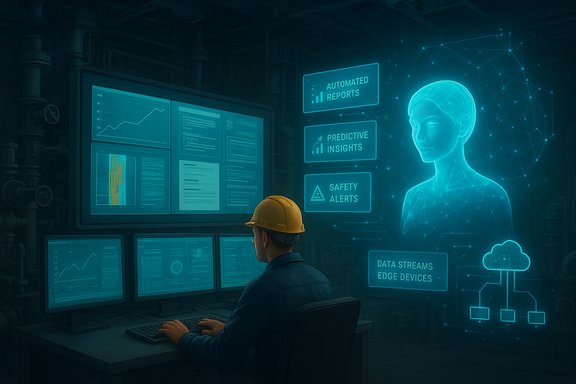
The public description of the energy Agent highlights a set of capabilities aimed squarely at operational teams:- Multimodal ingestion: interpret well logs, telemetry, downhole images and engineering documents.
- Conversational interface: natural‑language chat and voice that surface context‑aware summaries and next‑step recommendations.
- Report automation: auto‑drafting of daily reports, regulatory summaries and pre‑filled templates.
- Predictive insights and early warnings: anomaly detection and prescriptive suggestions to reduce NPT and avoid incidents.
- Hybrid cloud + edge operation: heavy inference and model orchestration on Azure while low‑latency alerts and safety loops run at the edge.
How the architecture likely fits together
Breaking the announced solution into its constituent layers shows why the approach is sensible for energy operations:Data and ingestion layer
Field instrumentation (SCADA/time series), well logs, lab reports, and images are ingested into a governed lakehouse or knowledge graph. A retrieval layer with vector search provides grounding so the agent cites specific documents and past incidents when producing recommendations.Agent orchestration and runtime
Infosys Topaz acts as the agent fabric for prompt engineering, workflow orchestration, observability and human‑in‑the‑loop controls. Microsoft Copilot Studio and Azure AI Foundry provide the runtime for model hosting, routing and multimodal inference using Foundry models such as GPT‑4o. This split separates domain logic from model compute, simplifying vendor upgrades and governance.Edge and low‑latency control
Time‑sensitive alarms and safety interlocks must remain deterministic. Edge inference nodes — possibly using smaller, purpose‑tuned models — handle immediate alerts while the cloud agent performs deeper analysis and report generation. This hybrid model reduces latency risk and limits unnecessary data egress.Governance, MLOps and auditability
Production agents require full audit trails (who asked what, which model produced the answer and what data was used), model versioning, drift detection and red‑teaming. Infosys’ Foundry and Microsoft’s enterprise tooling (Purview, model routing and observability) are part of the standard approach to satisfy compliance and safety requirements.Why this matters for operators and IT leaders
There are clear, immediate benefits if executed correctly:- Faster access to critical information — engineers can ask a chat agent instead of hunting through multiple systems.
- Reduced manual reporting burden — automated, auditable reports free engineers for higher‑value work.
- Earlier detection of anomalies — combining historical failure signatures with live telemetry shortens mean time to detect.
- Standardized operational knowledge — encoding lessons learned into a retrievable knowledge graph reduces reliance on tribal knowledge.
Technical verification and independent corroboration
Key technical claims in Infosys’ messaging are verifiable in vendor product literature and platform documentation:- Infosys Topaz and the Agentic AI Foundry are publicly described by Infosys as agent‑orchestration and deployment platforms.
- Azure AI Foundry / Azure OpenAI in Foundry Models supports multimodal and long‑context models (including GPT‑4o family models) and is positioned as a production runtime for agents.
- OpenAI’s GPT‑4o is documented as a native multimodal model that can handle text, image and audio inputs and is positioned for conversational, multimodal use cases.
Strengths: what this combination gets right
- Platform completeness: coupling Topaz (agent lifecycle) with Cobalt (cloud blueprints) and Microsoft’s Foundry runtime addresses the three most common enterprise pain points: orchestration, secure cloud deployment and model inference scale.
- Multimodal readiness: Foundry models including GPT‑4o are natively multimodal, which is essential for interpreting images, plots and text together — a core requirement for field engineering tasks.
- Hybrid cloud/edge design: by retaining low‑latency controls at the edge while running heavier reasoning in the cloud, operators can balance safety and compute cost effectively.
- Ecosystem leverage: integrating a systems integrator’s domain templates with a hyperscaler’s model catalog shortens time‑to‑pilot and simplifies vendor management for enterprise buyers.
Risks, limitations and the safeguards operators must demand
The potential benefits are real, but deployment in safety‑critical environments carries material risks that require contractual and technical mitigation:- Model hallucination and provenance: generative agents can produce plausible but incorrect outputs. Industrial use requires deterministic checks, evidence citation (linked documents and data points), and confidence estimates alongside every recommendation.
- Safety and control boundaries: any automation that can affect field equipment must have conservative human‑in‑the‑loop gates and clearly codified thresholds for autonomous actions. Vendor materials do not typically publish exhaustive safety validation regimes; insist on contractually mandated testing and rollback playbooks.
- Data residency and sensitivity: well logs and subsurface models are commercially and legally sensitive. Operators must confirm where data is stored, processed and retained — and demand encryption, RBAC and clear data contracts. Hybrid architectures help but require bespoke configuration and legal guarantees.
- Cybersecurity exposure: introducing new agent layers and connectors increases attack surface. Threat modelling, signed agent identities, zero‑trust segmentation between OT and agent endpoints, and runbooks for incident response are essential.
- Liability and compliance: when an AI recommendation influences a physical operation, contractual clarity on liability and auditability is critical. Operators should require comprehensive audit trails, “who approved” logs and joint incident response commitments.
- Drift and maintenance: models and data distributions drift. A continuous MLOps cadence — monitoring, retraining, and red‑teaming — must be built into any SLA and deployment budget.
Practical rollout checklist for energy operators
Operators moving from interest to a live pilot should follow a disciplined sequence:- Define a narrow, measurable pilot KPI (e.g., reduce NPT on a single rig by X% or shorten mean time to detect a kick by Y minutes).
- Lock down data contracts and schemas for telemetry, logs and images before model training or fine‑tuning begins.
- Require deterministic human‑in‑the‑loop gates for any recommendation that could trigger operational changes; classify actions by risk and automation tier.
- Validate multimodal interpretation by running the agent blind against historical incidents to measure recall, precision and false‑alarm rates.
- Instrument audit and observability: log who asked what, which model/version produced the output, and whether the recommendation was acted upon.
- Plan for continuous model validation, retraining cadence, and red‑teaming to detect drift and emergent failure modes.
Commercial and strategic implications
- Systems integrators that can productize vertical‑specific agent stacks (Topaz + Cobalt) gain an advantage in high‑touch, regulated industries because they reduce integration risk and time to value.
- Hyperscalers win predictable long‑term compute demand when agents move from pilot to production; that dynamic fuels partnerships around energy procurement and “energy‑for‑AI” strategies. Public industry moves show energy companies and hyperscalers are already coordinating on supply and compute.
- For competitors and smaller integrators, the bar is higher: buyers will compare not just feature lists but demonstrable pilot outcomes, governance models and commitments on liability, support and data sovereignty.
Bottom line — measured optimism
Infosys’ energy Agent, built on Topaz, Cobalt, Microsoft Copilot Studio, and Azure AI Foundry models (including GPT‑4o family models), is a credible, infrastructure‑forward attempt to industrialize agentic AI for energy operations. The architectural recipe is sound: multimodal models (for images, audio and text), a retrieval‑grounded knowledge layer, agent orchestration and hybrid edge/cloud deployment. Those building blocks exist and have been validated in adjacent industry pilots. Nevertheless, the most important verification is empirical: independent, transparent pilot data that proves the agent’s recall/precision on multimodal inputs, demonstrates safe human‑in‑the‑loop governance, and shows measurable operational improvements without introducing new systemic risks. Until such data is published, vendors’ quantitative claims should be considered directional and subject to rigorous validation during pilot contracts.Final recommendations for IT and operations leaders
- Start with bounded, low‑risk pilots (reporting, analytics, decision support) and require clear KPIs and auditability before entrusting agents with higher‑risk tasks.
- Insist on end‑to‑end governance: provenance, confidence metadata, model versioning and human override policies must be built into the SLA.
- Treat security as a first‑class requirement: zero‑trust segmentation between OT and agent endpoints, signed agent identities and incident playbooks are non‑negotiable.
- Negotiate liability, audit access and data residency terms up front; require deterministic rollback processes for any agent that can cause operational changes.
Source: Rediff MoneyWiz Infosys AI Agent for Energy Sector Operations
