

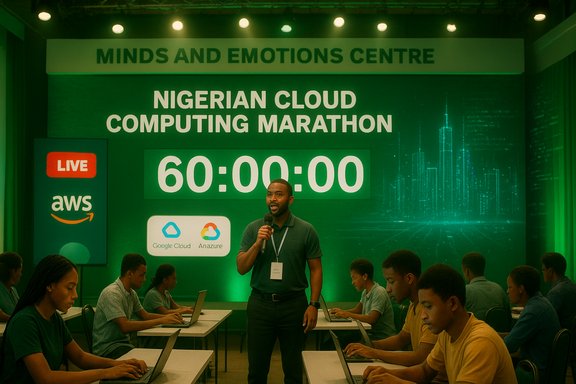
Abel Yakubu’s confirmed Guinness World Record for a continuous 60‑hour computer programming lesson is more than a headline; it is a high‑visibility inflection point for Nigeria’s tech ecosystem and a practical case study in how spectacle, pedagogy and verification collide in modern skills campaigns.
Background and overview
Abel Yakubu, a Nigerian‑born cloud engineer affiliated with NexEdge Technologies and based in Germany, led a continuous, three‑day programming lesson in Abuja that Guinness World Records lists as 60:00:00 hours and records as having occurred on 21 November 2025. The official Guinness listing documents the duration and the record holder’s name as the authoritative confirmation of the new mark. Local reporting places the lesson at the Minds and Emotions Centre, Graceland Garden, Wuse 2, Abuja, running from 11:00 a.m. on Friday, 21 November to 11:00 p.m. on Sunday, 23 November 2025, and describes the curriculum as centred on cloud computing platforms — notably Amazon Web Services (AWS), Google Cloud and Microsoft Azure. The attempt was livestreamed across major social platforms and was accompanied by several categories of witnesses and official observers, although counts vary between outlets. This 60‑hour achievement supersedes the previous Guinness benchmark for the Longest Computer Programming Lesson — 48 hours and 15 minutes, set by Santosh Kumar and St. Xavier’s School in Ranchi, India in January 2024 — and converts a two‑day endurance teaching benchmark into a three‑day continuous marathon.What the Guinness entry confirms — the hard facts
- Record title: Longest Computer Programming Lesson.
- Record holder: Abel Yakubu (Nigerian).
- Duration recorded: 60:00:00 (hours:minutes:seconds).
- Location: Abuja, Nigeria.
- Date listed: 21 November 2025 (start date); session ran through 23 November 2025 according to press reporting.
How the event was reported: attendance, witnesses and content
Press coverage agrees on the timeline and duration but differs slightly on participant and witness counts — a normal pattern in early reportage of complex events. Several outlets reported:- 60 students physically present and more than 25 official witnesses monitoring the attempt.
- Organiser statements also reference 30 committed participants and 20 independent witnesses as part of the verification package presented to Guinness. These differences are modest but material for researchers and auditors who care about the adjudication evidence bundle.
Why this matters: visibility, signalling and pipeline effects
This Guinness‑verified milestone matters on three levels:- Visibility. A world‑record credential draws national and international attention that typical training bootcamps struggle to achieve. That attention can be leveraged to attract partners, sponsors and policymakers to invest in follow‑on programmes.
- Signalling. The choice of cloud computing as the core syllabus aligns the event with concrete labour‑market demand. Publicising live labs on AWS, Azure and GCP signals a focus on employable skills rather than abstract theory.
- Pipeline potential. If organisers convert initial interest into structured cohorts, certification pathways, mentorship and placement mechanisms, the record can be a catalyst for long‑term talent development rather than a one‑off publicity moment. The value depends on follow‑through.
Critical analysis: strengths, limitations and risks
Strengths — what the achievement gets right
- Institutional validation. The Guinness confirmation gives the attempt external legitimacy and a documented outcome that third parties can point to when justifying investment or partnership.
- Relevance of subject matter. Teaching cloud platforms — the skills most enterprises demand today — is strategically sensible for maximizing employability of participants.
- Public documentation. Live streaming and media coverage produce a public audit trail that supports transparency, community engagement and promotional reach.
Limitations — pedagogy, verification and long‑term impact
- Pedagogical effectiveness. Educational research emphasises spaced repetition, distributed practice and deliberate rest as critical to learning retention. A continuous 60‑hour lesson risks diminishing returns as instructor and learner fatigue reduce interaction quality and memory consolidation. Visibility is not the same as mastery.
- Variable reporting on witnesses and participants. Multiple reputable outlets report slightly different witness and participant counts. While the Guinness entry confirms the overall duration and holder, the granular differences highlight a transparency gap that organisers should close by publishing the full evidence package.
- Health and safety transparency. Public reporting has not extensively documented medical supervision, mandatory rest periods or instructor rotation protocols. Endurance teaching raises legitimate welfare and ethical questions that deserve clear public answers.
- Outcome measurement. There is, as yet, no publicly released data on post‑event learning outcomes — certification pass rates, portfolio completions or employment placements — that would convert spectacle into measurable impact. The lack of outcome reporting reduces the event’s evidentiary value as a learning intervention.
Risks — what to watch for
- Record‑driven design. Events optimised to break records can unintentionally prioritise continuous time over instructional quality. That is a strategic hazard for organisers whose long‑term objective is skill building rather than publicity alone.
- Commercialisation without accountability. Sponsorship and media attention are useful but may skew priorities if commercial interests trump learner outcomes and safety protocols. Public accountability mechanisms should be embedded from planning onward.
- Verification vulnerability. Marathon records require extensive documentary evidence — continuous video, independent witness statements, time logs and adjudicator notes. If organisers fail to publish or archive the evidence package, critics will correctly ask for proof beyond headlines. Guinness adjudication reduces this risk, but it does not eliminate the need for transparency about the supporting materials.
The verification question: what Guinness requires and what we know
Guinness World Records typically requires:- Continuous timestamps and an unbroken record of start/stop times.
- Multiple independent witness statements or adjudicators.
- Continuous video or livestream archives.
- An evidence package (logs, witness statements and other supporting materials) submitted for adjudication.
Pedagogy under endurance: how to make marathon teaching work as learning
A marathon format can be made educationally useful — but only if it is intentionally designed with learning science and human factors in mind. Best practices include:- Modularise content. Break the 60 hours into tightly scoped modules with clear learning objectives and short assessment checkpoints.
- Rotate instructors. Use co‑instructors or guest experts to maintain delivery quality and reduce voice/fatigue risks for any single teacher.
- Integrate hands‑on lab windows. Alternate lecture segments with required lab work, during which the lead instructor can rest while learners practise.
- Mandate rest and medical supervision. Publish rest schedules, enforce time off for speakers and have on‑site medical staff.
- Measure outcomes immediately and at intervals. Run post‑lesson assessments, track certification attempts and publish three‑month job/mentee placement metrics.
- Publish the evidence. Release the time logs, witness statements and recorded archives so stakeholders can audit and learn from the model.
Turning a headline into lasting impact — a practical roadmap for organisers
To convert record attention into long‑term skills growth, organisers should adopt a simple five‑step operational playbook:- Create modular follow‑up tracks. Short, assessed modules (4–8 weeks) that build on the marathon’s foundation and culminate in a demonstrable project.
- Partner for certification. Secure discounted vouchers or exam sponsorships from cloud providers (AWS, Azure, GCP) to convert exposure into certified credentials.
- Publish metrics. Commit to three‑ and six‑month public reports showing certification pass rates, job placements and portfolio completions.
- Build mentorship cohorts. Pair graduates with mentors and employers through structured apprenticeship or internship programmes.
- Institutionalise safety and verification. For future events, publish full evidence packages and clear welfare protocols ahead of the attempt to reduce ambiguity.
What this means for Windows and cloud practitioners
WindowsForum readers — many of whom manage Windows systems, hybrid environments and cloud connected infrastructures — can translate the momentum from this event into practical, individual learning steps:- Start with core fundamentals: OS internals, networking basics and scripting (PowerShell, PowerShell Core and WSL) remain essential.
- Learn cloud provider CLIs: Install and practise with az, aws and gcloud on Windows using Windows Subsystem for Linux (WSL) and PowerShell modules.
- Use free tiers and sandbox labs: All three major clouds offer free tiers and trial credits suitable for hands‑on labs. Run identical stacks across Azure and AWS to compare management patterns.
- Automate infrastructure: Learn Terraform or Bicep to codify deployments and create reproducible labs that fit inside short teaching modules.
- Build a demonstrable portfolio: Publish IaC templates, CI/CD pipelines or containerised apps to GitHub — these are what recruiters verify, not the presence at a livestream.
Community and policy implications for Nigeria and similar ecosystems
A verified Guinness milestone like Yakubu’s places a spotlight on several systemic levers:- Policy opportunity. Governments can use the attention to justify budget lines for teacher training, certification subsidies and national apprenticeship strategies.
- Employer engagement. Private sector hiring teams should convert visibility into concrete commitments: internship slots, assessment partnerships and hiring pipelines for high‑performing programme graduates.
- NGO and donor leverage. Development partners often respond to high‑visibility wins; organisers should have rapid proposals ready that translate publicity into funded, measurable cohorts.
Open questions and items that need public clarification
While the headline is clear, the record leaves important questions unanswered in the public domain:- Exact composition and independence of witness statements (some outlets list 20 independent witnesses, others 25 or more).
- The full evidence package submitted to Guinness (time logs, witness forms, medical supervision records) — not routinely published.
- Post‑event outcome tracking on participants: certification completion, GitHub portfolio creation and employability metrics.
How other countries and organisers have structured similar events (brief comparative view)
- Recent record attempts for the largest programming lesson emphasise participant counts and institutional backing (for example, the University of Lisbon’s 1,668‑person lesson). Those efforts concentrated on reach rather than duration and paired public institutions with clear reporting.
- Prior marathon lessons of long duration (such as the 48h15m benchmark set in Ranchi, India) were classroom‑based and focused on a single curriculum (Java in that case), demonstrating a different model: depth in one technology vs breadth across multiple cloud providers. The new 60‑hour lesson clearly chose breadth and practical exposure to platform tooling as its signature.
Practical checklist for organisers planning a marathon lesson
- Pre‑register with Guinness and confirm exact evidence requirements.
- Publish a minute‑by‑minute schedule in advance (modules, speaker rotation, lab windows).
- Preconfigure cloud lab environments and automate participant accounts to minimise downtime.
- Establish on‑site medical supervision and mandatory rest windows for speakers and volunteers.
- Arrange independent witness rosters and make the list publicly available after the event.
- Commit to publishing an outcomes report (three and six months) including certification and placement metrics.
Conclusion
Abel Yakubu’s 60‑hour programming lesson is a headline‑worthy, Guinness‑verified achievement that puts Nigeria in the international conversation about skills, cloud engineering and the creative use of public spectacle to mobilise interest. The Guinness World Records confirmation secures the core factual claim — 60 hours in Abuja — and multiple independent outlets corroborate the chronology, the livestream and the cloud‑centric curriculum. The long‑term value of the event, however, will be judged by what comes next: transparent publication of the adjudication evidence, rigorous post‑course outcome tracking, and the conversion of initial visibility into funded, assessed and mentored learning pathways. If organisers and partners follow through with those measures, the record could be a genuine catalyst for workforce development; if not, it risks remaining an impressive headline with limited educational legacy. The immediate challenge is therefore operational and institutional: to turn an emblematic media moment into measurable, equitable opportunity for learners across Nigeria and the wider region.Source: Vanguard News Guinness confirms Nigerian engineer, Yakubu’s 60-hour coding record
