

Abel Yakubu has been confirmed as the Guinness World Records holder for the Longest Computer Programming Lesson, completing a marathon 60-hour coding lesson in Abuja that Guinness lists as taking place on 21 November 2025 — a high-profile attempt designed to spotlight cloud computing skills, inspire youth, and raise the profile of Nigeria’s tech education ecosystem.
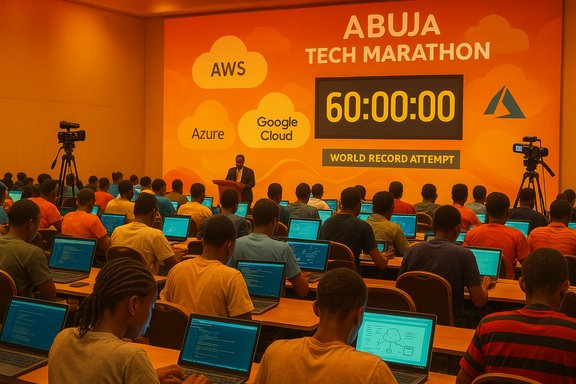
The attempt was organised and led by Abel Yakubu, a Nigerian-born cloud engineer described in media reports as being based in Germany. According to Guinness World Records, the official time recorded for the record is 60:00:00 (hours:minutes:seconds), and the event is listed as having occurred in Abuja on 21 November 2025. That official listing gives the claim strong institutional backing: Guinness World Records is the recognised adjudicator for this kind of time-based record. Nigerian outlets covering the event reported that the lesson ran from 11:00 a.m. on Friday, 21 November, through to 11:00 p.m. on Sunday, 23 November 2025, and that the programme focused heavily on cloud computing platforms — notably Amazon Web Services (AWS), Google Cloud Platform (GCP), and Microsoft Azure. Local reporting also highlighted live streaming, participant numbers, and the visible aim of inspiring young African developers.
Source: nigerianeye.com Nigerian Sets World Record for Longest Coding Lesson
 Background
The attempt was organised and led by Abel Yakubu, a Nigerian-born cloud engineer described in media reports as being based in Germany. According to Guinness World Records, the official time recorded for the record is 60:00:00 (hours:minutes:seconds), and the event is listed as having occurred in Abuja on 21 November 2025. That official listing gives the claim strong institutional backing: Guinness World Records is the recognised adjudicator for this kind of time-based record. Nigerian outlets covering the event reported that the lesson ran from 11:00 a.m. on Friday, 21 November, through to 11:00 p.m. on Sunday, 23 November 2025, and that the programme focused heavily on cloud computing platforms — notably Amazon Web Services (AWS), Google Cloud Platform (GCP), and Microsoft Azure. Local reporting also highlighted live streaming, participant numbers, and the visible aim of inspiring young African developers. What the official record entry says
The Guinness World Records entry for Longest Computer Programming Lesson lists the record-holder by name, the exact duration of 60 hours, and location as Abuja, Nigeria. Guinness entries typically reflect an adjudication process that includes evidence review, witness statements and an official timer log; the online entry is the most authoritative public confirmation available.The event: logistics, scope and immediate impact
Format and curriculum
Media reports indicate the lesson was structured as a continuous teaching session covering modern cloud technologies and core programming concepts, with explicit references to hands-on demonstrations and walkthroughs involving AWS, Google Cloud and Microsoft Azure. The presentation reportedly blended lecture, live demonstration, and guided coding exercises, with the stated aim of providing practical, career-oriented instruction rather than purely theoretical content. Whether the content depth across 60 continuous hours constitutes effective pedagogy is a separate question; however, the organisers emphasised accessibility and upskilling, positioning the event as both a record attempt and a mass training exercise. The social-media livestream element broadened viewership and furnished additional audit trails for the Guinness submission.Attendance, witnesses and verification
Published reports show some variance in the account of participants and witnesses: one account lists 60 students taking part physically with 25 witnesses monitoring, while another report describes 30 committed participants and 20 independent witnesses. Guinness World Records’ online listing confirms the record and names the record-holder, but the granular counts of witnesses and attendees differ across outlets. This discrepancy is notable because witness numbers and independence are material to the adjudication process for marathon records. Where details differ, the Guinness adjudication and its published entry are the final authority; other figures should be treated as reportage that may reflect different stages of planning, accreditation or local counting.Streaming and documentation
Reporters noted the event was streamed live on major platforms, which served a dual purpose: expanding reach and creating a continuous external record. For Guinness, continuous timestamped video, independent witness statements, and official logs are standard parts of a valid submission. The availability of livestream archives increases transparency, but livestreams alone do not replace other required documentation (such as independent witness statements, health-and-safety checks, and clearly logged start/stop times). Public streaming does, however, make it easier for third parties to verify salient moments of the attempt.Why this matters: significance for Nigerian tech education and global coding culture
Visibility for skills-based education
A Guinness World Record is a high-visibility credential. By linking coding instruction to a world-record narrative, the event generated national and international headlines and reframed the conversation about tech education in Nigeria. Public attention like this can be a lever for mobilising partners — employers, training providers, and government agencies — to invest in curricula, training infrastructure, and scholarship programmes. It also helps position Nigeria as a contributor to global tech culture rather than merely an audience.Talent pipeline and employability
The content reported—cloud platforms and career-oriented cloud engineering skills—aligns with global market demand. Cloud certifications and hands-on cloud experience are currently in high demand across the tech job market. An event that focuses attention on AWS, Google Cloud and Azure can therefore have direct downstream benefits for participants who convert what they learn into certification study or work-ready skills. Framing instruction as practical training rather than a publicity stunt strengthens the argument that such events can help fill talent pipelines.Inspiration and narrative
High-visibility achievements create aspirational narratives. For many prospective learners, seeing a fellow Nigerian engineer set a world record for sustained instruction is motivating in a way that standard press releases and local bootcamps are not. Records offer symbolic proof points: they say “it can be done here,” and that symbolism matters for ecosystems where infrastructure and investment are still catching up.Critical analysis: strengths, limitations, and risks
Strengths
- Institutional validation: The involvement of Guinness World Records lends formal credibility to the claim. The official listing of a 60-hour lesson is a clear public confirmation that the attempt met the adjudicator’s standards for this particular record category.
- Relevance of content: The event focused on cloud computing—one of the fastest-growing and most employable areas of tech. This makes the attempt more than symbolic; it was oriented toward practical, economically relevant upskilling.
- Public documentation: Live-streaming and widespread media coverage created a public record that aids transparency, outreach and legacy value for participants who can leverage the event in CVs and portfolios.
Limitations and caveats
- Pedagogical effectiveness: A continuous 60-hour lesson is a spectacle; it is not, by default, an optimal instructional model for learning retention. Cognitive science shows that attention, consolidation and deliberate practice require cycles of rest and spaced repetition. Marathon teaching risks diminishing returns as fatigue erodes both teaching quality and learner absorption. Any claim that a single marathon session is an efficient route to mastery should be treated skeptically. The record is meaningful for visibility but not necessarily a validation of a superior teaching model.
- Discrepancies in reported details: Media reports differ on witness and participant counts. These details matter for auditability and transparency. Where multiple outlets report inconsistent figures, journalists and researchers should default to the primary adjudicator (Guinness) or to the documentation package submitted for verification. Public-facing numbers may reflect pre-event expectations, last-minute changes, or reporting errors.
- Health and safety concerns: Extended endurance events carry risks: fatigue-related errors, heat stress, dehydration, and impaired judgment are possible for both instructor and participants. The public reporting does not extensively detail the medical supervision arrangements or enforced rest protocols, so while Guinness adjudication would normally require safety provisions, the public record about those provisions is thin. This is a gap that deserves transparency because it affects ethical appraisal of endurance teaching attempts.
Risks around "record-driven" initiatives
- Record-chasing versus systemic investment: Publicity-driven events can overshadow the slower, harder work of building sustainable training institutions, curricula, and teacher development programs. High-profile records are an opportunity if they catalyse investment; they become a distraction if organisers treat the record as an end rather than a means.
- Verification vulnerabilities: Marathon records by their nature depend on continuous monitoring. While a live stream helps, it is not a substitute for independent, detailed logs, and professionally supervised witness statements. Any gaps in documentation can make later verification difficult and may reduce the claim’s long-term evidentiary value if challenged. The Guinness entry provides a strong signal that submission procedures were followed, but the public detail is limited to summary facts.
What this means for stakeholders
For governments and policymakers
The event is a timely proof point for the value of targeted tech education investments. It signals public appetite and the potential to scale training interventions if matched by investment in accredited curricula, teacher training, and certification pathways. Governments can treat high-visibility events as recruitment tools for larger programmes — while also insisting on transparency about outcomes (certifications issued, job placements, follow-up training).For employers and recruiters
Employers looking for cloud-skilled candidates should view this event as a signal of interest and initiative in the ecosystem, but they should continue to prioritise industry-standard certifications and demonstrable project experience when hiring. Organisers and participants could be coached to translate the marathon’s content into tangible credentials: course completion certificates, microcredentials, and project portfolios. That conversion multiplies the event’s long-term value.For training providers and NGOs
This record illustrates a potential promotional strategy — pairing upskilling with media attention — but effective scaling demands follow-through. Training organisations should use momentum generated by the record to build modular learning pathways (shorter focused modules, mentorship, project-based assessment) that respect cognitive load and deliver verifiable outcomes. Partnerships with certification bodies are a clear next step.Lessons for organisers planning similar initiatives
- Plan evidence and verification rigorously. Guinness-style adjudication requires continuous logs, independent witness statements and archivable video. Build verification into the plan rather than retrofitting it afterwards.
- Prioritise health and safety. Document medical supervision, rest schedules and fatigue management strategies publicly to avoid ethical concerns.
- Translate spectacle into sustainable outcomes. Create post-event pathways for participants (certification support, mentorship, hiring fairs) so the event’s benefits compound.
- Use modular pedagogy within the marathon. Break content into discrete, assessable units, and include short, frequent checks for understanding rather than non-stop lecturing. This improves retention and makes the event’s educational value demonstrable.
The broader context: Nigeria’s rising profile in global record attempts and public learning marathons
Nigeria has seen a spate of high-profile record attempts across disciplines — from culinary feats to education marathons — which cumulatively highlight the country’s appetite for large-scale, public-facing achievement narratives. These events serve multiple functions: national branding, fundraising, and galvanising community participation. The 60-hour coding lesson is part of this larger trend of leveraging spectacle to drive attention to social causes (education, skill-building, and public engagement). Journalists and analysts should evaluate each attempt on both its symbolic merits and its measurable outcomes.Remaining questions and cautionary notes
- Documentation depth: The Guinness entry confirms the record and the 60-hour duration, but the public Guinness listing does not publish the complete evidence package. Interested stakeholders should request or require more detailed documentation (witness testimonies, timing logs, and health-and-safety declarations) if they are to judge the attempt beyond the headline. Until those documents are available publicly, some operational details remain unverified.
- Discrepancies in reportage: Local outlets reported different participant and witness numbers. While such variance is not uncommon in early press coverage, it should prompt cautious interpretation of media-reported logistical details. Where exact counts matter (for future research, replication or audit), the Guinness submission and organiser records are the ultimate references.
- Educational outcome tracking: There is no publicly available follow-up data yet showing whether participants converted the marathon exposure into certifications, employment, or further study. Measuring the event’s long-term impact requires outcome tracking that goes beyond the record itself. Organisers who want legacy impact should publish post-event metrics.
Conclusion: a high-profile milestone with practical caveats
Abel Yakubu’s confirmed Guinness World Record for the Longest Computer Programming Lesson (60 hours) is a striking symbolic achievement that puts a spotlight on Nigeria’s tech education ecosystem and on the global discourse around upskilling in cloud computing. The official Guinness listing anchors the claim, and multiple local media outlets corroborate the date, location and headline numbers. At the same time, the meaningfulness of a marathon lesson depends on what follows. The greatest value will come if organisers, partners and policymakers convert attention into durable learning pathways, transparent outcome reporting, and safety-validated delivery models. Marathon records can catalyse momentum; the challenge going forward is to turn that momentum into measurable, equitable opportunity for learners across Nigeria and Africa. This record is both a milestone and a prompt: it proves that high-visibility, world-stage achievements are possible in Nigeria’s tech space, and it underscores the need for rigorous documentation, learner-centred pedagogy and post-event accountability to ensure the spectacle translates into lasting educational value.Source: nigerianeye.com Nigerian Sets World Record for Longest Coding Lesson

