

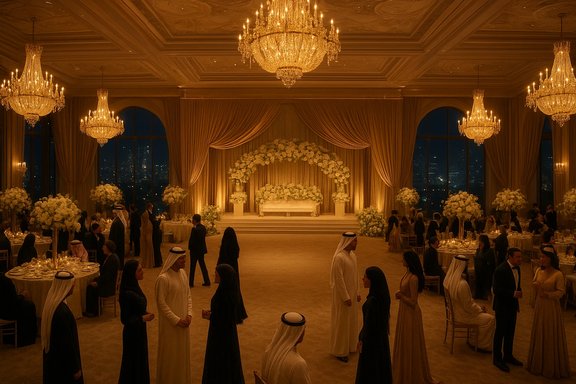
Sheikh Mohammed bin Hamdan bin Zayed Al Nahyan attended a high‑profile wedding reception in Abu Dhabi on 16 January 2026, appearing as a principal guest at the celebration hosted by Nekhaira Mohamed Rashed Al Shamsi for the marriage of her son, Nasser, to the daughter of Mubarak Mohamed Al Nayeli Al Shamsi — a social occasion held at the Erth Ballroom that drew senior officials, family members and well‑wishers.
Weddings in Abu Dhabi — particularly those attended by members of the Al Nahyan family or other leading houses — are both private family milestones and public events of social significance. The Abu Dhabi Media Office’s official coverage names His Excellency Sheikh Mohammed bin Hamdan bin Zayed Al Nahyan as an attendee and records the host as Nekhaira Mohamed Rashed Al Shamsi, with the ceremony taking place at Erth Ballroom in Abu Dhabi on 16 January 2026. The official story provides the core facts: the groom’s name (Nasser), the bride’s paternal family (daughter of Mubarak Mohamed Al Nayeli Al Shamsi), and the presence of senior officials and well‑wishers. Multiple independent news outlets republished the same details (syndicated regional wire and news aggregators reported a nearly identical account), confirming the basic elements of date, venue and primary participants. These secondary reports mirror the official release and underline that the reception was widely distributed through both government and non‑government outlets.
Source: MSN https://www.msn.com/en-ae/news/othe...aira-al-shamsi-wedding-reception/ar-AA1UmRn3]
 Background / Overview
Weddings in Abu Dhabi — particularly those attended by members of the Al Nahyan family or other leading houses — are both private family milestones and public events of social significance. The Abu Dhabi Media Office’s official coverage names His Excellency Sheikh Mohammed bin Hamdan bin Zayed Al Nahyan as an attendee and records the host as Nekhaira Mohamed Rashed Al Shamsi, with the ceremony taking place at Erth Ballroom in Abu Dhabi on 16 January 2026. The official story provides the core facts: the groom’s name (Nasser), the bride’s paternal family (daughter of Mubarak Mohamed Al Nayeli Al Shamsi), and the presence of senior officials and well‑wishers. Multiple independent news outlets republished the same details (syndicated regional wire and news aggregators reported a nearly identical account), confirming the basic elements of date, venue and primary participants. These secondary reports mirror the official release and underline that the reception was widely distributed through both government and non‑government outlets. What happened — the verifiable facts
- The reception was held on 16 January 2026 at the Erth Ballroom in Abu Dhabi; this is the date and venue recorded in the Abu Dhabi Media Office release.
- The host of the reception was Nekhaira Mohamed Rashed Al Shamsi; the groom is named Nasser, and the bride is identified as the daughter of Mubarak Mohamed Al Nayeli Al Shamsi.
- Sheikh Mohammed bin Hamdan bin Zayed Al Nahyan attended and conveyed congratulations to the newlyweds and their families. The official copy uses the honorific and formal phrasing customary in Abu Dhabi governmental releases.
- The reception was attended by several senior officials, family members and well‑wishers; the public release emphasizes the social breadth of attendees rather than a full guest list.
Why the attendance matters: rituals, visibility and soft power
Weddings as political and social language
In the UAE, public appearances by members of ruling families at private ceremonies perform multiple functions:- They reaffirm family and tribal ties that undergird social cohesion in the Emirates. A royal attendance is a public signal of endorsement and blessing that carries cultural weight.
- They function as soft‑power moments: the presence of senior royals keeps such events in the public eye, reinforcing narratives of continuity, stability and mutual support among elite networks.
- They serve a diplomatic and image management role. Government media coverage of family events is part of a broader communications strategy that shapes domestic sentiment and projects a polished social image internationally.
The social economy of high‑profile receptions
Beyond symbolism, these gatherings are venues for informal networking. While official statements emphasize personal felicitations, the same reception spaces are also opportunities for:- Private conversations among senior officials and business leaders who are present in support roles or as guests.
- The reinforcement of patronage relationships, which remain a salient feature of governance and economic life in the Gulf.
- Community visibility for host families — social standing, philanthropic positioning and cross‑family alliances are shaped by who hosts and who attends.
The players: who’s who in this reception
Sheikh Mohammed bin Hamdan bin Zayed Al Nahyan
Described in the official release with his honorific, Sheikh Mohammed bin Hamdan bin Zayed is a member of the Al Nahyan family and a known public figure in Abu Dhabi’s official calendar. His participation is consistent with the pattern of senior family members attending ceremonial family events and being recorded in government communiqués. The official text used by the Abu Dhabi Media Office confirms his attendance; independent outlets republished the detail.The Al Shamsi and Al Nayeli families
- Nekhaira Mohamed Rashed Al Shamsi is listed as the host; the groom is her son, Nasser.
- The bride is identified as the daughter of Mubarak Mohamed Al Nayeli Al Shamsi — tying two well‑known local families together through marriage. These family names appear regularly in community and societal coverage across Abu Dhabi, and the government release frames the match in conventional celebratory terms.
Patterns and precedent: how this fits into the wider official media practice
Abu Dhabi’s governmental media units routinely publish short, formal notices when senior royals attend family and community events: condolence visits, openings, and wedding receptions. These notices are intentionally concise, focusing on protocol and well‑wishing while avoiding speculation or private detail.- Similar items earlier this month and in recent months show near‑identical structure and editorial tone: headline, honorifics, short paragraph confirming attendance, and a final line about the venue and the presence of other officials and family members. This consistent structure is the normal operating procedure for official communications.
Critical analysis: strengths, signals and the potential risks
Strengths — what the event communicates effectively
- Local legitimacy and continuity. The public record of royal attendance underscores continuity and the family’s role in public life, reinforcing social stability and cultural norms.
- Clear, coordinated messaging. The official release is crisp and replicable, enabling consistent coverage across domestic and international aggregators — that reduces confusion and preserves the intended tone.
- Community cohesion. Formal recognition by leading figures contributes to social cohesion and lends public weight to family milestones.
Potential risks and downsides
- Perception of elite circulation. Repeated high‑visibility attendance by ruling family members at private celebrations can feed critiques — domestic or international — that governance and privilege are intertwined with social ceremony. While such critiques are relatively muted in the UAE context, they are part of the modern media calculus.
- Privacy and commercialization. The line between private celebration and public spectacle can be thin. Extensive coverage, images and syndicated republishing can erode privacy and create commercial pressure on hosting families who may be obliged to stage visible events.
- Security and operational footprint. Any publicized royal appearance necessarily requires security arrangements and logistical coordination that are not disclosed; this invisible operational cost is a recurring governance consideration for administrators and hosts.
- Over‑interpretation risk. Observers tempted to read policy or political intent into attendance at a wedding should exercise caution: these are primarily social events, and the formal statements avoid policy content. Drawing firm policy inferences from presence alone risks conflating ceremony with governance.
What is verifiable — and what remains uncertain
The following items are verifiable and corroborated by at least two independent outlets:- Date and venue: 16 January 2026, Erth Ballroom, Abu Dhabi.
- Host and participants: Nekhaira Mohamed Rashed Al Shamsi as host; groom Nasser; bride the daughter of Mubarak Mohamed Al Nayeli Al Shamsi; attendance by Sheikh Mohammed bin Hamdan bin Zayed and other senior officials and family members.
- Any claim that the reception included private, policy‑level discussions between officials — there is no reporting or official confirmation of substantive political or commercial meetings occurring at the reception.
- Detailed guest lists beyond the general “senior officials” phrasing — official releases intentionally omit granular guest names.
- Financial or commercial arrangements associated with the wedding (sponsorship, vendor contracts, hospitality deals) — there is no public accounting for such details in the released materials.
The media environment: how the story was distributed
The Abu Dhabi Media Office published the primary notice; the text was then republished across regional aggregators and syndicated newswires, creating rapid distribution across domestic and international pages. Pakistan Point and UrduPoint republished the core details shortly after the official release, consistent with the usual flow of government statements into regional feeds. This quick syndication cycle is typical for official community news in the Emirates and explains the near‑identical phrasing across outlets.A checklist for readers and analysts (practical takeaways)
- Confirm primary facts against official releases (government media offices or court communications) when assessing social events that include public figures.
- Treat syndicated or aggregated articles as corroboration only if they reproduce or cite the original official release; identical copy often signals republication rather than independent reporting.
- Avoid inferring polimonial attendance alone — seek explicit statements or follow‑up press releases for any policy, economic or diplomatic claims.
- Respect privacy and cultural norms in reporting: official notices are intentionally succinct; when covering family events, prioritize verified facts and avoid uncorroborated speculation.
Wider context: why these moments matter beyond the family photo
Publicized family celebrations in the UAE function as micro‑moments in a larger narrative about stability, continuity and soft governance. They reinforce the social contract between the leadership and society at a human scale: faces, rituals, and blessings that translate institutional presence into everyday legitimacy.- In the short term, such receptions are communal events; they are also part of a longer communications pattern that shapes international perception of a stable, orderly polity.
- For domestic audiences, recurring ceremonial visibility by ruling family members helps sustain narratives of care, presence and shared social values at a local level.
Conclusion
The official record is clear and compact: Sheikh Mohammed bin Hamdan bin Zayed Al Nahyan attended the wedding reception hosted by Nekhaira Mohamed Rashed Al Shamsi for her son Nasser’s marriage to the daughter of Mubarak Mohamed Al Nayeli Al Shamsi, held in the Erth Ballroom in Abu Dhabi on 16 January 2026. The story — reported by the Abu Dhabi Media Office and republished across regional outlets — is a social notice consistent with the UAE’s established pattern of formalized public communication around family events. This event is best understood as a cultural and social gesture: a public reaffirmation of family ties that also serves as a visible marker of continuity and communal goodwill. Attempts to read deeper policy or political meaning from attendance alone are not supported by the public record and should be treated with caution. The official coverage supplies the facts necessary for accurate reporting; further claims require direct documentary evidence or formal, follow‑up statements.Source: MSN https://www.msn.com/en-ae/news/othe...aira-al-shamsi-wedding-reception/ar-AA1UmRn3]
