

Microsoft’s decision to apologise and offer refunds after Australia’s consumer watchdog took the company to court marks a pivotal moment in how Big Tech must communicate AI-driven changes to subscription products—and it raises probing questions about transparency, UX design and regulatory appetite for policing the monetisation of generative AI.
Background
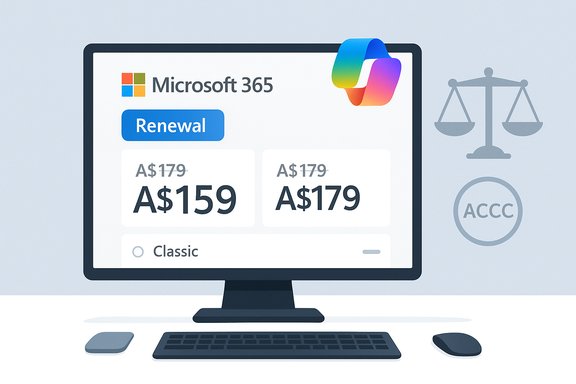
In late 2024 Microsoft began integrating its generative-AI assistant, Copilot, into consumer Microsoft 365 plans. The integration was paired with headline price increases: the ACCC’s initiating materials and independent reporting show the annual Microsoft 365 Personal plan moved from A$109 to A$159 (≈ +45%) and the Family plan from A$139 to A$179 (≈ +29%). The Australian Competition and Consumer Commission (ACCC) commenced Federal Court proceedings on 27 October 2025, alleging that Microsoft’s communications to auto‑renewing subscribers created the false impression customers had only two choices—accept the Copilot-integrated, higher-priced plan or cancel—while a lower-cost “Classic” no‑AI plan was available but effectively hidden until customers entered the cancellation flow. The ACCC quantified the potentially affected cohort at roughly 2.7 million Australian subscribers and attached those numbers to a narrow legal theory: omission of a material fact in renewal communications that likely misled a reasonable consumer. The regulator is seeking penalties, consumer redress and injunctions under the Australian Consumer Law—exposure that can include fines up to A$50 million per contravention, three times the benefit obtained, or 30% of adjusted turnover in severe cases. Microsoft responded publicly by reviewing the regulator’s claim. In the days after the ACCC’s filing, Microsoft began emailing Australian Microsoft 365 Personal and Family subscribers with a message that, according to reporting and a subscriber copy of the email, expressed regret for not being clearer about subscription options, described how to switch to the non‑AI “Classic” plans, and offered refunds for eligible subscribers who choose to move to the Classic SKU. Local reporting summarised Microsoft’s outreach and said the company told customers refunds would apply to payments made after November 30, 2024, if they switch before the end of 2025. That outreach appears to be a direct response to the ACCC’s allegations.What the ACCC alleges, in plain terms
The communications at issue
- The ACCC’s complaint centers on three primary communications: two targeted emails to auto‑renewing subscribers and a public Microsoft blog post announcing Copilot’s inclusion and price increases.
- The regulator says those communications conveyed a binary choice—accept Copilot at the higher price or cancel—without contemporaneously disclosing a third option: Microsoft 365 Personal Classic and Microsoft 365 Family Classic, which preserved the prior features and price.
Why placement and timing matter
Regulators evaluate misleading or deceptive conduct by the impression created in the mind of a reasonable consumer. When a subscription’s feature set and price materially change, how and where alternatives are shown matters legally and practically. The ACCC’s case rests on screenshots and a concise statement lodged with the court that show the Classic option surfacing only after a user had already started the cancellation flow—meaning many auto‑renewing users would not have seen the alternative at the moment they were told their renewal would be at a higher price.The claimed harm
The ACCC frames the harm as twofold:- Economic: millions of automated renewals at higher prices, producing measurable loss to consumers.
- Informational: consumers were denied the opportunity to make an informed choice at the point of renewal.
Microsoft’s outreach and the refund offer — what is verified
Microsoft’s email to subscribers acknowledged they “could have been clearer” about the availability of non‑AI plans and offered an opportunity to switch back to Classic subscriptions and receive refunds for eligible payments. Local news coverage summarised the email’s contents and timings; however, the precise terms Microsoft communicated (for example, the exact refund look‑back date and the mechanics of switching between SKUs) are reported by some outlets and subscriber screenshots but have not been consolidated into a single, detailed Microsoft public statement available on corporate press pages at the time of writing. Readers should therefore treat the detailed refund mechanics reported by local outlets as substantiated by subscriber-facing emails and some reporting, but not yet reproduced in a Microsoft press release on the company’s global newsroom.Cross-check: the ACCC’s initiating materials and major independent news organisations confirm the core timeline and pricing figures cited above, and multiple outlets reported Microsoft was reviewing the claim. That independent corroboration validates the central elements of the story.
Legal stakes and likely trajectories
Remedies the ACCC seeks
The ACCC is seeking a mix of remedies: declarations, injunctions, consumer redress and penalties. Under Australian law, maximum penalties for corporations can be substantial—the greater of A$50 million, three times the benefit obtained, or 30% of adjusted turnover where the benefit can’t reasonably be quantified. In practice, courts weigh the seriousness, duration, and systemic nature of the breach when setting penalties.What the court will focus on
- The content and timing of Microsoft’s emails and the blog post: what did a reasonable consumer deduce from those messages?
- The discoverability of the Classic SKUs: were they contemporaneously available and reasonably visible in the renewal journey?
- Causation and quantification of harm: how many consumers paid higher prices as a direct result of the communications, versus those who consciously accepted Copilot and the new price?
Probable defenses Microsoft may raise
- Microsoft will likely stress that the Classic plans were publicly documented and technically available; that customers had an avenue to choose an alternative; and that broad product announcements and support pages communicated the change.
- The company may argue that any failure was communicational or operational rather than deceptive—that the Classic plan was not hidden intentionally but surfaced in different parts of the account UX or support documentation.
Consumer and product-design implications
Why UX is no longer just a design issue
This case turns on choice architecture—how options are presented to the user—and illustrates that regulators now treat interface design as potentially material to consumer law outcomes.- Buried alternatives inside a cancellation flow can functionally be the difference between an opt‑in versus an opt‑out experience.
- For subscription services, automatic renewals plus subtle UX changes make immediate, clear disclosure essential.
For product managers: a practical checklist
- Make alternatives equally discoverable in marketing emails and renewal notices.
- Include short, plain-language summaries of what changes and what options exist.
- Ensure cancellation flows are not the only place to present downgrade choices.
- Keep a clear audit trail of customer-facing communications for compliance review.
Financial and reputational costs
The immediate financial cost of refunds to subscribers could amount to multiple millions of dollars depending on take-up; that’s before any court-ordered redress or civil penalties. Beyond direct costs, there is reputational fallout: trust is a core asset for subscription businesses and can be harder to rebuild than one-off payouts. Markets and regulators will weigh whether the product rollout prioritised monetisation over customer clarity.Broader significance: a bellwether for AI monetisation
This litigation extends beyond one company or jurisdiction. Microsoft rolled Copilot into Microsoft 365 in multiple markets; the legal framing the ACCC adopts—focusing on how companies disclose AI monetisation and price changes—could influence global enforcement patterns.- Regulators in other jurisdictions are likely to monitor the Federal Court’s findings for precedent on interface-driven omission claims.
- Product teams at competing firms will reassess how they deploy and charge for AI features inside legacy products.
- Consumer groups may lobby for more prescriptive disclosure rules for AI-enabled product changes.
Notable strengths and potential weaknesses of the ACCC’s case
Strengths
- Documentary evidence: The ACCC has published a concise statement and screenshots as part of its initiating materials—concrete artifacts that courts rely on when assessing how communications would be perceived.
- Clear quantification: Headline price changes and the number of affected subscribers (≈2.7 million) provide a measurable scale for alleged consumer harm.
- Regulatory appetite: The ACCC has shown willingness to tackle powerful tech platforms on subscription transparency; a favourable ruling would give the regulator stronger leverage in future cases.
Weaknesses / evidentiary gaps the defence can exploit
- Intent is hard to prove: Deliberate concealment is difficult to establish without internal documents; motive is an allegation unless discovery produces clear evidence. Courts typically distinguish between negligent communication and deliberate deception.
- User heterogeneity: Proving that a “reasonable” consumer would have been misled across a diverse subscriber base is a factual question. Some consumers read emails; others rely on account pages or support documents.
- Availability of alternatives: If Microsoft can show that Classic SKUs were documented publicly and accessible outside the cancellation flow, the court may weigh whether the omission materially misled reasonable subscribers.
Practical guidance for affected subscribers
- Review bank and subscription statements to identify when your Microsoft 365 subscription renewed and at what rate.
- Capture screenshots of any renewal notices, emails and account pages.
- If you believe you were misled, lodge a complaint with the ACCC and preserve written records of communications with Microsoft.
- If Microsoft’s email offering refunds applies to you and you want to switch back to Classic, follow the steps in the message and retain confirmation of any refund transactions for future claims. Note that specifics of refund eligibility and look‑back periods have been reported in subscriber emails but may not be uniformly documented in a global Microsoft press release—keep written evidence.
Where this could lead: scenarios and consequences
- Court finds for the ACCC
- Likely remedies: declarations, injunctions, consumer redress and significant penalties. Microsoft might be ordered to adopt clearer communications and provide refunds at scale.
- Court finds for Microsoft
- The company avoids fines but could still face reputational damage and increased scrutiny from other regulators.
- Settlement
- The parties could settle with agreed refunds and compliance commitments; this is a common outcome in high‑profile regulatory disputes where the costs and uncertainty of litigation are substantial.
Risk assessment for product teams and executives
- Operational risk: Buried UX options and inconsistent email language can translate directly into regulatory risk and remediation costs.
- Reputational risk: Perceptions of using design to extract higher fees accelerate churn and push customers toward competitors or alternative productivity suites.
- Regulatory risk: Governments and consumer bodies are paying attention; this case will factor into compliance programs and legal signoffs for product launches.
Final assessment and cautionary notes
The ACCC’s case against Microsoft is a clarifying moment for how the law applies to choice architecture in a subscription economy that increasingly monetises AI. The regulator has assembled a focused complaint and supporting screenshots; independent reporting and Microsoft’s subsequent outreach to subscribers indicate the company recognises the reputational stakes and is attempting remediation. Two important cautions:- Internal motives and the precise number of subscribers who were in fact misled versus those who consciously upgraded remain empirical questions that the court will have to resolve. Those aspects are allegations until substantiated in evidence disclosed during litigation.
- Some details about Microsoft’s refund mechanics and exact eligibility windows have been reported from subscriber emails and local outlets; however, a single global Microsoft press release reproducing the full terms was not publicly available at the time of reporting. Treat the specific refund look‑back mechanics as reported but subject to confirmation in Microsoft’s formal communications or court-ordered remediation orders.
What to watch next
- The Federal Court’s handling of discovery and whether internal Microsoft documents reveal intent or show a design choice to prioritise upgrade uptake.
- Any settlement talks or Microsoft product changes that make the Classic SKUs more discoverable outside cancellation flows.
- Whether other regulators—especially in the UK, EU or North America—use this case as a model for enforcement against opaque AI monetisation tactics.
Microsoft’s apology and refund offer may reduce immediate consumer anger, but they do not remove the larger questions the case exposes: how companies should present paid AI features to existing customers, how regulators should define transparency in the age of AI, and how legal systems will translate nuanced UX design choices into enforceable rules. The Federal Court’s response will help set that framework—or at least test its limits—for years to come.
Source: theqldr.com.au Microsoft apologises for AI confusion, offers refunds
