

Microsoft said on April 27, 2026, that Accenture is rolling out Microsoft 365 Copilot across roughly 743,000 employees in more than 120 countries, expanding from pilots that began in August 2023 into what Microsoft calls its largest enterprise Copilot deployment to date. The announcement is less a simple customer win than a stress test of Microsoft’s entire AI-at-work thesis. If Copilot cannot prove itself inside a consulting giant that sells transformation for a living, the road to mass enterprise adoption becomes much harder. If it can, Microsoft has a case study every CIO will be asked to explain.
Accenture is not an ordinary customer in this story. It is a global services firm, a Microsoft partner, and, through Avanade, part of a long-running joint venture with Microsoft that exists to turn Microsoft technology into enterprise projects. That makes the rollout both commercially meaningful and awkwardly convenient.
Microsoft needs a proof point bigger than demos, analyst decks, and carefully staged keynote scenarios. Accenture offers one: a huge white-collar workforce spread across geographies, job roles, regulatory regimes, and data estates. A Copilot rollout at that scale touches email, meetings, documents, sales workflows, marketing operations, search, and internal knowledge management — exactly the territory Microsoft says generative AI should inhabit.
But the partnership also means readers should keep one eyebrow raised. Accenture is not a skeptical midmarket manufacturer reluctantly testing an add-on license. It is a company with every incentive to master Copilot, package the lessons, and sell the playbook to its own customers.
That does not make the deployment fake. It makes it strategically revealing. The most important thing about Accenture’s Copilot rollout is not that 743,000 people may eventually have access to the assistant; it is that Microsoft is moving the AI adoption debate away from “Can the model write a decent paragraph?” and toward “Can an enterprise actually change how work gets done?”
Accenture’s own account of the deployment emphasizes governance, access controls, data strategy, and training. That is the part many organizations quietly underfund. Copilot is only as useful as the permissioned Microsoft 365 data it can reason across, and only as safe as the identity, sharing, retention, and compliance practices already in place.
For WindowsForum readers who administer Microsoft 365 tenants, this is the operational heart of the story. Copilot does not magically fix years of overshared SharePoint sites, chaotic Teams sprawl, stale OneDrive permissions, or documents that should never have been visible to half the company. It makes those problems more searchable, more conversational, and potentially more embarrassing.
Accenture appears to have treated deployment as a change-management program rather than a software switch. That is exactly how large organizations will have to approach it. The assistant lives inside familiar tools, but the readiness work lives in the tenant, the data estate, the security model, and the habits of employees who have spent years treating corporate filesystems as dumping grounds.
That is why Accenture’s rollout is a useful signal. Employees did not have to leave their daily workflow for a separate AI destination. The assistant was embedded in the apps where meetings are scheduled, transcripts are stored, decks are drafted, documents are reviewed, and customer conversations are prepared.
This is Microsoft’s oldest enterprise trick updated for the AI era. Windows won because it became the default environment for work. Office won because it became the grammar of business documents. Teams won ground because it was bundled into the collaboration layer many companies already paid for. Copilot is now trying to become the interface to all of that accumulated corporate context.
That integration is also why rivals face a harder enterprise path than raw model quality comparisons suggest. A more capable standalone model may impress a user in a browser tab, but the enterprise buyer wants identity controls, auditability, compliance hooks, regional availability, licensing predictability, and access to internal data without a security architecture built from hope and plug-ins. Microsoft’s advantage is not that Copilot always gives the best answer. It is that Copilot can be made available inside the existing administrative perimeter.
Those numbers are impressive. They are also mostly perception and usage metrics, not the same thing as audited productivity gains. “I completed a routine task faster” is useful information, but it is not the same as proving that a firm’s margin improved, delivery quality rose, customer satisfaction increased, or headcount could be redeployed without downstream costs.
That distinction matters because enterprise AI has entered the spreadsheet phase. The early excitement around generative AI was about capability. The next phase is about whether subscriptions, implementation services, training time, governance costs, and security reviews produce measurable business value.
Accenture’s data does suggest something important: employees are using the tool when it is deployed with intent. That alone separates Copilot from many enterprise software rollouts where assigned licenses sit idle. But the harder question is whether this usage compounds into better organizational output, or whether it mostly accelerates the production of more emails, more slides, more summaries, and more internal content.
For IT leaders, the lesson is to separate activity acceleration from business outcomes. If Copilot saves 20 minutes on a meeting summary but the organization schedules more meetings because summaries are easier, the productivity gain becomes murky. If it helps a seller prepare for a client meeting that creates a real opportunity, the value is easier to defend.
That is powerful because most organizations do not lack curiosity about AI. They lack confidence. They want to know which use cases are worth funding, how to prevent data leakage, how to train employees without creating prompt-engineering theater, and how to measure whether AI is improving work or merely making work look more modern.
Accenture’s phased deployment gives it an answer to sell. Start with controlled pilots. Clean up access and data governance. Target high-friction workflows. Build role-specific training rather than generic evangelism. Promote internal examples. Watch usage patterns. Expand only when the organization can absorb the next wave.
That playbook is not revolutionary, but it is credible. It also reinforces Microsoft’s channel strategy. Microsoft can sell Copilot licenses; Accenture and Avanade can sell the organizational surgery required to make those licenses useful.
This is where the announcement becomes more than customer news. It is a map of the enterprise AI economy Microsoft wants to build. Copilot is the subscription. Azure is the infrastructure. Microsoft 365 is the data surface. Partners turn adoption into professional services. Customers, ideally, conclude that the safest path to AI is to deepen their dependence on the Microsoft stack.
That is the kind of use case enterprise AI needs more of. It is not simply asking a model to “make this email better.” It connects AI to a workflow with a business result: preparing sellers to understand a customer, identify relevant issues, and engage with more context.
Microsoft says Avanade rolled D3 out to 25 percent of its sellers and found that active users generated 43 percent more sales opportunities than non-users. That is still not a perfect randomized controlled trial, because motivated users may be more likely to adopt the tool in the first place. But it is closer to a commercially meaningful metric than vague claims about creativity.
The D3 example also hints at how Copilot may evolve inside enterprises. The future is not one generic assistant answering everything. It is a set of role-specific agents, notebooks, workflows, and knowledge surfaces that sit on top of curated data. Sales gets account intelligence. Marketing gets brand-aware content support. Engineering gets code and documentation workflows. HR gets policy and onboarding support. Finance gets analysis and reconciliation assistance.
That is both promising and dangerous. The more specific the workflow, the more useful the AI can become. The more deeply it touches business processes, the more important it becomes to know what data it used, what it inferred, what it fabricated, and who remains accountable.
That puts Microsoft 365 administrators, identity teams, endpoint managers, and security operations staff in the middle of the rollout. The question is not merely whether users like Copilot. It is whether the organization can safely expose the right information to the right people through a conversational interface.
The practical work is familiar but newly urgent. Review sharing policies. Audit sensitive sites. Classify data. Tighten conditional access. Validate retention and eDiscovery requirements. Understand where transcripts are stored. Decide which features should be enabled in which regions. Train users not to paste secrets into prompts simply because the box feels official.
Copilot does not eliminate old IT hygiene. It punishes the lack of it. If permissions are messy, AI makes the mess legible. If documents are mislabeled, AI may treat them as ordinary reference material. If meeting recordings and transcripts proliferate without policy, Copilot turns them into a searchable institutional memory that may contain more than leadership intended.
This is why Accenture’s emphasis on governance is not corporate throat-clearing. It is the whole deployment. The impressive part is not assigning licenses to hundreds of thousands of people. The impressive part, if it works, is doing so without turning corporate data into a hallucination-fed discovery machine.
This is the frontier Microsoft cares about. A chatbot can be useful, but it is easy to compare and easy to replace. A workflow layer that connects identity, documents, meetings, calendars, business applications, security controls, and role-specific agents is much stickier.
That is why the deployment should be read alongside Microsoft’s broader push into AI agents, Copilot Studio, Security Copilot, and role-based AI experiences. The company wants Copilot to become the way employees initiate work across the Microsoft estate. In that version of the future, the prompt box is not a novelty; it is a command line for office labor.
The risk is that Microsoft may be moving faster than many organizations can govern. AI features are arriving in waves, product names keep shifting, and administrators are being asked to distinguish between consumer Copilot, Microsoft 365 Copilot, Copilot Chat, Copilot Studio agents, Windows AI features, and security-specific Copilots. Even seasoned IT pros can struggle to track what is included, what costs extra, what data is used, and which controls apply.
Accenture may have the scale and consulting muscle to absorb that complexity. Smaller organizations may not. For them, the lesson is not “deploy everywhere.” It is “do not confuse availability with readiness.”
That is not accidental. Microsoft’s enterprise AI strategy rewards customers who already use the stack deeply. The more Teams meetings, SharePoint sites, OneDrive files, Outlook messages, Entra identities, Purview labels, and Defender signals a company has, the stronger the Copilot pitch becomes.
For many enterprises, that may be a reasonable trade. Microsoft’s integrated approach can reduce vendor sprawl and simplify security review compared with stitching together separate AI services. But it also concentrates power. If the assistant becomes the interface to work, the vendor controlling that assistant gains enormous influence over how work is searched, summarized, prioritized, and automated.
This is where CIOs should be especially disciplined. Copilot adoption should not be measured only by user enthusiasm. It should also be evaluated against portability, data governance, model transparency, cost predictability, and the organization’s ability to say no to features that do not fit its risk profile.
The Accenture rollout proves that Copilot can scale inside a Microsoft-heavy enterprise environment. It does not prove that every organization should let Microsoft become the default cognitive layer for its business. That is a strategic decision, not a feature toggle.
Copilot’s promise is conversational simplicity. Ask for a summary. Draft a deck. Analyze a spreadsheet. Prepare for a meeting. Build an agent. But behind those verbs sit identity systems, content stores, compliance boundaries, model routing, cloud availability, API limits, and policy decisions.
When that plumbing works, AI feels like magic. When it fails, users see a blank page, a wrong answer, an inaccessible file, or a response that should never have been generated. At enterprise scale, the difference between magic and mess is operations.
Accenture’s rollout is therefore a reminder that AI transformation is still IT transformation. It requires the same unglamorous work that has always separated successful deployments from expensive shelfware: architecture, governance, training, measurement, support, and executive patience.
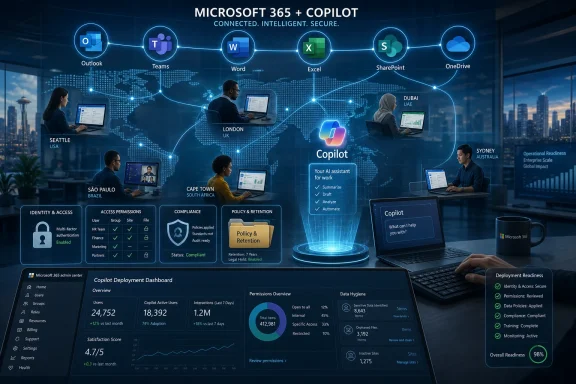 Microsoft Finds Its Ideal Copilot Showroom
Accenture is not an ordinary customer in this story. It is a global services firm, a Microsoft partner, and, through Avanade, part of a long-running joint venture with Microsoft that exists to turn Microsoft technology into enterprise projects. That makes the rollout both commercially meaningful and awkwardly convenient.Microsoft needs a proof point bigger than demos, analyst decks, and carefully staged keynote scenarios. Accenture offers one: a huge white-collar workforce spread across geographies, job roles, regulatory regimes, and data estates. A Copilot rollout at that scale touches email, meetings, documents, sales workflows, marketing operations, search, and internal knowledge management — exactly the territory Microsoft says generative AI should inhabit.
But the partnership also means readers should keep one eyebrow raised. Accenture is not a skeptical midmarket manufacturer reluctantly testing an add-on license. It is a company with every incentive to master Copilot, package the lessons, and sell the playbook to its own customers.
That does not make the deployment fake. It makes it strategically revealing. The most important thing about Accenture’s Copilot rollout is not that 743,000 people may eventually have access to the assistant; it is that Microsoft is moving the AI adoption debate away from “Can the model write a decent paragraph?” and toward “Can an enterprise actually change how work gets done?”
The Pilot Was Never the Product
The rollout began in August 2023, shortly after Microsoft introduced Microsoft 365 Copilot to early customers. Accenture started with a few hundred senior leaders and selected employees, then expanded to 20,000 users before widening the deployment further. That sequence matters because it contradicts the fantasy version of enterprise AI adoption, where a license is assigned and productivity appears as if summoned.Accenture’s own account of the deployment emphasizes governance, access controls, data strategy, and training. That is the part many organizations quietly underfund. Copilot is only as useful as the permissioned Microsoft 365 data it can reason across, and only as safe as the identity, sharing, retention, and compliance practices already in place.
For WindowsForum readers who administer Microsoft 365 tenants, this is the operational heart of the story. Copilot does not magically fix years of overshared SharePoint sites, chaotic Teams sprawl, stale OneDrive permissions, or documents that should never have been visible to half the company. It makes those problems more searchable, more conversational, and potentially more embarrassing.
Accenture appears to have treated deployment as a change-management program rather than a software switch. That is exactly how large organizations will have to approach it. The assistant lives inside familiar tools, but the readiness work lives in the tenant, the data estate, the security model, and the habits of employees who have spent years treating corporate filesystems as dumping grounds.
Copilot’s Real Advantage Is Boring Integration
The easy way to describe Copilot is as a chatbot inside Office. That is also the least interesting way to understand it. Microsoft’s enterprise pitch is that Copilot sits where knowledge workers already spend their day: Outlook, Teams, Word, PowerPoint, Excel, SharePoint, OneDrive, and the broader Microsoft Graph.That is why Accenture’s rollout is a useful signal. Employees did not have to leave their daily workflow for a separate AI destination. The assistant was embedded in the apps where meetings are scheduled, transcripts are stored, decks are drafted, documents are reviewed, and customer conversations are prepared.
This is Microsoft’s oldest enterprise trick updated for the AI era. Windows won because it became the default environment for work. Office won because it became the grammar of business documents. Teams won ground because it was bundled into the collaboration layer many companies already paid for. Copilot is now trying to become the interface to all of that accumulated corporate context.
That integration is also why rivals face a harder enterprise path than raw model quality comparisons suggest. A more capable standalone model may impress a user in a browser tab, but the enterprise buyer wants identity controls, auditability, compliance hooks, regional availability, licensing predictability, and access to internal data without a security architecture built from hope and plug-ins. Microsoft’s advantage is not that Copilot always gives the best answer. It is that Copilot can be made available inside the existing administrative perimeter.
The Productivity Claims Are Big, but the Measurement Problem Is Bigger
Microsoft says Accenture’s 2025 company data involving 200,000 users found that 97 percent of employees reported completing routine tasks 15 times faster with Copilot, while 53 percent reported significant productivity and efficiency improvements. In one tranche of roughly 200,000 licenses, monthly active usage reportedly reached 89 percent. Accenture also found that 84 percent of surveyed employees said they would deeply miss the tool if it were removed.Those numbers are impressive. They are also mostly perception and usage metrics, not the same thing as audited productivity gains. “I completed a routine task faster” is useful information, but it is not the same as proving that a firm’s margin improved, delivery quality rose, customer satisfaction increased, or headcount could be redeployed without downstream costs.
That distinction matters because enterprise AI has entered the spreadsheet phase. The early excitement around generative AI was about capability. The next phase is about whether subscriptions, implementation services, training time, governance costs, and security reviews produce measurable business value.
Accenture’s data does suggest something important: employees are using the tool when it is deployed with intent. That alone separates Copilot from many enterprise software rollouts where assigned licenses sit idle. But the harder question is whether this usage compounds into better organizational output, or whether it mostly accelerates the production of more emails, more slides, more summaries, and more internal content.
For IT leaders, the lesson is to separate activity acceleration from business outcomes. If Copilot saves 20 minutes on a meeting summary but the organization schedules more meetings because summaries are easier, the productivity gain becomes murky. If it helps a seller prepare for a client meeting that creates a real opportunity, the value is easier to defend.
Accenture Turns Adoption Into a Consulting Asset
Accenture did not just roll out Copilot to answer internal emails faster. It is building a reusable adoption narrative. The company can now tell clients it has lived through the same governance, training, and cultural issues those clients are about to face.That is powerful because most organizations do not lack curiosity about AI. They lack confidence. They want to know which use cases are worth funding, how to prevent data leakage, how to train employees without creating prompt-engineering theater, and how to measure whether AI is improving work or merely making work look more modern.
Accenture’s phased deployment gives it an answer to sell. Start with controlled pilots. Clean up access and data governance. Target high-friction workflows. Build role-specific training rather than generic evangelism. Promote internal examples. Watch usage patterns. Expand only when the organization can absorb the next wave.
That playbook is not revolutionary, but it is credible. It also reinforces Microsoft’s channel strategy. Microsoft can sell Copilot licenses; Accenture and Avanade can sell the organizational surgery required to make those licenses useful.
This is where the announcement becomes more than customer news. It is a map of the enterprise AI economy Microsoft wants to build. Copilot is the subscription. Azure is the infrastructure. Microsoft 365 is the data surface. Partners turn adoption into professional services. Customers, ideally, conclude that the safest path to AI is to deepen their dependence on the Microsoft stack.
The Avanade Example Shows Where AI Gets Less Abstract
The strongest part of the rollout is not the broad claim that employees write and summarize faster. It is the narrower example from Avanade, the Microsoft-Accenture joint venture. Avanade’s sales innovation team built a Copilot-powered sales intelligence system called D3, short for Data Driven Decisions, designed to aggregate internal data, industry context, and external information into customer-specific insights.That is the kind of use case enterprise AI needs more of. It is not simply asking a model to “make this email better.” It connects AI to a workflow with a business result: preparing sellers to understand a customer, identify relevant issues, and engage with more context.
Microsoft says Avanade rolled D3 out to 25 percent of its sellers and found that active users generated 43 percent more sales opportunities than non-users. That is still not a perfect randomized controlled trial, because motivated users may be more likely to adopt the tool in the first place. But it is closer to a commercially meaningful metric than vague claims about creativity.
The D3 example also hints at how Copilot may evolve inside enterprises. The future is not one generic assistant answering everything. It is a set of role-specific agents, notebooks, workflows, and knowledge surfaces that sit on top of curated data. Sales gets account intelligence. Marketing gets brand-aware content support. Engineering gets code and documentation workflows. HR gets policy and onboarding support. Finance gets analysis and reconciliation assistance.
That is both promising and dangerous. The more specific the workflow, the more useful the AI can become. The more deeply it touches business processes, the more important it becomes to know what data it used, what it inferred, what it fabricated, and who remains accountable.
The Windows Angle Is the Admin Angle
For Windows enthusiasts, Copilot can feel like a consumer branding exercise: a button on a keyboard, a sidebar in Edge, an assistant that has changed names and behaviors often enough to exhaust casual users. In the enterprise, the story is different. Copilot is less about a shiny AI panel and more about the administrative consequences of letting natural language query a company’s working memory.That puts Microsoft 365 administrators, identity teams, endpoint managers, and security operations staff in the middle of the rollout. The question is not merely whether users like Copilot. It is whether the organization can safely expose the right information to the right people through a conversational interface.
The practical work is familiar but newly urgent. Review sharing policies. Audit sensitive sites. Classify data. Tighten conditional access. Validate retention and eDiscovery requirements. Understand where transcripts are stored. Decide which features should be enabled in which regions. Train users not to paste secrets into prompts simply because the box feels official.
Copilot does not eliminate old IT hygiene. It punishes the lack of it. If permissions are messy, AI makes the mess legible. If documents are mislabeled, AI may treat them as ordinary reference material. If meeting recordings and transcripts proliferate without policy, Copilot turns them into a searchable institutional memory that may contain more than leadership intended.
This is why Accenture’s emphasis on governance is not corporate throat-clearing. It is the whole deployment. The impressive part is not assigning licenses to hundreds of thousands of people. The impressive part, if it works, is doing so without turning corporate data into a hallucination-fed discovery machine.
Microsoft’s AI Pitch Moves From Assistant to Operating Layer
Microsoft’s language around Copilot has steadily shifted from helpful assistant to digital colleague, agent, and workflow participant. That evolution is visible in the Accenture story. The company is not only using Copilot to summarize meetings; non-technical staff are reportedly building agents and work processes around it.This is the frontier Microsoft cares about. A chatbot can be useful, but it is easy to compare and easy to replace. A workflow layer that connects identity, documents, meetings, calendars, business applications, security controls, and role-specific agents is much stickier.
That is why the deployment should be read alongside Microsoft’s broader push into AI agents, Copilot Studio, Security Copilot, and role-based AI experiences. The company wants Copilot to become the way employees initiate work across the Microsoft estate. In that version of the future, the prompt box is not a novelty; it is a command line for office labor.
The risk is that Microsoft may be moving faster than many organizations can govern. AI features are arriving in waves, product names keep shifting, and administrators are being asked to distinguish between consumer Copilot, Microsoft 365 Copilot, Copilot Chat, Copilot Studio agents, Windows AI features, and security-specific Copilots. Even seasoned IT pros can struggle to track what is included, what costs extra, what data is used, and which controls apply.
Accenture may have the scale and consulting muscle to absorb that complexity. Smaller organizations may not. For them, the lesson is not “deploy everywhere.” It is “do not confuse availability with readiness.”
The Vendor Lock-In Argument Is Back, Wearing an AI Badge
Every successful Microsoft platform eventually raises the same question: convenience or captivity? Copilot is no exception. The more value an organization gets from Copilot reasoning over Microsoft 365 data, the harder it becomes to imagine moving away from Microsoft 365.That is not accidental. Microsoft’s enterprise AI strategy rewards customers who already use the stack deeply. The more Teams meetings, SharePoint sites, OneDrive files, Outlook messages, Entra identities, Purview labels, and Defender signals a company has, the stronger the Copilot pitch becomes.
For many enterprises, that may be a reasonable trade. Microsoft’s integrated approach can reduce vendor sprawl and simplify security review compared with stitching together separate AI services. But it also concentrates power. If the assistant becomes the interface to work, the vendor controlling that assistant gains enormous influence over how work is searched, summarized, prioritized, and automated.
This is where CIOs should be especially disciplined. Copilot adoption should not be measured only by user enthusiasm. It should also be evaluated against portability, data governance, model transparency, cost predictability, and the organization’s ability to say no to features that do not fit its risk profile.
The Accenture rollout proves that Copilot can scale inside a Microsoft-heavy enterprise environment. It does not prove that every organization should let Microsoft become the default cognitive layer for its business. That is a strategic decision, not a feature toggle.
The Cloudflare Error Is a Fitting Metaphor
The article that prompted this discussion was hidden behind a Cloudflare origin error, a mundane failure in the chain between reader and server. It is an accidental but useful metaphor for enterprise AI. The glossy output depends on plumbing most users never see.Copilot’s promise is conversational simplicity. Ask for a summary. Draft a deck. Analyze a spreadsheet. Prepare for a meeting. Build an agent. But behind those verbs sit identity systems, content stores, compliance boundaries, model routing, cloud availability, API limits, and policy decisions.
When that plumbing works, AI feels like magic. When it fails, users see a blank page, a wrong answer, an inaccessible file, or a response that should never have been generated. At enterprise scale, the difference between magic and mess is operations.
Accenture’s rollout is therefore a reminder that AI transformation is still IT transformation. It requires the same unglamorous work that has always separated successful deployments from expensive shelfware: architecture, governance, training, measurement, support, and executive patience.
The Copilot Rollout Gives CIOs a More Useful Checklist Than a Victory Lap
The Accenture deployment is big enough to matter, close enough to Microsoft to warrant skepticism, and detailed enough to offer practical lessons. The most useful reading is neither fanfare nor dismissal. It is a field report from a company with the resources to do enterprise AI the hard way.- Accenture’s rollout suggests that Copilot adoption depends as much on change management and governance as on model capability.
- Microsoft’s strongest advantage is not a single AI model but Copilot’s position inside Microsoft 365, identity, storage, collaboration, and compliance systems.
- Reported productivity gains should be treated as promising signals, not final proof of broad business value.
- Role-specific workflows such as Avanade’s sales intelligence tool are more convincing than generic claims about faster writing and summarization.
- Administrators should treat Copilot readiness as a permissions, data hygiene, and compliance project before treating it as a user-experience upgrade.
- The deeper Copilot becomes embedded in daily work, the more seriously organizations must consider lock-in, accountability, and feature governance.
References
- Primary source: asatunews.co.id
Published: 2026-06-01T10:50:06.432664
Loading…
www.asatunews.co.id - Official source: news.microsoft.com

Accenture is rolling out Copilot to a workforce the size of Denver. Here’s how they're doing it. - Source
The global professional services firm is rolling out Copilot across its workforce to around 743,000 people – the largest enterprise Copilot deployment to date. news.microsoft.com
- Related coverage: qz.com
Loading…
qz.com - Related coverage: ndtv.com
Loading…
www.ndtv.com - Related coverage: es.qz.com
Loading…
es.qz.com - Related coverage: itpro.com

Accenture has been trialling Microsoft Copilot since 2023 – now it’s rolling out the AI tool to all 743,000 staff
Accenture will roll out Microsoft Copilot to nearly three quarters of a million employees after years of testing www.itpro.com
- Related coverage: siliconangle.com
Loading…
siliconangle.com - Related coverage: resultsense.com
Loading…
www.resultsense.com - Related coverage: timesofindia.indiatimes.com
Loading…
timesofindia.indiatimes.com - Related coverage: allwork.space
Loading…
allwork.space - Related coverage: parameter.io
Loading…
parameter.io - Related coverage: windowscentral.com
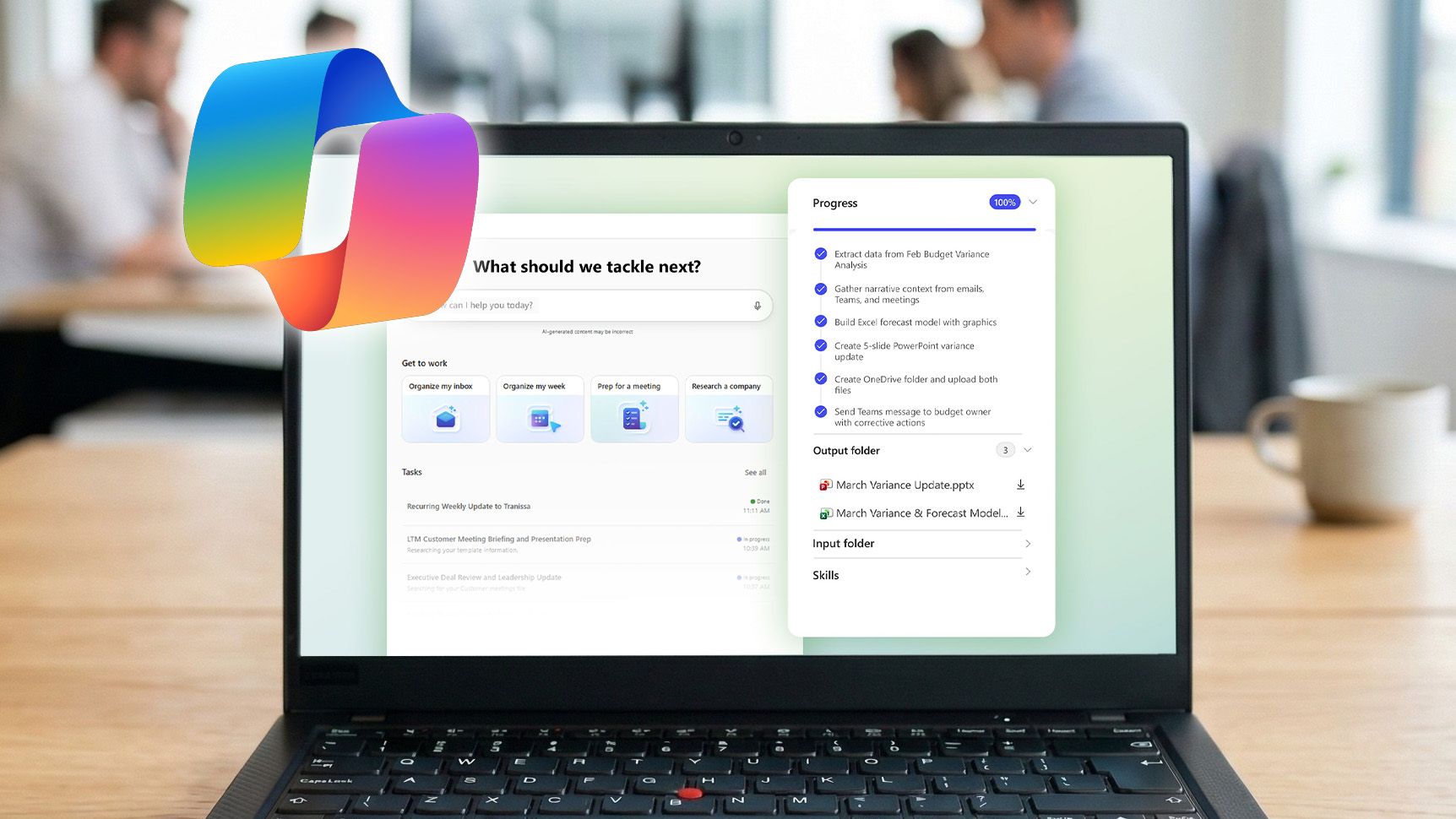
Copilot Cowork suddenly makes Microsoft 365’s AI‑centric E7 subscription far more compelling
Copilot Cowork makes Microsoft 365’s AI‑focused E7 subscription a stronger value proposition for $99 per month. www.windowscentral.com
- Official source: microsoft.com
Loading…
www.microsoft.com - Related coverage: techradar.com
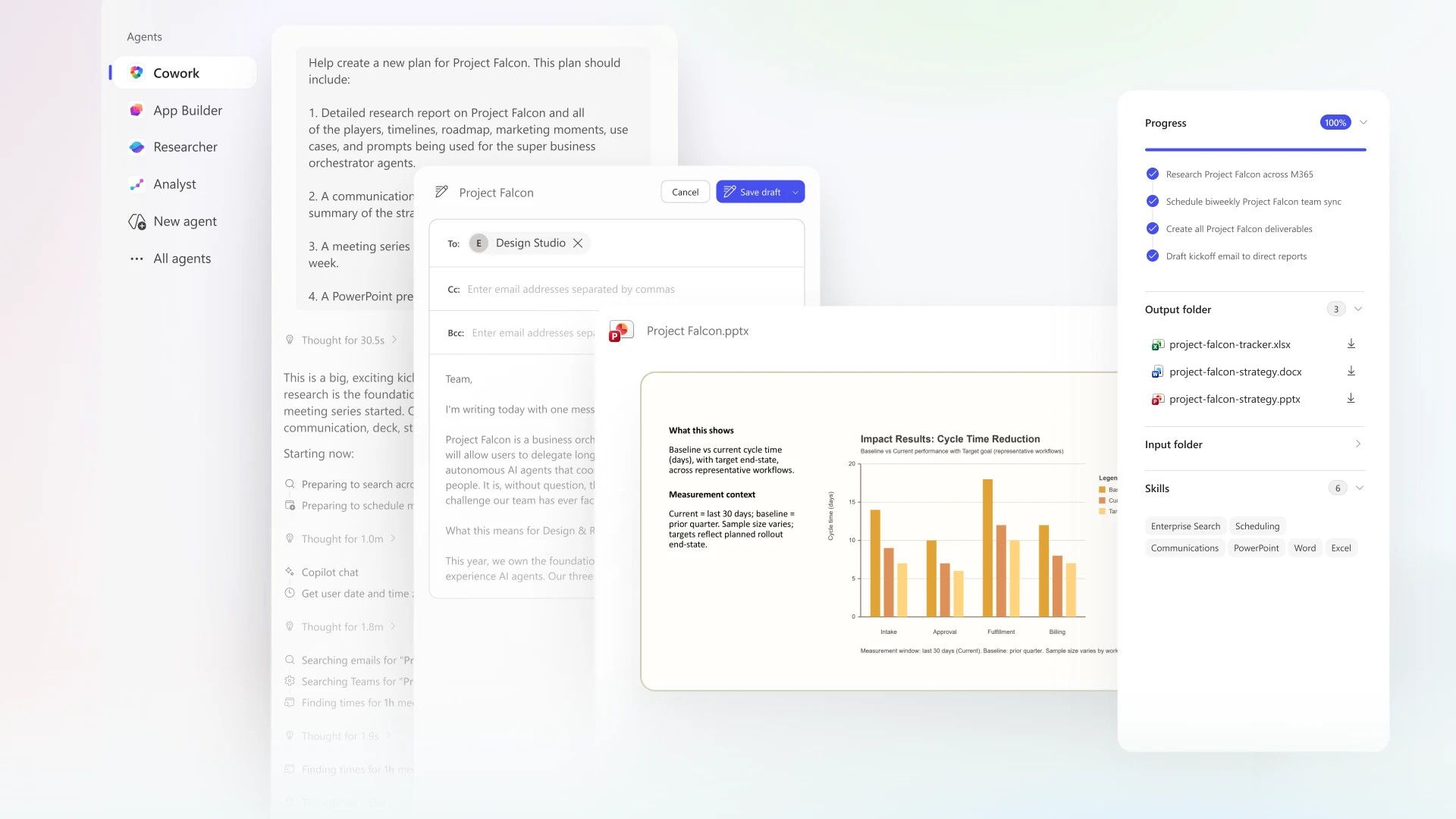
Microsoft's Copilot Cowork uses Anthropic AI to conquer all your biggest work tasks
Microsoft and Anthropic team up to release Copilot Cowork, a more effective way of getting work done.www.techradar.com
- Related coverage: axios.com
Loading…
www.axios.com - Official source: adoption.microsoft.com
Loading…
adoption.microsoft.com - Related coverage: newsroom.ibm.com
Loading…
newsroom.ibm.com