

Accenture’s sprawling video operations — roughly 779,000 employees producing hundreds of events and post‑production projects each month — have been stitched together into a searchable, AI‑driven media fabric after the company deployed a new Video IQ system built on Azure Video Indexer and Azure Data Factory, turning a petabyte of unmanaged footage into a reusable corporate media asset with conversational search, automated summaries and planned multilingual reach.
Accenture uses video as a primary internal communications and knowledge‑sharing medium, running an estimated 140 broadcast events and more than 100 post‑production projects every month. That scale created a classic enterprise media problem: massive, dispersed storage; fragile findability; and low reuse of previously produced assets. The company’s Accenture Cloud Video Platform (ACVP) and Virtual Post Services (VPS) already moved production workflows toward Azure, but a missing intelligence layer left valuable footage effectively invisible. Accenture addressed that gap with Video IQ — an intelligence layer that leverages Azure Video Indexer for automated analysis and Azure Data Factory for ingestion orchestration. The business case was immediate: manual tagging would have required multiple full‑time analysts and would still miss deep semantic signals; a programmatic AI approach promised richer metadata, faster discovery, lower operational cost and the ability to build new experiences such as conversational search and stitched highlight reels.
The deployment also underscores the responsibilities that come with media AI: privacy controls for face and voice recognition, careful accuracy validation, rights management, and cost governance. Organizations that adopt this pattern should combine technical pilots with a strong governance and editorial program to realize the benefits while limiting operational and legal risk. Accenture’s implementation provides a pragmatic, implementable model for other enterprises looking to unlock value in their video archives.
Source: Microsoft Accenture transforms video content management with Azure Video Indexer | Microsoft Customer Stories
 Background
Accenture uses video as a primary internal communications and knowledge‑sharing medium, running an estimated 140 broadcast events and more than 100 post‑production projects every month. That scale created a classic enterprise media problem: massive, dispersed storage; fragile findability; and low reuse of previously produced assets. The company’s Accenture Cloud Video Platform (ACVP) and Virtual Post Services (VPS) already moved production workflows toward Azure, but a missing intelligence layer left valuable footage effectively invisible. Accenture addressed that gap with Video IQ — an intelligence layer that leverages Azure Video Indexer for automated analysis and Azure Data Factory for ingestion orchestration. The business case was immediate: manual tagging would have required multiple full‑time analysts and would still miss deep semantic signals; a programmatic AI approach promised richer metadata, faster discovery, lower operational cost and the ability to build new experiences such as conversational search and stitched highlight reels. What Accenture built: architecture and core capabilities
The core components
- Accenture Cloud Video Platform (ACVP) — virtualized production switchers and live/studio workflows already running on Azure; ACVP handles roughly 25% of live events and 60% of studio recordings.
- Virtual Post Services (VPS) — an automated system that spawns personalised editing environments for each project, enabling remote, scalable post production.
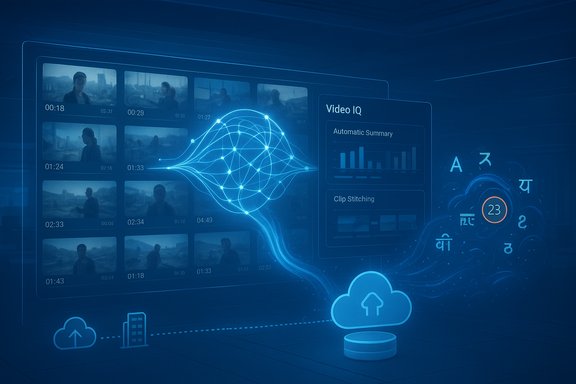
- Video IQ (intelligence layer) — built on Azure Video Indexer to analyze and tag every file and on Azure Data Factory to orchestrate ingestion pipelines from on‑premises stores to Azure. This turns raw footage into a searchable, insight‑rich asset library.
Key AI-driven features now in production
- Automatic metadata extraction (transcripts, keywords, topics, OCR, visual labels).
- Speaker diarization and time‑coded transcripts for fine‑grained navigation and highlight clipping.
- Custom facial recognition models used with individual approval to identify speakers or recurring participants (subject to limited‑access policy).
- Concise video summaries produced via Azure OpenAI models to accelerate consumption and indexing.
- Automated clip stitching and editorial assembly so users can request targeted compilations (for example, “top 10 innovations in APAC HR tech”) assembled from multiple source files.
Why this matters: immediate benefits and strategic upside
Efficiency and cost
By moving storage and indexing to Azure, Accenture expects to reduce data centre footprint and operating costs, rebuild its Chicago data centre at a much smaller scale, and create entirely cloud‑native production control rooms (for example, a new control room planned in Bangalore). These changes free production engineers from storage hunting and manual tagging, and redirect effort toward higher‑value creative and analytics work.Discovery and reuse
AI‑extracted metadata functions as an “AI librarian,” enabling fast, accurate search across previously inaccessible footage. That means teams can find precise segments, repurpose material, and reduce redundant production — creating operational leverage in global communications and client capture activities.New employee experiences
Accenture plans conversational search via an internal agent (Amethyst) based on Microsoft Copilot and Azure OpenAI, avatar‑based video summaries, and translations into 23 languages — all designed to make video archives globally accessible and usable as a day‑to‑day communication channel. These features will change video from a passive repository into an actionable knowledge layer.Technical validation: what Azure Video Indexer and related services provide
Azure Video Indexer is positioned as a cloud and edge video analytics service that extracts insights across audio and visual modalities (transcripts, OCR, visual labels, object detection, face detection/recognition under limited access, and more). It supports REST APIs, web portals and widgets for integration, and can run on‑premises through Azure Arc where data residency is required. The service also supports transcription and translation across dozens of languages and produces time‑coded insights that can drive search, clipping and content stitching. Microsoft’s product documentation and transparency notes clarify feature scopes and limitations: facial recognition capabilities are limited‑access and require registration/approval for sensitive use cases, while speaker identification within Video Indexer is typically constrained to diarization per file (speaker identifiers are random across files unless extended solutioning is used). These operational details matter for compliance and product design. Azure Data Factory provides the orchestration and ingestion pipelines required to lift media from distributed on‑premises storage into Azure at scale; combined with Video Indexer’s API surface it enables end‑to‑end automated indexing. For conversational, retrieval‑augmented experiences, Accenture’s architecture leverages Azure OpenAI and search/RAG patterns to ground generative answers in indexed transcripts and time‑stamped clips.Strengths: what Accenture and Azure do well together
- Enterprise scale and integration: Azure’s global footprint, managed services and identity/governance tooling let an organization of Accenture’s size centralize media without compromising security controls. This is crucial for a company with hundreds of offices and millions of minutes of video.
- Operational automation: Automating ingestion, indexing and environment provisioning (VPS) reduces manual handoffs and accelerates delivery cycles for broadcasts and post production. The reported 200–300 clips/week throughput indicates a usable production cadence.
- Search and composability: Time‑coded transcripts, speaker labels, and rich metadata enable advanced UX patterns — conversational agents, auto‑stitched highlight reels, and role‑targeted internal channels. These are not just conveniences; they change how knowledge flows in a large professional services firm.
- Platform‑first monetization: By productizing Video IQ as an internal service and client offering, Accenture gains the ability to showcase enterprise media modernization capabilities in RFPs, creating potential revenue channels.
Risks, caveats and governance considerations
Privacy and consent
Facial recognition and person identification are powerful but sensitive. Microsoft’s Video Indexer places facial identification behind limited‑access policies; any enterprise deployment must enforce consent workflows, opt‑in processes, and legal review for local privacy laws. Accenture’s approach of requiring individual approval for facial recognition use is a prudent baseline, but implementation details — consent capture, audit logs, deletion flows — determine compliance in different jurisdictions.Accuracy and editorial risk
Automated transcripts and AI summaries accelerate discovery but carry error rates. Audio quality, overlapping speech, domain vocabulary and accents can reduce transcription accuracy; speaker diarization may misassign lines in multi‑speaker or noisy segments. Any downstream production or business decision that relies on extracted metadata should include human verification points and confidence‑threshold handling in UX. Microsoft’s documentation calls out these limitations and recommends validation for low‑quality audio scenarios.Cost and consumption model
Video indexing pricing is duration‑based and tiered by audio/video feature sets. At scale, indexing minutes and the cost of storage, transcoding and retrieval can accumulate. Accenture’s move to Azure reduced legacy data centre spend, but teams should budget for indexing minutes, streaming egress, and potential preview/render costs when stitching clips for many users. Use of Azure’s pricing model and billing controls is essential to avoid surprise charges.Security and vendor lock‑in
Centralizing media and workflows on Azure delivers integration benefits but concentrates risk and vendor dependency. Organizations must define export/exit pathways for indexed metadata and ensure key management and data residency controls align with governance requirements. Hybrid deployment options (Video Indexer via Arc) mitigate some data‑sovereignty concerns but add architectural complexity.Ethical and IP considerations
Automated reuse and clip stitching may inadvertently surface copyrighted or externally sourced material (for example, guest appearances or third‑party clips). Rights management workflows and content provenance tracking must be baked into the indexing pipeline to prevent unintended distribution or IP violations. Metadata alone does not remove the need for editorial and legal checks.Practical checklist for organizations adopting a similar approach
- Define the business outcomes you need from video (searchability, compliance, monetization) and map them to feature sets (transcription, face matching, translation).
- Audit current media footprint: file formats, codecs, storage locations, retention policies and estimated minutes to index.
- Pilot ingestion and indexing for a representative set (noisy audio, multi‑speaker, multilingual) to validate transcription, diarization and facial recognition accuracy.
- Build consent and privacy controls before enabling facial recognition or speaker identity features; log approvals and make deletion flows auditable.
- Implement human‑in‑the‑loop review for high‑risk outputs (summaries used in decision making, clips exposed externally).
- Model total cost of ownership: indexing minutes, storage, egress, compute for AV processing and any downstream LLM usage for summaries or generative agents. Use Azure pricing calculators and reserve budgets for index growth.
Implementation patterns and operational best practices
- Use Azure Data Factory or similar ETL pipelines to standardize ingestion, normalize codecs and compute checksums for provenance. This enables repeatable, auditable content flows into the index.
- Employ confidence thresholds for automated metadata: only surface low‑confidence results in edit workflows rather than publishing them directly. This reduces noise and prevents bad metadata from propagating.
- Integrate indexed metadata into existing DAM/MAM systems using REST APIs and web widgets to preserve editorial workflows and content lifecycle management.
- Design UX that shows provenance and timestamped context for every auto‑generated summary or clip so users can quickly verify accuracy before reuse.
- Treat conversation‑style search agents (e.g., Amethyst/Copilot) as interfaces, not sources of truth: they should link to time‑coded segments and provide citations back to the underlying video and transcript. Embed guardrails that surface model confidence and original timestamps.
Cost considerations — illustrative (not definitive)
- Video indexing is billed by input duration and by feature tier (basic, standard, advanced). A free trial gives limited minutes; production usage will require paid accounts and careful quota planning. For heavy indexing, measure expected minutes/month and model both indexing and storage growth. Microsoft’s pricing page outlines duration‑based billing and feature bundles. Organizations should run a small, measurable pilot to extrapolate costs rather than rely solely on per‑minute heuristics.
Strategic takeaways and what to watch
- Accenture’s Video IQ demonstrates a pragmatic path to turn video from siloed storage into an indexable knowledge asset. The most immediate ROI is operational: less wasted time, fewer duplicate productions and faster content reuse.
- The next wave of value lies in search‑first experiences: conversational agents that stitch clips, multi‑language accessibility, and role‑based personalization of an internal video channel. These use cases depend as much on governance and UX design as on raw AI capability.
- Risk persists around accuracy, privacy and cost. Enterprises should treat AI‑extracted metadata as an augmentation, not an uncontested truth, and build verification, consent, and audit layers into the platform from day one.
- Finally, this is a repeatable enterprise pattern: centralize ingestion, index with multimodal AI, surface via conversational and programmatic interfaces. For large organizations that produce video at scale, the pattern reduces friction and consistently raises the value of previously dormant content.
Conclusion
Accenture’s Video IQ marks a clear shift in how enterprise media is managed: from fragmented, costly storage silos to a cloud‑native, AI‑indexed media fabric that enables discovery, reuse and new employee experiences. The project validates a practical playbook — centralize media on Azure, automate ingestion with Azure Data Factory, extract multimodal insights with Azure Video Indexer, and surface those insights through Copilot‑style conversational layers and targeted UX. The outcome is not only lower operational cost and faster production cycles but the creation of a searchable knowledge layer that can change how a global firm communicates and innovates.The deployment also underscores the responsibilities that come with media AI: privacy controls for face and voice recognition, careful accuracy validation, rights management, and cost governance. Organizations that adopt this pattern should combine technical pilots with a strong governance and editorial program to realize the benefits while limiting operational and legal risk. Accenture’s implementation provides a pragmatic, implementable model for other enterprises looking to unlock value in their video archives.
Source: Microsoft Accenture transforms video content management with Azure Video Indexer | Microsoft Customer Stories
