

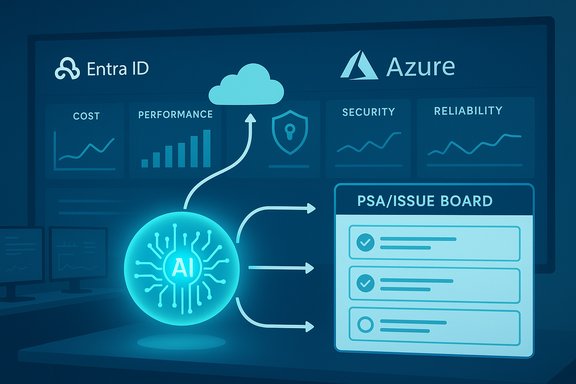
Auckland startup Spotto has moved its AI-driven cloud optimisation platform out of beta and into general availability, pitching a product aimed squarely at managed service providers (MSPs) and enterprise IT teams running Microsoft Azure estates and promising continuous scanning, consolidated insights, and automated ticket creation that converts optimisation signals into engineer‑ready, billable work.
Background
Spotto was founded in 2025 by cloud and SaaS veterans who built and operated Azure-centric managed services before launching the product, and the company frames Spotto as an operationally informed toolset designed to close the gap between raw cloud signals and deliverable engineering work. The platform’s core pitch is simple: rather than surfacing isolated alerts and recommendations across multiple Azure portals, Spotto continuously analyses tenants and automatically turns high‑confidence findings into contextualised tasks that flow into the MSP’s existing professional services automation (PSA) or issue tracker. Spotto’s move to general availability follows a period of active beta testing with MSPs, SaaS firms and early enterprise adopters. Public reporting of the GA release cites the product’s ability to run multiple daily scans per connected Azure tenant and to generate recommendations across cost, performance, security and reliability domains. The company claims its models now generate a material share of recommendations that go beyond what Azure Advisor provides.What Spotto does — a practical overview
Continuous, read‑only discovery and analysis
- Spotto connects to Azure via an Entra ID (Azure AD) application and operates with read‑only permissions, commonly using the Reader and Billing Reader roles across the subscriptions it monitors. This approach is intended to keep the platform auditable and reduce risk from an access‑control perspective.
- Once onboarded, Spotto runs multiple daily scans (the company describes the cadence as “multiple times per day”) and aggregates signals across:
- Cost and FinOps metrics (idle/underutilised resources, SKU mismatches),
- Performance indicators (misconfigured scale sets, inefficient VM types),
- Security posture items (policy drift, missing hardening), and
- Reliability and operational hygiene (backup gaps, single points of failure).
Action Engine: from signal to ticket
Spotto’s central differentiator is what it calls the Action Engine — a component that contextualises findings, prioritises them by business impact and effort estimate, and converts them into actionable tickets inside the MSP’s PSA or issue tracker (the company lists Jira, ConnectWise and Halo among integration examples). The intention is to hand engineers “ready‑to‑execute” tasks with supporting context, risk notes, alternatives and estimated effort, enabling more junior staff to deliver repeatable remediation work under standardised guidance.Proprietary AI recommendations
Spotto reports that roughly one‑third of its optimisation recommendations are produced by its own proprietary AI models rather than being direct translations of Azure Advisor signals — a claim the company says is based on operational experience running large, mission‑critical Azure environments. Each recommendation is documented with reasoning, impact analysis, risks and alternatives to support decision‑making. This claim appears prominently in vendor materials and press coverage and should be treated as a company‑reported metric until independently validated.Why MSPs and Azure‑first enterprises will care
Spotto’s product positioning addresses several recurring friction points for MSPs and enterprise cloud teams:- Operationalising insights into revenue: By converting optimisation signals into billable remediation tasks, Spotto reframes continuous optimisation as a recurring services pipeline rather than a one‑off cost exercise — a potentially attractive proposition for MSP business models that depend on predictable service revenue.
- Lowering the skill threshold for routine work: The platform’s contextual guidance and prioritisation aims to enable junior engineers to safely perform repeatable fixes, improving utilisation and reducing reliance on senior specialist time.
- Consolidation of disparate telemetry: Azure surfaces many signals across separate portals and products. Spotto aggregates performance, security, cost and reliability insights into a unified dashboard to reduce investigation time and help teams make prioritised decisions at scale.
- Workflow embedding: The PSA integrations mean work appears in systems MSPs already use, reducing workflow friction and making generated recommendations worth selling as services rather than simply showing them in a new dashboard. Public documentation and partner materials emphasise Jira as a documented integration and list ConnectWise and Halo as supported examples.
Product strengths and differentiators
1. Operator‑led design
Spotto’s founding team comes from hands‑on Azure MSP backgrounds, and the platform clearly reflects operational workflows (ticket creation, templated remediation, effort estimation) rather than being a pure analytics console. That design intent matters when tooling must fit into tight margins and predictable service packages.2. Actionable outputs, not only dashboards
Moving from visibility to execution—automated ticket creation and contextualised remediation instructions—closes a common gap in cloud management tooling: the inability to convert insights into predictable delivery. For MSP sales motions, that’s the difference between “looks interesting” and “billable work secured.”3. Azure focus
By specialising on Microsoft Azure, Spotto reduces multi‑cloud complexity and claims to apply deeper platform‑specific heuristics and models that generalist FinOps tools may not cover. For Azure‑heavy MSPs, that narrow focus can yield higher signal relevance and more practical remediation playbooks.Practical limitations and risks — what to probe before buying
Company‑reported claims need validation
Several headline claims—most notably the “33% of recommendations derived from Spotto’s models” figure and promised margin uplifts for MSPs—are presented as company outcomes in press materials. Procurement teams should ask for measurable pilot results, anonymised sample runs, and the vendor’s precision/recall or true‑positive rate on recommendations. Treat those figures as vendor‑reported until validated by trials in representative environments.Noise, signal quality and alert fatigue
Any automated recommendation engine can produce false positives. If remediation suggestions require heavy triage, MSPs will see the opposite outcome: higher triage cost, engineer distraction and reduced trust in automation. Ensure the pilot measures:- Recommendation acceptance rate,
- Time-to‑remediation when actions are recommended, and
- False positive and rollback events.
Integration maturity and operational brittleness
While Jira integration is documented, other PSA integrations are variably referenced in press materials and may require custom work or additional configuration. Confirm two‑way sync behavior, field mapping rules (project keys, epics, custom fields), and token handling before committing to deeply automated flows. Integration gaps can break billing flows and cause mismatches between ticket status and actual remediation progress.Permission and security posture
Spotto’s read‑only model (Reader + Billing Reader) is a good security baseline, but any automation that stores API tokens, triggers ticket creation or supports delegated execution introduces new attack surfaces. MSPs must insist on:- Encrypted token storage and key management,
- Robust audit logging correlated to customer identities,
- RBAC for who can enable automated execution, and
- A clear rollback/test mechanism for risky changes.
Vendor lock‑in and long‑term TCO
Embedding Spotto deeply into PSA and runbook workflows could raise switching costs. Buyers should model pricing (per tenant, per seat, or value‑share) against projected billable hours recovered, and run a 90‑day pilot to capture realistic economics. Ask for trial credits or pilot allowances to avoid early commercial surprises.A recommended evaluation plan for MSPs and enterprises
- Scope a representative pilot (30–90 days)
- Select 5–15 Azure tenants that match real customer profiles (mixed sizes, workloads and criticality).
- Maintain read‑only mode and require manual approvals for all actions for the first 30 days.
- Baseline critical KPIs
- Current MTTR (mean time to repair),
- Average monthly non‑worked remediation recommendations,
- Engineer utilisation and average ticket handling time,
- Cloud spend trends for pilot tenants.
- Measure recommendation quality
- Track: surfaced → accepted → implemented → validated (savings or risk mitigation).
- Capture acceptance ratio and time saved per accepted recommendation.
- Validate integration fidelity
- Confirm ticket creation, field mapping, comments/attachments, and status sync with Jira/ConnectWise/Halo.
- Stress test conditional routing (e.g., escalate high‑impact items to senior engineers; route repeatable tasks to juniors).
- Confirm governance and security
- Review audit logs, API token handling, RBAC controls, and encryption policies.
- Validate data residency and telemetry retention rules if regulatory constraints apply.
- Economic model
- Calculate billable revenue from accepted tasks vs. Spotto cost.
- Include ramp time to first billable engagement and conservative acceptance rates in TCO models.
- Exit criteria
- Define success thresholds for acceptance rates, MTTR reduction, and net margin improvement. Walk away or renegotiate if the pilot does not meet minimum thresholds within the agreed timescale.
Implementation guidance — technical knobs and operational controls
Onboarding and permissions
Spotto’s setup guides and documentation describe creating an Entra ID application and granting scoped Reader and Billing Reader permissions to the Spotto service principal. This follows established best practice for third‑party read‑only tooling and supports auditability. Confirm the vendor’s mechanism for subscription discovery and role assignment, and insist on least‑privilege techniques (resource group scoping where possible).Ticketing and flow control
- Map Spotto’s recommendation categories to existing PSA project keys and epics before enabling automated ticket creation.
- Add approval gates for actions that could affect production availability.
- Use templated remediation playbooks to ensure junior engineers follow consistent steps and to standardise time estimates.
Automation staging
- Start with read‑only guidance, then enable low‑risk, idempotent automations (e.g., scheduled off‑hours VM shutdowns).
- Maintain human approval for non‑idempotent operations (reboots, scale changes or configuration rollouts).
- Create canary targets and rollback playbooks for any automated change.
Monitoring and continuous improvement
- Track acceptance and rollback rates as control metrics.
- Periodically review model performance and request the vendor’s model‑confidence signals for low‑confidence recommendations.
- Feed outcomes back to the vendor for model improvement in a tightly governed signals loop.
Commercial and competitive context
The market for cloud optimisation, FinOps and CloudOps tooling is crowded and evolving. Established players already offer sophisticated FinOps, rightsizing and cloud optimisation features; Spotto’s strategic bet is to marry operator experience, Azure‑specific heuristics and tightly integrated PSA workflows. This narrow but deep approach can pay dividends for Azure‑centric MSPs, but buyers should benchmark recommendation quality, automation safety and the platform’s surface area against incumbents in their procurement process.Pricing models matter: fixed subscription, per‑tenant, or share‑of‑savings approaches each alter the economic calculus for MSPs. Ensure pilots capture time‑to‑first‑billable‑task so you can model realistic payback windows.
What Spotto still needs to prove (and where buyers must be cautious)
- Recommendation precision at scale: Vendor demos and early adopter quotes are encouraging, but the most important metric for operational adoption is precision (how often a recommended action is correct and useful) and effort accuracy (do estimated engineering hours match reality?. Request anonymised sample outputs and measurable pilot results.
- Integration completeness across PSAs: Jira documentation exists, but other integrations are mentioned more variably in press materials. Confirm the product’s integration matrix and test two‑way syncs before enabling automated processes.
- Economic durability: Some optimisation gains are one‑time; others recur. Buyers must model recurring value and confirm how Spotto’s recommendations maintain value after the first remediation wave.
- Operational risk from automated actions: Automated remediation is powerful but can be hazardous. Start small, require approvals, and enforce RBAC and auditability.
Final assessment — who should pilot Spotto and why
Spotto is a well‑targeted solution for Azure‑first MSPs and enterprise platform teams that:- Run multiple customer tenants at scale,
- Need predictable, billable operational work streams,
- Use PSAs like Jira, ConnectWise or Halo and want tighter automation, and
- Are willing to manage automation governance carefully.
Spotto’s GA launch marks another iteration in the industry’s push to make cloud operations actionable and monetisable, but success in the field will depend on measurable precision, safe automation, robust PSA integration and defensible economics — exactly the attributes MSPs must evaluate in a real pilot before scaling the platform across their customer base.
Source: ChannelLife New Zealand https://channellife.co.nz/story/spo...-platform-to-boost-azure-efficiency-for-msps/
