

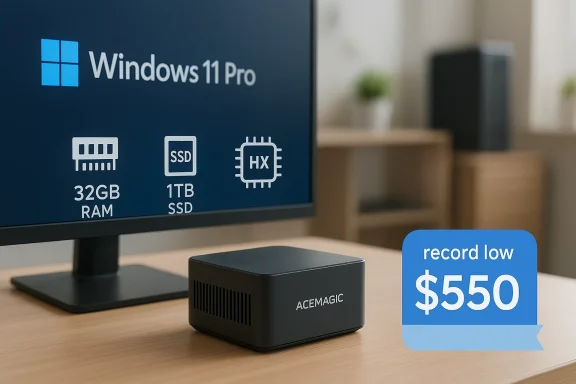
There is a reason mini PCs keep showing up in deal roundups: they solve one of the oldest problems in personal computing, which is how to get real desktop performance without surrendering your entire desk. The latest example is Gizmodo’s March 19, 2026 spotlight on the ACEMAGIC M5 Mini PC, a Windows 11 Pro machine with 32GB of RAM and a 1TB SSD that has reportedly fallen to a record-low $550 on Amazon, down from a stated regular price of $800. That combination of compact size, high-end memory, and a full desktop operating system makes the machine feel like a direct challenge to bulkier towers and even to some entry-level Macs. The bigger story, though, is not just that this one box is cheap; it is that the mini PC category has matured into a legitimate performance-first segment rather than a niche curiosity. (gizmodo.com)
Mini PCs have spent years moving from novelty to necessity. What began as a category dominated by ultra-low-power office boxes and media-center curiosities has increasingly become a space where manufacturers pack in laptop-class and even high-performance mobile silicon, substantial memory, and real storage. The result is a new kind of desktop: one that can sit behind a monitor, under a TV, or on a crowded shelf and still feel like a proper computer rather than a compromise. Gizmodo’s framing of the ACEMAGIC M5 as a Mac mini alternative is telling because the comparison is no longer about size alone; it is about what consumers can reasonably expect from a tiny PC in 2026. (gizmodo.com)
The ACEMAGIC M5 listing itself positions the machine as a configurable mini PC with Intel HX-series CPU options, including an i7-14650HX and i9-14900HX, while the article’s headline specifically highlights a model with an Intel Core 14500HX processor, 32GB RAM, and 1TB storage. Intel’s HX family is a clue to how far the category has come: these chips are designed for demanding mobile systems, not bargain-bin nettops. In Intel’s own product brief, the 14th-gen HX line stretches from the i5-14500HX up to the i9-14900HX, with the i5-14500HX reaching up to 4.9GHz on performance cores, which gives a sense of why mini PCs are now being sold on desktop-class feel rather than just convenience. (gizmodo.com)
Windows 11 Pro adds another layer to the appeal. Microsoft markets the Pro edition around basic enterprise security, including BitLocker and Windows Hello, plus business-oriented management and deployment features. That matters because many buyers do not want a cute little box that merely browses the web; they want something that can fit into a home office, a small business counter, or a study setup and still behave like a serious endpoint. In that sense, Windows 11 Pro is not just a software add-on; it is part of the pitch that mini PCs can be workstation-like in everyday use.
Mini PC deals also reflect a broader market pattern. Amazon’s deal culture has pushed hardware vendors toward short-lived price cuts, coupon gimmicks, and “record low” marketing language designed to create urgency. We have seen similar coverage around ACEMAGIC systems before, including other mini PCs with 32GB RAM and 1TB storage being positioned as Mac mini alternatives or compact gaming boxes. That recurring pattern suggests the category is increasingly competitive, but also somewhat unstable, with prices that can swing quickly and inventory that may not last long.
What makes the deal more interesting is the balance of specs. 32GB of RAM is more than enough for heavy multitasking, browser tab overload, office software, media work, and many development workflows. The 1TB SSD is equally important because one of the easiest ways to make a tiny PC feel premium is to avoid the constant storage anxiety that comes with 256GB or 512GB machines. In practice, storage and memory are what keep compact systems from feeling toy-like. (gizmodo.com)
That said, record-low claims should always be read carefully. The category’s pricing is volatile, and Amazon deal pages can be temporary, dynamic, or tied to limited stock. The practical takeaway is not that the price will inevitably disappear in minutes, but that buyers looking at mini PC promotions should treat them as time-sensitive rather than permanent benchmark pricing. (gizmodo.com)
Key reasons this deal stands out:
The practical significance is that mini PCs are now leveraging chips once reserved for more obviously premium laptops. That does not mean they are identical to full desktop CPUs in sustained thermal behavior, but it does mean they can handle workloads that would have sounded absurd in this form factor a few years ago. If the cooling design is competent, the user experience can be much closer to a compact desktop than to a bare-bones office box. (gizmodo.com)
It also changes the competitive landscape for all-in-one desktop alternatives. A mini PC with a laptop-derived HX chip may not replace a gaming tower, but it can absolutely replace an aging office desktop, a noisy underpowered box, or a Mac mini for users whose workflows are more Windows-oriented. In other words, the CPU is not just a component; it is a market positioning tool. (gizmodo.com)
Notable CPU implications:
For consumer buyers, the most important part of the memory story is less about benchmarks and more about friction. More RAM means more browser tabs, more apps open, less swapping, and a smoother experience when the machine is used for schoolwork, office work, or household management. A 1TB SSD, meanwhile, gives room for local files, project folders, cached assets, and app installs without immediately forcing cloud-first habits. (gizmodo.com)
In real-world use, the synergy matters. A system with ample RAM but poor storage feels sluggish under load, while a system with a fast SSD but too little memory can still stutter under tab-heavy workflows. The M5’s configuration tries to avoid that “half-premium” problem, and that is one of the strongest reasons a buyer might choose it over lower-cost mini PCs with cut-down specs. (gizmodo.com)
The practical takeaway:
This is also where the consumer-versus-enterprise split becomes important. For a home user, Windows 11 Pro may be appreciated mainly as a bonus: more control, more flexibility, and a sense of getting the “full” version of Windows. For a small business, freelancer, or IT-managed environment, Pro can matter because it aligns better with domain-style expectations, remote management habits, and a more disciplined update/security posture.
There is also a psychological dimension. Buyers often assume that anything in a mini form factor must be a compromise machine, but Pro licensing pushes against that assumption. It signals that the box is not merely small; it is intended to participate in the same security and workflow expectations as larger PCs. That is subtle, but it matters in how the product is perceived.
Windows 11 Pro advantages that matter here:
That matters more than people think because the compact-PC market is often won or lost on the unglamorous stuff: display outputs, USB ports, wireless stability, and how painless it is to add a keyboard, mouse, and external storage. Performance matters, but usability is what determines whether the device becomes a daily driver or a curiosity that lives in a drawer. (gizmodo.com)
For buyers, the real question is not whether the mini PC has ports at all, but whether it has enough of the right ports for their setup. The more a system can handle display, storage, input, and networking without adapters, the more it behaves like a proper desktop replacement. That is one reason compact PCs with richer I/O tend to age better in the market. (gizmodo.com)
In practice, this section of the spec sheet is what helps mini PCs cross the line from “interesting hardware” to “sensible purchase.”
That said, the competition is asymmetrical. The Mac mini remains a polished, integrated product with strong brand appeal, while ACEMAGIC’s offering is a value-driven hardware bundle whose strength lies in raw configuration. In the Windows world, the mini PC is often more practical because it preserves compatibility with desktop software, business tools, and peripheral ecosystems that still skew heavily toward Windows. (gizmodo.com)
Price is the other obvious advantage. A well-configured mini PC at $550 can look like a bargain precisely because it bundles RAM, storage, OS, and processor into a tidy package. Apple’s value proposition is different and often stronger for certain users, but for price-sensitive buyers who want a space-saving desktop, the ACEMAGIC deal makes a convincing case. (gizmodo.com)
The tradeoffs are equally clear:
That crowdedness has implications for the broader market. As more brands chase the mini PC space, the baseline for what counts as “good enough” keeps rising. A bare-bones mini PC is no longer especially interesting; buyers now expect at least 16GB of RAM, SSD storage, respectable connectivity, and a processor that does not feel dated on arrival. (gizmodo.com)
For consumers, that means deal literacy matters. The smartest buyers compare not only CPU and storage, but also cooling, firmware support, warranty policy, and seller reliability. In a category moving this fast, the cheapest machine is not always the smartest buy, even when the spec sheet looks irresistible.
Market dynamics to note:
The ACEMAGIC M5 deal also hints at how shopping behavior is changing. Buyers are now comfortable treating a mini PC as a legitimate replacement for a desktop tower or a Mac mini, especially when the spec mix looks generous and the footprint is minimal. The next phase of the market will likely reward vendors that pair strong hardware with trust, because trust is the scarce resource in a category built on aggressive pricing and compact ambition.
What to watch next:
Source: Gizmodo Forget the Mac Mini, This Windows 11 Pro Mini PC (32GB RAM, 1TB SSD) Drops to a Record Low on Amazon
 Background
Mini PCs have spent years moving from novelty to necessity. What began as a category dominated by ultra-low-power office boxes and media-center curiosities has increasingly become a space where manufacturers pack in laptop-class and even high-performance mobile silicon, substantial memory, and real storage. The result is a new kind of desktop: one that can sit behind a monitor, under a TV, or on a crowded shelf and still feel like a proper computer rather than a compromise. Gizmodo’s framing of the ACEMAGIC M5 as a Mac mini alternative is telling because the comparison is no longer about size alone; it is about what consumers can reasonably expect from a tiny PC in 2026. (gizmodo.com)The ACEMAGIC M5 listing itself positions the machine as a configurable mini PC with Intel HX-series CPU options, including an i7-14650HX and i9-14900HX, while the article’s headline specifically highlights a model with an Intel Core 14500HX processor, 32GB RAM, and 1TB storage. Intel’s HX family is a clue to how far the category has come: these chips are designed for demanding mobile systems, not bargain-bin nettops. In Intel’s own product brief, the 14th-gen HX line stretches from the i5-14500HX up to the i9-14900HX, with the i5-14500HX reaching up to 4.9GHz on performance cores, which gives a sense of why mini PCs are now being sold on desktop-class feel rather than just convenience. (gizmodo.com)
Windows 11 Pro adds another layer to the appeal. Microsoft markets the Pro edition around basic enterprise security, including BitLocker and Windows Hello, plus business-oriented management and deployment features. That matters because many buyers do not want a cute little box that merely browses the web; they want something that can fit into a home office, a small business counter, or a study setup and still behave like a serious endpoint. In that sense, Windows 11 Pro is not just a software add-on; it is part of the pitch that mini PCs can be workstation-like in everyday use.
Mini PC deals also reflect a broader market pattern. Amazon’s deal culture has pushed hardware vendors toward short-lived price cuts, coupon gimmicks, and “record low” marketing language designed to create urgency. We have seen similar coverage around ACEMAGIC systems before, including other mini PCs with 32GB RAM and 1TB storage being positioned as Mac mini alternatives or compact gaming boxes. That recurring pattern suggests the category is increasingly competitive, but also somewhat unstable, with prices that can swing quickly and inventory that may not last long.
What makes this deal stand out
The headline attraction here is obvious: a compact PC with a relatively powerful processor, generous memory, and a full terabyte of SSD storage for $550. For shoppers comparing whole-system value rather than component line items, that is a compelling bundle. The price cut is especially noteworthy because it places the machine in the zone where many buyers start comparing mini PCs against laptops, refurbished desktops, and even small-form-factor office towers. (gizmodo.com)What makes the deal more interesting is the balance of specs. 32GB of RAM is more than enough for heavy multitasking, browser tab overload, office software, media work, and many development workflows. The 1TB SSD is equally important because one of the easiest ways to make a tiny PC feel premium is to avoid the constant storage anxiety that comes with 256GB or 512GB machines. In practice, storage and memory are what keep compact systems from feeling toy-like. (gizmodo.com)
Why buyers notice “record low” pricing
“Record low” language works because mini PCs are often bought by spec-conscious shoppers who already know the market. They compare CPUs, storage, ports, and operating systems more aggressively than casual buyers do, which means even modest price changes can look dramatic. When a box that normally sits near $800 is suddenly marketed at $550, the discount lands as a value narrative, not just a coupon. (gizmodo.com)That said, record-low claims should always be read carefully. The category’s pricing is volatile, and Amazon deal pages can be temporary, dynamic, or tied to limited stock. The practical takeaway is not that the price will inevitably disappear in minutes, but that buyers looking at mini PC promotions should treat them as time-sensitive rather than permanent benchmark pricing. (gizmodo.com)
Key reasons this deal stands out:
- 32GB RAM makes multitasking feel far less constrained.
- 1TB SSD gives the system room to breathe immediately.
- Windows 11 Pro adds business-friendly features out of the box.
- HX-series Intel silicon signals higher performance ambition.
- The small footprint suits desks, dorms, counters, and media setups.
The CPU story matters more than the size
The processor is the part of the spec sheet that turns this from a gimmick into a serious buy. Intel’s Core i5-14500HX sits in the 14th-gen HX mobile family, which is aimed at systems that need more headroom than ordinary thin-and-light laptops. Intel’s product materials show the HX lineup built around higher turbo frequencies and a mobile architecture that can be configured in performance-heavy devices, which is exactly why it shows up in mini PCs that try to punch above their weight.The practical significance is that mini PCs are now leveraging chips once reserved for more obviously premium laptops. That does not mean they are identical to full desktop CPUs in sustained thermal behavior, but it does mean they can handle workloads that would have sounded absurd in this form factor a few years ago. If the cooling design is competent, the user experience can be much closer to a compact desktop than to a bare-bones office box. (gizmodo.com)
What 14500HX-class silicon signals
An HX chip changes the conversation around mini PCs because it raises expectations. Instead of asking whether the device can open a browser and stream video, buyers start asking whether it can manage photo editing, coding, multiple virtual desktops, or a modest creative workload. That shift matters because it expands the addressable audience from bargain hunters to serious productivity users.It also changes the competitive landscape for all-in-one desktop alternatives. A mini PC with a laptop-derived HX chip may not replace a gaming tower, but it can absolutely replace an aging office desktop, a noisy underpowered box, or a Mac mini for users whose workflows are more Windows-oriented. In other words, the CPU is not just a component; it is a market positioning tool. (gizmodo.com)
Notable CPU implications:
- Better headroom for multitasking and heavier productivity apps.
- Higher appeal for users who want a real desktop feel in a tiny chassis.
- More justification for pairing the device with 32GB RAM.
- Stronger positioning against entry-level desktops and refurb systems.
Memory and storage define the daily experience
A mini PC lives or dies by whether it feels cramped after the honeymoon period. That is why 32GB of RAM and a 1TB SSD are more than just attractive numbers; they are the difference between a machine that feels generous and one that constantly asks users to compromise. The Gizmodo piece leans heavily on that abundance for a reason, because the spec mix is what makes the deal feel premium rather than merely cheap. (gizmodo.com)For consumer buyers, the most important part of the memory story is less about benchmarks and more about friction. More RAM means more browser tabs, more apps open, less swapping, and a smoother experience when the machine is used for schoolwork, office work, or household management. A 1TB SSD, meanwhile, gives room for local files, project folders, cached assets, and app installs without immediately forcing cloud-first habits. (gizmodo.com)
Why capacity beats “just enough”
There is a reason budget computers still frustrate people years after purchase: they are often sold with just enough capacity to pass a launch-day review. Mini PCs avoid that trap when vendors ship them with serious memory and storage from the start. That is especially true when the operating system is Windows 11 Pro, which itself benefits from having breathing room for updates, background tasks, and business-oriented features.In real-world use, the synergy matters. A system with ample RAM but poor storage feels sluggish under load, while a system with a fast SSD but too little memory can still stutter under tab-heavy workflows. The M5’s configuration tries to avoid that “half-premium” problem, and that is one of the strongest reasons a buyer might choose it over lower-cost mini PCs with cut-down specs. (gizmodo.com)
The practical takeaway:
- 32GB RAM helps sustain multitasking over time.
- 1TB SSD avoids immediate upgrade pressure.
- The spec pairing is ideal for set-and-forget home office use.
- It also makes the system more viable for light creative and developer tasks.
Windows 11 Pro adds enterprise credibility
One of the better choices ACEMAGIC made here is shipping the machine with Windows 11 Pro instead of a more stripped-down edition. Microsoft’s own business documentation highlights features such as BitLocker, Windows Hello, and hardware-backed protection, which are meaningful if the mini PC is going to live in a home office, a reception area, or any shared environment where security and control matter.This is also where the consumer-versus-enterprise split becomes important. For a home user, Windows 11 Pro may be appreciated mainly as a bonus: more control, more flexibility, and a sense of getting the “full” version of Windows. For a small business, freelancer, or IT-managed environment, Pro can matter because it aligns better with domain-style expectations, remote management habits, and a more disciplined update/security posture.
Business features in a tiny box
The appeal of Windows 11 Pro in mini PCs is that it packages desktop computing and business readiness together. A small system can sit in a store, a front office, a study nook, or a WFH desk and still fit into standard Windows management patterns. That is a meaningful advantage over consumer appliances or more locked-down ecosystems because it preserves flexibility.There is also a psychological dimension. Buyers often assume that anything in a mini form factor must be a compromise machine, but Pro licensing pushes against that assumption. It signals that the box is not merely small; it is intended to participate in the same security and workflow expectations as larger PCs. That is subtle, but it matters in how the product is perceived.
Windows 11 Pro advantages that matter here:
- BitLocker for device-level protection.
- Windows Hello for modern sign-in options.
- Better fit for remote work and business workflows.
- A more credible story for managed endpoints.
Ports, connectivity, and desk-friendliness
A mini PC’s usefulness depends on how gracefully it disappears into a workspace. Gizmodo notes that the ACEMAGIC M5 has enough ports to make peripheral hookup easy and says the Wi‑Fi performance should keep the machine comfortably connected, which is exactly what buyers want from this kind of device. A tiny box is only truly small if it avoids cable chaos and dongle dependency. (gizmodo.com)That matters more than people think because the compact-PC market is often won or lost on the unglamorous stuff: display outputs, USB ports, wireless stability, and how painless it is to add a keyboard, mouse, and external storage. Performance matters, but usability is what determines whether the device becomes a daily driver or a curiosity that lives in a drawer. (gizmodo.com)
The importance of practical expansion
Mini PCs are often purchased by people who already have the rest of the ecosystem in place. They may own a monitor, use a wireless mouse and keyboard, and need only a small compute core. In that situation, a box with decent port selection and reliable networking can feel wonderfully elegant because it reduces visual clutter without reducing capability. (gizmodo.com)For buyers, the real question is not whether the mini PC has ports at all, but whether it has enough of the right ports for their setup. The more a system can handle display, storage, input, and networking without adapters, the more it behaves like a proper desktop replacement. That is one reason compact PCs with richer I/O tend to age better in the market. (gizmodo.com)
In practice, this section of the spec sheet is what helps mini PCs cross the line from “interesting hardware” to “sensible purchase.”
- Good Wi‑Fi reduces desk friction.
- Enough USB ports reduce dock dependence.
- Multiple display options improve placement flexibility.
- Better I/O makes the machine more future-proof.
How it stacks up against the Mac mini
The Mac mini comparison is not just clickbait; it reflects a genuine shopping decision. Apple’s tiny desktop has long been the gold standard for compact computing, but it also lives inside Apple’s ecosystem and, for many users, comes with higher entry pricing for similar memory and storage flexibility. A Windows 11 Pro mini PC like the ACEMAGIC M5 competes by offering more spec-for-spec flexibility and a different software environment that is often better for existing Windows users. (gizmodo.com)That said, the competition is asymmetrical. The Mac mini remains a polished, integrated product with strong brand appeal, while ACEMAGIC’s offering is a value-driven hardware bundle whose strength lies in raw configuration. In the Windows world, the mini PC is often more practical because it preserves compatibility with desktop software, business tools, and peripheral ecosystems that still skew heavily toward Windows. (gizmodo.com)
Where Windows mini PCs win
The biggest advantage of a Windows mini PC is straightforward: it is still a PC first. That means broader application compatibility for many work environments, easier integration into mixed-device households, and a more familiar path for users who already live inside Windows. For shoppers who do not want to adapt their workflow to macOS, the argument for a compact Windows machine is very strong.Price is the other obvious advantage. A well-configured mini PC at $550 can look like a bargain precisely because it bundles RAM, storage, OS, and processor into a tidy package. Apple’s value proposition is different and often stronger for certain users, but for price-sensitive buyers who want a space-saving desktop, the ACEMAGIC deal makes a convincing case. (gizmodo.com)
The tradeoffs are equally clear:
- Windows mini PCs can offer better value per spec.
- Mac minis often deliver stronger ecosystem polish.
- Mini PCs are more varied, which means quality can differ by vendor.
- Windows buyers may prioritize software compatibility over design.
The mini PC market is getting crowded
One of the most revealing things about this deal is not the product itself but how familiar it feels. Similar ACEMAGIC deals have appeared in other coverage, and that suggests the company is actively using Amazon to move inventory and keep its compact systems visible in a crowded category. Kotaku and Tom’s Guide have both highlighted ACEMAGIC mini PC offers in recent months, reinforcing the idea that these are not isolated bargains but part of a sustained pricing strategy.That crowdedness has implications for the broader market. As more brands chase the mini PC space, the baseline for what counts as “good enough” keeps rising. A bare-bones mini PC is no longer especially interesting; buyers now expect at least 16GB of RAM, SSD storage, respectable connectivity, and a processor that does not feel dated on arrival. (gizmodo.com)
Competitive pressure on rivals
The growing competition pressures both established PC brands and smaller import-focused vendors. Bigger names must decide whether to answer with cleaner support, better thermal engineering, and stronger warranty reputations, while newer entrants tend to compete on aggressively stacked specs. This creates a market where paper value can outshine long-term product confidence, especially if buyers focus too narrowly on the discount.For consumers, that means deal literacy matters. The smartest buyers compare not only CPU and storage, but also cooling, firmware support, warranty policy, and seller reliability. In a category moving this fast, the cheapest machine is not always the smartest buy, even when the spec sheet looks irresistible.
Market dynamics to note:
- More brands are using Amazon-first pricing to build volume.
- High-spec mini PCs are becoming mainstream productivity tools.
- Support and warranty quality remain a key differentiator.
- The category is still vulnerable to flash-sale hype.
Strengths and Opportunities
This ACEMAGIC M5 deal is attractive because it packages serious performance into a very small footprint, and it does so at a price that broadens the audience far beyond enthusiasts. The combination of 32GB RAM, 1TB SSD, Windows 11 Pro, and HX-class Intel silicon makes it suitable for students, home-office users, and small-business buyers who want desktop capability without desktop bulk. It is also a reminder that the mini PC has become a legitimate category, not a stopgap product class. (gizmodo.com)- Space-saving design fits modern home offices and dorm rooms.
- Strong memory and storage reduce upgrade pressure.
- Windows 11 Pro enhances business usefulness.
- HX-series CPU options raise performance expectations.
- Good price-to-spec ratio makes it easy to recommend on paper.
- Flexible placement works for desks, counters, and media setups.
- Broad PC compatibility remains a major selling point versus more locked ecosystems.
Risks and Concerns
The biggest caution is that mini PC deals can hide variance in build quality, cooling behavior, firmware maturity, and customer support. A great spec sheet is not the same as a polished long-term experience, and buyers should remember that discount-driven products sometimes lean heavily on the headline numbers. That is especially true in a category where brands are still fighting for trust and attention.- Thermal limits may affect sustained performance in a tiny chassis.
- Vendor support quality can be inconsistent across mini PC brands.
- Limited stock may make the deal disappear quickly.
- Warranty confidence may matter more than the discount itself.
- Marketing language like “record low” can oversell short-term pricing.
- Unknown component substitutions are always a concern in lower-profile PC brands.
- Long-term update and firmware support may lag behind bigger vendors.
Looking Ahead
Mini PCs are heading toward a simple but important future: they will increasingly be judged like mainstream desktops, not novelty hardware. That means consumers will expect better thermals, cleaner firmware, stronger support channels, and fewer compromises once the box is on the desk. If ACEMAGIC and its rivals want to keep winning, they will need to prove that a tiny PC can be dependable for years, not just exciting on sale day. (gizmodo.com)The ACEMAGIC M5 deal also hints at how shopping behavior is changing. Buyers are now comfortable treating a mini PC as a legitimate replacement for a desktop tower or a Mac mini, especially when the spec mix looks generous and the footprint is minimal. The next phase of the market will likely reward vendors that pair strong hardware with trust, because trust is the scarce resource in a category built on aggressive pricing and compact ambition.
What to watch next:
- Whether the $550 price holds or disappears after limited stock clears.
- Whether competing mini PCs answer with better cooling or better support.
- How the market values Windows 11 Pro versus consumer editions.
- Whether more brands adopt HX-series processors in compact systems.
- Whether buyers start demanding clearer warranty and firmware commitments.
Source: Gizmodo Forget the Mac Mini, This Windows 11 Pro Mini PC (32GB RAM, 1TB SSD) Drops to a Record Low on Amazon
