

The mini PC market keeps proving that small form factors no longer mean compromise, and this ACEMAGIC Ryzen 7 5700U system is a good example of why. The headline specs — 8 cores / 16 threads, 32GB of RAM, 512GB SSD storage, and Windows 11 Pro — place it firmly in the “serious everyday machine” category rather than the “toy computer” bucket. But the real question is not whether it looks impressive on paper; it is whether the CPU, graphics, storage, and connectivity choices make sense for the price and the use cases being advertised. ACEMAGIC itself has been positioning the 5700U family as a compact desktop solution for work, media, and light gaming, and the broader mini-PC market suggests the pitch is aimed squarely at buyers who want maximum versatility from minimal desk space
Mini PCs have matured from niche office appliances into legitimate desktop alternatives. A few years ago, the category was mostly defined by low-power Intel N-series chips, stripped-down memory configurations, and modest port selection. Today, buyers can find Ryzen-powered systems with enough memory and storage to handle mainstream productivity, multi-monitor work, and even casual gaming without needing a full tower or discrete GPU. That shift matters because it changes what “compact” means: no longer a synonym for limited, but rather a design choice that trades expansion and raw GPU headroom for footprint, energy efficiency, and convenience.
This particular ACEMAGIC model sits in the middle of that transition. ACEMAGIC’s own product pages for similar 5700U mini PCs show a consistent formula: Ryzen 7 mobile silicon, ample RAM, NVMe storage, Windows 11 Pro, and VESA mounting for behind-monitor placement. That combination is appealing because it covers the broadest possible audience. Office users get a fast, quiet machine. Home users get a media and browsing box. Light gamers get enough integrated graphics to run popular esports titles at reduced settings. IT buyers get a small system that is easy to deploy in signage, kiosks, or desktop fleets.
The CPU choice is also telling. AMD’s official specs for the Ryzen 7 5700U list 8 cores, 16 threads, a 1.8 GHz base clock, and up to 4.3 GHz boost, along with integrated AMD Radeon Graphics rated at 1900 MHz on the processor page. That means the product listing’s “up to 4.4GHz” claim is close to AMD’s published boost number, though not identical. In practice, that difference is small, but it is the kind of detail careful buyers should notice because mini-PC vendors frequently emphasize best-case numbers while leaving thermal constraints to the fine print.
The integrated graphics story is more nuanced. The 5700U is not a gaming chip in the modern desktop-GPU sense, but it is powerful enough for older or lighter titles, video playback, and general acceleration. ACEMAGIC’s own marketing around the 5700U family has repeatedly framed it as a “mini desktop” for work and entertainment, and independent coverage of similar Ryzen 7 5700U mini PCs has described them as capable of basic productivity, streaming, and light gaming rather than AAA-class performance. That distinction is important: the machine can absolutely be useful for gaming, but only within realistic expectations.
At the same time, the 5700U is no longer a cutting-edge part. Newer Ryzen mobile chips, especially those with Radeon 780M-class graphics or newer Zen 4/Zen 5 designs, can deliver meaningfully better GPU performance and stronger AI or media engines. That means this ACEMAGIC model is best understood as a value-focused purchase, not a future-proof flagship.
The 512GB SSD is sensible as a starter drive, though not generous. ACEMAGIC’s own product ecosystem and related coverage show a tendency to bundle 512GB as the standard storage floor on budget and midrange mini PCs. That keeps the entry price down, but it also means buyers who collect large game libraries or media assets may outgrow the drive quickly. The listing’s mention of a second 2.5-inch SSD slot and total expansion up to 2TB is a practical selling point, assuming the chassis and thermal design support sustained usage without throttling.
Independent coverage of Ryzen 7 5700U mini PCs has repeatedly framed them as value systems for basic tasks and light gaming, not enthusiast rigs. That is consistent with the hardware class. The 5700U’s iGPU is fine for mainstream titles that are optimized, older, or less demanding, but it will struggle as game engines get heavier and memory bandwidth demands increase.
The inclusion of Wake-on-LAN and auto power-on points to more than casual home use. These are the kinds of features that make sense in classrooms, kiosks, retail displays, and small business deployments. If a device is going to live behind a monitor or in a rack, the ability to bring it back online remotely can be more important than raw peak performance.
The stronger the enterprise angle, the more important reliability becomes. Mini PC buyers often expect these systems to run 24/7, and features like remote wake, embedded Windows Pro licensing, and VESA mounting all reinforce that idea. This is less like buying a gaming laptop and more like buying a compact endpoint.
The small chassis also works well in living rooms and media setups. A full tower can dominate a console cabinet or TV stand, but a VESA-mounted mini PC can stay out of sight. That is a genuine lifestyle advantage, not just a marketing flourish.
That said, buyers in specialized environments should be careful. A consumer mini PC is not automatically an industrial PC. Environmental tolerance, long-term parts availability, and validated support all matter more in those settings than they do in a home office.
That does not make the 5700U obsolete. It just means the machine must win on price, not headline performance. If ACEMAGIC positions it correctly, the system can still be compelling for buyers who value affordability and mature platform behavior over peak frame rates or bleeding-edge features.
For consumers:
For creative work, expectations should be moderate. Light photo editing, casual content creation, and modest video work are realistic. Heavy 4K editing, 3D rendering, or anything that needs a discrete GPU is a different category entirely.
Buyers should therefore judge this machine the way they would judge a compact appliance: how stable, cool, and quiet is it over time? A mini PC that runs a little slower but stays reliable is often more useful than one that spikes high and then throttles hard.
If buyers treat it as a compact productivity PC with light gaming capability, it makes sense. If they expect a hidden gaming powerhouse, disappointment is likely. That gap between marketing narrative and actual hardware behavior is where many small PCs win or lose their reputations.
In that sense, this ACEMAGIC mini PC is a very contemporary product: not groundbreaking, not perfect, but well aligned with how a lot of people now want to use Windows. If the price is right, it could be exactly the kind of box that turns a cluttered desk into a cleaner, more functional workspace without making the owner feel like they compromised on capability.
Source: kliksolonews.com https://kliksolonews.com/7-5700U-32GB-RAM-512GB-SSD-Windows-11-Pro-4K-Triple-Display-762097/
 Overview
Mini PCs have matured from niche office appliances into legitimate desktop alternatives. A few years ago, the category was mostly defined by low-power Intel N-series chips, stripped-down memory configurations, and modest port selection. Today, buyers can find Ryzen-powered systems with enough memory and storage to handle mainstream productivity, multi-monitor work, and even casual gaming without needing a full tower or discrete GPU. That shift matters because it changes what “compact” means: no longer a synonym for limited, but rather a design choice that trades expansion and raw GPU headroom for footprint, energy efficiency, and convenience.This particular ACEMAGIC model sits in the middle of that transition. ACEMAGIC’s own product pages for similar 5700U mini PCs show a consistent formula: Ryzen 7 mobile silicon, ample RAM, NVMe storage, Windows 11 Pro, and VESA mounting for behind-monitor placement. That combination is appealing because it covers the broadest possible audience. Office users get a fast, quiet machine. Home users get a media and browsing box. Light gamers get enough integrated graphics to run popular esports titles at reduced settings. IT buyers get a small system that is easy to deploy in signage, kiosks, or desktop fleets.
The CPU choice is also telling. AMD’s official specs for the Ryzen 7 5700U list 8 cores, 16 threads, a 1.8 GHz base clock, and up to 4.3 GHz boost, along with integrated AMD Radeon Graphics rated at 1900 MHz on the processor page. That means the product listing’s “up to 4.4GHz” claim is close to AMD’s published boost number, though not identical. In practice, that difference is small, but it is the kind of detail careful buyers should notice because mini-PC vendors frequently emphasize best-case numbers while leaving thermal constraints to the fine print.
The integrated graphics story is more nuanced. The 5700U is not a gaming chip in the modern desktop-GPU sense, but it is powerful enough for older or lighter titles, video playback, and general acceleration. ACEMAGIC’s own marketing around the 5700U family has repeatedly framed it as a “mini desktop” for work and entertainment, and independent coverage of similar Ryzen 7 5700U mini PCs has described them as capable of basic productivity, streaming, and light gaming rather than AAA-class performance. That distinction is important: the machine can absolutely be useful for gaming, but only within realistic expectations.
Hardware Positioning
The strongest thing about this ACEMAGIC configuration is not any single component. It is the balance of the parts. The Ryzen 7 5700U remains a respectable Zen 3 mobile chip, and paired with 32GB of DDR4 RAM, the system should feel smooth for everyday multitasking, browser-heavy workflows, office suites, messaging, and moderate creative work. The amount of memory matters more than many buyers realize, because on integrated-graphics systems the GPU also borrows system RAM, which makes 32GB a meaningful cushion rather than a luxury.Why the 5700U Still Makes Sense
AMD’s published specs show a chip designed for efficiency rather than brute force: 15W default TDP and configurable power tuning from 10–25W. That helps explain why this processor remains popular in mini PCs. It delivers enough multi-threaded performance to feel modern while staying relatively manageable in compact enclosures. For office work, streaming, and light photo editing, that is a strong fit.At the same time, the 5700U is no longer a cutting-edge part. Newer Ryzen mobile chips, especially those with Radeon 780M-class graphics or newer Zen 4/Zen 5 designs, can deliver meaningfully better GPU performance and stronger AI or media engines. That means this ACEMAGIC model is best understood as a value-focused purchase, not a future-proof flagship.
- Good fit for productivity and multitasking
- Strong enough for light content creation
- Adequate for casual gaming and emulation
- Not ideal for heavy AAA gaming
- More efficient than many traditional desktops
Memory and Storage Choices
The included 32GB of RAM is arguably the most future-proof part of the configuration. In 2026, 16GB is still acceptable for basic Windows use, but 32GB gives room for browser tabs, conferencing apps, photo tools, and multiple virtual desktops without immediate pressure. It also fits the mini-PC audience well, because these systems are often purchased to replace older office towers where memory upgrades are inconvenient.The 512GB SSD is sensible as a starter drive, though not generous. ACEMAGIC’s own product ecosystem and related coverage show a tendency to bundle 512GB as the standard storage floor on budget and midrange mini PCs. That keeps the entry price down, but it also means buyers who collect large game libraries or media assets may outgrow the drive quickly. The listing’s mention of a second 2.5-inch SSD slot and total expansion up to 2TB is a practical selling point, assuming the chassis and thermal design support sustained usage without throttling.
- 32GB RAM is the configuration’s real comfort zone
- 512GB SSD is usable, but not expansive
- Expansion support adds meaningful flexibility
- Integrated systems benefit more from memory than raw clock speed
- Buyers should verify the exact drive bay and M.2 layout before ordering
Graphics and Gaming Reality
The advertised AMD Radeon Vega 7 graphics are the most marketing-heavy part of the pitch. The underlying 5700U platform uses integrated Radeon graphics, and the processor page lists an 8-core graphics block running at 1900 MHz. In other words, this is competent integrated graphics, not a discrete gaming solution. That distinction needs to stay front and center because it defines the machine’s real ceiling.What “Gaming” Actually Means Here
The claim that it can play CS:GO, PUBG, COD, and DOTA 2 is plausible only with qualifiers. Esports and older competitive titles are where integrated Radeon graphics can still shine, especially at lower resolutions or reduced details. But if buyers interpret “gaming” as high-framerate modern AAA play, they will be disappointed. The mini PC can handle games, yes — just not every game in the same way a true gaming desktop can.Independent coverage of Ryzen 7 5700U mini PCs has repeatedly framed them as value systems for basic tasks and light gaming, not enthusiast rigs. That is consistent with the hardware class. The 5700U’s iGPU is fine for mainstream titles that are optimized, older, or less demanding, but it will struggle as game engines get heavier and memory bandwidth demands increase.
Triple Display Support and 4K Output
The most compelling graphics-related feature is actually not gaming performance; it is display flexibility. The system advertises 4K triple-display support, which is a major productivity advantage for a compact PC. Mini PCs are especially strong in roles where screen real estate matters more than graphics horsepower: dashboards, coding setups, financial work, control rooms, and digital signage.- Three displays can transform a tiny box into a workstation
- 4K output is ideal for media and office clarity
- Multi-monitor support is valuable for remote work
- Integrated graphics are enough when the use case is spread across screens
- Gaming on one screen while productivity runs on others is realistic only at modest settings
Connectivity and Ports
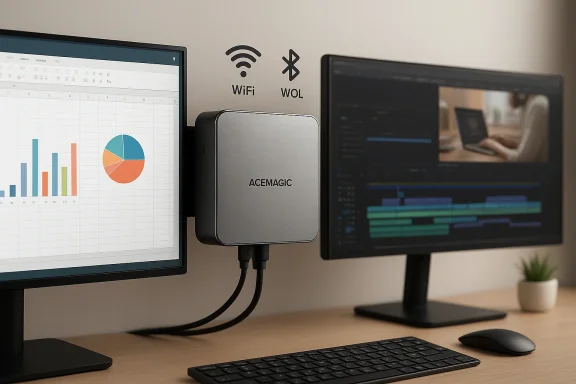
Mini PCs live or die by connectivity. Because they are small, they cannot afford to waste the few ports they have. ACEMAGIC’s inclusion of Wi‑Fi 6, Bluetooth 5.2, auto power-on, Wake-on-LAN, and Windows 11 Pro puts this machine firmly in the business-friendly camp as well as the consumer one. That is exactly how compact systems win buyers: by acting like infrastructure, not just a tiny PC.Why Wireless and Wake Features Matter
Wi‑Fi 6 is now table stakes for a modern desktop-class device, but it still matters because many mini PCs end up in homes or offices where Ethernet is not always convenient. Bluetooth 5.2 also makes sense for keyboards, headsets, and game controllers. These are small quality-of-life details that make a big difference on a compact system because the whole point is to reduce cable clutter.The inclusion of Wake-on-LAN and auto power-on points to more than casual home use. These are the kinds of features that make sense in classrooms, kiosks, retail displays, and small business deployments. If a device is going to live behind a monitor or in a rack, the ability to bring it back online remotely can be more important than raw peak performance.
- Wi‑Fi 6 improves wireless stability and throughput
- Bluetooth 5.2 supports modern accessories
- Wake-on-LAN helps with remote management
- Auto power-on is useful after outages
- Windows 11 Pro adds business features and flexibility
Windows 11 Pro as a Selling Point
Windows 11 Pro is not just a checkbox. For many buyers, it unlocks BitLocker, Remote Desktop host support, group policy controls, and easier business deployment. That is one reason mini PCs have become popular in office refresh cycles: they give IT departments a low-footprint machine with familiar software tooling.The stronger the enterprise angle, the more important reliability becomes. Mini PC buyers often expect these systems to run 24/7, and features like remote wake, embedded Windows Pro licensing, and VESA mounting all reinforce that idea. This is less like buying a gaming laptop and more like buying a compact endpoint.
Design and Deployment
The design language of these systems has become standardized for a reason. Buyers want something discreet, easy to mount, and professional-looking. ACEMAGIC’s brushed texture finish and included VESA mount match that expectation, allowing the machine to disappear behind a monitor or under a desk while still remaining easy to service.The Value of Physical Discretion
In a home office, the mini PC removes the visual and acoustic footprint of a traditional tower. In a business environment, it reduces clutter and simplifies cable management. That makes it an ideal fit for shared spaces, front desks, conference rooms, and permanent installations where aesthetics matter almost as much as performance.The small chassis also works well in living rooms and media setups. A full tower can dominate a console cabinet or TV stand, but a VESA-mounted mini PC can stay out of sight. That is a genuine lifestyle advantage, not just a marketing flourish.
- VESA mounting improves placement flexibility
- Brushed finish makes the system look more professional
- Tiny footprint helps on crowded desks
- Hidden placement can reduce visual noise
- Serviceability still matters, so access panels should be easy to reach
Office, Home, and Embedded Uses
The listing’s mention of digital signage, medical devices, and industrial use is typical of mini-PC marketing, but those categories are not random. Compact Windows systems are popular wherever space is limited and software compatibility matters. They are also easier to deploy in large numbers than bulky desktops, especially when the same model can be mounted behind displays or integrated into a fixture.That said, buyers in specialized environments should be careful. A consumer mini PC is not automatically an industrial PC. Environmental tolerance, long-term parts availability, and validated support all matter more in those settings than they do in a home office.
Competitive Context
The ACEMAGIC system arrives in a market crowded with similar-value mini PCs from names like Beelink, GMKtec, TRIGKEY, Kamrui, and others. The broad trend across recent coverage is clear: manufacturers are packing more RAM, faster storage, and richer display support into increasingly affordable boxes. That has made mini PCs one of the most competitive corners of consumer computing.How It Compares to Newer Mini PCs
The challenge for a Ryzen 7 5700U machine is that the category has moved on quickly. Newer mini PCs with Ryzen 7 7735U, 7840U, or 8745HS-class processors bring stronger graphics, better memory platforms, and often more modern I/O. TechRadar and PCWorld coverage of newer compact systems shows a market where Wi‑Fi 6E, dual 2.5GbE LAN, USB4, and faster integrated graphics are becoming common in higher-end models.That does not make the 5700U obsolete. It just means the machine must win on price, not headline performance. If ACEMAGIC positions it correctly, the system can still be compelling for buyers who value affordability and mature platform behavior over peak frame rates or bleeding-edge features.
Consumer vs Enterprise Appeal
Consumers care about smooth Windows use, streaming, office work, and casual gaming. Enterprises care about manageability, footprint, and predictability. The ACEMAGIC 5700U package speaks to both, but not equally.For consumers:
- The low-profile design is attractive
- Triple-monitor support is a real advantage
- 32GB RAM improves day-to-day comfort
- Light gaming is good enough for many buyers
- Windows 11 Pro is a strong checkbox
- Wake-on-LAN helps remote handling
- VESA mounting simplifies deployment
- A proven AMD platform can ease imaging and support
Performance Expectations
This is the section where expectations need discipline. The Ryzen 7 5700U is a capable CPU, but mini PCs are constrained by cooling, power limits, and memory bandwidth. A desktop tower with the same chip could behave differently under sustained loads, and a mini enclosure can pull performance down if thermals are not well managed. That is why product design matters so much in this category.Real-World Use Cases
For office and productivity work, the system should feel fast. The 8-core/16-thread CPU combined with 32GB RAM is enough for spreadsheets, browser-heavy research, video calls, and office multitasking. For media consumption, 4K playback and dual- or triple-display setups are particularly attractive.For creative work, expectations should be moderate. Light photo editing, casual content creation, and modest video work are realistic. Heavy 4K editing, 3D rendering, or anything that needs a discrete GPU is a different category entirely.
- Excellent for web, office, and communication tools
- Very good for media and multitasking
- Acceptable for light creative workloads
- Limited for modern AAA gaming
- Not a substitute for a workstation GPU setup
Thermal Behavior and Sustained Loads
One of the less glamorous truths about mini PCs is that sustained performance matters more than benchmark headlines. A short boost to 4.3 or 4.4 GHz sounds good, but compact cooling can force the chip to settle lower during extended workloads. That is not necessarily a flaw — it is the compromise that makes the product small.Buyers should therefore judge this machine the way they would judge a compact appliance: how stable, cool, and quiet is it over time? A mini PC that runs a little slower but stays reliable is often more useful than one that spikes high and then throttles hard.
Strengths and Opportunities
This ACEMAGIC mini PC has several strengths that explain why the category keeps growing. The combination of 32GB RAM, a proven Ryzen 7 5700U, and Windows 11 Pro is immediately practical, and the addition of triple-display support broadens its appeal far beyond casual desktop use. In other words, it is not trying to be flashy; it is trying to be useful, and that is often the smarter pitch in the mini-PC market.- Strong multitasking thanks to 8 cores and 16 threads
- 32GB of RAM reduces memory pressure in Windows 11
- Compact form factor saves desk space
- Triple 4K display support improves productivity
- VESA mount makes placement flexible
- Windows 11 Pro helps with business and remote management
- Good fit for media centers, office work, and signage deployments
Risks and Concerns
The biggest risk is overpromising. When a product says “gaming” in the headline, many buyers will mentally leap to desktop-like expectations, even when the hardware is integrated graphics only. The Ryzen 7 5700U is a good chip, but it is still a 2021-era mobile processor, and the mini-PC market has advanced quickly since then.- Integrated graphics will not satisfy demanding gamers
- Newer mini PCs may offer better value if price differences are small
- The 512GB SSD may feel cramped over time
- Thermal limits can reduce sustained performance
- Product listings sometimes exaggerate boost clocks or expansion claims
- Buyers should verify exact port and storage configurations before purchase
Looking Ahead
The mini-PC segment is moving toward a simple formula: more performance per cubic inch, more useful I/O, and fewer excuses. This ACEMAGIC machine fits the current moment because it offers enough CPU and memory for mainstream users while staying small enough to vanish into a workspace. But its long-term relevance will depend on price discipline and honest positioning, not just spec-sheet appeal.If buyers treat it as a compact productivity PC with light gaming capability, it makes sense. If they expect a hidden gaming powerhouse, disappointment is likely. That gap between marketing narrative and actual hardware behavior is where many small PCs win or lose their reputations.
- Watch how it is priced against newer Ryzen 7000/8000 mini PCs
- Compare real port layouts, not just headline connectivity claims
- Check whether the 2.5-inch storage bay is truly present in every SKU
- Look for thermal testing under sustained load
- Confirm whether the Wi‑Fi and Bluetooth modules are modern revisions
- Evaluate whether 32GB/512GB is enough for the intended workload
In that sense, this ACEMAGIC mini PC is a very contemporary product: not groundbreaking, not perfect, but well aligned with how a lot of people now want to use Windows. If the price is right, it could be exactly the kind of box that turns a cluttered desk into a cleaner, more functional workspace without making the owner feel like they compromised on capability.
Source: kliksolonews.com https://kliksolonews.com/7-5700U-32GB-RAM-512GB-SSD-Windows-11-Pro-4K-Triple-Display-762097/
