

Acer’s latest refresh of the Aspire lineup brings the company’s mainstream notebooks into the new era of on-device AI by shipping Aspire 14 AI and Aspire 16 AI Copilot+ PCs built around Intel’s new Core Ultra Series 3 (Panther Lake) silicon, combining thinner, lighter industrial designs with OLED display options, refreshed I/O and media features, and on-device neural acceleration intended to make Windows 11’s Copilot and Acer’s own AI toolset more responsive and private than cloud-dependent alternatives.
Intel’s Core Ultra Series 3, code‑named Panther Lake, is the first mainstream client SoC family produced on Intel’s 18A process and represents the company’s latest push to fuse general CPU, GPU, and neural processing into power‑efficient mobile platforms. These processors introduce new core microarchitectures, an updated integrated GPU generation (Xe3), and refreshed NPU/AI accelerators to deliver higher sustained performance within thin laptop envelopes.
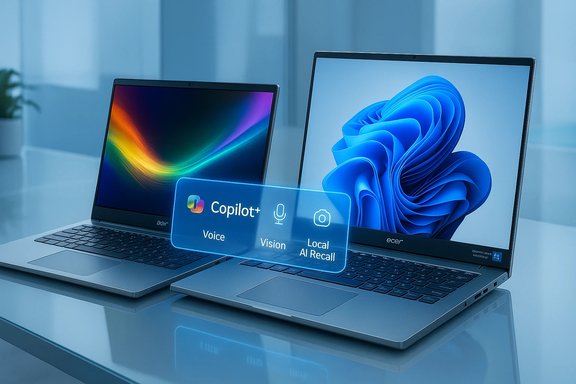
Acer’s announcement places the new Aspire AI machines squarely in the “Copilot+ PC” category promoted by Microsoft, meaning the hardware is tuned to support richer local AI experiences in Windows 11 — voice and vision features, selective local inference, and accelerated co‑processing between the CPU, GPU and NPU. The Aspire 14 AI (A14‑I71M/T) and Aspire 16 AI (A16‑I71M/T) shipped in Acer’s messaging with options for up to Intel Core Ultra 9 386H silicon, up to 32 GB LPDDR5X memory, PCIe Gen 4 SSD storage, and panel choices that include high‑refresh WUXGA 16:10 and OLED options.
The strength of the proposition depends less on headline TOPS or architectural slides and more on ecosystem readiness: driver maturity, Windows and third‑party app support, and realistic thermal behavior in thin chassis. For everyday users and organizations seeking Copilot+ capabilities now, Acer’s new Aspire AI models are compelling candidates — provided buyers temper expectations around sustained heavy compute and plan for the normal rollout bumps that accompany any platform shift to integrated, on‑device AI.
Source: TechPowerUp Acer Introduces Aspire AI Copilot+ PCs Featuring Intel Core Ultra Series 3 Processors
 Background / Overview
Intel’s Core Ultra Series 3, code‑named Panther Lake, is the first mainstream client SoC family produced on Intel’s 18A process and represents the company’s latest push to fuse general CPU, GPU, and neural processing into power‑efficient mobile platforms. These processors introduce new core microarchitectures, an updated integrated GPU generation (Xe3), and refreshed NPU/AI accelerators to deliver higher sustained performance within thin laptop envelopes.Acer’s announcement places the new Aspire AI machines squarely in the “Copilot+ PC” category promoted by Microsoft, meaning the hardware is tuned to support richer local AI experiences in Windows 11 — voice and vision features, selective local inference, and accelerated co‑processing between the CPU, GPU and NPU. The Aspire 14 AI (A14‑I71M/T) and Aspire 16 AI (A16‑I71M/T) shipped in Acer’s messaging with options for up to Intel Core Ultra 9 386H silicon, up to 32 GB LPDDR5X memory, PCIe Gen 4 SSD storage, and panel choices that include high‑refresh WUXGA 16:10 and OLED options.
What Acer announced: Aspire 14 AI and Aspire 16 AI — the essentials
Acer’s refreshed Aspire AI pair is designed to be the practical, accessible end of the Copilot+ PC market — mainstream devices with a tilt toward productivity, hybrid learning, and general content creation.- Models: Aspire 14 AI (A14‑I71M/T) and Aspire 16 AI (A16‑I71M/T).
- Processors: Up to Intel Core Ultra 9 386H (Series 3 Panther Lake).
- Memory: Up to 32 GB LPDDR5X (onboard).
- Storage: Up to 2 TB M.2 PCIe Gen 4 SSD (varies by model).
- Displays: 14‑ and 16‑inch WUXGA 16:10 panels with refresh rates up to 120 Hz, plus optional OLED versions and touch/non‑touch choices.
- Camera / audio: 1080p FHD IR webcam with privacy shutter, triple‑mic array, DTS:X audio.
- Ports: Dual USB‑C with Thunderbolt 4, USB‑A, HDMI 2.1, audio jack.
- Battery / chassis: Thin‑and‑light designs with large touchpads and a 180‑degree full‑flat hinge for collaborative use.
Inside Panther Lake: what Series 3 brings to Aspire AI
New node, new microarchitecture, new balance
Intel’s Series 3 Core Ultra (Panther Lake) is significant for three architectural reasons:- It is the first mainstream client product line built on Intel’s advanced 18A process node, a step Intel describes as improving transistor density and power efficiency compared with previous nodes.
- The CPU core mix has been remodeled with newer P‑ and E‑core designs (referred to in Intel materials by new code names) to deliver improved instructions per watt and higher multi‑threaded throughput within similar thermal budgets.
- Integrated graphics move to Xe3 architecture with larger core counts on higher SKUs (e.g., Arc‑class iGPU options), making the integrated GPU substantially more capable than prior generations.
NPU and on‑device AI: how it matters
Panther Lake is built around the expectation that everyday AI features should run locally and efficiently. The platform aggregates performance across CPU, GPU and a dedicated NPU to accelerate:- Natural language tasks such as dictation, context‑aware command execution and Copilot interactions.
- Computer vision tasks tied to Copilot Vision and camera pipelines (e.g., scene understanding, live transcription, image prompts).
- Local model inference for snappy “click to do” actions and privacy‑sensitive workflows that don’t require round trips to cloud services.
Design and media: displays, haptics, and usability
Acer kept familiar design cues but tuned them for hybrid work and media creation:- Display choices: Both Aspire models offer 16:10 aspect ratio panels with high refresh rates (up to 120 Hz) and optional OLED that promise deeper contrast and wider color gamuts than standard LCDs. These panels are well suited for video conferencing, content creation, and media consumption.
- Touchpad and hinge: The Aspire machines include a generously sized touchpad and a full‑flat 180° hinge — small but practical touches that improve collaboration in classrooms and meetings.
- Webcam and microphones: A 1080p IR webcam and triple‑mic array with privacy shutter positions both machines as better than average for the videoconferencing era.
- Thermals and chassis: Acer emphasizes thin‑and‑light construction; however, thin designs always force a tradeoff between sustained performance and acoustics/thermal throttling. Expect constrained sustained clocks on the highest TDP workloads without an aggressive thermal solution.
Software stack and Copilot+ experience
Acer sells the hardware as Copilot+ PCs, which in practical terms means:- Deep integration with Windows 11 Copilot features such as voice and vision assistants, Recall previews, and local co‑processing of AI tasks.
- On‑device enhancements via Acer Intelligence Space and bundled utilities like PurifiedVoice (noise suppression), PurifiedView and Acer My Key (user‑programmable hotkeys).
- Support for hardware acceleration routing between CPU, GPU, and NPU to speed common AI tasks.
Performance expectations: vendor claims vs. real‑world signals
Intel and its OEM partners headline big percentage gains in IPC, graphics and AI TOPS — claims that are useful directional signals but require cautious reading.- Vendor claims: Intel’s architectural briefings and OEM PR emphasize double‑digit improvements in CPU efficiency and step‑level gains in integrated graphics. Acer’s product materials highlight fluid multitasking, snappy AI features and competent media editing on the integrated graphics in the higher‑end SKUs.
- Real‑world caveats:
- Benchmarks in vendor slides are typically best‑case scenarios; thin laptops will not sustain peak clocks for prolonged rendering or gaming.
- NPU TOPS numbers (platform TOPS) illustrate potential throughput but don’t directly translate to application‑level latency or model compatibility.
- Driver and ecosystem readiness (Windows ML runtimes, accelerator drivers, and third‑party apps) will heavily influence real‑world gains.
Competitive context: where Aspire AI fits in the market
Acer’s Aspire AI refresh enters a crowded field of AI‑aware laptops, and several factors will determine how competitive it is:- Against AMD Ryzen AI: AMD’s Ryzen AI chips have pushed aggressive NPU performance and strong CPU efficiency in certain notebooks. Acer has previously shipped Aspire variants with Ryzen AI, and buyers comparing options will weigh raw NPU TOPS, software compatibility, and thermal envelopes.
- Against Qualcomm and Apple silicon: Qualcomm’s Snapdragon X platforms and Apple M‑series chips continue to compete on always‑on AI features, power efficiency and integrated modem + platform synergy. Windows PC OEMs must differentiate on Windows compatibility and broader app ecosystems.
- Value positioning: Aspire historically targets mainstream budgets, so Acer’s ability to offer optional OLED and Series 3 silicon at accessible price points could make the Aspire AI a pragmatic entry point to Copilot+ for students and SMBs.
Pricing, availability and regional rollout
Acer’s announcements included region‑specific timing rather than single global ship dates. Product availability will vary by market and configuration:- Aspire 16 AI: slated for North America availability in Q2 2026, with EMEA availability in Q2 2026.
- Aspire 14 AI: indicated to reach North America in Q3 2026, with EMEA and Australia timing announced slightly earlier.
Strengths: what Acer gets right
- Practical AI integration: By combining Panther Lake silicon with Windows 11 Copilot and Acer’s utility suite, Acer is delivering usable, privacy‑focused local AI features rather than theoretical NPU benchmarks.
- Balanced hardware for everyday use: The specs — up to 32 GB LPDDR5X, PCIe Gen 4 storage, OLED panels — align well with the needs of students, office workers and light creators.
- Modern I/O and media: Thunderbolt 4, HDMI 2.1, 1080p IR webcams and good speakers place the Aspire AI models ahead of many value laptops in meeting hybrid‑work demands.
- Product segmentation: Acer continues to differentiate Swift, Nitro and Aspire lines clearly, letting Aspire be the practical mainstream choice while Swift and Predator address premium and gaming markets respectively.
Risks, tradeoffs and unanswered questions
No launch is without risk. The Aspire AI announcements surface several issues buyers and IT managers should weigh:- Thermal versus performance tradeoffs: Thin chassis improve portability but constrain sustained power. Expect performance throttling on prolonged CPU/GPU loads compared to thicker H‑class gaming laptops. For users needing consistent heavy workloads, a more robust thermal design may be necessary.
- Driver and software maturity: Many of the user‑facing wins depend on driver stacks, Windows integration, and app‑level optimizations for Intel’s NPU. Early adopters may encounter driver updates, feature rollouts, or compatibility gaps during the first months of availability.
- NPU real‑world advantage: TOPS figures are useful marketing numbers but not a direct measure of perceived speed in real tasks. Model availability, quantization support, and runtime optimization determine how much of the NPU’s theoretical power is consumable by applications.
- Privacy vs. convenience: On‑device Copilot features reduce reliance on the cloud but raise questions about local data storage, model updates, and enterprise policy controls. Organizations will need to review data governance around local AI recall and voice processing.
- Repairability and longevity: Thin, soldered designs with onboard LPDDR5X improve density but reduce upgradability. For long‑term TCO, limited serviceability and component soldering may weigh against modular business devices.
- Supply and pricing uncertainty: Regionally staggered availability and unannounced pricing for many configurations create purchasing uncertainty for constrained budgets or procurement schedules.
Buying guidance: who should consider Aspire 14/16 AI
- Students and general office users who want a Windows laptop that feels faster day‑to‑day thanks to local AI acceleration and a responsive UI.
- Hybrid workers who value better webcams, microphones and battery life combined with modern I/O.
- Content creators on a budget who will benefit from OLED options and a competent integrated GPU for light editing and rendering.
- IT buyers in small organizations seeking Copilot+ capabilities without committing to high‑end workstations.
Practical tips for buyers and IT administrators
- Evaluate the exact SKU: choose the CPU/GPU/NPU configuration that matches the thermal budget and expected workloads.
- Prioritize displays based on use: OLED for color‑accurate media work; high‑refresh WUXGA for smoother scrolling and cursor movement in productivity apps.
- Factor in software maturity: plan for driver updates and test Copilot+ workflows in a pilot group before an organization‑wide roll‑out.
- Consider warranty and service options: thin machines are often less repairable — extended warranty or on‑site service can reduce downtime risk.
- Assess privacy settings and enterprise policies: define how local AI features store or access data and ensure compliance with corporate data governance.
Conclusion
Acer’s introduction of the Aspire 14 AI and Aspire 16 AI Copilot+ PCs with Intel’s Core Ultra Series 3 processors is a pragmatic step toward mainstreaming on‑device AI. The combination of Panther Lake silicon, optional OLED displays, modern I/O and a clear focus on Windows 11 Copilot makes these notebooks a meaningful option for users who want faster, more private AI interactions without moving to premium price points.The strength of the proposition depends less on headline TOPS or architectural slides and more on ecosystem readiness: driver maturity, Windows and third‑party app support, and realistic thermal behavior in thin chassis. For everyday users and organizations seeking Copilot+ capabilities now, Acer’s new Aspire AI models are compelling candidates — provided buyers temper expectations around sustained heavy compute and plan for the normal rollout bumps that accompany any platform shift to integrated, on‑device AI.
Source: TechPowerUp Acer Introduces Aspire AI Copilot+ PCs Featuring Intel Core Ultra Series 3 Processors
