

At Computex 2026 in Taipei, Acer’s Predator booth centered on three gaming devices: the Windows 11-based Predator Atlas 8 handheld with Intel Arc G3 Extreme graphics, the Predator Helios 18 AI laptop with RTX 5090-class hardware, and the Predator XB273K 3D 4K monitor. The through-line was not subtle. Acer is trying to make Predator feel less like a badge on fast parts and more like an ecosystem for every place PC gaming now happens: couch, desk, hotel room, tournament table, and streaming setup. The gamble is that Windows gaming hardware can keep scaling outward without collapsing under its own complexity.
For years, the gaming PC industry had a fairly simple Computex rhythm: faster CPUs, larger GPUs, thinner chassis, brighter RGB, and a few thermal claims that sounded suspiciously familiar from the previous year. Acer’s 2026 Predator showing still has plenty of that muscle-flexing, especially in the Helios 18 AI, but the more interesting story is how the company is spreading the Predator brand across form factors that used to be separate categories.
The Predator Atlas 8 is the clearest example. A Windows handheld is not a laptop, not a console, and not exactly a tablet, but Acer is treating it as a serious Predator-class machine rather than a novelty side project. That matters because the handheld PC market has moved from “Steam Deck curiosity” to a real competitive lane where AMD, Intel, Lenovo, Asus, MSI, Acer, and Microsoft-adjacent Xbox branding all now have something to prove.
The Helios 18 AI plays a different role. It is the cathedral of the booth: an 18-inch showcase for the highest-end laptop parts Acer can credibly cool, topped with a Mini LED WQUXGA display that reads less like a portable compromise and more like a desk replacement trying to justify its existence. If the Atlas is about mobility, the Helios is about permission to ignore mobility almost entirely.
Then there is the Predator XB273K 3D, which is perhaps the strangest of the three. A 27-inch 4K 180 Hz IPS gaming monitor with built-in 2D-to-3D conversion sounds like a throwback to an earlier 3D-display boom that the market mostly abandoned. Yet its presence is revealing: Acer is betting that immersion is becoming a hardware feature again, not just a buzzword attached to ray tracing, HDR, and spatial audio.
That 1920×1200 panel is the most important spec after the processor. On a handheld, resolution is not just about sharpness; it is about UI density, game scaling, emulator presentation, text legibility, and whether Windows feels merely tolerated or actually usable. A 16:10 panel gives Acer a little more vertical room than 16:9 alternatives, which matters in both games and the Windows shell.
The 120 Hz refresh rate is equally strategic. Handhelds rarely live at maximum fidelity, but high refresh panels allow smoother motion at lower settings, variable frame pacing, and more graceful performance targets like 40, 48, or 60 fps. The best handheld experiences are not always the ones that chase raw frame rates; they are the ones that find a stable performance envelope and stay there.
Intel’s presence is the headline because AMD has dominated the Windows handheld story through Ryzen Z-series silicon and its many close relatives. Acer choosing Intel Arc G3 Extreme gives Intel a visible design win in a category where perception matters as much as benchmarks. Handheld buyers do not just buy silicon; they buy faith that drivers, firmware, power management, and game compatibility will hold together six months after launch.
That is where Acer’s PredatorSense interface becomes more than a skin. Running on top of Windows 11 Home, it is intended to control hardware features and organize games, which is exactly the kind of layer every Windows handheld needs because Windows itself still has not become a console-like handheld operating system. Microsoft has improved pieces of the experience, and OEMs have built their own launchers, but the category remains a patchwork of Windows, vendor utilities, storefronts, overlays, and controller translation.
The Atlas 8 therefore carries two burdens at once. It has to prove that Intel’s new handheld graphics platform can compete with AMD’s established mobile gaming stack, and it has to prove that Acer can tame Windows into something that feels natural in both hands. The silicon will get the headlines, but the software layer may decide whether people keep using it after the first week.
Acer cannot fix that alone. PredatorSense can hide some complexity, centralize performance controls, and make the device feel more appliance-like, but the underlying platform remains Windows 11 Home. That means the Atlas 8 will probably live or die by how quickly Acer can expose the controls gamers actually need: TDP settings, fan curves, resolution presets, refresh rate switching, game profiles, controller mapping, firmware updates, and launcher integration.
This is the hidden competition among Windows handhelds. The processor matters, the battery matters, and the display matters, but the interface layer increasingly defines the product. Asus has Armoury Crate SE, Lenovo has Legion Space, MSI has its own handheld software stack, and Acer now has PredatorSense serving as both command center and game shelf.
The problem is that every OEM building its own handheld shell risks repeating the classic Windows PC fragmentation problem in miniature. Each launcher works differently, each exposes different settings, and each depends on vendor support after purchase. SteamOS succeeded on the Steam Deck not because Linux magically became easier than Windows, but because Valve controlled the experience end to end.
That is the challenge facing the Atlas. Acer is selling PC freedom in a handheld body, but PC freedom is only attractive when the friction is low enough not to ruin the living-room moment. A handheld is used in shorter bursts, in less controlled environments, and often by people who do not want to troubleshoot a driver dialog before playing a game on the couch.
That does not mean Intel is doomed. Integrated graphics have improved dramatically, and Intel’s recent GPU work has been far more serious than the company’s old reputation in graphics would suggest. But handheld gaming is cruel because every watt is visible. Performance that looks good in a spec sheet can become less impressive once battery life, thermals, fan noise, and driver consistency enter the picture.
Acer’s booth demo can show that the Atlas 8 is real, responsive, and visually compelling. It cannot yet answer the deeper questions that buyers and reviewers will ask: how long the machine lasts in demanding games, how well it handles shader compilation, whether older DirectX titles behave properly, how quickly Intel releases game-ready fixes, and whether performance collapses when the device is tuned for sane acoustics.
The 24 GB of LPDDR5X memory is a sensible move because handhelds share memory between CPU and GPU. More memory gives the system breathing room for modern games, background launchers, and Windows itself. It also helps distinguish the Atlas from lower-spec devices that can look attractive on price but age quickly as games become more demanding.
The 1 TB NVMe drive is similarly pragmatic. PC games are enormous, and a premium handheld with 512 GB increasingly feels like a device designed around immediate storage anxiety. Acer appears to understand that a handheld PC should not force its owner into storage triage before the third major install.
The CPU configuration described for the 290HX Plus, with eight performance cores and sixteen efficiency cores, is exactly the kind of hybrid architecture Intel has made central to its high-end mobile strategy. For gamers, the raw number is less interesting than how the system allocates work under load. A high-end gaming laptop can be derailed by background tasks, thermal spikes, or overly aggressive power limits, and that is where platform tuning matters.
The RTX 5090 Laptop GPU is the other half of the identity. Mobile GPUs are not desktop GPUs, and experienced buyers know to ask about power limits, cooling capacity, and sustained clocks rather than just the model name. Still, putting the 5090 badge in an 18-inch Predator machine signals that Acer wants this device judged against the heaviest hitters in mobile gaming, not against mainstream notebooks.
The display may be the component most likely to age well. A 16:10 Mini LED WQUXGA panel with 1000 nits brightness and Calman verification gives Acer a screen that speaks to gamers, creators, and anyone who has grown tired of expensive laptops with mediocre panels. The 3840×2400 resolution is demanding for games, but it is excellent for desktop work, editing timelines, coding, and multitasking.
That combination is what makes the Helios 18 AI interesting beyond the usual “fast laptop is fast” story. It is not only a gaming notebook; it is a machine for people who want one device to replace a tower, a monitor, and perhaps a content-creation workstation. Acer is chasing the buyer who edits video, plays at night, travels occasionally, and refuses to choose between performance and display quality.
Gaming laptop performance has become increasingly dependent on chassis-level engineering. Two notebooks with the same CPU and GPU can behave very differently depending on power budgets, vapor chamber design, fan behavior, keyboard surface temperature, and firmware tuning. This is why spec-sheet comparisons are often misleading at the high end.
The Helios 18 AI’s 18-inch chassis gives Acer room to work. Larger laptops can move more air, fit larger heat pipes or vapor chambers, and avoid the worst compromises of thin-and-light designs. But size alone is not a guarantee. A big chassis with conservative tuning can underperform, while a thinner machine with aggressive acoustics can win benchmarks and lose owners.
The MagKey 4.0 low-profile mechanical keyboard is another sign Acer is trying to make the Helios feel like a true desktop replacement. Keyboard feel matters more on an 18-inch laptop than on an ultraportable because users are more likely to actually use the built-in deck for long sessions. If the machine is supposed to replace a battlestation, the keyboard cannot feel like an afterthought.
The risk is that “AI” in the name becomes the least meaningful part of the product. In 2026, nearly every premium PC is wrapped in AI branding, whether or not the user experience changes in a visible way. For the Helios 18 AI, buyers will care much more about thermals, fan noise, panel quality, keyboard feel, GPU power limits, and upgradeability than about another badge on the palm rest.
That feature will divide people immediately. Some will hear “2D-to-3D conversion” and remember a wave of televisions, laptops, and monitors that promised depth and mostly delivered eye strain, gimmicks, and abandoned ecosystems. Others will see it as part of a broader return to spatial computing, glasses-free 3D experimentation, and display-side processing that does not depend entirely on game developers.
Acer is not alone in revisiting immersive display concepts, but the XB273K 3D’s challenge is unusually clear. Gamers will tolerate a novelty mode only if the base monitor is good enough when the novelty is off. A 4K 180 Hz IPS panel gives it that foundation, assuming real-world response behavior, overdrive tuning, brightness, contrast, and input latency hold up in reviews.
The 27-inch size is also significant. At 4K, 27 inches remains a sweet spot for pixel density, desk fit, and competitive gaming posture. It is not as cinematic as a 32-inch or ultrawide panel, but it is easier to place, easier to drive, and more familiar to esports-minded players who sit close to the screen.
The 3D conversion feature therefore becomes an add-on rather than the whole identity. That is probably the right approach. The first rule of resurrecting a once-failed display idea is to make sure the product remains useful if the resurrection does not convince everyone.
A monitor like the XB273K 3D has a different opportunity. If Acer’s conversion system can add depth without demanding constant attention, it may succeed as an optional enhancement rather than a lifestyle change. That is the difference between a feature and a burden.
The danger is latency and artifacting. Any display-side conversion system has to interpret a 2D image and generate a convincing depth effect quickly enough not to harm gameplay. That may be acceptable in cinematic single-player titles but less attractive in competitive shooters, racing games, or anything where visual clarity and timing matter more than immersion.
There is also the content problem. Native stereoscopic support in mainstream PC gaming is not where earlier 3D evangelists once hoped it would be. Conversion can work around that, but conversion is by definition an approximation. Acer will need the XB273K 3D to make ordinary games look better often enough that users remember to turn the feature on.
Still, the timing is not absurd. Gamers are already comfortable with upscaling, frame generation, HDR tone mapping, variable refresh, and driver-level enhancements that manipulate the final image. Display-side 3D is another step in that direction: not pure rendering, but processed experience.
This is where PC hardware is heading. The raw components are still essential, but the user experience increasingly depends on the layers between the component and the player. Firmware, utilities, display processors, AI-assisted tuning, driver stacks, and profile systems are becoming the actual product.
That is uncomfortable for traditional PC enthusiasts because it moves value away from easily compared specifications. A processor model, memory capacity, panel resolution, and GPU name can be placed in a table. A good handheld interface, a sane fan curve, or a convincing 3D conversion algorithm cannot be judged as cleanly.
It also raises the support stakes. If Acer sells the Atlas 8 as a premium Windows handheld, owners will expect updates that improve compatibility and performance over time. If it sells the Helios 18 AI as an elite machine, owners will expect BIOS and control software that do not sabotage expensive parts. If it sells the XB273K 3D as a monitor with a special visual mode, buyers will expect that feature not to be abandoned once the next panel generation arrives.
The best gaming hardware companies in the next few years may not be the ones that merely ship the fastest devices. They may be the ones that maintain the invisible glue after launch.
That breadth is valuable, but it is also risky. Predator can mean “portable console-like Windows device,” “giant enthusiast notebook,” and “experimental display” only if Acer maintains a coherent quality bar. If one product feels half-baked, it weakens the brand logic connecting the others.
For WindowsForum readers, the Atlas 8 is probably the most consequential product because it touches the unresolved question of Windows on handheld PCs. Microsoft and its partners clearly see handheld gaming as too important to leave to Valve and console makers, but the platform experience remains uneven. Acer’s device will add pressure for better Windows handheld modes, better controller-first navigation, and better power management.
For sysadmins and IT pros, the Helios 18 AI may be the more familiar machine. It fits into the long history of powerful laptops used for creative work, engineering, software development, demos, and gaming after hours. Its Windows 11 Home configuration may not be enterprise-oriented, but the hardware class overlaps with mobile workstation expectations.
For display enthusiasts, the XB273K 3D is the curiosity worth watching. It may not redefine gaming monitors, but it shows that panel vendors and OEMs are still looking for differentiation beyond refresh rate escalation. At some point, the race from 144 Hz to 180 Hz to 240 Hz to 500 Hz becomes less meaningful for most buyers; immersion features are one attempt to find a new axis.
The Atlas 8 needs independent battery-life numbers across real games, not just performance demos. It needs driver maturity across older and newer titles, reliable suspend and resume behavior, and a UI that does not collapse when a launcher misbehaves. It also needs pricing that acknowledges how crowded the handheld field has become.
The Helios 18 AI needs sustained performance testing under combined CPU and GPU loads. Reviewers will need to measure fan noise, keyboard deck temperature, panel behavior, power draw, and whether the RTX 5090 Laptop GPU is configured aggressively enough to justify the premium. The badge alone is not enough.
The XB273K 3D needs scrutiny of its core monitor performance before anyone judges the 3D feature. A fast 4K IPS panel can still be compromised by poor overdrive, weak HDR, mediocre contrast, or awkward processing. If the base experience is strong, the 3D mode can be a bonus; if the base experience is weak, the 3D mode becomes a distraction.
This is the part of the story where the enthusiast community earns its keep. Spec sheets start the conversation, but owners and reviewers finish it.
That pressure creates opportunity for Acer, Intel, NVIDIA, AMD, Microsoft, and every display maker in the chain. It also creates more ways for products to disappoint. The more complex the experience becomes, the more important integration becomes.
The Atlas 8 may be the most politically important device because it gives Intel another public shot at the handheld category and gives Acer a chance to establish Predator as a serious name in portable PC gaming. The Helios 18 AI is the prestige machine, designed to remind buyers that Acer can still build a heavyweight laptop around the most expensive silicon available. The XB273K 3D is the experiment, a monitor that asks whether immersion can be processed into the display rather than coded into every game.
Acer’s booth, in other words, was less about one killer product than a map of where gaming hardware is going. The PC is no longer a single shape. Predator now has to follow it everywhere.
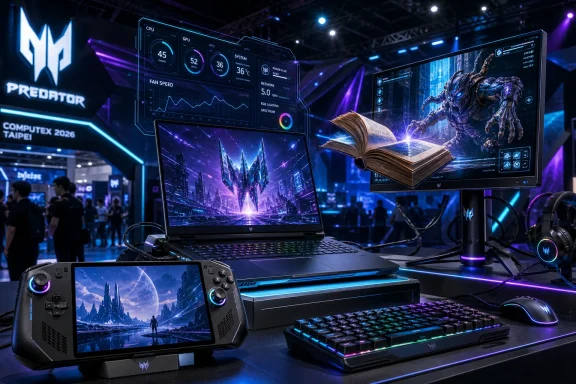 Acer’s Predator Pitch Is No Longer Just Bigger Frames per Second
For years, the gaming PC industry had a fairly simple Computex rhythm: faster CPUs, larger GPUs, thinner chassis, brighter RGB, and a few thermal claims that sounded suspiciously familiar from the previous year. Acer’s 2026 Predator showing still has plenty of that muscle-flexing, especially in the Helios 18 AI, but the more interesting story is how the company is spreading the Predator brand across form factors that used to be separate categories.The Predator Atlas 8 is the clearest example. A Windows handheld is not a laptop, not a console, and not exactly a tablet, but Acer is treating it as a serious Predator-class machine rather than a novelty side project. That matters because the handheld PC market has moved from “Steam Deck curiosity” to a real competitive lane where AMD, Intel, Lenovo, Asus, MSI, Acer, and Microsoft-adjacent Xbox branding all now have something to prove.
The Helios 18 AI plays a different role. It is the cathedral of the booth: an 18-inch showcase for the highest-end laptop parts Acer can credibly cool, topped with a Mini LED WQUXGA display that reads less like a portable compromise and more like a desk replacement trying to justify its existence. If the Atlas is about mobility, the Helios is about permission to ignore mobility almost entirely.
Then there is the Predator XB273K 3D, which is perhaps the strangest of the three. A 27-inch 4K 180 Hz IPS gaming monitor with built-in 2D-to-3D conversion sounds like a throwback to an earlier 3D-display boom that the market mostly abandoned. Yet its presence is revealing: Acer is betting that immersion is becoming a hardware feature again, not just a buzzword attached to ray tracing, HDR, and spatial audio.
The Atlas 8 Is Acer’s First Real Argument in the Handheld PC War
The Predator Atlas 8 is built around Intel’s Arc G3 Extreme platform, paired here with 24 GB of LPDDR5X memory and 1 TB of NVMe storage. Its display is an 8-inch-class 16:10 touchscreen running at 1920×1200 and 120 Hz, a specification that immediately tells you where Acer thinks the market is heading. The lesson of recent handhelds is that 720p was good enough to start the category, but not good enough to define its future.That 1920×1200 panel is the most important spec after the processor. On a handheld, resolution is not just about sharpness; it is about UI density, game scaling, emulator presentation, text legibility, and whether Windows feels merely tolerated or actually usable. A 16:10 panel gives Acer a little more vertical room than 16:9 alternatives, which matters in both games and the Windows shell.
The 120 Hz refresh rate is equally strategic. Handhelds rarely live at maximum fidelity, but high refresh panels allow smoother motion at lower settings, variable frame pacing, and more graceful performance targets like 40, 48, or 60 fps. The best handheld experiences are not always the ones that chase raw frame rates; they are the ones that find a stable performance envelope and stay there.
Intel’s presence is the headline because AMD has dominated the Windows handheld story through Ryzen Z-series silicon and its many close relatives. Acer choosing Intel Arc G3 Extreme gives Intel a visible design win in a category where perception matters as much as benchmarks. Handheld buyers do not just buy silicon; they buy faith that drivers, firmware, power management, and game compatibility will hold together six months after launch.
That is where Acer’s PredatorSense interface becomes more than a skin. Running on top of Windows 11 Home, it is intended to control hardware features and organize games, which is exactly the kind of layer every Windows handheld needs because Windows itself still has not become a console-like handheld operating system. Microsoft has improved pieces of the experience, and OEMs have built their own launchers, but the category remains a patchwork of Windows, vendor utilities, storefronts, overlays, and controller translation.
The Atlas 8 therefore carries two burdens at once. It has to prove that Intel’s new handheld graphics platform can compete with AMD’s established mobile gaming stack, and it has to prove that Acer can tame Windows into something that feels natural in both hands. The silicon will get the headlines, but the software layer may decide whether people keep using it after the first week.
Windows 11 Is Still the Handheld’s Best Asset and Biggest Liability
The awkward truth about Windows handhelds is that their greatest advantage is also their central weakness. Windows gives users access to Steam, Epic Games Store, Xbox PC titles, Battle.net, GOG, emulators, mods, anti-cheat-dependent multiplayer games, and the messy fullness of PC gaming. It also brings desktop assumptions, pop-up windows, background services, inconsistent scaling, driver utilities, and update behavior that can feel absurd on a device shaped like a console.Acer cannot fix that alone. PredatorSense can hide some complexity, centralize performance controls, and make the device feel more appliance-like, but the underlying platform remains Windows 11 Home. That means the Atlas 8 will probably live or die by how quickly Acer can expose the controls gamers actually need: TDP settings, fan curves, resolution presets, refresh rate switching, game profiles, controller mapping, firmware updates, and launcher integration.
This is the hidden competition among Windows handhelds. The processor matters, the battery matters, and the display matters, but the interface layer increasingly defines the product. Asus has Armoury Crate SE, Lenovo has Legion Space, MSI has its own handheld software stack, and Acer now has PredatorSense serving as both command center and game shelf.
The problem is that every OEM building its own handheld shell risks repeating the classic Windows PC fragmentation problem in miniature. Each launcher works differently, each exposes different settings, and each depends on vendor support after purchase. SteamOS succeeded on the Steam Deck not because Linux magically became easier than Windows, but because Valve controlled the experience end to end.
That is the challenge facing the Atlas. Acer is selling PC freedom in a handheld body, but PC freedom is only attractive when the friction is low enough not to ruin the living-room moment. A handheld is used in shorter bursts, in less controlled environments, and often by people who do not want to troubleshoot a driver dialog before playing a game on the couch.
Intel’s Arc G3 Extreme Gets a Public Test It Cannot Afford to Fumble
The Intel Arc G3 Extreme processor is more than a component in the Atlas 8; it is Intel’s attempt to enter a market where it has spent the last few years looking like the outsider. In desktop graphics, Intel has had to build credibility against Nvidia and AMD from a difficult starting position. In handhelds, the company faces a different problem: AMD already became the default answer before Intel had a broadly recognized alternative.That does not mean Intel is doomed. Integrated graphics have improved dramatically, and Intel’s recent GPU work has been far more serious than the company’s old reputation in graphics would suggest. But handheld gaming is cruel because every watt is visible. Performance that looks good in a spec sheet can become less impressive once battery life, thermals, fan noise, and driver consistency enter the picture.
Acer’s booth demo can show that the Atlas 8 is real, responsive, and visually compelling. It cannot yet answer the deeper questions that buyers and reviewers will ask: how long the machine lasts in demanding games, how well it handles shader compilation, whether older DirectX titles behave properly, how quickly Intel releases game-ready fixes, and whether performance collapses when the device is tuned for sane acoustics.
The 24 GB of LPDDR5X memory is a sensible move because handhelds share memory between CPU and GPU. More memory gives the system breathing room for modern games, background launchers, and Windows itself. It also helps distinguish the Atlas from lower-spec devices that can look attractive on price but age quickly as games become more demanding.
The 1 TB NVMe drive is similarly pragmatic. PC games are enormous, and a premium handheld with 512 GB increasingly feels like a device designed around immediate storage anxiety. Acer appears to understand that a handheld PC should not force its owner into storage triage before the third major install.
The Helios 18 AI Is a Desktop Replacement Wearing a Laptop Costume
If the Atlas 8 asks whether Windows can shrink gracefully, the Predator Helios 18 AI asks whether a laptop can still be meaningfully portable when fitted with near-top-end parts. Acer’s enthusiast machine combines Intel’s Core Ultra 9 290HX Plus “Arrow Lake Refresh” processor, an NVIDIA GeForce RTX 5090 Laptop GPU, and an 18-inch Mini LED WQUXGA display at 3840×2400. This is not a travel laptop with gaming ambitions; it is a transportable workstation-class gaming rig with a battery attached because the form factor requires one.The CPU configuration described for the 290HX Plus, with eight performance cores and sixteen efficiency cores, is exactly the kind of hybrid architecture Intel has made central to its high-end mobile strategy. For gamers, the raw number is less interesting than how the system allocates work under load. A high-end gaming laptop can be derailed by background tasks, thermal spikes, or overly aggressive power limits, and that is where platform tuning matters.
The RTX 5090 Laptop GPU is the other half of the identity. Mobile GPUs are not desktop GPUs, and experienced buyers know to ask about power limits, cooling capacity, and sustained clocks rather than just the model name. Still, putting the 5090 badge in an 18-inch Predator machine signals that Acer wants this device judged against the heaviest hitters in mobile gaming, not against mainstream notebooks.
The display may be the component most likely to age well. A 16:10 Mini LED WQUXGA panel with 1000 nits brightness and Calman verification gives Acer a screen that speaks to gamers, creators, and anyone who has grown tired of expensive laptops with mediocre panels. The 3840×2400 resolution is demanding for games, but it is excellent for desktop work, editing timelines, coding, and multitasking.
That combination is what makes the Helios 18 AI interesting beyond the usual “fast laptop is fast” story. It is not only a gaming notebook; it is a machine for people who want one device to replace a tower, a monitor, and perhaps a content-creation workstation. Acer is chasing the buyer who edits video, plays at night, travels occasionally, and refuses to choose between performance and display quality.
Cooling Is the Feature Nobody Can Judge From a Booth Placard
Acer’s AeroBlade 3D fans are part of the company’s long-running thermal branding, and the Helios 18 AI will need them to be more than marketing. The combination of a high-end Intel HX-class processor and RTX 5090-class laptop graphics creates a thermal problem before the first benchmark is run. The question is not whether Acer can make the machine fast for a short demo; it is whether the laptop remains fast, tolerable, and stable during hours of real use.Gaming laptop performance has become increasingly dependent on chassis-level engineering. Two notebooks with the same CPU and GPU can behave very differently depending on power budgets, vapor chamber design, fan behavior, keyboard surface temperature, and firmware tuning. This is why spec-sheet comparisons are often misleading at the high end.
The Helios 18 AI’s 18-inch chassis gives Acer room to work. Larger laptops can move more air, fit larger heat pipes or vapor chambers, and avoid the worst compromises of thin-and-light designs. But size alone is not a guarantee. A big chassis with conservative tuning can underperform, while a thinner machine with aggressive acoustics can win benchmarks and lose owners.
The MagKey 4.0 low-profile mechanical keyboard is another sign Acer is trying to make the Helios feel like a true desktop replacement. Keyboard feel matters more on an 18-inch laptop than on an ultraportable because users are more likely to actually use the built-in deck for long sessions. If the machine is supposed to replace a battlestation, the keyboard cannot feel like an afterthought.
The risk is that “AI” in the name becomes the least meaningful part of the product. In 2026, nearly every premium PC is wrapped in AI branding, whether or not the user experience changes in a visible way. For the Helios 18 AI, buyers will care much more about thermals, fan noise, panel quality, keyboard feel, GPU power limits, and upgradeability than about another badge on the palm rest.
The XB273K 3D Revives an Old Dream With Better Timing
The Predator XB273K 3D is a 27-inch 4K Ultra HD monitor built around an IPS LCD panel, with a 180 Hz refresh rate, a claimed 0.5 ms response time, AMD FreeSync Premium support, and NVIDIA G-SYNC compatibility. Those specifications alone would make it a fairly conventional high-end gaming display. The twist is its built-in 3D viewer that converts 2D images to 3D.That feature will divide people immediately. Some will hear “2D-to-3D conversion” and remember a wave of televisions, laptops, and monitors that promised depth and mostly delivered eye strain, gimmicks, and abandoned ecosystems. Others will see it as part of a broader return to spatial computing, glasses-free 3D experimentation, and display-side processing that does not depend entirely on game developers.
Acer is not alone in revisiting immersive display concepts, but the XB273K 3D’s challenge is unusually clear. Gamers will tolerate a novelty mode only if the base monitor is good enough when the novelty is off. A 4K 180 Hz IPS panel gives it that foundation, assuming real-world response behavior, overdrive tuning, brightness, contrast, and input latency hold up in reviews.
The 27-inch size is also significant. At 4K, 27 inches remains a sweet spot for pixel density, desk fit, and competitive gaming posture. It is not as cinematic as a 32-inch or ultrawide panel, but it is easier to place, easier to drive, and more familiar to esports-minded players who sit close to the screen.
The 3D conversion feature therefore becomes an add-on rather than the whole identity. That is probably the right approach. The first rule of resurrecting a once-failed display idea is to make sure the product remains useful if the resurrection does not convince everyone.
3D Gaming Needs Subtlety More Than Spectacle
The last major consumer 3D push failed partly because the industry tried to make depth the event. Movies were marketed around it, televisions required glasses, laptops shipped with special panels, and game support was inconsistent. The result was a technology that people noticed immediately but did not necessarily want to live with.A monitor like the XB273K 3D has a different opportunity. If Acer’s conversion system can add depth without demanding constant attention, it may succeed as an optional enhancement rather than a lifestyle change. That is the difference between a feature and a burden.
The danger is latency and artifacting. Any display-side conversion system has to interpret a 2D image and generate a convincing depth effect quickly enough not to harm gameplay. That may be acceptable in cinematic single-player titles but less attractive in competitive shooters, racing games, or anything where visual clarity and timing matter more than immersion.
There is also the content problem. Native stereoscopic support in mainstream PC gaming is not where earlier 3D evangelists once hoped it would be. Conversion can work around that, but conversion is by definition an approximation. Acer will need the XB273K 3D to make ordinary games look better often enough that users remember to turn the feature on.
Still, the timing is not absurd. Gamers are already comfortable with upscaling, frame generation, HDR tone mapping, variable refresh, and driver-level enhancements that manipulate the final image. Display-side 3D is another step in that direction: not pure rendering, but processed experience.
Acer Is Selling Control Layers as Much as Hardware
Across all three products, the most revealing pattern is Acer’s emphasis on mediation. PredatorSense mediates the Atlas 8’s Windows handheld experience. Thermal systems and keyboard design mediate the Helios 18 AI’s attempt to convert desktop-class ambition into a laptop body. The XB273K 3D’s viewer mediates flat game imagery into simulated depth.This is where PC hardware is heading. The raw components are still essential, but the user experience increasingly depends on the layers between the component and the player. Firmware, utilities, display processors, AI-assisted tuning, driver stacks, and profile systems are becoming the actual product.
That is uncomfortable for traditional PC enthusiasts because it moves value away from easily compared specifications. A processor model, memory capacity, panel resolution, and GPU name can be placed in a table. A good handheld interface, a sane fan curve, or a convincing 3D conversion algorithm cannot be judged as cleanly.
It also raises the support stakes. If Acer sells the Atlas 8 as a premium Windows handheld, owners will expect updates that improve compatibility and performance over time. If it sells the Helios 18 AI as an elite machine, owners will expect BIOS and control software that do not sabotage expensive parts. If it sells the XB273K 3D as a monitor with a special visual mode, buyers will expect that feature not to be abandoned once the next panel generation arrives.
The best gaming hardware companies in the next few years may not be the ones that merely ship the fastest devices. They may be the ones that maintain the invisible glue after launch.
The Predator Line Now Has to Convince Three Different Buyers at Once
The Atlas 8, Helios 18 AI, and XB273K 3D sit under the same Predator umbrella, but they speak to very different users. The handheld buyer wants convenience without surrendering PC compatibility. The 18-inch laptop buyer wants maximum performance without building or transporting a desktop. The 3D monitor buyer wants a premium panel with an immersion trick that might be more than a gimmick.That breadth is valuable, but it is also risky. Predator can mean “portable console-like Windows device,” “giant enthusiast notebook,” and “experimental display” only if Acer maintains a coherent quality bar. If one product feels half-baked, it weakens the brand logic connecting the others.
For WindowsForum readers, the Atlas 8 is probably the most consequential product because it touches the unresolved question of Windows on handheld PCs. Microsoft and its partners clearly see handheld gaming as too important to leave to Valve and console makers, but the platform experience remains uneven. Acer’s device will add pressure for better Windows handheld modes, better controller-first navigation, and better power management.
For sysadmins and IT pros, the Helios 18 AI may be the more familiar machine. It fits into the long history of powerful laptops used for creative work, engineering, software development, demos, and gaming after hours. Its Windows 11 Home configuration may not be enterprise-oriented, but the hardware class overlaps with mobile workstation expectations.
For display enthusiasts, the XB273K 3D is the curiosity worth watching. It may not redefine gaming monitors, but it shows that panel vendors and OEMs are still looking for differentiation beyond refresh rate escalation. At some point, the race from 144 Hz to 180 Hz to 240 Hz to 500 Hz becomes less meaningful for most buyers; immersion features are one attempt to find a new axis.
The Computex Sizzle Still Leaves the Hard Questions Unanswered
Computex hands-on time is useful, but it is not a verdict. Booth units are curated, software builds may be incomplete, and pricing is often missing or strategically delayed. Acer has shown enough to make the Predator lineup interesting, but the products still need to survive the duller tests that matter more than show-floor excitement.The Atlas 8 needs independent battery-life numbers across real games, not just performance demos. It needs driver maturity across older and newer titles, reliable suspend and resume behavior, and a UI that does not collapse when a launcher misbehaves. It also needs pricing that acknowledges how crowded the handheld field has become.
The Helios 18 AI needs sustained performance testing under combined CPU and GPU loads. Reviewers will need to measure fan noise, keyboard deck temperature, panel behavior, power draw, and whether the RTX 5090 Laptop GPU is configured aggressively enough to justify the premium. The badge alone is not enough.
The XB273K 3D needs scrutiny of its core monitor performance before anyone judges the 3D feature. A fast 4K IPS panel can still be compromised by poor overdrive, weak HDR, mediocre contrast, or awkward processing. If the base experience is strong, the 3D mode can be a bonus; if the base experience is weak, the 3D mode becomes a distraction.
This is the part of the story where the enthusiast community earns its keep. Spec sheets start the conversation, but owners and reviewers finish it.
Acer’s Computex Trio Shows Where Windows Gaming Hardware Is Splitting
Acer’s Predator announcements are not just three isolated products. They show the Windows gaming market splitting into more specialized forms while still depending on the same underlying PC ecosystem. The handheld, the desktop-replacement laptop, and the high-refresh experimental monitor are all responses to the same pressure: players want PC flexibility without being pinned to the traditional tower-and-monitor setup.That pressure creates opportunity for Acer, Intel, NVIDIA, AMD, Microsoft, and every display maker in the chain. It also creates more ways for products to disappoint. The more complex the experience becomes, the more important integration becomes.
The Atlas 8 may be the most politically important device because it gives Intel another public shot at the handheld category and gives Acer a chance to establish Predator as a serious name in portable PC gaming. The Helios 18 AI is the prestige machine, designed to remind buyers that Acer can still build a heavyweight laptop around the most expensive silicon available. The XB273K 3D is the experiment, a monitor that asks whether immersion can be processed into the display rather than coded into every game.
Acer’s booth, in other words, was less about one killer product than a map of where gaming hardware is going. The PC is no longer a single shape. Predator now has to follow it everywhere.
The Practical Read for Windows Gamers Is Written Between the Spec Lines
The Computex glamour is real, but the buying logic is more grounded. These products are exciting precisely because they sit at the fault lines of Windows gaming: portability versus complexity, performance versus heat, immersion versus gimmickry, and vendor software versus platform polish.- The Predator Atlas 8 looks like Acer’s serious entry into Windows handheld gaming, but its success will depend as much on PredatorSense, drivers, and battery tuning as on Intel Arc G3 Extreme performance.
- The 1920×1200 120 Hz touchscreen gives the Atlas 8 a credible premium foundation, especially for users who care about Windows usability and sharper game presentation.
- The Predator Helios 18 AI is best understood as a desktop replacement, not a conventional laptop, and its real value will hinge on sustained thermals and GPU power behavior.
- The Mini LED WQUXGA panel in the Helios 18 AI may matter as much as the CPU and GPU because it broadens the machine’s appeal beyond gaming into creative and productivity work.
- The Predator XB273K 3D should be judged first as a 4K 180 Hz gaming monitor and only second as a 3D experiment, because novelty cannot rescue a weak panel.
- Acer’s biggest challenge across all three devices is long-term software and firmware support, the unglamorous work that turns impressive hardware into a product people still like after launch month.
References
- Primary source: TechPowerUp
Published: 2026-06-06T02:10:35.751837
Loading…
www.techpowerup.com - Related coverage: tomsguide.com
Loading…
www.tomsguide.com - Related coverage: gamesradar.com
Loading…
www.gamesradar.com - Related coverage: t3.com
Loading…
www.t3.com - Related coverage: tomshardware.com

Computex 2026 Day Zero Wrap-Up: Nvidia launches RTX Spark Superchip assault on laptop and desktop markets, Intel readies Xeon 6+
Computex 2026 is off to a strong startwww.tomshardware.com
- Related coverage: acer.com
Loading…
www.acer.com
- Related coverage: windowscentral.com
Loading…
www.windowscentral.com - Related coverage: techtimes.com
Intel Arc G3 Arrives Before Computex: First Dedicated Handheld Chip Challenges AMD Ryzen Z2
Intel Arc G3 and Arc G3 Extreme are the first chips designed exclusively for gaming handhelds, announced May 28 ahead of Computex 2026. Built on the Intel 18A process, the Arc G3 Extreme powers the MSI Claw 8 EX AI+ and Acer Predator Atlas 8, challenging AMD Ryzen Z2 devices with strong benchmark www.techtimes.com
- Related coverage: videocardz.com
Loading…
videocardz.com - Related coverage: retrohandhelds.gg

Acer Predator Atlas 8 Announced at Computex 2026, Powered by Intel Arc G3 Extreme | Retro Handhelds
Acer jumps into Computex 2026 with the Predator Atlas 8, an Intel Panther Lake handheld with Arc graphics and an October launch window ahead. retrohandhelds.gg
- Related coverage: overclock3d.net
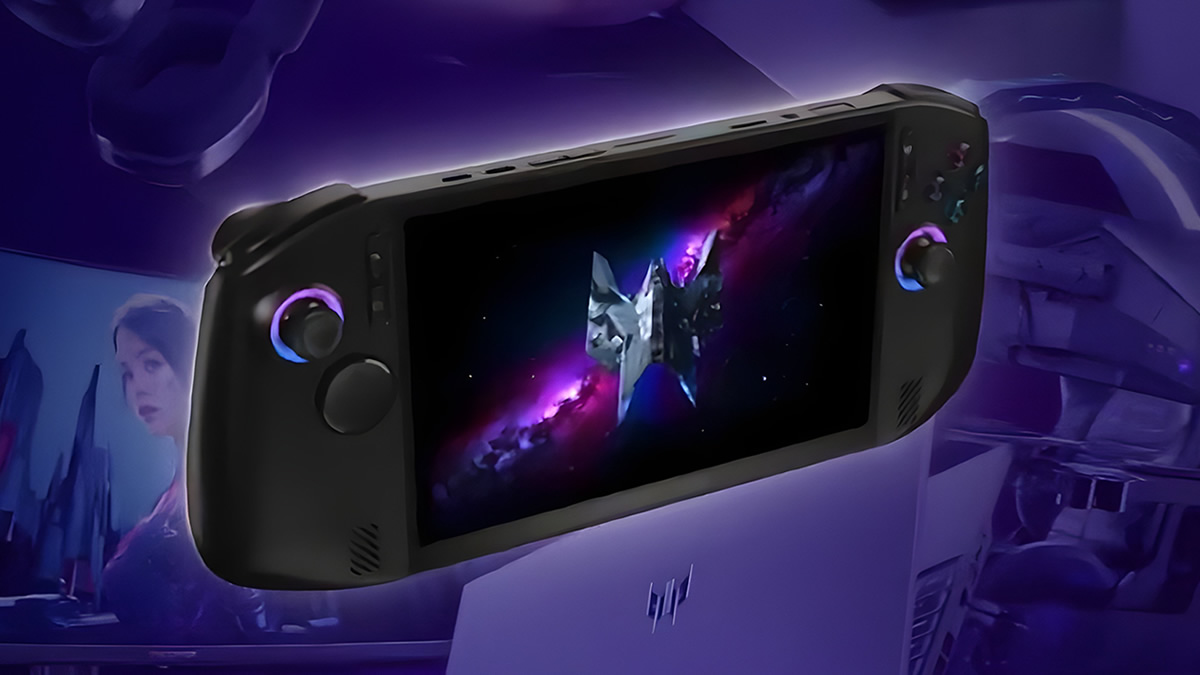
Acer unveils its Intel ARC G3 Elite powered Predator Atlas 8 PC gaming handheld
Acer is getting ready to showcase its Intel G3 Elite powered Predator Atlas 8 PC gaming handheld at Computex 2026.overclock3d.net
- Related coverage: computerbase.de
Loading…
www.computerbase.de - Related coverage: unbox.ph
Loading…
unbox.ph - Related coverage: tweaktown.com
Loading…
www.tweaktown.com - Related coverage: itc.ua
Loading…
itc.ua - Related coverage: acerid.com
Loading…
www.acerid.com