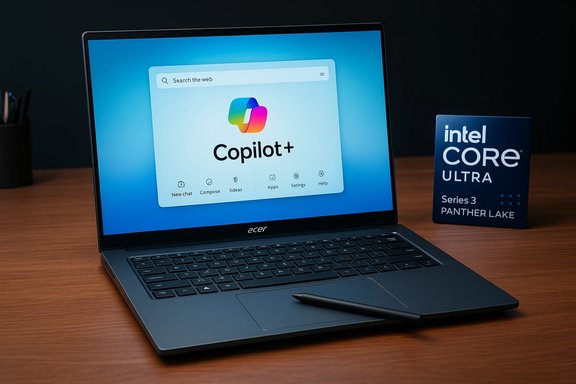
Acer’s latest push into the “Copilot+” era folds high-performance silicon, OLED displays, and new on-device AI features into both its mainstream Aspire line and its premium Swift family, pairing Intel’s freshly revealed Panther Lake mobile silicon — the Core Ultra Series 3 — with a raft of hardware and software refinements aimed at creators, students, and road‑warrior professionals.
Acer’s January announcements present two parallel narratives. The Aspire refresh tries to democratize the Copilot+ experience by bringing Intel’s Core Ultra Series 3 into accessible 14‑ and 16‑inch designs, while the Swift AI range targets premium thin‑and‑light buyers with more aggressive displays, chassis materials, and what Acer calls creator‑focused input devices. Both families emphasize on‑device neural acceleration, Microsoft Copilot+ integration, OLED panels at 120 Hz on higher trims, and a consistent set of Acer AI utilities (PurifiedVoice, PurifiedView, User Sensing, and the Acer Intelligence Space app hub). These products arrive at the same time Intel publicly positioned Panther Lake (Core Ultra Series 3) as the company’s next major mobile platform with stronger CPU/GPU performance and an increased focus on NPU throughput — the foundation OEMs need to advertise local Copilot+ features without always falling back to cloud inference. Independent press coverage and Reuters’ reporting from CES confirm that Intel framed Panther Lake as a meaningful generational step optimized for on‑device AI.
Key platform-level drivers:
Summary of the primary materials used in this piece: Acer’s official product announcement and PR materials for the Swift AI and Aspire AI Copilot+ laptops, TechPowerUp coverage uploaded for the Swift and Aspire announcements, and contemporary CES reporting on Intel’s Panther Lake (Core Ultra Series 3) debut. These sources align on the principal hardware features and market positioning while leaving real‑world performance and battery behavior to be validated by independent testing.
Source: TechPowerUp Acer Introduces Aspire AI Copilot+ PCs Featuring Intel Core Ultra Series 3 Processors | TechPowerUp}
Source: TechPowerUp Acer Announces New Lineup of Premium Swift AI Copilot+ PCs | TechPowerUp}
 Background / Overview
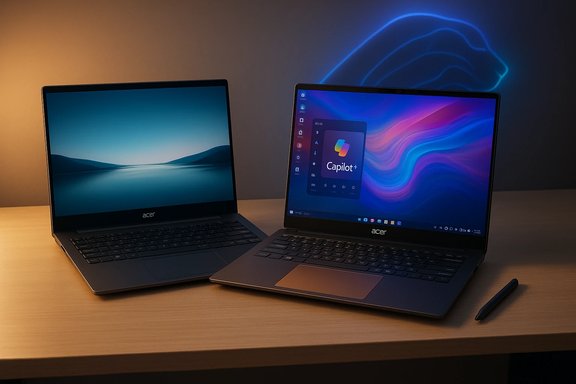
Acer’s January announcements present two parallel narratives. The Aspire refresh tries to democratize the Copilot+ experience by bringing Intel’s Core Ultra Series 3 into accessible 14‑ and 16‑inch designs, while the Swift AI range targets premium thin‑and‑light buyers with more aggressive displays, chassis materials, and what Acer calls creator‑focused input devices. Both families emphasize on‑device neural acceleration, Microsoft Copilot+ integration, OLED panels at 120 Hz on higher trims, and a consistent set of Acer AI utilities (PurifiedVoice, PurifiedView, User Sensing, and the Acer Intelligence Space app hub). These products arrive at the same time Intel publicly positioned Panther Lake (Core Ultra Series 3) as the company’s next major mobile platform with stronger CPU/GPU performance and an increased focus on NPU throughput — the foundation OEMs need to advertise local Copilot+ features without always falling back to cloud inference. Independent press coverage and Reuters’ reporting from CES confirm that Intel framed Panther Lake as a meaningful generational step optimized for on‑device AI. Why this matters: on‑device AI, Windows Copilot+, and the PC market shift
Microsoft’s Copilot strategy has pushed OEMs and silicon vendors to prioritize on‑device inference. The promise is straightforward: AI features that are faster, more private, and usable offline if the device has sufficient NPU and platform support. Acer’s messaging is a direct response—ship hardware that can run Copilot+ experiences locally, and complement that with software hooks and branded features to make the AI useful for everyday users.Key platform-level drivers:
- Intel’s Panther Lake (Core Ultra Series 3) increases on‑package NPU capability and tightens GPU integration — enabling more Copilot+ features to run locally.
- OEMs add sensors (Human Presence Detection, large IR webcams), dedicated AI indicators, and software features (Recall, Click‑to‑Do) to turn silicon capability into concrete user experiences.
- Shorter latency for context‑aware features (e.g., Copilot Vision and Click‑to‑Do).
- Better privacy control for sensitive inference tasks retained on device.
- New tradeoffs in thermal design, battery life, and pricing.
What Acer announced — headline hardware and positioning
Aspire AI (Mainstream, value‑oriented Copilot+ PCs)
Acer’s Aspire 14 AI and Aspire 16 AI are positioned as mainstream Copilot+ laptops that bring many high‑end features down the price ladder. These models are offered with Core Ultra 9 386H SKUs (per Acer’s PR) and promise:- OLED display options (WUXGA and higher) with 16:10 aspect ratios and up to 120 Hz refresh on some trims.
- Up to 32 GB RAM and up to 2 TB PCIe Gen4 SSD storage.
- Large touchpads, 180° flat hinges for collaboration, and thin‑and‑light chassis design.
- Copilot+ integration and Acer’s AI software stack.
Swift AI (Premium thin‑and‑light Copilot+ PCs)
The Swift AI family is the premium push. Notable models and specs called out by Acer and press include:- Swift 16 AI (flagship): Up to Intel Core Ultra X9 388H, 16‑inch 3K OLED WQXGA+ (2880×1800) at 120 Hz, what Acer claims to be the world’s largest haptic touchpad, stylus support (MPP 2.5), dual Thunderbolt 4, HDMI 2.1, Wi‑Fi 7, and a thin aluminum chassis.
- Swift Edge 14/16 AI (ultra‑portable): Targeting sub‑1 kg (certain SKUs), MIL‑STD‑810H durability on select SKUs, up to Core Ultra 9 386H, up to 32 GB LPDDR5X, and OLED options.
- Swift Go 14/16 AI (value premium): Aims to balance price and features with OLED options, Copilot+ enablement, and robust connectivity.
The silicon: Intel Panther Lake / Core Ultra Series 3 — what’s new and what to expect
Intel’s Panther Lake is central to Acer’s product messaging. The platform is presented as a multi‑chiplet design manufactured on Intel’s newer 18A node with notable upgrades: higher CPU/GPU performance compared with prior Core Ultra generations and substantially increased on‑device AI throughput. Reuters and multiple outlets reported Intel’s Panther Lake debut at CES, noting the platform’s AI ambitions and improved performance. Concrete platform claims and their implications:- Higher single‑thread and multi‑thread CPU performance and beefed‑up integrated Arc graphics, which directly benefit creative apps and GPU‑assisted inference.
- Substantial increases in NPU/AI throughput marketed by Intel and echoed in OEM materials; vendors sometimes bundle NPU TOPS with GPU and media engines into “platform TOPS.” This creates strong marketing numbers but also hides important differences in supported data types and model compatibility.
- TOPS (tera‑operations per second) is a raw throughput metric and does not translate directly to real‑world generative AI performance in all cases. Implementation details — supported numeric formats (INT8, FP16), memory bandwidth, driver maturity, and software‑stack optimization — matter far more for practical tasks. Acer’s product pages and PR give device TOPS numbers in marketing language, but those figures are best treated as directional.
Technical deep dive: displays, inputs, I/O, and real‑world use cases
OLED and creator features
Acer standardizing high‑refresh OLED panels in Swift and offering OLED options in Aspire marks a continued industry shift. OLED gives creators:- Deep blacks and higher contrast ratios for photo/video editing.
- Wide color gamut (100% DCI‑P3 on higher tiers) and VESA True Black certification on selected Swift 16 models, which helps color‑critical workflows.
- OLED panels are glossy and can be reflective in bright environments — not ideal for outdoor work without high brightness variants.
- Color calibration out of box varies; professionals should expect to recalibrate screens when color accuracy is essential.
Input and Haptic Touchpad
Acer’s claim of a very large haptic touchpad (Swift 16 AI: ~175.5 mm × 109.7 mm) and stylus support is a deliberate move to add new interaction surfaces for creators. Haptic touchpads can support sketching gestures, contextual controls, and richer touch feedback — but they are not a replacement for a dedicated pen display or tablet for precision artwork.Connectivity, battery, and thermals
High‑performance NPUs and faster Arc graphics increase thermal load and can affect battery life. Acer lists Wi‑Fi 7, Thunderbolt 4, HDMI 2.1, and varying battery sizes (70–71 Wh on some models). Real‑world endurance will depend heavily on configuration (X‑series H SKUs vs U‑series) and usage patterns (AI inference, advanced video encode, sustained creative workloads). Acer’s availability windows (Q1/Q2 2026 for various markets) are specified, but region‑by‑region SKUs and pricing remain critical for real comparisons.Software and feature set: Copilot+ PC integration and Acer’s AI layer
Acer is not selling silicon alone — it highlights a package of features designed to make Copilot+ practical:- Copilot key and contextual Copilot+ hooks (Click‑to‑Do, Recall, Copilot Vision/Voice when opted in).
- Acer PurifiedVoice (AI noise cancellation), PurifiedView (video enhancements), and User Sensing/Human Presence Detection to enable presence‑aware behaviors (screen lock, camera activation).
- Acer Intelligence Space hub to download and update AI tools and utilities.
- Microsoft’s Copilot experiences are evolving; some features are cloud‑dependent, and local equivalents rely on OEM/driver support and model availability.
- The richness of the Copilot+ experience will be heavily influenced by software maturity and the availability of well‑integrated Windows and third‑party apps that can leverage NPUs.
Cross‑checking the claims: what’s verified and what needs caution
Acer’s press materials and third‑party reporting line up on most headline specs: Core Ultra Series 3 support, OLED displays, Nova‑class touchpads, and Copilot+ messaging. Acer’s official newsroom and PR channels list model numbers, screen types, and availability windows that match TechPowerUp’s published coverage. However, several common areas warrant caution and independent verification upon review unit testing:- NPU / TOPS marketing: Acer and Intel publish TOPS and platform throughput figures, but independent benchmarks that measure end‑user latency and model support are needed to validate real‑world Copilot+ performance. Treat TOPS as a marketing‑adjacent metric until review tests show application‑level gains.
- Battery life under AI workloads: vendor battery test claims often use standardized light workloads; prolonged local inference or GPU‑assisted editing will change results substantially.
- Pricing and configurability: Acer’s availability windows are clear, but final MSRP across regions and SKU mixes (RAM soldered vs upgradeable, display options, and storage) will determine value. Acer provided region‑by‑region availability dates but withheld complete pricing in many regions at announcement time.
Strengths — what Acer gets right
- Holistic Copilot+ approach: pairing Intel’s Panther Lake silicon with tangible hardware features (large touchpads, IR webcams, PurifiedVoice) helps deliver a more coherent Copilot+ experience than silicon alone could. This vertical integration matters for users who want features that work out of the box.
- OLED across price bands: offering high‑quality OLEDs in both Swift and Aspire lines gives creators and mainstream users access to better displays sooner — that’s a real productivity and content‑quality win.
- Variety of form factors: Swift 16 as a large‑canvas ultraportable, Swift Edge for ultra‑light mobile pros, and Aspire for mainstream buyers create a clear product ladder for different buyers.
- Connectivity and I/O: Thunderbolt 4, HDMI 2.1, and Wi‑Fi 7 on modern SKUs address real needs for creators (external displays, fast docks, and high‑bandwidth networking).
Risks and limitations — what to watch for
- Marketing vs. real‑world AI performance: TOPS and platform‑level throughput are not the same as usable LLM or vision model performance. Expect reviewers to measure latency and measurable feature impact before buying for AI workloads.
- Battery and thermal tradeoffs: running on‑device inference, especially on higher TDP X‑series SKUs, will produce heat and increased power draw; thin designs sometimes throttle sustained performance to stay within thermal limits.
- Software maturity and driver support: Intel’s Panther Lake is new; early drivers and developer support for accelerated model runtimes (ONNX, DirectML, vendor toolkits) will be crucial. Early adopter devices can suffer from driver churn and periodic firmware updates that disrupt workflows.
- Upgradeability and longevity: Some premium thin‑and‑light designs solder RAM and use single SSD slots — buyers who expect to keep machines for several years should confirm upgrade pathways and warranty/repair policies.
- Privacy vs. convenience: on‑device AI does improve privacy, but integrations with Copilot+ services and cloud fallbacks may still route data to cloud services unless explicitly configured otherwise.
How to decide: buying guide and recommended checks
- Identify your core use case:
- If your workflows are cloud‑centric (SaaS, server‑side inference), a mainstream Aspire with a nice OLED and better battery might be the best value.
- If local creative editing, color‑critical work, or low‑latency AI features matter, prioritize Swift 16 AI or Swift Edge with higher Core Ultra SKUs and OLED panels.
- Wait for independent reviews if:
- You’ll rely on on‑device LLMs or local generative models — look for latency and usable throughput tests.
- Battery life under sustained AI workloads is critical.
- Confirm regional SKUs and pricing:
- Acer announced timing (Q1/Q2 2026 for many SKUs) but full SKUs and pricing vary by market. Locking in purchases before seeing the US/EU MSRP can be premature.
- Probe upgradeability and ports:
- Verify whether RAM is soldered, how many M.2 slots exist, and whether the unit supports external eGPUs or docks if you plan to extend the machine’s life.
Competition and market context
Acer’s announcements arrive amid a broader industry pivot. Intel’s Panther Lake framing at CES and other OEMs’ Copilot+ pushes show a market-wide strategy to move inference onto client devices. Competitors (AMD, Qualcomm) are also racing to define their AI‑capable mobile silicon roadmaps, and software ecosystems (Microsoft, Adobe, and enterprise vendors) are quickly integrating Copilot‑style capabilities that will determine which hardware features matter most in practice. Reuters and consumer tech outlets corroborate Intel’s Panther Lake ambitions and OEM product updates from CES. Acer’s advantage is breadth: it places AI‑focused features across mainstream and premium lines, rather than reserving them for niche high‑end models. That may accelerate adoption — but only if software and drivers keep pace.Final assessment: who should care and why
Acer’s Aspire AI and Swift AI Copilot+ families are a pragmatic, well‑timed response to a market moving from “AI is a buzzword” to “AI is a platform consideration.” For buyers who value:- Immediate access to Windows Copilot+ features,
- High‑quality OLED panels for hybrid creative work,
- A range of prices and weights across Aspire and Swift,
Conclusion
Acer’s January refresh intelligently packages Intel’s Core Ultra Series 3 / Panther Lake momentum into both mainstream and premium products, giving buyers legitimate access to on‑device AI features without forcing everyone into a single price tier. The Swift family pushes creative features and premium hardware design, while Aspire aims to make Copilot+ broadly available. The promise of lower latency, greater privacy, and richer local AI experiences is real — but the meaningfulness of those promises will be proven by independent reviews, driver and software maturation, and real‑world battery and thermal behavior once review units hit the hands of journalists and enthusiasts. Until then, treat vendor TOPS and “world’s largest” claims as early marketing markers that require hands‑on verification.Summary of the primary materials used in this piece: Acer’s official product announcement and PR materials for the Swift AI and Aspire AI Copilot+ laptops, TechPowerUp coverage uploaded for the Swift and Aspire announcements, and contemporary CES reporting on Intel’s Panther Lake (Core Ultra Series 3) debut. These sources align on the principal hardware features and market positioning while leaving real‑world performance and battery behavior to be validated by independent testing.
Source: TechPowerUp Acer Introduces Aspire AI Copilot+ PCs Featuring Intel Core Ultra Series 3 Processors | TechPowerUp}
Source: TechPowerUp Acer Announces New Lineup of Premium Swift AI Copilot+ PCs | TechPowerUp}