

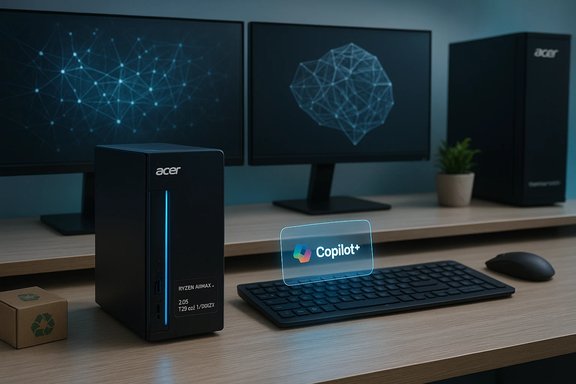
Acer’s latest Veriton family pushes the company further into the “AI-first” PC era with a compact new mini workstation that markets itself as a Windows 11 Copilot+ PC and a trio of business-focused All‑in‑One and tower systems that aim to balance AI performance, security, and sustainability for offices and creatives. The headline product—the Acer Veriton RA100 AI Mini Workstation—pairs AMD’s Ryzen™ AI Max+ 395 APU with an unusually high memory ceiling in a tiny chassis and is positioned to enable local LLM inference, generative workflows, 3D design acceleration and responsive Copilot+ experiences on-device, while the refreshed Veriton AIOs and tower deliver Intel Core Ultra silicon and options for NVIDIA Blackwell GPUs for heavier content creation needs.
AI-enabled PCs are now a mainstream OEM priority: Microsoft’s Copilot+ initiative explicitly asks hardware partners to build devices that can host on-device models or accelerate inference with dedicated NPUs, while AMD, Intel and NVIDIA are shipping silicon tuned for those workloads. The Veriton refresh demonstrates how vendors are re-blending traditional CPU/GPU capability with neural engines and high-bandwidth memory to move more of the latency‑sensitive and privacy‑sensitive AI stack onto endpoints. Acer’s messaging emphasizes Copilot+ readiness, local LLM capability and hybrid workflows that mix cloud and on-device compute.
These specs are consistent with AMD’s platform documentation and oxide press coverage: AMD’s Ryzen AI Max family lists the 395 with up to 50 TOPS NPU capability and the Radeon 8060S graphics block, while AMD’s own guidance highlights support for large unified memory configurations on some OEM platforms. That alignment between AMD’s ecosystem positioning and Acer’s product sheet strengthens the baseline credibility of the RA100’s hardware claims.
The Veriton 2000 tower and Vero AIOs add necessary depth to Acer’s lineup: one path leads to discrete‑GPU performance for studios and rendering farms, and the other delivers green, manageable endpoints for mainstream business. Buyers building AI‑aware fleets should combine hardware validation (benchmarks and thermal profiles) with procurement questions about update windows, warranty and service levels before committing at scale.
Acer’s refresh is thoughtfully proportioned across desks and racks: from eco‑aware AIOs for teams to a mini AI workstation for edge‑first creators, and a tower that scales into NVIDIA Blackwell territory when workloads demand it. The PC ecosystem is shifting rapidly; buyers who combine measured technical validation with a clear plan for model runtimes and management will extract the most value from these new Veriton systems.
Source: TECHNOLOGY RESELLER Acer Introduces the Veriton RA100 AI Mini Workstation, a Windows 11 Copilot+ PC Powered by AMD Ryzen – TECHNOLOGY RESELLER
 Background
AI-enabled PCs are now a mainstream OEM priority: Microsoft’s Copilot+ initiative explicitly asks hardware partners to build devices that can host on-device models or accelerate inference with dedicated NPUs, while AMD, Intel and NVIDIA are shipping silicon tuned for those workloads. The Veriton refresh demonstrates how vendors are re-blending traditional CPU/GPU capability with neural engines and high-bandwidth memory to move more of the latency‑sensitive and privacy‑sensitive AI stack onto endpoints. Acer’s messaging emphasizes Copilot+ readiness, local LLM capability and hybrid workflows that mix cloud and on-device compute. What Acer announced: the lineup at a glance
- Acer Veriton RA100 AI Mini Workstation (VRA100) — compact Copilot+ PC built around the AMD Ryzen™ AI Max+ 395 APU, with Radeon 8060S integrated graphics, a dedicated on‑chip NPU, up to 128 GB quad‑channel LPDDR5X, and up to 4 TB M.2 NVMe storage. Targeted at prosumers, creators, AI developers and light‑to‑moderate gamers.
- Acer Veriton Vero 4000 & 6000 All‑in‑One desktops — eco‑oriented AIOs built on Intel Core Ultra processors (up to Core Ultra 9 Series 2), up to 64 GB DDR5, Wi‑Fi 7 connectivity and business security features; the 6000 series adds Intel vPro SKUs for manageability. These AIOs use post‑consumer recycled materials and fully recyclable packaging for sustainability-conscious deployments.
- Acer Veriton 2000 Large Tower (VK2730G) — scalable tower for content producers, supporting up to Intel Core Ultra 9 Series 2 CPUs and discrete NVIDIA GeForce RTX 5080 GPUs (Blackwell) for heavier GPU‑accelerated rendering and AI tasks. Built for expandability, advanced cooling and device management via Acer Sense.
- Acer Veriton 2000 All‑in‑One (VZ2515G) — SMB‑focused AIO built on Intel Core Ultra 7 Series 2 processors for field teams and office use with TPM 2.0 hardware security and standard collaboration features.
Deep dive: Acer Veriton RA100 AI Mini Workstation
Hardware fundamentals and the Copilot+ pitch
The RA100’s core identity is simple: a small footprint mini workstation explicitly tuned for on‑device AI. At the heart is the AMD Ryzen AI Max+ 395 APU: a 16‑core / 32‑thread Zen‑5 family part that integrates a modern RDNA‑class iGPU (Radeon 8060S) and an XDNA‑class neural engine rated by vendor materials at ~50 TOPS for quantized integer inference. Acer pairs that silicon with up to 128 GB of quad‑channel LPDDR5X and fast M.2 NVMe storage—an unusually high memory ceiling for a mini PC intended to host larger working sets for models and creative assets. Acer markets the RA100 as capable of supporting “up to 120 billion parameters” for local model workloads, while also listing ~60 TFLOPS of GPU compute as a comparative headline.These specs are consistent with AMD’s platform documentation and oxide press coverage: AMD’s Ryzen AI Max family lists the 395 with up to 50 TOPS NPU capability and the Radeon 8060S graphics block, while AMD’s own guidance highlights support for large unified memory configurations on some OEM platforms. That alignment between AMD’s ecosystem positioning and Acer’s product sheet strengthens the baseline credibility of the RA100’s hardware claims.
What the numbers mean in practice (and the caveats)
Vendor headline metrics—TOPS and TFLOPS—are useful for relative comparison but must be read with nuance:- TOPS (Tera Operations Per Second) is typically an integer throughput metric cited for NPUs and is precision‑dependent (INT8, INT4, etc.. A 50 TOPS rating is a peak theoretical figure under specific precision assumptions; real‑world transformer inference performance also depends on model format, quantization, memory bandwidth and runtime efficiency.
- TFLOPS for GPU compute are also peak figures that depend on precision format and do not translate directly to transformer or generative model throughput because those workloads often rely on mixed‑precision kernels, memory staging and specialized tensor primitives.
- The “up to 120 billion parameters” marketing claim is conditional. Storing a dense 120B parameter model in FP16 requires roughly ~240 GB for weights alone; aggressive 4‑bit or specialized FP4/INT4 quantization or sparsity techniques are required to host such models within a 128 GB memory envelope. In short, the parameter headline is a plausibility ceiling, not an out‑of‑the‑box guarantee for FP16 inference at native precision. Buyers should expect to rely on quantized model toolchains, distillation or offloading/sharding strategies to reach that scale on a single RA100 unit.
System design & ergonomics
Acer equips the RA100 with adaptive performance modes (Silent, Balanced, Performance) that let users tune thermals and acoustics for mixed workloads. Connectivity includes RJ45 Ethernet, Wi‑Fi 7 and Bluetooth 5.4, plus modern display and USB I/O to suit multi‑monitor creative setups. Physical security is addressed via a Kensington lock slot for shared environments. The small chassis makes the RA100 attractive for dense desktop deployments, creative desks and edge AI test beds where space matters.The Veriton Vero All‑in‑One family: sustainability and manageability
What’s new and who it targets
The Veriton Vero 4000 and 6000 AIOs are aimed at modern office teams and hybrid workers. They combine Intel Core Ultra 9 Series 2 processors, optional vPro for the higher tier, up to 64 GB DDR5, and up to 2 TB PCIe Gen4 SSD storage. The AIOs feature a 23.8‑inch Full HD 144 Hz touch display, a 5.0 MP IR webcam with privacy shutter, and Acer PurifiedVoice audio software for conferencing. Importantly, Acer emphasizes circular design: the chassis and packaging use post‑consumer recycled materials and 100% recyclable packaging, and the devices meet energy/eco certifications such as EPEAT Gold and Energy Star 9.0 in vendor claims.Security and manageability
These AIOs include enterprise‑grade features such as TPM 2.0, Kensington lock compatibility and, for select SKUs, Intel vPro to enable remote management and enhanced stability for IT departments. Acer’s single‑pane device management app, Acer Sense, is positioned as the vendor’s solution to simplify updates, diagnostics and inventory tracking in mixed fleets. For corporate buyers, these elements are as important as raw silicon: they reduce total cost of ownership and speed rollouts.Acer Veriton 2000 Large Tower and AIO: content creators and SMBs
Tower: expandability and discrete GPU power
The Veriton 2000 Large Tower (VK2730G) is the heavy‑lifting sibling in the refresh: up to Intel Core Ultra 9 Series 2 CPUs and optional NVIDIA GeForce RTX 5080 (Blackwell) GPUs provide a platform for demanding GPU‑accelerated workloads such as 3D rendering, large batch inference, video encoding and complex simulation. NVIDIA’s Blackwell family brings high AI throughput—NVIDIA lists the RTX 5080 laptop/desktop variants with around 1,334–1,801 AI TOPS depending on SKU and vendor marketing—and features like DLSS 4 and improved tensor performance to speed creative pipelines. Consider the tower when workloads need discrete GPU memory and sustained throughput beyond what an integrated APU can deliver.Veriton 2000 AIO: SMB practicalities
The Veriton 2000 AIO is configured for small and medium businesses, field teams and kiosks. With up to Intel Core Ultra 7 Series 2, 64 GB DDR5, and 1 TB SSD, it focuses on reliability, manageable performance and the standard security features (TPM 2.0, Kensington lock) required for shared deployments. Its 23.8‑inch Full HD panel and VESA compatibility make it flexible for office or customer‑facing roles.Strengths: where Acer’s new Veriton line stands out
- Clear Copilot+ positioning — The RA100 explicitly targets Windows 11 Copilot+ use cases and on‑device LLM inference, aligning hardware, software and marketing to a coherent buyer story.
- High memory ceiling in a compact chassis — Up to 128 GB quad‑channel LPDDR5X in a mini workstation is rare and meaningful for large working sets in creative and inference tasks. This differentiator matters for users who need bigger on‑device caches without moving to a full tower.
- Balanced product family — From compact AI mini workstation to eco‑focused AIOs and an expandable tower, Acer covers a wide set of business needs with a consistent management story and security baseline.
- Modern connectivity and management — Wi‑Fi 7, Bluetooth 5.4, RJ45 and Acer Sense management are practical enablers for hybrid teams and managed fleets.
- Discrete GPU path for heavy AI/graphics — The Veriton 2000 tower’s support for NVIDIA Blackwell GPUs opens a path to much higher sustained AI/graphics throughput when workloads demand it.
Risks and practical limitations buyers should weigh
- Marketing vs. usable model scale: The “up to 120B parameters” claim is conditional on aggressive quantization and specialized runtimes. Expect to combine quantization, distillation or sharding to run very large models locally; don’t assume dense FP16 hosting at that parameter count on a single RA100 without tradeoffs.
- Thermals and sustained throughput in a mini chassis: Peak TOPS/TFLOPS numbers are ceilings. Sustained AI or rendering workloads can be constrained by cooling and configurable TDP in compact designs, which may lead to throttling under long jobs. Seek validated performance numbers for the particular models or rendering workloads you plan to run.
- Software and toolchain maturity: On‑device inference quality depends on NPU runtimes, model quantization toolchains, and Windows 11 Copilot+ feature rollouts (which vary by market and update cadence). Buyers should confirm compatibility with the model runtimes and frameworks they rely upon.
- Price and competitive alternatives: Several OEMs are shipping similar Ryzen AI Max+ 395‑based mini PCs; pricing and configured cooling/tuning will be decisive. If Acer’s RA100 is priced at a substantial premium over comparable, well‑tuned alternatives, its niche appeal could narrow to those needing Acer’s manageability or service options. Independent reviews note that value and thermal tuning are critical differentiators in this crowded segment.
- Ecosystem lock and workflow tradeoffs: For teams whose pipelines are CUDA‑first or who require NVIDIA‑specific stacks, the integrated APU path may necessitate different optimization work — the Veriton 2000 tower with discrete RTX 50‑series GPUs is the safer choice for CUDA‑centric shops.
Practical buying guidance and configuration checklist
For IT managers and prosumer buyers evaluating the Veriton family, use this checklist to match hardware to workload:- Define the workload: interactive Copilot+ / local LLM access, creative editing, 3D rendering, or batch model training.
- If the priority is low‑latency Copilot+ interactions and on‑device inference for retrieval or assistant tasks, the RA100 is the right form factor. Confirm quantized model tooling and runtime support for your target LLMs.
- For heavy GPU rendering, VR workflows, or large‑batch inference, prefer the Veriton 2000 Tower with an RTX 5080/5090 class GPU. Check power and cooling requirements before integration.
- For managed office fleets needing remote management and sustainability credentials, Vero 4000/6000 AIOs offer vPro SKUs, recycled materials and EPEAT classing—verify corporate warranty and on‑site options.
- Ask for validated benchmarks: request vendor‑provided or third‑party benchmark runs for the specific models and runtimes you’ll use (e.g., quantized LLMs, 3D render engines, cloud hybrid workflows).
Final assessment: Where the Veriton family fits in 2026
Acer’s Veriton refresh is a practical, well‑rounded response to two clear market threads: aggressive OEM deliveries of Copilot+‑capable hardware, and enterprise buyers who want AI capability without wholesale cloud dependency. The RA100 is especially notable because it crams a Ryzen AI Max+ 395 APU, a meaningful NPU block and an unusually generous 128 GB LPDDR5X memory ceiling into a mini workstation—making it a credible choice for developers, creators and IT teams experimenting with on‑device LLMs and generative workflows. That said, real value will depend on pricing, thermal tuning, and software maturity; the RA100’s bold parameter and TOPS claims are directional and useful for comparison, but they require careful interpretation and validation against the models and runtimes you plan to deploy.The Veriton 2000 tower and Vero AIOs add necessary depth to Acer’s lineup: one path leads to discrete‑GPU performance for studios and rendering farms, and the other delivers green, manageable endpoints for mainstream business. Buyers building AI‑aware fleets should combine hardware validation (benchmarks and thermal profiles) with procurement questions about update windows, warranty and service levels before committing at scale.
Bottom line
Acer’s Veriton series acknowledges that the next generation of productive PCs will be hybrid: part traditional workstation, part on‑device AI accelerator and part managed corporate endpoint. The Veriton RA100 AI Mini Workstation is a bold attempt to democratize local LLM inference and Copilot+ responsiveness in a compact form factor, but its headline numbers—50 TOPS NPU, ~60 TFLOPS GPU compute and “up to 120B parameters”—should be treated as directional indicators that need workload‑specific validation. For organizations and creators who prioritize low latency, privacy and offline AI capabilities, the RA100 and the wider Veriton family are worthy candidates—provided procurement includes careful benchmarking, quantization toolchain checks, and attention to thermal/sustained performance characteristics.Acer’s refresh is thoughtfully proportioned across desks and racks: from eco‑aware AIOs for teams to a mini AI workstation for edge‑first creators, and a tower that scales into NVIDIA Blackwell territory when workloads demand it. The PC ecosystem is shifting rapidly; buyers who combine measured technical validation with a clear plan for model runtimes and management will extract the most value from these new Veriton systems.
Source: TECHNOLOGY RESELLER Acer Introduces the Veriton RA100 AI Mini Workstation, a Windows 11 Copilot+ PC Powered by AMD Ryzen – TECHNOLOGY RESELLER
