

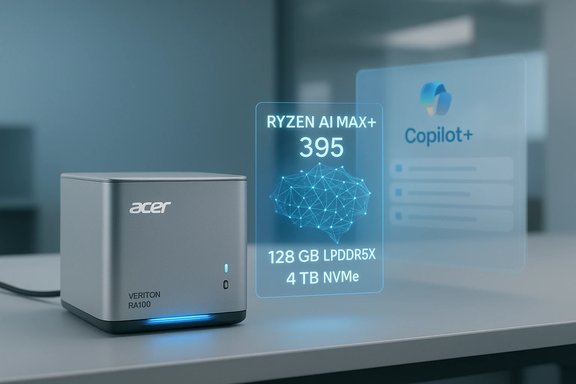
Acer’s new Veriton RA100 AI Mini Workstation arrives as a compact, Windows 11 Copilot+ PC built around AMD’s flagship Ryzen AI Max+ 395 APU, promising a rare combination of high‑end CPU cores, a modern integrated RDNA GPU, a substantive NPU, and an unusually high memory ceiling for a mini workstation — all packaged for prosumers, creators, and teams who want on‑device AI and low‑latency Copilot+ experiences.
Acer positions the Veriton RA100 as an AI‑first mini workstation intended to deliver responsive Copilot+ features in Windows 11, accelerate local large language model (LLM) inference, and serve as a compact hub for creative workflows that benefit from on‑device generative tooling. The headline hardware is the AMD Ryzen AI Max+ 395 APU with integrated Radeon 8060S graphics and an on‑chip neural engine (NPU). Acer lists support for up to 128 GB of quad‑channel LPDDR5X and up to 4 TB M.2 NVMe storage in a chassis measuring roughly 203 × 192 × 70 mm. Availability is targeted for Q1 2026 in North America and EMEA. This article verifies the main technical claims, explains what they mean in real‑world workflows, highlights strengths and potential risks, and offers practical buying guidance for anyone considering the Veriton RA100 as a mini workstation for Copilot+, local LLM work, and creative acceleration.
For buyers who prioritize on‑device Copilot responsiveness, creative assistance, and compact IT footprint, the RA100 is a compelling option — provided expectations are aligned with the practical constraints laid out above and validation steps are taken before widespread deployment.
Source: The Malaysian Reserve https://themalaysianreserve.com/202...x-395-processors-for-advanced-ai-performance/
 Overview
Acer positions the Veriton RA100 as an AI‑first mini workstation intended to deliver responsive Copilot+ features in Windows 11, accelerate local large language model (LLM) inference, and serve as a compact hub for creative workflows that benefit from on‑device generative tooling. The headline hardware is the AMD Ryzen AI Max+ 395 APU with integrated Radeon 8060S graphics and an on‑chip neural engine (NPU). Acer lists support for up to 128 GB of quad‑channel LPDDR5X and up to 4 TB M.2 NVMe storage in a chassis measuring roughly 203 × 192 × 70 mm. Availability is targeted for Q1 2026 in North America and EMEA. This article verifies the main technical claims, explains what they mean in real‑world workflows, highlights strengths and potential risks, and offers practical buying guidance for anyone considering the Veriton RA100 as a mini workstation for Copilot+, local LLM work, and creative acceleration.Background: Why Copilot+ PCs and NPUs matter
Windows 11’s Copilot+ initiative marks a shift in Microsoft’s vision of the PC: AI‑enabled features such as Recall, semantic search, and local assistant functionality are designed to run either partly or wholly on device when hardware supports it. That on‑device capability depends on integrated NPUs and a software stack that routes specific inference workloads to those neural engines, reducing latency and offering privacy advantages compared with always‑on cloud inference. Early Windows 11 Insider previews and vendor pilots have illustrated how NPUs enable offline semantic search and faster Copilot responses for supported locales and builds. At the silicon level, the new class of APUs — where CPU, GPU, and NPU are engineered together — aims to let a single compact box handle everyday productivity plus accelerated on‑device inference for models that have been quantized or optimized for NPUs. The RA100 is Acer’s consumer/prosumer response to this trend: a small chassis that emphasizes on‑device AI capability as a primary selling point.What Acer announced: key specifications and availability
Acer’s public specification sheet and PR describe the Veriton RA100 primarily as:- Operating system: Windows 11 Pro (marketed as a Windows 11 Copilot+ PC).
- Processor: AMD Ryzen™ AI Max+ 395 APU (16 cores / 32 threads, Zen‑5 family, up to 5.1 GHz boost).
- Graphics: AMD Radeon™ 8060S integrated GPU.
- NPU: vendor and AMD documentation list an on‑chip neural engine rated around 50 TOPS (quantization and precision dependent).
- Memory: Up to 128 GB quad‑channel LPDDR5X (rated speeds cited up to 8,533 MT/s by Acer; AMD documents reference LPDDR5X‑8000 support).
- Storage: Up to 4 TB M.2 2280 NVMe.
- Connectivity: Wi‑Fi 7, Bluetooth 5.4, 2.5 GbE, multiple display outputs, and USB4/USB‑C ports.
- Form factor: compact "mini workstation" dimensions ~203 × 192 × 70 mm and an adaptive performance mode (Silent/Balanced/Performance) to tune thermals and acoustics.
- Availability: Q1 2026 in North America and EMEA; regional SKUs and pricing to be announced.
Hardware deep dive: Ryzen AI Max+ 395, NPU, memory and throughput
CPU + GPU + NPU: the Strix Halo family approach
The Ryzen AI Max+ 395 is a high‑end APU from AMD’s Strix Halo family that pairs 16 Zen‑5 CPU cores (32 threads) with the Radeon 8060S integrated GPU and an XDNA‑class neural accelerator. AMD’s product documentation and reputable hardware databases list the APU’s boost clock near 5.1 GHz, configurable TDP windows commonly used in compact systems (45–120 W depending on OEM tuning), and an NPU capability in the neighborhood of 50 TOPS for INT8 workloads. These characteristics make the part well suited for mixed CPU/GPU/AI workloads without adding a discrete GPU. Acer’s spec sheet supplements the silicon paperwork with practical system details such as the LPDDR5X memory ceiling and chassis dimensions, clarifying how AMD’s APU might be deployed in a mini form factor.What “50 TOPS” and “60 TFLOPS” actually tell you
Performance marketing tends to mix TOPS (Tera Operations Per Second) and TFLOPS depending on the target unit of computation. Important clarifications:- TOPS is usually quoted for NPUs using integer workloads (INT8, INT4) and provides a peak theoretical throughput number. Real‑world transformer‑style inference performance depends on precision, quantization strategy, and runtime optimizations.
- TFLOPS references GPU floating‑point throughput, but TFLOPS alone don’t map cleanly to transformer inference throughput because model runtimes use mixed‑precision kernels and rely heavily on memory bandwidth and latency.
Memory math and the “up to 120 billion parameters” claim
Acer’s press materials say the RA100 can support model hosting “up to 120 billion parameters.” That statement is plausible only with qualification.- A 120‑billion‑parameter dense model stored in FP16 consumes roughly 240 GB for weights alone (120B × 2 bytes). Even with 8‑bit quantization that drops to ~120 GB, and with 4‑bit quantization to ~60 GB — not accounting for activations, KV cache, or runtime overhead. That math is why a 128 GB LPDDR5X ceiling can only host very aggressively quantized or sparsely activated models locally, or models adapted to NPU‑friendly formats.
- Practically, running models of tens of billions of parameters locally typically requires either model offloading, sharded execution, effective 4‑bit quantization, distillation, or architectures that activate a fraction of the parameters per inference step (Mixture‑of‑Experts). Acer’s marketing frames “up to 120B” as a ceiling rather than a promise of out‑of‑the‑box FP16 hosting. Treat the number as conditional.
Real‑world workflows: where the Veriton RA100 helps — and where it won’t
Strengths: interactive, privacy‑sensitive, and creative tasks
- Copilot+ responsiveness and local recall: On‑device NPUs help reduce latency when Copilot features (like semantic search and local assistance) are configured to use local models, improving responsiveness and protecting sensitive data from constant cloud round‑trips. Early Windows Insider testing shows offline semantic search and local assistant features working on Copilot+ hardware.
- Real‑time creative assistance: Image upscaling, style transfer, interactive image generation, and certain creative filters can be accelerated by the iGPU or NPU, offering more fluid iteration for designers and creators. The RA100’s high memory ceiling and modern iGPU make it a credible compact creative workstation for interactive tasks.
- Prototype AI development and inference: Students, small teams, or privacy‑conscious developers can prototype quantized models or small LLMs locally without recurring cloud costs, which is useful for experimentation and demonstration work. The RA100’s local NPU and SSD capacity simplify offline testing.
Limits: training, large‑scale batch work, and sustained high‑TDP workloads
- Not a training server: The RA100 is not a replacement for rack GPUs or cloud instances when it comes to model pretraining or large‑scale fine‑tuning. The integrated NPU and iGPU are aimed at inference and small‑scale tuning, not multi‑node distributed training.
- Thermals and sustained throughput: In a mini chassis, extended high‑TDP activity (multi‑hour renders, full‑precision batch inference) will often hit thermal or power ceilings, leading to throttling and elevated fan noise. Acer offers adaptive performance profiles to balance noise vs performance, but physics still apply.
Software ecosystem: toolchains, runtimes, and maturity
Hardware alone does not make an AI PC. The NPU must be usable by developers and applications through drivers and runtimes tailored to common ML frameworks and quantization toolchains.- AMD and OEM partners are shipping NPUs with vendor runtimes that expose quantized kernels and accelerator APIs, but ecosystem maturity varies across frameworks and model formats. Quantization libraries, ONNX runtimes, and vendor‑specific acceleration layers are still evolving. Buyers should verify that the models and frameworks they plan to use (for example, quantized LLM runtimes, image generation pipelines, or optimized inference engines) are supported on AMD’s XDNA‑class NPUs or can be mapped efficiently to the integrated iGPU.
- Microsoft’s Copilot+ features will progressively expand hardware support across silicon vendors and locales; some Copilot capabilities have already rolled out on selected Copilot+ devices in preview, but full parity across features and geographies remains a work in progress. Confirm local feature availability for your language and region before buying for enterprise deployment.
Comparative context: RA100 versus the mini‑workstation wave
The RA100 joins a 2025–2026 wave of AI‑centric mini PCs from multiple OEMs that blend mobile APUs with NPUs and high memory ceilings. Competing approaches vary:- Some vendors lean on NVIDIA GB10‑based modules for heavier AI workloads and larger local memory pools (suiting research and bigger inference tasks), while others — like Acer’s RA100 — choose AMD’s balanced CPU/GPU/NPU APUs to optimize for mixed workloads and lower cost of ownership.
- Several recent mini PCs also advertise 50 TOPS NPUs and 128 GB memory ceilings; the differentiator becomes thermal design, I/O, and software validation for specific models and runtimes. Independent testing and vendor‑validated benchmarks are therefore crucial when picking between models.
Practical buying guidance and validation checklist
For IT teams, creative pros, and enthusiasts eyeing the RA100, the following checklist helps transform marketing into purchase decisions:- Confirm the exact SKU and memory configuration you need; ask if the listed "up to 128 GB" is soldered or uses accessible modules and whether LPDDR5X speeds are validated for your workload.
- Request vendor‑validated benchmarks for the actual models and runtimes you plan to run (for example, a quantized LLM with the exact tokenizer, or a real‑world Premiere Pro/DaVinci Resolve project). Benchmarks should be provided under sustained loads, not just short synthetic bursts.
- Verify Windows 11 Copilot+ features availability in your region and language, and whether IT management tools (Autopilot, Intune) and enterprise security options are supported in your intended lifecycle.
- Ask about warranty, enterprise support, and service‑level options for professional use; mini workstations are productive but may require onsite service differently than full towers.
- Consider whether your workflows are primarily interactive (good fit) or sustained large batch (likely better in tower/cloud), and budget accordingly.
Risks and caveats: interpreting marketing claims responsibly
- The “up to 120B parameters” anchor is marketing‑friendly but technically conditional. Unless your model uses aggressive quantization (4‑bit or better), model sparsity, or offloading strategies, hosting a 120B dense FP16 model locally on 128 GB of RAM is implausible. Buyers must align model format, quantization level, and runtime with device memory constraints.
- TOPS and TFLOPS are directional metrics. They help compare raw capability across devices but do not predict latency, sustained throughput, or single‑user responsiveness without workload‑specific benchmarks.
- Software maturity: NPU exploitation depends on vendor runtimes, framework adapters, and quantization toolchains. Expect a period of incremental support and frequent driver/tool updates as vendors and the open‑source ecosystem adapt. Early adopters may need to troubleshoot and adapt pipelines.
Bottom line: who should consider the Veriton RA100?
The Acer Veriton RA100 is best suited to:- Creators who need interactive AI‑assisted workflows and value on‑device privacy for drafts and assets.
- Small teams and developers who want a compact local inference and prototyping box for quantized LLMs and generative models without full cloud dependency.
- IT buyers seeking a space‑efficient Windows 11 Copilot+ PC that integrates modern connectivity and management features for hybrid office setups.
- Organizations that need multi‑node training or sustained large training jobs (those workloads remain the domain of full‑size towers, rack servers, or cloud GPU instances).
- Buyers who expect out‑of‑the‑box hosting of 120B FP16 models without quantization, sharding, or specialized model engineering.
Conclusion
The Veriton RA100 is a credible and timely entry in the Copilot+ mini workstation category: Acer pairs a high‑end AMD Ryzen AI Max+ 395 APU, an integrated Radeon 8060S GPU, and a meaningful NPU, and then packages them with a high memory ceiling and modern I/O into a compact chassis. These choices reflect the broader industry move to put meaningful on‑device AI into everyday Windows PCs, enabling lower latency Copilot+ experiences and practical local inference for many workflows. That said, buyers must read the headline metrics carefully. TOPS, TFLOPS, and “parameter” claims are directional; their real‑world value depends on quantization strategy, memory headroom, thermal behavior, and the maturity of vendor runtimes and model toolchains. Ask vendors for validated, workload‑specific benchmarks, confirm Copilot+ feature availability in your locale, and plan configurations around whether your tasks are interactive and latency‑sensitive (a strong match) or long‑running and large‑scale (still better suited to towers or cloud).For buyers who prioritize on‑device Copilot responsiveness, creative assistance, and compact IT footprint, the RA100 is a compelling option — provided expectations are aligned with the practical constraints laid out above and validation steps are taken before widespread deployment.
Source: The Malaysian Reserve https://themalaysianreserve.com/202...x-395-processors-for-advanced-ai-performance/
