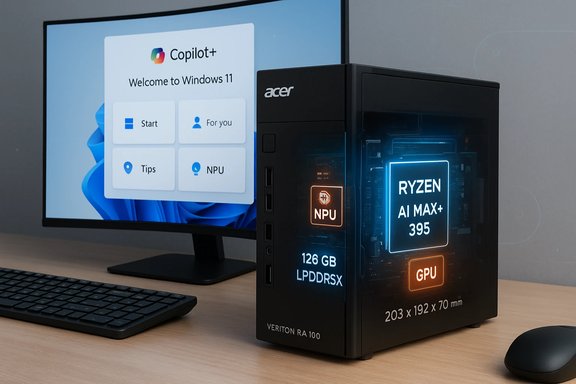
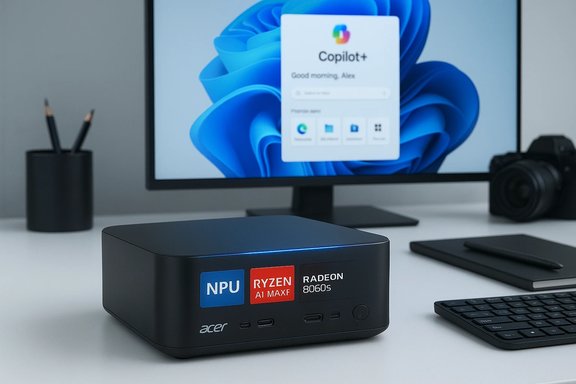
Acer’s new Veriton RA100 AI Mini Workstation arrives as a compact, Windows 11 Copilot+ PC aimed at prosumers, creators, and gamers, built around the AMD Ryzen™ AI Max+ 395 APU and an integrated Radeon™ 8060S GPU with a 50 TOPS NPU—promising on-device AI acceleration, up to 128 GB of LPDDR5X memory, and up to 4 TB of M.2 NVMe storage in a mini‑workstation form factor.
Acer’s announcement of the Veriton RA100 is the latest example of PC makers shipping AI-optimized hardware that pairs traditional CPU/GPU capability with dedicated neural processing to power local inference, Copilot+ features in Windows 11, and creative workflows without continuously offloading compute to the cloud. Microsoft’s Copilot+ PC initiative explicitly targets machines with high‑performance NPUs and on‑device AI experiences; OEMs including Acer have been among the partners lined up to deliver hardware that fits that category. This product arrives alongside Acer’s wider Veriton refresh that includes All‑In‑One and tower desktops targeted at business and creative users—positioning the RA100 as the compact, AI‑first mini workstation in that family.
Source: WV News Acer Introduces the Veriton RA100 AI Mini Workstation, a Windows 11 Copilot+ PC Powered by AMD Ryzen AI Max+ 395 Processors for Advanced AI Performance
 Background
Acer’s announcement of the Veriton RA100 is the latest example of PC makers shipping AI-optimized hardware that pairs traditional CPU/GPU capability with dedicated neural processing to power local inference, Copilot+ features in Windows 11, and creative workflows without continuously offloading compute to the cloud. Microsoft’s Copilot+ PC initiative explicitly targets machines with high‑performance NPUs and on‑device AI experiences; OEMs including Acer have been among the partners lined up to deliver hardware that fits that category. This product arrives alongside Acer’s wider Veriton refresh that includes All‑In‑One and tower desktops targeted at business and creative users—positioning the RA100 as the compact, AI‑first mini workstation in that family. What Acer is claiming: headline specs and positioning
- Processor: AMD Ryzen AI Max+ 395 (16 cores / 32 threads; Zen 5 family) with an integrated Radeon 8060S GPU and an on‑chip NPU rated at 50 TOPS.
- AI throughput claims: The RA100 is promoted as delivering up to 60 TFLOPS of GPU compute and supporting workloads that can reach “up to 120 billion parameters” for local LLM inference, according to Acer’s release.
- Memory & storage: Up to 128 GB LPDDR5X (quad‑channel) and up to 4 TB M.2 2280 NVMe storage.
- Connectivity & I/O: RJ45 Ethernet, Wi‑Fi 7, Bluetooth 5.4, multiple display outputs and modern USB connectivity to support creators’ peripherals.
- Windows integration: Ships as a Windows 11 Copilot+ PC with on‑device features such as Recall and other Copilot‑powered experiences that rely on NPU acceleration.
Hardware deep dive: Ryzen AI Max+ 395 and the platform
The APU: what the silicon actually is
The AMD Ryzen AI Max+ 395 is a high‑end Strix Halo family APU built on Zen 5 cores with 16 CPU cores and 32 threads, paired with an Radeon 8060S integrated GPU and an XDNA‑2 NPU block. Independent CPU/APU databases and benchmark aggregators document the part as a 3.0 GHz base with boost frequencies up to ~5.1 GHz, a configurable TDP envelope (commonly referenced around 45–120 W in mobile/compact workstation builds), and an NPU rated at ~50 TOPS for INT8/quantized inference workloads. Those OEM‑level APUs bring a rare combination: significant CPU multi‑thread throughput for compile/render tasks, a modern integrated RDNA‑class iGPU, and a substantial neural engine for local AI acceleration. That Intel/Qualcomm/AMD triangle—CPU, GPU, NPU—defines Copilot+ era hardware.Memory, storage, and the claim of hosting large models
Acer specifies up to 128 GB LPDDR5X (quad‑channel) in the Veriton RA100. AMD’s platform support for LPDDR5X‑8000 and quad‑channel operation on Strix Halo‑class parts aligns with that goal, which makes the RA100 more capable than many mini PCs that ship with soldered, lower‑capacity memory. However, raw memory does not translate linearly into the model‑size headline Acer uses. For example:- A 120‑billion‑parameter model stored in FP16 weights would require roughly ~240 GB of memory just for the weights (120B × 2 bytes), before overhead for activations, KV cache and runtime metadata. At 8‑bit quantization that drops to ~120 GB; at 4‑bit quantization it’s ~60 GB. Running full‑precision or modest quantization models locally therefore depends heavily on quantization strategy, model architecture (dense vs MoE), and toolchain. That math is not new and is widely used to evaluate whether a given device can host a specified model locally.
Performance expectations and how to read the marketing numbers
TOPS, TFLOPS, and practical throughput
Acer cites 50 NPU TOPS and 60 TFLOPS in the RA100 spec sheet. Third‑party technical sources for the Ryzen AI Max+ 395 corroborate the NPU channel as being in the neighborhood of 50 TOPS for INT8 workloads, while the Radeon 8060S iGPU throughput is consistent with multi‑tens of TFLOPS figures depending on the math format used. Those metrics are useful indicators but are best understood as relative throughput ceilings rather than direct user performance guarantees. Key points for readers:- TOPS are architecture‑ and precision‑sensitive. A 50 TOPS NPU figure typically assumes an INT8 or similarly quantized workload; FP16 or other precisions give different effective performance.
- TFLOPS claims for GPUs vary by operation and driver optimizations. TFLOPS alone don’t tell the whole story about latency or sustained inference throughput for transformer workloads.
- Sustained performance in a mini chassis is limited by thermals and power. Mini workstations can provide burst compute that throttles under sustained multi‑hour loads unless cooling and power delivery are generous. Treat TOPS/TFLOPS as capability indicators, not guarantees.
Real‑world workflows: where the RA100 should help
The RA100 is positioned for workloads that benefit from on‑device AI and high single‑machine throughput:- Local LLM inference / Copilot+ features: Faster local responses, lower latency for Recall and Copilot tasks, and privacy advantages for sensitive data workflows when models or distilled agents run on‑prem. Windows 11 Copilot+ features were designed to take advantage of devices with NPUs, so the RA100’s hardware fits that narrative.
- Generative creative tooling: Real‑time image generation, accelerated upscaling, local style transfer, and creative assistants in applications like image editors or 3D tools that can offload specific kernels to the NPU or the integrated GPU.
- 3D design and visualization: The Radeon 8060S integrated graphics and high memory ceiling make the RA100 suitable for interactive 3D modeling and scene editing where large texture and model datasets are needed.
- AI development & prototyping: For students, researchers, and small dev teams, being able to prototype and fine‑tune quantized models locally without cloud expenditure is attractive—especially for privacy‑sensitive data.
Thermals, power, and the mini workstation trade‑offs
Miniaturization creates constraints. Compact chassis reduce thermal headroom, which affects sustained performance for both CPU and NPU workloads. Independent testing and industry reporting for similar mini workstations highlights these recurring trade‑offs:- Fan noise and throttling are common under prolonged heavy AI inferencing or prolonged GPU rendering runs.
- Vendors often offer performance profiles (Silent, Balanced, Performance) to tune acoustics vs throughput; these work but don’t negate physics—higher performance modes raise temperatures and acoustic output.
Software: Windows 11 Copilot+ integration and developer tooling
Acer positions the RA100 as a Windows 11 Copilot+ PC, meaning it’s intended to provide the best on‑device Copilot experiences Microsoft describes: Recall, Cocreator workflows, and on‑device model inference for certain apps. Microsoft’s Copilot+ program explicitly expects a class of devices with NPUs capable of 40+ TOPS to deliver these experiences locally, and the RA100’s silicon fits that threshold on paper. On the developer side, expect:- Support for common model runtimes and frameworks that Microsoft and OEMs are optimizing for Copilot+ experiences.
- The need for tooling maturity—model quantization toolchains, runtime optimizers, and device drivers to fully exploit the NPU. This is an evolving area: software maturity will determine how well the RA100 translates peak TOPS numbers into real‑world latency and throughput for your models.
Security, manageability, and sustainability
Acer’s broader Veriton series emphasizes business‑grade features such as TPM 2.0, Kensington lock support, and enterprise manageability tools. Copilot+ PCs also ship with Microsoft’s recommended security baseline for the category—Secured-core options and Pluton where applicable—making the RA100 appropriate for mixed business/creative deployments where data governance matters. Acer also continues its trend of sustainability messaging across its Veriton AIOs by using recycled materials; while the RA100 mini workstation’s press materials emphasize compute and performance, environmental claims for the product family are present elsewhere in the Veriton line.Pricing and availability — what we know and what we don’t
Acer’s PR materials describe the RA100 and the rest of the Veriton portfolio but do not publish a global MSRP for the RA100 at the time of the release. Acer directs customers to local offices and retail channels for region‑specific pricing and availability windows. Until regional SKUs and channel pricing are published, expect variable availability and pricing depending on configuration (memory, SSD capacity, warranty services).Strengths: where the RA100 stands out
- Balanced AI stack in a compact chassis: CPU, GPU, and a substantive NPU make the RA100 a genuine Copilot+ candidate for device‑centric AI features.
- High memory ceiling for a mini: Up to 128 GB LPDDR5X is uncommon in mini platforms and directly benefits large dataset handling and working set sizes for creative apps.
- Windows Copilot+ compatibility: Native support for Windows 11 Copilot+ features promises integrated experiences and low‑latency assistance that cloud‑dependent setups can’t match.
Risks and caveats buyers should weigh
- Marketing vs practical model hosting: Claims such as “up to 120B parameters” need interpretation. Realistic local hosting of models at that scale depends on aggressive quantization, sparse architectures, or model offloading. Without those, memory and compute limits will constrain what can run locally. Always validate with the specific model and runtime you intend to use.
- TOPS and TFLOPS are not user‑experience guarantees: These metrics are useful but require careful benchmarking in your target workloads. Expect variance between synthetic numbers and real app latency/throughput.
- Sustained workloads vs burst performance: Mini chassis can throttle. For long AI training runs or prolonged rendering, a full‑sized workstation or server remains preferable.
- Software maturity matters: The NPU and driver/tooling ecosystem are evolving rapidly. Early adopters may encounter rough edges until quantization, toolchains, and vendor runtimes mature.
How the RA100 compares with the recent mini‑workstation wave
The RA100 follows a broader industry move toward AI inclined mini PCs and compact workstations (examples include NVIDIA GB10‑based designs and other vendor Ryzen AI builds). Acer itself has a separate NVIDIA‑powered Veriton GN100 targeting heavier, server‑like AI workloads; the RA100 sits on the other side of that same strategy—more of a balanced, AMD‑centric Copilot+ station for creators rather than a dedicated DGX‑style box. Buyers should pick the form factor and silicon blend that matches their workload profile.Recommendations for potential buyers
- Define your primary workload. If you need interactive LLM access, Copilot+ responsiveness, or real‑time creative AI assistance, the RA100’s hardware stack is promising. If your work involves long‑running model training or large‑batch transforms, consider larger systems or cloud/hybrid approaches.
- Ask about validated configurations. Request benchmarks or validated model runs from Acer or reseller partners for the specific models and runtimes you’ll use.
- Plan for software setup. Check the availability of quantized model toolchains, NPU runtimes, and Windows 11 Copilot+ feature availability in your region and language set.
- Verify warranty and service levels. For pro use, enterprise warranty, onsite support, and service options matter—confirm them before purchase.
Conclusion
The Acer Veriton RA100 AI Mini Workstation is a clear sign of how PC hardware is adapting to an AI‑first era: a compact package combining a high‑end AMD Ryzen AI Max+ APU, a modern integrated RDNA GPU, a substantial NPU, and a high memory ceiling. For creators, prosumers, and IT teams looking to run Copilot+ features and local inference workloads, the RA100 promises a compelling blend of capabilities—if buyers understand the practical limits around model sizes, quantization needs, and thermal constraints inherent to mini workstations. The RA100’s true value will be revealed through independent, workload‑specific benchmarks and real‑world deployments. Until then, treat Acer’s headline numbers as an invitation to test and validate: the hardware platform is promising, but the on‑device AI story still depends as much on software, quantization techniques, and thermal engineering as it does on peak TOPS and TFLOPS metrics.Source: WV News Acer Introduces the Veriton RA100 AI Mini Workstation, a Windows 11 Copilot+ PC Powered by AMD Ryzen AI Max+ 395 Processors for Advanced AI Performance