

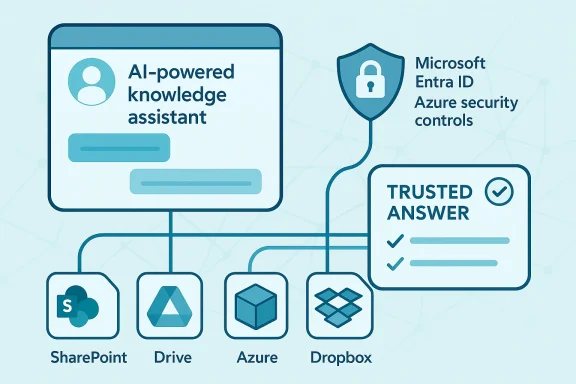
Adactin’s launch of AFIVE lands squarely in one of the busiest corners of enterprise software: the race to make internal knowledge searchable, trustworthy and useful through natural language. The Sydney-based services firm is pitching the platform as an AI knowledge layer that can unify information from SharePoint, Google Drive, Azure Blob Storage and Dropbox into a single conversational interface, while keeping access governed through Microsoft Entra ID and Azure-based security controls. In a market crowded with copilots, assistants and search overlays, the real question is not whether AI can answer questions from company documents, but whether it can do so reliably enough for regulated organisations to trust. That is where AFIVE will be judged. The underlying architecture — RAG, vector search and Azure AI services — is now familiar, but the commercial opportunity lies in packaging those building blocks into something enterprises can actually adopt at scale.
Enterprise knowledge management has been promising a “single pane of glass” for years, yet most organisations still live with fragmentation. Teams keep policies in SharePoint, working files in Google Drive, archives in Azure Blob Storage, project material in Dropbox and critical decisions buried in email threads or local folders. Even where formal search exists, it often depends on brittle keyword matching, inconsistent metadata and manual navigation across systems that were never designed to behave as one. AFIVE is Adactin’s attempt to tackle that long-running problem with modern AI rather than another traditional search portal.
The timing matters because the market has moved beyond generic chatbots. Buyers now expect retrieval-augmented generation, stronger permissions, auditability and better contextual answers, not just a polished prompt box. Microsoft’s own Azure AI Foundry and Azure OpenAI documentation reflects that shift, describing RAG-style solutions that combine search and generation, often backed by Azure AI Search and Azure Blob Storage, with Microsoft Entra ID used for secure access control. That makes AFIVE less of an experiment than a commercial assembly of well-established cloud patterns.
There is also a broader strategic story here. Systems integrators and consulting firms increasingly want to turn repeatable delivery know-how into proprietary software products. That approach creates higher margins, deeper customer stickiness and a clearer story for investors than services alone. Adactin has already been positioning itself around AI-led delivery and enterprise transformation, and AFIVE extends that trajectory by productising a problem it likely encounters repeatedly in client environments.
For enterprise buyers, the stakes are simple but unforgiving. If the platform can surface the right answer quickly, obey permission boundaries, and avoid hallucinating over confidential material, it can save real time and reduce duplicate work. If it cannot, the system becomes just another AI layer that staff distrust and eventually abandon. That tension sits at the centre of almost every knowledge platform launch in 2026.
That promise is especially attractive in larger organisations where knowledge is both abundant and inaccessible. Public sector bodies, in particular, often have formal document repositories but weak cross-system discovery. AFIVE’s value proposition is that staff do not need to remember where a file lives or which team owns it; the platform becomes a knowledge mediator between user intent and enterprise data.
In practical terms, this means AFIVE is not merely a search bar with AI branding. It is trying to become a front end to internal knowledge work, combining search, summarisation and workflow routing. That raises the ceiling on what employees can do with the platform, but it also raises expectations around answer quality.
This matters because buyers increasingly want architecture they can explain to security teams. A conversational system that clearly separates retrieval from generation is easier to govern than a black-box model left to improvise from memory. The inclusion of vector databases is also important, because it allows matching based on meaning rather than exact wording, which is crucial when users ask questions differently from the language used in original documents.
That design choice addresses one of the biggest concerns in enterprise AI: stale knowledge. Companies do not want a model offering confident answers from an old snapshot of policy or an out-of-date manual. By grounding output in approved repositories, AFIVE can, in theory, stay closer to the version of truth the organisation already uses. In theory is doing a lot of work there, of course, because the reliability of the answer depends on ingestion quality, document freshness and retrieval tuning.
Key technical implications include:
That emphasis is sensible. AI knowledge platforms can inadvertently widen access if permissions are not inherited properly or if retrieval logic ignores document-level restrictions. Microsoft’s own guidance on secure use of Azure OpenAI data solutions highlights role-based access, virtual networks and private endpoints as important controls for production workloads. In other words, governance is not a side feature; it is the price of admission.
AFIVE’s focus on approved internal sources is therefore a key selling point. It signals that the platform is meant to act as a governed layer rather than a free-ranging assistant. That distinction is especially important for public sector customers, financial services firms, healthcare operators and any business handling legal or personal data.
The company also says the platform is meant to support employees rather than replace them. That language reflects a wider pattern in the current AI market, where vendors are careful to present automation as augmentation. For buyers, that framing helps reduce labour anxiety and makes internal adoption easier, even if the underlying economics still revolve around automating low-value cognitive work.
This is the direction enterprise AI is heading broadly: not just asking questions, but completing work. Microsoft has been pushing the same convergence through its broader Foundry and Copilot ecosystem, where data, reasoning and action are increasingly connected. AFIVE appears to be following that trend with an emphasis on internal knowledge access.
The broader industry logic is straightforward. As services companies mature, they often try to package reusable expertise into products. That shift can create higher gross margins and improve differentiation, especially in crowded delivery markets where many firms offer similar implementation capabilities. AFIVE helps Adactin claim a product narrative instead of being seen only as a project-based integrator.
Adactin’s current messaging suggests it understands this. The company has been talking publicly about AI innovation and GenAI adoption, and AFIVE looks like the concrete outcome of that positioning. If the firm can turn internal delivery patterns into a repeatable platform, it could gain leverage across its existing client base.
What differentiates each player is usually not the idea of AI search itself, but the surrounding ecosystem, governance model and implementation path. Microsoft has the advantage of deep enterprise identity, cloud and productivity integration. Google and others are leaning into conversational knowledge access. Specialist vendors are focusing on narrower use cases such as legal documents, customer support or operations. AFIVE’s pitch is broader and more integrator-like, which can be an advantage if customers want custom deployment with enterprise controls.
Still, the market is moving quickly. Competitors are increasingly bundling search, agents, automation and analytics into end-to-end platforms. That creates pressure on AFIVE to show that it can do more than retrieve content. It must participate in workflow, compliance and decision support if it wants to remain relevant.
For consumers, this kind of platform barely exists because the value is tied to private organisational data. For enterprises, by contrast, the potential payoff is substantial because even modest efficiency improvements across thousands of employees can justify serious investment. That difference is why the product should be judged as infrastructure for work, not as a general-purpose chatbot.
AFIVE’s design could potentially fit all of those contexts because the pattern is similar: find, ground, summarise and route. But the implementation details will vary sharply, and that is where an experienced services company can be helpful. The platform’s success may depend on how well Adactin can tailor ingestion, permissions and interface design to each vertical.
The biggest opportunity is that the product aligns with how enterprise buying is already evolving. Companies are less interested in abstract AI experimentation and more interested in concrete productivity outcomes, security and measurable time savings. If AFIVE can prove those benefits, it may find an audience well beyond Adactin’s existing client base.
There is also the problem of expectation management. Customers may hear “AI knowledge platform” and assume near-magical retrieval across all enterprise content, when the reality is usually far messier. If the product cannot handle document sprawl, stale files and inconsistent metadata gracefully, adoption will be slower than hoped.
Watch also for how Adactin positions AFIVE commercially. If it is sold as part of a broader transformation engagement, it may gain traction faster with existing clients. If it is sold as a standalone product, it will need sharper messaging, clearer packaging and a stronger demonstration of repeatable value.
Adactin’s AFIVE launch is best understood as a bet that the next phase of enterprise AI will be about trusted internal knowledge rather than flashy consumer-style chat. That is a sensible bet, and one that reflects the real pain points of large organisations. Whether it becomes a durable business will depend on execution: the quality of retrieval, the rigour of governance, and the ability to turn a good idea into a dependable product.
Source: ecommercenews.com.au https://ecommercenews.com.au/story/adactin-launches-afive-ai-knowledge-platform-for-firms/
 Background
Enterprise knowledge management has been promising a “single pane of glass” for years, yet most organisations still live with fragmentation. Teams keep policies in SharePoint, working files in Google Drive, archives in Azure Blob Storage, project material in Dropbox and critical decisions buried in email threads or local folders. Even where formal search exists, it often depends on brittle keyword matching, inconsistent metadata and manual navigation across systems that were never designed to behave as one. AFIVE is Adactin’s attempt to tackle that long-running problem with modern AI rather than another traditional search portal.The timing matters because the market has moved beyond generic chatbots. Buyers now expect retrieval-augmented generation, stronger permissions, auditability and better contextual answers, not just a polished prompt box. Microsoft’s own Azure AI Foundry and Azure OpenAI documentation reflects that shift, describing RAG-style solutions that combine search and generation, often backed by Azure AI Search and Azure Blob Storage, with Microsoft Entra ID used for secure access control. That makes AFIVE less of an experiment than a commercial assembly of well-established cloud patterns.
There is also a broader strategic story here. Systems integrators and consulting firms increasingly want to turn repeatable delivery know-how into proprietary software products. That approach creates higher margins, deeper customer stickiness and a clearer story for investors than services alone. Adactin has already been positioning itself around AI-led delivery and enterprise transformation, and AFIVE extends that trajectory by productising a problem it likely encounters repeatedly in client environments.
For enterprise buyers, the stakes are simple but unforgiving. If the platform can surface the right answer quickly, obey permission boundaries, and avoid hallucinating over confidential material, it can save real time and reduce duplicate work. If it cannot, the system becomes just another AI layer that staff distrust and eventually abandon. That tension sits at the centre of almost every knowledge platform launch in 2026.
What AFIVE Is Trying to Solve
At heart, AFIVE is addressing a very old enterprise pain point: people waste time looking for information they already own. The difference is that the documents are now spread across cloud services, and the volume is large enough that traditional navigation no longer scales. Adactin is arguing that employees should ask questions in plain English and receive a consolidated, contextual response drawn from approved internal sources.That promise is especially attractive in larger organisations where knowledge is both abundant and inaccessible. Public sector bodies, in particular, often have formal document repositories but weak cross-system discovery. AFIVE’s value proposition is that staff do not need to remember where a file lives or which team owns it; the platform becomes a knowledge mediator between user intent and enterprise data.
From Search to Answering
The shift from classic search to AI answering is more significant than it sounds. Traditional enterprise search returns links, leaving the user to interpret the results. A RAG-based assistant can instead extract, summarise and synthesize relevant passages into a direct answer, which is a much more natural interaction model for non-technical staff. Microsoft’s guidance on Azure OpenAI and Azure AI Search treats that kind of conversational retrieval as a core pattern for modern internal tools.In practical terms, this means AFIVE is not merely a search bar with AI branding. It is trying to become a front end to internal knowledge work, combining search, summarisation and workflow routing. That raises the ceiling on what employees can do with the platform, but it also raises expectations around answer quality.
- Reduce time spent hunting across systems
- Surface governed internal knowledge in one interface
- Support natural-language queries instead of rigid keywords
- Turn fragmented repositories into a shared discovery layer
- Enable faster follow-up actions from the same interface
The Technology Stack Behind the Pitch
Adactin says AFIVE is built on Microsoft Azure services, including Azure OpenAI Service and Azure AI Foundry architecture, with LangChain supporting the RAG workflow. That places the platform firmly in the mainstream of enterprise GenAI engineering. Microsoft’s documentation explicitly frames Azure OpenAI in Foundry Models as a route to grounded answers using customer data, while Azure AI Search supports retrieval-based architectures that combine vector and semantic techniques.This matters because buyers increasingly want architecture they can explain to security teams. A conversational system that clearly separates retrieval from generation is easier to govern than a black-box model left to improvise from memory. The inclusion of vector databases is also important, because it allows matching based on meaning rather than exact wording, which is crucial when users ask questions differently from the language used in original documents.
Why RAG Still Dominates Enterprise AI
RAG remains the most practical approach for enterprise knowledge systems because it can ground responses in live organisational content. Instead of relying solely on the model’s pretraining, the system retrieves relevant internal material and uses it to construct the answer. Microsoft’s guidance describes this as the core logic of Azure OpenAI “your data” solutions, and more recent Foundry materials continue that direction with agentic retrieval and knowledge sources.That design choice addresses one of the biggest concerns in enterprise AI: stale knowledge. Companies do not want a model offering confident answers from an old snapshot of policy or an out-of-date manual. By grounding output in approved repositories, AFIVE can, in theory, stay closer to the version of truth the organisation already uses. In theory is doing a lot of work there, of course, because the reliability of the answer depends on ingestion quality, document freshness and retrieval tuning.
Key technical implications include:
- Better relevance through semantic matching
- Lower dependence on exact keywords
- Easier scaling across mixed document types
- More contextual answers than legacy search
- Higher engineering demand around indexing and governance
Security, Governance and Permission Boundaries
Security is the real make-or-break issue for internal AI search. A system that can retrieve answers from multiple repositories must still respect the same access controls as the underlying data. Adactin says AFIVE includes network isolation, encrypted credential management and role-based access through Microsoft Entra ID, which suggests the product is being positioned for regulated environments where information leakage is unacceptable.That emphasis is sensible. AI knowledge platforms can inadvertently widen access if permissions are not inherited properly or if retrieval logic ignores document-level restrictions. Microsoft’s own guidance on secure use of Azure OpenAI data solutions highlights role-based access, virtual networks and private endpoints as important controls for production workloads. In other words, governance is not a side feature; it is the price of admission.
The Enterprise Trust Problem
The hardest issue is not whether the platform can return an answer, but whether the answer is safe to return to that particular user. That requires careful mapping between identity, document permissions, index design and retrieval policy. If a system gets that wrong, it can expose sensitive material even when the model itself is technically behaving as designed.AFIVE’s focus on approved internal sources is therefore a key selling point. It signals that the platform is meant to act as a governed layer rather than a free-ranging assistant. That distinction is especially important for public sector customers, financial services firms, healthcare operators and any business handling legal or personal data.
- Inherited permissions must remain intact
- Sensitive content needs policy-aware retrieval
- Credentials should be isolated and encrypted
- Audit trails must support compliance review
- The model should not overreach beyond authorised scope
Productivity Claims and Operational Value
Adactin frames AFIVE as a productivity tool that reduces duplication and improves data consistency across teams. That is a familiar claim, but it is not meaningless. Large organisations often lose significant time to duplicated searches, repeated questions and manual coordination between departments that each hold different fragments of the same business context. A well-tuned knowledge platform can shave minutes off many tasks, and those minutes compound across a workforce.The company also says the platform is meant to support employees rather than replace them. That language reflects a wider pattern in the current AI market, where vendors are careful to present automation as augmentation. For buyers, that framing helps reduce labour anxiety and makes internal adoption easier, even if the underlying economics still revolve around automating low-value cognitive work.
From Retrieval to Workflow
One of the more interesting details is AFIVE’s integration potential with Power BI and Power Automate. That moves the product beyond document search and into workflow support, where the return on investment becomes more tangible. If a user can not only find a policy but also trigger a report, task or approval flow from the same interface, the platform becomes materially more valuable.This is the direction enterprise AI is heading broadly: not just asking questions, but completing work. Microsoft has been pushing the same convergence through its broader Foundry and Copilot ecosystem, where data, reasoning and action are increasingly connected. AFIVE appears to be following that trend with an emphasis on internal knowledge access.
- Ask a question in natural language.
- Retrieve information from authorised repositories.
- Summarise the answer in context.
- Link the answer to a report, task or workflow.
- Keep the interaction inside governed enterprise systems.
Why This Launch Fits Adactin’s Strategy
AFIVE is not a random side project; it looks like a strategic extension of Adactin’s existing identity as a Microsoft- and AWS-oriented services company. The firm says it was established in 2011, is headquartered in Sydney and employs more than 300 people across the Asia-Pacific region. It has already been associated with growth rankings such as the Financial Times High-Growth Companies Asia-Pacific list and Deloitte Technology Fast 50, which suggests an ambition to be seen as more than a small boutique consultancy.The broader industry logic is straightforward. As services companies mature, they often try to package reusable expertise into products. That shift can create higher gross margins and improve differentiation, especially in crowded delivery markets where many firms offer similar implementation capabilities. AFIVE helps Adactin claim a product narrative instead of being seen only as a project-based integrator.
From Services to Software Product
That transition is not easy, and many consultancies fail to make it credibly. A software product needs a roadmap, support model, pricing strategy and repeatable customer outcome, not just a clever demo. But the incentive to try is strong because pure services businesses can be vulnerable to commoditisation, while software can scale more efficiently once product-market fit exists.Adactin’s current messaging suggests it understands this. The company has been talking publicly about AI innovation and GenAI adoption, and AFIVE looks like the concrete outcome of that positioning. If the firm can turn internal delivery patterns into a repeatable platform, it could gain leverage across its existing client base.
- Stronger differentiation versus generic consultancy competitors
- Potential for recurring software revenue
- Better alignment with enterprise AI demand
- Clearer proof of technical depth
- Greater stickiness with existing customers
Competitive Landscape: Who AFIVE Is Up Against
AFIVE enters a busy field. Enterprises exploring internal knowledge assistants can choose from Microsoft-native options, Google Cloud-driven assistants, specialist workflow tools and a growing list of vendor-specific knowledge agents. Recent market activity shows strong interest in conversational enterprise search, with offerings that also integrate SharePoint, Drive and adjacent systems. That means AFIVE is competing less against a vacuum than against a fast-forming category.What differentiates each player is usually not the idea of AI search itself, but the surrounding ecosystem, governance model and implementation path. Microsoft has the advantage of deep enterprise identity, cloud and productivity integration. Google and others are leaning into conversational knowledge access. Specialist vendors are focusing on narrower use cases such as legal documents, customer support or operations. AFIVE’s pitch is broader and more integrator-like, which can be an advantage if customers want custom deployment with enterprise controls.
The Differentiation Question
Adactin’s likely edge is not brand recognition but implementation flexibility. Because the platform sits on Azure and integrates with multiple repositories, it may appeal to organisations that already live in mixed environments and need a partner to stitch everything together. That is especially relevant for firms that have both Microsoft and non-Microsoft content estates, where a single-vendor approach can be limiting.Still, the market is moving quickly. Competitors are increasingly bundling search, agents, automation and analytics into end-to-end platforms. That creates pressure on AFIVE to show that it can do more than retrieve content. It must participate in workflow, compliance and decision support if it wants to remain relevant.
- Microsoft-native competitors have ecosystem depth
- Google-oriented tools may appeal to mixed-cloud users
- Point solutions can be faster to deploy for narrow use cases
- Systems integrators can win on bespoke delivery
- AI search features are becoming table stakes in many suites
Use Cases by Industry and Buyer Type
The most plausible early adopters are organisations with large internal document estates, strict permissions and recurring knowledge lookup needs. Public sector agencies are an obvious fit because they often have dispersed content, formal governance requirements and a mandate to improve service efficiency. So too are financial services firms, insurers, healthcare providers and large professional services organisations.For consumers, this kind of platform barely exists because the value is tied to private organisational data. For enterprises, by contrast, the potential payoff is substantial because even modest efficiency improvements across thousands of employees can justify serious investment. That difference is why the product should be judged as infrastructure for work, not as a general-purpose chatbot.
Different Needs Across Sectors
Each sector will care about different outcomes. A public agency may prioritise document retrieval and policy consistency. A bank may focus on compliance and controlled knowledge sharing. A manufacturer may care more about operational manuals, maintenance records and cross-site collaboration.AFIVE’s design could potentially fit all of those contexts because the pattern is similar: find, ground, summarise and route. But the implementation details will vary sharply, and that is where an experienced services company can be helpful. The platform’s success may depend on how well Adactin can tailor ingestion, permissions and interface design to each vertical.
- Public sector: policy access and controlled knowledge sharing
- Financial services: compliance and least-privilege retrieval
- Healthcare: sensitive document governance
- Professional services: faster reuse of internal expertise
- Operations-heavy firms: manuals, incidents and process knowledge
Strengths and Opportunities
AFIVE has several compelling strengths if Adactin can deliver on the product promise. It is grounded in familiar enterprise technologies, it addresses a real problem, and it arrives at a moment when organisations are actively looking for AI that makes work faster without weakening controls. The platform’s combination of search, summarisation and workflow integration gives it a credible path from novelty to utility.The biggest opportunity is that the product aligns with how enterprise buying is already evolving. Companies are less interested in abstract AI experimentation and more interested in concrete productivity outcomes, security and measurable time savings. If AFIVE can prove those benefits, it may find an audience well beyond Adactin’s existing client base.
- Real enterprise pain point: knowledge fragmentation is universal
- Familiar cloud stack: Azure, Entra and RAG are widely understood
- Governance-first design: security positioning will resonate with buyers
- Workflow potential: Power BI and Power Automate broaden value
- Consultancy leverage: Adactin can bundle platform and delivery services
- Cross-industry applicability: public and private sectors both fit
- Productisation story: the launch strengthens Adactin’s strategic narrative
Risks and Concerns
The central risk is that AFIVE may look more impressive in a launch note than in production. Enterprise AI search is notoriously sensitive to document quality, index tuning and permissions logic, and a system that fails in any of those areas can quickly lose user trust. A polished interface cannot compensate for poor grounding or inconsistent access control.There is also the problem of expectation management. Customers may hear “AI knowledge platform” and assume near-magical retrieval across all enterprise content, when the reality is usually far messier. If the product cannot handle document sprawl, stale files and inconsistent metadata gracefully, adoption will be slower than hoped.
- Hallucination risk if grounding is weak
- Permission leakage if access control is misconfigured
- Data quality issues from fragmented repositories
- Integration complexity across varied enterprise environments
- Adoption friction if users do not trust the answers
- Commoditisation pressure from larger platform vendors
- Implementation overhead if customers need heavy customisation
What to Watch Next
The next phase will determine whether AFIVE becomes a useful enterprise product or remains a promising announcement. The most important signs will be customer references, deployment patterns and evidence that the platform can operate safely across real-world document estates. Buyers will want proof that the system can handle complexity without creating new security headaches.Watch also for how Adactin positions AFIVE commercially. If it is sold as part of a broader transformation engagement, it may gain traction faster with existing clients. If it is sold as a standalone product, it will need sharper messaging, clearer packaging and a stronger demonstration of repeatable value.
- First customer wins or pilot deployments
- Evidence of sector-specific adoption, especially in regulated industries
- Clarity on pricing and deployment model
- Demonstrations of permission-aware retrieval at scale
- Integration depth with Microsoft and non-Microsoft repositories
- Measurable productivity outcomes from live users
- Whether AFIVE becomes a repeatable product or remains a custom engagement layer
Adactin’s AFIVE launch is best understood as a bet that the next phase of enterprise AI will be about trusted internal knowledge rather than flashy consumer-style chat. That is a sensible bet, and one that reflects the real pain points of large organisations. Whether it becomes a durable business will depend on execution: the quality of retrieval, the rigour of governance, and the ability to turn a good idea into a dependable product.
Source: ecommercenews.com.au https://ecommercenews.com.au/story/adactin-launches-afive-ai-knowledge-platform-for-firms/
