

Carlsberg’s new “Global Brain” knowledge assistant — built with Microsoft under a Unified agreement — reached production-quality results in a matter of days, promising to collapse manual document hunts that once took supply‑chain engineers half an hour into near‑instant answers and driving a planned rollout to more than 10,000 integrated supply chain (ISC) workers. The proof point reads like a textbook case of modern enterprise generative AI: a focused business problem, a well-scoped content domain, rapid assembly using cloud-hosted foundation models, and a governance posture that treats model consumption and cost as first‑class operational metrics. The story is noteworthy not because the technology is novel, but because one global brewer used an end‑to‑end Microsoft stack — Azure OpenAI in Foundry Models, Microsoft Copilot Studio, Power Platform, and SharePoint — plus expert support under a Microsoft Unified engagement, to produce a working knowledge assistant in an ultra‑short timeframe while emphasizing governance, upskilling, and ownership transfer.
Carlsberg Group operates a complex global manufacturing and distribution network that depends on rigorous, auditable operational standards. The company’s Integrated Supply Chain (ISC) and the Carlsberg Excellence program maintain thousands of operational standards, training materials, and compliance documents that front‑line staff and engineers rely on to run breweries and packaging lines consistently across regions.
The business challenge was simple and acute: users needed a fast way to find the complete, accurate, and actionable set of standards and procedures for a specific manufacturing site or task — not a partial list, not an answer with surrounding noise, and not a vague summary. The manual approach — searching across large SharePoint libraries, file servers, and internal documents — could take 20–30 minutes per query and required skilled users to interpret disparate documents.
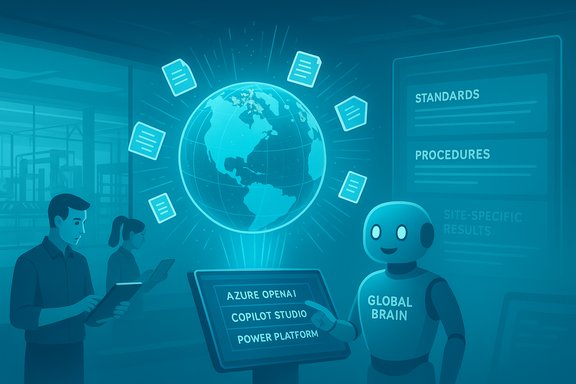
Carlsberg’s solution, called Global Brain, is an enterprise knowledge assistant designed to deliver context‑aware answers to natural language queries, grounded in the company’s authoritative documents. Microsoft’s customer story reports dramatic results: prototype assembly in two days, a reduction in query time of roughly 99% for operational templates, testing engagement above 90%, and a target audience of more than 10,000 ISC users at launch.
This implementation was completed as part of a broader strategic shift: Carlsberg’s IT leadership reorienting technology from a support function to a business innovation engine. Under that strategy, programs that tightly align domain subject matter experts with cloud AI engineering and governance capabilities gain priority.
At the same time, the headline metrics must be read with nuance. Claims such as “~99% reduction” and “two‑day build” are compelling but originate in company and partner reporting; independent validation at scale is limited in the public record. The true long‑term value will be determined by how Carlsberg manages hallucination risk, enforces provenance, controls costs, and integrates the assistant into everyday work. Those are the harder problems that take months, not days, to solve.
For technology leaders, the takeaways are pragmatic:
Source: Microsoft Carlsberg builds AI knowledge base in two days with Microsoft Unified | Microsoft Customer Stories
 Background / Overview
Carlsberg Group operates a complex global manufacturing and distribution network that depends on rigorous, auditable operational standards. The company’s Integrated Supply Chain (ISC) and the Carlsberg Excellence program maintain thousands of operational standards, training materials, and compliance documents that front‑line staff and engineers rely on to run breweries and packaging lines consistently across regions.The business challenge was simple and acute: users needed a fast way to find the complete, accurate, and actionable set of standards and procedures for a specific manufacturing site or task — not a partial list, not an answer with surrounding noise, and not a vague summary. The manual approach — searching across large SharePoint libraries, file servers, and internal documents — could take 20–30 minutes per query and required skilled users to interpret disparate documents.
Carlsberg’s solution, called Global Brain, is an enterprise knowledge assistant designed to deliver context‑aware answers to natural language queries, grounded in the company’s authoritative documents. Microsoft’s customer story reports dramatic results: prototype assembly in two days, a reduction in query time of roughly 99% for operational templates, testing engagement above 90%, and a target audience of more than 10,000 ISC users at launch.
This implementation was completed as part of a broader strategic shift: Carlsberg’s IT leadership reorienting technology from a support function to a business innovation engine. Under that strategy, programs that tightly align domain subject matter experts with cloud AI engineering and governance capabilities gain priority.
What Carlsberg built — the essentials
The business capability
- A natural‑language AI assistant that answers supply‑chain operational questions and retrieves exhaustive lists of standards and requirements for specific sites or roles.
- A user experience built for speed and clarity: short natural queries (the way you’d ask a colleague) that return digestible, actionable outputs.
- Feedback mechanisms (thumbs up / thumbs down) to capture user trust and continual improvement signals.
The platform components (what the teams used)
- SharePoint: the authoritative content source where Carlsberg stores standards, training materials, and supply‑chain documentation.
- Azure AI / Azure OpenAI (Foundry Models): foundation and reasoning models powering large‑language-model (LLM) inference, with enterprise governance and model selection available through the Foundry model catalog.
- Microsoft Copilot Studio: the agent builder used to create the production‑ready “Copilot” style assistant and orchestrate data connectors and flows.
- Power Platform: configuration and integration tooling, used to ensure compliant environments and manage application lifecycle aspects.
- Microsoft Unified engagement: expert Cloud Solution Architect(s) and governance support provided under the Microsoft agreement to speed delivery and ensure adherence to enterprise security and compliance patterns.
The outcome claimed
- Prototype developed in two days.
- Query time reduced by ~99% for retrieving operational templates.
- 90%+ engagement in initial testing with 200 queries from 10 testers.
- Launch targeted to 10,000+ integrated supply chain workers.
How they likely did it — a practical technical anatomy
Carlsberg’s published description maps to a standard, repeatable RAG (retrieval‑augmented generation) pattern, accelerated by Microsoft tooling. The general architecture that enables the claimed experience can be summarized in the following functional blocks:- Content ingestion & indexing
- Authoritative SharePoint documents are scanned, parsed, and indexed.
- Document enrichment includes metadata extraction, section segmentation, and possibly embedded vectorization for semantic search.
- Vector store & search
- A vector index (or an enterprise semantic search service) supports fast retrieval of relevant content chunks to ground LLM answers.
- The retrieval layer provides deterministic access to the exact set of operational standards for a given site.
- Model orchestration
- Azure OpenAI / Foundry Models handle the reasoning and generation. Model choice balances cost, latency, and safety.
- A model router or selection strategy chooses between smaller or larger models depending on the query.
- Agent UI & orchestration
- Microsoft Copilot Studio implements the assistant front end, conversation orchestration, connectors to SharePoint and Power Platform flows, and publishing controls.
- The agent provides a conversational interface and includes feedback controls for human evaluation.
- Governance, telemetry & cost management
- Monitoring tracks token consumption, Copilot credits usage, performance SLAs, and response quality metrics.
- Teams benchmark usage vs. ROI and use those metrics to scale safely.
Why the two‑day turnaround is credible — and what it really means
On the surface, “two days” to produce a working AI knowledge assistant looks extraordinary. The speed is plausible when three conditions hold:- The problem scope was tight and data sources were consolidated. Carlsberg’s primary content source was SharePoint — a single, authoritative repository — which dramatically lowers the data‑preparation effort compared with fragmented sources.
- Out‑of‑the‑box tooling and templates were used. Microsoft now provides Copilot Studio templates, prebuilt connectors for SharePoint and Power Platform, and Foundry model provisioning designed to accelerate prototyping.
- Microsoft Unified provided expert delivery support. Cloud Solution Architects and a collaborative engagement model can remove friction in environment setup, governance configuration, and secure provisioning, enabling rapid iteration.
Strengths: where this approach really delivers value
- Speed to first value. Rapid prototyping reduces time‑to‑insight and validates use cases before major investment.
- High adoption potential when output is accurate. Enterprise users prefer a single place that provides complete and authoritative answers rather than partial summaries.
- Enterprise grounding and governance. Using Copilot Studio and Microsoft’s management tooling provides centralised controls: RBAC, telemetry, content grounding, and tenant governance.
- Operational efficiency gains. Automating routine searches and delivering contextual guidance reduces wasted time and lowers the cognitive load on engineers and operators.
- Retained organizational ownership. A key success factor was Microsoft’s upskilling of Carlsberg’s internal teams, enabling the company to own and evolve the assistants after the initial delivery.
- Measured scaling. Tracking token consumption and comparing with ROI helps avoid uncontrolled bill shock and supports phased expansion.
Risks, caveats, and blind spots — what to watch for
Even well‑executed enterprise copilots carry real risks and operational costs. The Carlsberg example surfaces both good practice and areas where organizations must be vigilant:- Hallucination and completeness tradeoffs.
- LLMs can invent plausible but incorrect answers. RAG patterns mitigate this by returning grounded evidence, but engineering discipline is required to ensure the assistant always cites or returns the exact documents when correctness matters.
- For regulatory or safety‑critical operational standards, any answer that is not traceable to a specific source must be treated as non‑authoritative.
- Data privacy and leakage.
- Sensitive operational data stored in SharePoint must be mapped against role‑based access and DLP policies. Agents that summarize or expose sensitive content incorrectly can breach policy or legal obligations.
- Vendor and platform lock‑in.
- Building deep integrations with a single cloud’s agent ecosystem and foundry models simplifies delivery but increases dependency on the platform’s APIs, pricing, and product roadmap.
- Cost control and credit models.
- Copilot Studio and Foundry models operate on consumption pricing (Copilot credits, token usage). Rapid growth without governance can lead to escalating costs. Carlsberg’s practice of tracking token consumption and benchmarking ROI is essential.
- Model lifecycle and drift.
- Foundation models and knowledge artifacts evolve — monitoring, retesting, and re‑grounding are necessary to maintain accuracy and relevance.
- Change management and skills.
- Delivering the assistant is only half the challenge; embedding it into daily workflows, training thousands of users, and ensuring trust requires sustained change management.
- Auditability and compliance.
- Enterprises need robust logging, explainability, and retained evidence trails to meet audit requirements; “answers” must link back to document versions and timestamps.
Practical lessons and a repeatable recipe for enterprise teams
For IT leaders and supply‑chain heads contemplating a similar path, Carlsberg’s story yields a pragmatic checklist and a suggested delivery cadence.Preflight: business and data readiness (1–2 weeks)
- Inventory your authoritative sources and remove or flag content that is duplicated, outdated, or inconsistent.
- Build a canonical mapping of documents to sites, roles, and processes; add structured metadata where possible.
- Define the initial scope narrowly: pick one manufacturing site or one discipline (e.g., packaging standards) to deliver immediate value.
Prototype (1–3 days for MVP with vendor support; 1–2 weeks otherwise)
- Provision a sandbox tenant and secure access controls.
- Use Copilot Studio Lite templates or an agent template to connect to SharePoint and index a limited corpus.
- Configure retrieval settings to return entire compliance lists instead of summaries when a user asks for requirements.
- Run a short test with 5–15 SMEs to validate answer correctness and completeness.
Harden & Govern (2–8 weeks)
- Implement deterministic grounding: every answer must include the authoritative document reference and the section used.
- Add RBAC enforcement and DLP policies across connectors (ensuring private documents never leak to external usage).
- Set up telemetry: usage, top queries, confidence metrics, and explicit feedback loops.
- Create a cost governance model: Copilot credits forecast, token budgeting, and monthly consumption reports.
Iterate & Scale (ongoing)
- Expand the indexed corpus gradually, retest, and bake model monitoring into change control.
- Integrate Copilot agents into common workflows (Teams, intranet, mobile apps) and measure time saved.
- Continue capability building: train internal authors to improve document structure and to act as model stewards.
Recommended minimum controls before broad rollout
- Grounding guarantee: For any compliance or operational answer, link to the precise document name, version, and section used to assemble the response.
- Human-in-the-loop escalation: For high‑risk queries, provide an automatic escalation path to a subject matter expert or a ticketing workflow.
- Access policy enforcement: Ensure that the assistant respects SharePoint permissions end‑to‑end; users can’t retrieve documents they aren’t allowed to see.
- Cost guardrails: Implement caps, alerts, and a budgeting cadence for Copilot credits and token consumption.
- Audit logging: Retain conversation logs, model prompt/response pairs, and grounding evidence for a defined retention period to meet audit requirements.
Business impact: measurable benefits and reasonable expectations
Carlsberg’s example highlights three concrete business outcomes enterprises should expect when they do the foundational work well:- Time savings at scale. Even small per‑user time savings compound across thousands of users and repetitive tasks, delivering thousands of hours saved annually.
- Faster onboarding and standardization. New hires and less experienced operators gain immediate access to consistent answers, improving first‑time‑right metrics.
- Improved compliance and quality. Centralised, authoritative retrieval reduces the chance of working from stale or incorrect documents, reducing incidents and rework.
Strategic considerations: platform choices and long‑term architecture
- Multi‑model strategy. Use smaller, cheaper models for routine retrieval and larger, more capable reasoning models for complex decision support. A model router delivers the right tradeoff between latency, cost, and capability.
- Open interfaces. Architect connectors and embeddings to be portable — store embeddings and vector indexes in a vendor‑agnostic format when possible so you can migrate or co‑host components.
- Observable AI. Instrument prompts, retrievals, and model outputs with monitoring: answer accuracy, source fidelity, latency, and user feedback.
- Governed data pipelines. Keep the extraction and enrichment layer auditable and repeatable so knowledge updates align with document change control.
Final analysis — balanced verdict
Carlsberg’s Global Brain is a vivid demonstration of how modern enterprise AI stacks enable fast, measurable improvements for mission‑critical operational workflows. The sprint from concept to MVP — two days, as reported — underscores the power of prebuilt connectors, foundation models offered through a model catalog, and vendor‑led delivery under a Unified agreement. More importantly, the program’s emphasis on governance, consumption tracking, and upskilling reflects mature thinking: speed without stewardship creates risk.At the same time, the headline metrics must be read with nuance. Claims such as “~99% reduction” and “two‑day build” are compelling but originate in company and partner reporting; independent validation at scale is limited in the public record. The true long‑term value will be determined by how Carlsberg manages hallucination risk, enforces provenance, controls costs, and integrates the assistant into everyday work. Those are the harder problems that take months, not days, to solve.
For technology leaders, the takeaways are pragmatic:
- Start with a narrow, high‑value domain and authoritative sources.
- Use Copilot Studio or comparable agent builders to accelerate prototyping.
- Treat governance, cost control, and auditability as part of the minimum viable product — not optional extras.
- Invest in people: transfer skills to internal teams so the organisation can iterate without depending on external consultants.
Source: Microsoft Carlsberg builds AI knowledge base in two days with Microsoft Unified | Microsoft Customer Stories
