

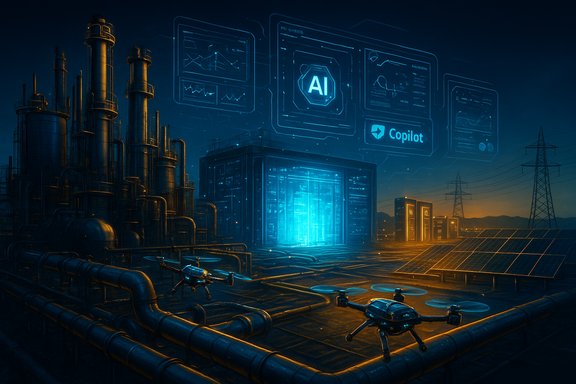
ADNOC’s announcement that it has expanded its AI partnership with Microsoft — bringing Masdar and ADNOC’s investment arm XRG into the fold — marks a deliberate shift in how energy majors are positioning themselves in the era of large-scale generative AI and hyperscale data center growth. The agreement, unveiled at an energy-and-AI forum in Abu Dhabi, promises two intertwined outcomes: the accelerated deployment of AI inside ADNOC’s operations to drive automation and efficiency, and the delivery of energy solutions — including renewables and grid-capacity planning — to support Microsoft’s global AI and data center expansion. The deal sits at the nexus of two fast-moving trends: unprecedented electricity demand from AI-driven compute, and energy companies moving from fuel suppliers to infrastructure partners for cloud and AI operators.
The last 18 months have seen hyperscalers announce extensive data center builds and strategic investments worldwide while energy operators race to provide secure, resilient, and lower‑carbon power. Large cloud providers now compete not only on software, but on guaranteed power, efficient cooling, and low‑latency interconnection. Simultaneously, energy companies are embedding AI across oil & gas and renewables operations to reduce downtime, optimize production, and compress decision cycles.
ADNOC’s new cooperation agreement with Microsoft adds Masdar — the UAE’s renewable energy champion — and XRG, ADNOC’s global investment arm, to a pre‑existing technology partnership. The stated aim is twofold: co‑develop and deploy AI agents that enable autonomous operations across ADNOC’s value chain, and collaborate on energy projects and infrastructure that can power Microsoft’s growing AI platform and data centers. In parallel, ADNOC also signed three separate deals with a robotics-and‑inspection specialist to accelerate hardware-level data capture for AI models.
ADNOC cites an enterprise rollout of generative AI beginning in November 2023 that leveraged Microsoft Copilot across thousands of employees. The stated outcomes include extensive training completion numbers and productivity metrics that the company uses to justify moving further into agentic AI.
At the same time, this alignment between a major state‑owned energy company and a global cloud provider raises questions about how national strategic objectives, foreign investment, and data center investment interact — particularly in regions where governments and national champions play an outsized role.
There will also be accelerating competition for advanced compute hardware and the enabling components — GPUs, cooling systems, and high‑capacity fiber — which introduces supply‑chain friction and geopolitical complexity. Countries and companies that align energy strategy with digital infrastructure strategy will likely have an edge in attracting hyperscale investment.
That combination unlocks both opportunity and responsibility. It can accelerate decarbonization by mobilizing capital to build clean capacity and grid-flexibility. But it also amplifies the need for disciplined governance: clear procurement terms, robust cybersecurity, independent verification of corporate claims, and concrete commitments to workforce transition.
For organizations and technologists watching this space, the lesson is clear: plan for AI and energy as co‑dependent systems. Build architectures, contracts, and governance that reflect that reality. The companies that do will benefit from new commercial channels and operational resilience; those that treat AI growth and energy supply as separate or secondary risks may find themselves exposed to real, material operational and reputational hazards in a world where compute is as physical as oil and electrons as strategic as barrels.
Source: Rigzone ADNOC, Masdar Pen AI Collaboration with Microsoft
 Background
The last 18 months have seen hyperscalers announce extensive data center builds and strategic investments worldwide while energy operators race to provide secure, resilient, and lower‑carbon power. Large cloud providers now compete not only on software, but on guaranteed power, efficient cooling, and low‑latency interconnection. Simultaneously, energy companies are embedding AI across oil & gas and renewables operations to reduce downtime, optimize production, and compress decision cycles.ADNOC’s new cooperation agreement with Microsoft adds Masdar — the UAE’s renewable energy champion — and XRG, ADNOC’s global investment arm, to a pre‑existing technology partnership. The stated aim is twofold: co‑develop and deploy AI agents that enable autonomous operations across ADNOC’s value chain, and collaborate on energy projects and infrastructure that can power Microsoft’s growing AI platform and data centers. In parallel, ADNOC also signed three separate deals with a robotics-and‑inspection specialist to accelerate hardware-level data capture for AI models.
What the new collaboration covers
Core components of the agreement
- AI agents and automation: ADNOC and Microsoft will co‑develop agentic AI solutions to automate decision workflows, extend predictive maintenance, and enable more autonomous operations across upstream, midstream and downstream assets.
- Upskilling and AI tools: Microsoft will provide advanced AI toolsets and employee upskilling programs aimed at embedding AI literacy and operational use cases across ADNOC’s workforce.
- Energy solutions for data centers: Masdar and XRG will participate in designing and delivering energy projects — renewables, storage and grid infrastructure — intended to supply or stabilize the power that large AI data centers will need.
- Joint innovation ecosystem: The partners will explore a broader innovation ecosystem where tooling, data, and operational models can be joint‑developed and potentially commercialized for the wider energy industry.
Additional robotics and inspection deals
Separately, ADNOC broadened its robotics footprint with three agreements designed to digitize plant inspection and maintenance workflows. These focus on deploying a robotics operating system across ADNOC Gas assets, exploring local manufacturing of robotic systems, and delivering joint training programs to build local talent.Why this matters: the energy-for-AI and AI-for-energy loop
This partnership captures a reciprocal logic that is increasingly shaping corporate strategy in both sectors:- AI-for-energy: Energy companies are adopting AI to reduce operating costs, extend asset life, predict failures, and cut emissions. The promise is measurable operational uplift: fewer unplanned shutdowns, improved yield, and safer operations.
- Energy-for-AI: Conversely, AI — particularly large language models and model training/inference on GPUs — requires dense, continuous, and predictable power. Hyperscale data centers place strong demands on grids and often require bespoke generation, storage, and procurement strategies to ensure uptime and sustainability commitments.
The technical pieces: AI agents, Copilot, Cantilever and edge intelligence
AI agents and autonomous operations
The agreement speaks of AI agents — autonomous software entities that can make complex, multi-step decisions in real time. In industrial settings, these agents typically integrate sensor telemetry, digital twins, scheduling systems, and human oversight. When done correctly, they can reduce human operator load and accelerate responses to abnormal conditions.ADNOC cites an enterprise rollout of generative AI beginning in November 2023 that leveraged Microsoft Copilot across thousands of employees. The stated outcomes include extensive training completion numbers and productivity metrics that the company uses to justify moving further into agentic AI.
Copilot and upskilling
Microsoft’s Copilot product family is being repackaged for enterprise workflows, and Microsoft has aggressively integrated Copilot into its suite of productivity and cloud tools. For an energy company, Copilot functions as an assistant for knowledge retrieval, report drafting, and even initial diagnostic reasoning — but deployment at scale also requires integration with industrial control systems and strict governance over access, change control, and safety boundaries.Cantilever, robotics, and “physical data”
The robotics agreements focus on capturing high‑fidelity physical data from equipment and infrastructure using inspection robots and a cloud analytics platform. The collected sensor and imagery data feed into AI models to build predictive maintenance and integrity analytics. This physical‑data-first approach is critical: AI models need robust, labeled, time-series data from the field to make reliable operational recommendations.Verifiable claims and numbers
Several specific claims were made in the announcement and accompanying material:- ADNOC asserts that it rolled out generative AI enterprise‑wide in November 2023 and that more than 40,000 employees completed AI training, with utilization rates above 90% and productivity gains exceeding 70,000 hours per month.
- The partners quote projections that data center electricity demand will surge in the next decades; one figure referenced forecasts demand rising from roughly 105 GW to 450 GW by 2040 in some scenarios.
- Microsoft has publicly signaled aggressive investments in data center capacity and has sought export approvals for high‑performance AI GPUs to equip facilities.
Strategic rationale for each partner
ADNOC
- Operational uplift: Embedding AI and robotics reduces inspection cycles, increases uptime, and lowers maintenance costs.
- Value chain modernization: Autonomous operations and AI agents enable ADNOC to squeeze efficiency across exploration, refining, and logistics.
- Positioning: Moving from a commodity supplier to an energy‑and‑infrastructure partner increases ADNOC’s strategic value to hyperscalers and global tech companies.
Masdar
- Market for low‑carbon power: The hyperscaler sector represents one of the largest long‑term buyers of renewables and storage projects.
- Scale and credibility: Partnering with a major cloud provider delivers anchor demand, reduces offtake risk, and helps Masdar accelerate project financing and construction.
XRG (ADNOC’s investment arm)
- Capital allocation: XRG can underwrite large energy infrastructure projects and take an active investment role in enabling data center clusters.
- Global footprint: A dedicated investor arm can target strategic geographies where hyperscalers are expanding.
Microsoft
- Securing power and resilience: For hyperscalers, co‑designing energy supply and resilience plans with local partners is critical to uptime SLAs and emissions goals.
- Proximity and data gravity: Partnerships with national energy champions accelerate data center siting and ensure regulatory engagement.
- Operational AI innovation: Access to industrial use cases — and the associated field data — accelerates product development and improves domain‑specific AI models.
Market and geopolitical context
The agreement occurs against a backdrop of major corporate pushes into regional AI infrastructure and heightened geopolitical scrutiny of AI supply chains. Hyperscalers are negotiating complex regulatory and export control landscapes while trying to secure the high‑performance computing hardware they need. Strategic partnerships with national energy and investment entities help hyperscalers navigate local permitting, secure power, and align with sovereign economic priorities.At the same time, this alignment between a major state‑owned energy company and a global cloud provider raises questions about how national strategic objectives, foreign investment, and data center investment interact — particularly in regions where governments and national champions play an outsized role.
Risks, trade‑offs and governance issues
The announcement advances a promising industrial strategy, but it also surfaces a range of material risks and potential downsides:- Grid stress and system reliability: Rapid data center buildouts create concentrated, always‑on loads. Utilities and grid operators need multi‑year lead times for transmission upgrades. Without careful coordination, new data centers can exacerbate congestion and increase system costs.
- Carbon accounting and dispatchable power: Even when renewables are contracted, the need for dispatchable, always‑available power often leads to reliance on gas or other thermal generation. Ensuring genuinely additional and low‑carbon electricity, especially at times of high demand, requires careful procurement structures and possibly new storage or flexible demand solutions.
- Vendor concentration and lock‑in: Deep technology integrations (agentic AI in operations, Microsoft tooling, Copilot, cloud stacks) can create technical and procurement lock‑in that is hard and costly to unwind.
- Data sovereignty and jurisdictional risk: Industrial operational data, telemetry, and model artifacts may cross infrastructures with differing legal regimes. Governance over where models are trained and where operational decisions are executed will be critical.
- Cybersecurity: AI agents controlling, or aiding, operational decisions significantly increase the attack surface. Robust cybersecurity, multi‑party access control, and fail‑safe engineering are essential. Historically, industrial control systems impose tight separation; integrating LLM‑style interfaces demands new security architectures.
- Workforce and skills transition: While the announcements stress upskilling, automation can shift job responsibilities and require targeted programs to reskill affected staff. Achieving local hiring and skills transfer commitments will require sustained investment.
- Marketing claims vs. reality: Corporate statements about being “the first” or claiming specific utilization/productivity gains are often used for strategic signalling. Independent verification and ongoing transparency are needed to turn marketing claims into durable proof points.
Technical and operational considerations for enterprise architects
For CIOs, data center managers, and enterprise architects tracking this shift, several practical implications follow:- Plan for energy as part of capacity planning. When designing compute clusters or negotiating capacity with cloud providers, include energy sourcing, resiliency clauses, and curtailment language in procurement.
- Treat operational AI deployments like instrumentation projects. Successful agentic AI requires high‑quality, labeled field data; investments in sensors, robotics, edge compute and data pipelines are not optional.
- Design robust governance for AI agents. Operational AI must include model verification, conservative action envelopes, human‑in‑the‑loop failover, and rigorous logging for auditability.
- Integrate security and safety engineering early. Convergence of IT, OT (operational technology), and AI amplifies risk if system hardening is delayed.
- Consider multi‑vendor strategies. Where feasible, build interoperability and exportability into AI pipelines to avoid lock‑in and preserve optionality.
Where value will be captured — and who stands to win
- Project developers and financiers who can structure green, dispatchable power combined with long‑term offtake from hyperscalers will capture stable returns.
- Systems integrators and AI platform vendors that can bridge cloud AI capabilities with OT environments will win the large integration projects.
- Robotics and sensing firms that provide high‑fidelity physical data will be strategic suppliers; their data becomes the raw material for high‑value AI models.
- Nations and regions that can offer predictable regulation, grid access, and financing will attract data center clusters and related economic activity.
Accountability and transparency: what to watch for next
To assess whether this deal delivers on its rhetoric, stakeholders should monitor a few concrete signals over the coming months and years:- Power purchase agreements and offtake details: Will the projects actually supply additional renewable power, and are there clear guarantees on carbon intensity at times of high compute demand?
- Grid investments and transmission upgrades: How will transmission constraints be addressed, and who bears the costs of upgrades required to serve new data center loads?
- Operational metrics and independent audits: Will ADNOC, Microsoft, or project partners publish independent audits of productivity claims, emissions reductions, and safety performance?
- Workforce outcomes: Are training programs tied to measurable local hiring or skill‑certification targets?
- Security architecture and incident transparency: Will partners publish how they will segregate AI systems from critical control paths and how they will report and remediate incidents?
The wider energy and AI market: implications beyond Abu Dhabi
This deal is an emblem of a larger global pattern: cloud providers need physical power and strategic partners; energy companies need new revenue lines and digital capabilities. Expect similar commercial constructs in other energy hubs: data center operators striking long‑term power supply deals with utilities, renewable developers forming joint ventures with hyperscalers, and national investment vehicles underwriting the large capital needs of the AI infrastructure race.There will also be accelerating competition for advanced compute hardware and the enabling components — GPUs, cooling systems, and high‑capacity fiber — which introduces supply‑chain friction and geopolitical complexity. Countries and companies that align energy strategy with digital infrastructure strategy will likely have an edge in attracting hyperscale investment.
Conclusion
The ADNOC–Masdar–XRG–Microsoft agreement is a strategic move that codifies a central truth of this decade: AI growth and energy systems are indivisible. The deal pairs industrial AI adoption with the commercial imperative to supply reliable, low‑carbon power to data centers — creating an interdependent relationship where energy companies become infrastructure partners for cloud giants, and tech companies become deep customers of the energy transition.That combination unlocks both opportunity and responsibility. It can accelerate decarbonization by mobilizing capital to build clean capacity and grid-flexibility. But it also amplifies the need for disciplined governance: clear procurement terms, robust cybersecurity, independent verification of corporate claims, and concrete commitments to workforce transition.
For organizations and technologists watching this space, the lesson is clear: plan for AI and energy as co‑dependent systems. Build architectures, contracts, and governance that reflect that reality. The companies that do will benefit from new commercial channels and operational resilience; those that treat AI growth and energy supply as separate or secondary risks may find themselves exposed to real, material operational and reputational hazards in a world where compute is as physical as oil and electrons as strategic as barrels.
Source: Rigzone ADNOC, Masdar Pen AI Collaboration with Microsoft
