

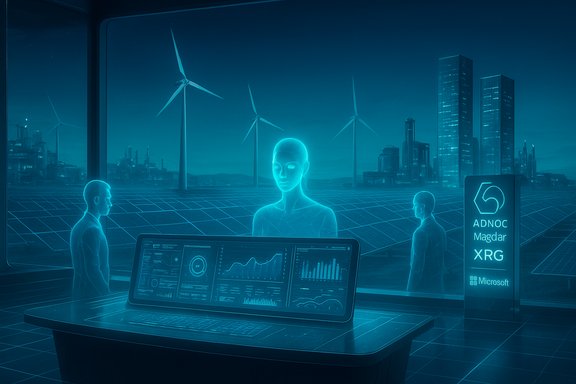
In a move that stitches together the deep pockets of the hydrocarbon business, the global reach of a top renewables developer, and the software and cloud muscle of a hyperscaler, ADNOC, Masdar, XRG and Microsoft have announced a strategic alliance to accelerate artificial intelligence (AI) adoption across the energy value chain and to develop low‑carbon power and infrastructure to support Microsoft’s expanding global AI and data‑center footprint. Announced at the ENACT Majlis in Abu Dhabi, the partnership centers on co‑developing agentic AI across ADNOC’s operations, scaling renewable power for data centers and building a joint innovation ecosystem — an ambition that, if successfully executed, would dovetail two of the world’s most urgent transitions: decarbonizing energy and powering exponential AI demand.
ADNOC’s push into AI is not sudden. The company has publicly documented multi‑tool AI deployments that it says generated $500 million in value and abated up to 1 million tonnes of CO2 between 2022 and 2023, milestones it attributes to over 30 AI solutions across its value chain. Those projects — spanning subsurface decisioning, predictive maintenance and emissions detection — set the stage for enterprise‑scale generative and agentic AI rollouts the company now proposes to scale further with Microsoft’s platforms and Masdar’s clean energy capacity. Masdar, meanwhile, has been in aggressive expansion mode. The renewables developer and investor reports a portfolio that grew to roughly 51 GW across operational, under‑construction and advanced pipeline assets by the end of 2024, and it publicly targets 100 GW of capacity by 2030 — a trajectory backed by major acquisitions and multi‑billion‑dollar project commitments. Those capacity ambitions are precisely the kind of supply that hyperscalers say they will need as data centers and AI compute loads surge. Reuters and Masdar’s own statements confirm the 51 GW baseline and the 100 GW target. Microsoft’s stated problem is simple: AI-first services are energy‑intensive, and the growth of large models and inference at scale requires both huge compute capacity and predictable, low‑carbon power. Microsoft has framed part of its cloud strategy around securing carbon‑free energy for data centers, developing purpose‑built infrastructure and investing in technologies that reduce energy intensity of AI workloads. The company’s public messaging stresses collaboration across energy, technology and finance to meet both compute growth and climate goals.
The strategy is compelling on paper: pair the appetite for compute with committed renewables and use agentic AI to cut emissions and operational costs. Yet the partnership’s real test will be execution against the hard physics of grids, the economics of firming, the governance of industrial AI, and the transparency of results. Public disclosures so far validate significant AI‑derived value for ADNOC and confirm Masdar’s rapid capacity expansion, but several high‑visibility claims about training, user adoption and productivity should be treated as company‑reported until independently audited. If executed with technical rigor, open measurement and strong governance, this alliance could set a new benchmark for how energy producers, renewable developers and hyperscalers collaborate to both decarbonize industry and power the next wave of AI. If executed poorly, it risks becoming a high‑profile example of ambition outrunning feasibility — with exposed grid systems, contested environmental claims and unanswered governance gaps. The difference will be in the details: contract structures, engineering designs, third‑party verification and the willingness of partners to publish measurable, auditable outcomes rather than aspirational targets.
Source: Khaleej Times Adnoc, Masdar, XRG, and Microsoft join forces to power the future of AI and energy
 Background
ADNOC’s push into AI is not sudden. The company has publicly documented multi‑tool AI deployments that it says generated $500 million in value and abated up to 1 million tonnes of CO2 between 2022 and 2023, milestones it attributes to over 30 AI solutions across its value chain. Those projects — spanning subsurface decisioning, predictive maintenance and emissions detection — set the stage for enterprise‑scale generative and agentic AI rollouts the company now proposes to scale further with Microsoft’s platforms and Masdar’s clean energy capacity. Masdar, meanwhile, has been in aggressive expansion mode. The renewables developer and investor reports a portfolio that grew to roughly 51 GW across operational, under‑construction and advanced pipeline assets by the end of 2024, and it publicly targets 100 GW of capacity by 2030 — a trajectory backed by major acquisitions and multi‑billion‑dollar project commitments. Those capacity ambitions are precisely the kind of supply that hyperscalers say they will need as data centers and AI compute loads surge. Reuters and Masdar’s own statements confirm the 51 GW baseline and the 100 GW target. Microsoft’s stated problem is simple: AI-first services are energy‑intensive, and the growth of large models and inference at scale requires both huge compute capacity and predictable, low‑carbon power. Microsoft has framed part of its cloud strategy around securing carbon‑free energy for data centers, developing purpose‑built infrastructure and investing in technologies that reduce energy intensity of AI workloads. The company’s public messaging stresses collaboration across energy, technology and finance to meet both compute growth and climate goals. What each partner brings
ADNOC — operator scale, industrial data and operational context
ADNOC supplies operational scale and mission‑critical industrial data. Its control rooms, subsurface datasets and field networks are the real‑world systems where agentic AI could unlock faster decisions, fewer unplanned stoppages and lower emissions intensity. ADNOC also brings governance and capital for upstream and downstream modernization programs. The company’s March 2024 disclosure of $500 million in AI‑derived value demonstrates both a track record and an appetite to expand AI from pilots into enterprise workflows.Masdar and XRG — clean power capacity, development capital
Masdar offers the renewable power pipeline and project delivery capacity required to match hyperscaler demand with low‑carbon electrons. With stated capacity of ~51 GW and a stated objective of 100 GW by 2030, Masdar’s portfolio — including wind, solar, storage and green hydrogen ambitions — positions it as a primary supplier for large PPAs (power purchase agreements) or dedicated feed for hyperscale campuses. XRG, ADNOC’s international investment vehicle, is being used to consolidate and re‑structure holdings, which could make project financing and international dealmaking more agile. Reuters reporting confirms the XRG restructuring activity and Masdar’s capacity targets.Microsoft — cloud platforms, AI tools, agent frameworks and skilling
Microsoft supplies the Azure platform, Copilot and agent frameworks, plus enterprise security and identity controls necessary for industrial deployments. The company also offers skilling programs, Copilot integrations and operational tooling to measure adoption and productivity. Microsoft’s public statements repeatedly position the firm as the bridging layer between AI software and energy infrastructure, arguing that AI can both consume electricity and help optimize generation and grid operations.The technical core: agentic AI for energy operations
The partnership highlights a next phase of enterprise AI: agentic systems — autonomous or semi‑autonomous agents that can observe, reason and act across operational systems. For energy firms this means AI agents that can:- Monitor telemetry and trigger preventative maintenance in real time.
- Suggest or autonomously apply optimizations for production, reducing fuel or flaring.
- Orchestrate supply, storage and grid interactions to minimize curtailment and maximize renewable utilization.
- Interface with human operators through Copilot‑style conversational controls embedded in operational apps.
Powering AI: supply, matching and energy system integration
A central plank of the alliance is pairing AI demand with low‑carbon supply. Microsoft will evaluate opportunities to source power from Masdar and ADNOC‑backed energy projects to serve regional and global data centers. That can take multiple forms:- Long‑term PPAs that underwrite new renewables built to serve data‑center clusters.
- Behind‑the‑meter or dedicated microgrid builds co‑located with compute campuses.
- Integrated solutions that combine renewables, storage and firming resources (including gas or potentially hydrogen/nuclear where appropriate) to provide dispatchable low‑carbon capacity.
- Will power be physically routed to Microsoft data centers via grid‑level agreements, or structured as bundled contractual PPAs?
- How will variable renewable generation be firmed to meet the uninterrupted supply expectations of hyperscalers?
- What level of renewable attribution (e.g., hourly matching, contractual attribution) will Microsoft require to claim low carbon intensity for AI workloads?
What the partnership promises in the near term
- Co‑development of AI agents across ADNOC’s upstream and downstream operations to improve efficiency and lower emissions. Microsoft will provide tooling and skilling to enable broader workforce uptake. ADNOC has previously reported significant AI gains and intends to scale these systems further.
- Evaluation and procurement of renewable energy to underpin Microsoft’s growing AI and data‑center footprint, with Masdar and XRG supplying capacity and financing muscle. Masdar’s public target of 100 GW by 2030 is central to the narrative.
- A joint innovation ecosystem — labs, pilots and training programs — aimed at building industrialized AI products for energy and at upskilling thousands of workers to operate and supervise AI agents in production. Microsoft has emphasized skilling programs in its regional engagements.
Strengths and strategic reasons this alliance matters
- Scale and complementarity: This is a rare combination where a national oil champion, a major renewables developer and a hyperscaler align around a shared objective. That reduces the risk of capability gaps — ADNOC supplies datasets and operations, Masdar supplies low‑carbon electrons and project delivery, and Microsoft supplies software, platforms and skilling.
- Commercial alignment with market demand: Hyperscaler growth is a real, quantifiable driver of incremental electricity demand. Locking in renewable capacity now — or underwriting new builds — can be an efficient way for Microsoft to manage future price and carbon risks while delivering capital to renewable projects.
- Operational leverage for decarbonization: AI agents, if well‑designed, can materially reduce emissions intensity through predictive maintenance, optimized operations and reduced flaring. ADNOC’s own figures show measurable value and emissions reductions from earlier AI deployments, which suggests the approach can scale.
- Regional positioning: Abu Dhabi’s ambition to be a hub for energy‑plus‑AI innovation is strengthened when national champions, sovereign capital and global tech firms converge around funded projects and shared labs. ENACT Majlis events amplify those ambitions and create a political and economic backdrop for cross‑border deals.
Risks, execution challenges and unresolved questions
While strategically appealing, several significant risks and execution hurdles deserve scrutiny.1) Grid physics, intermittency and reliability
Renewables are variable. For latency‑sensitive AI inference and data‑center SLAs, Microsoft will need either firming capacity (storage, dispatchable low‑carbon generation) or contractual structures that accept some grid exposure. Claims about powering data centers with renewables must be evaluated in the context of transmission constraints, curtailment risk and balancing services. Several recent industry studies show that hourly matching and certificate‑based accounting are not equivalent to physical firming; careful design is needed.2) Vendor concentration and governance
Large enterprises embedding agentic AI into critical operational workflows introduce concentration risk. If a single vendor supplies models, control planes and identity, operators must demand robust auditability, independent model validation, explainability and fail‑safe human override. Human‑in‑the‑loop design and conservative guardrails are non‑negotiable for safety‑critical decisions.3) Data governance, secrecy and sovereignty
Energy operators are custodians of sensitive geological and operational data. Any cloud‑hosted AI solution must preserve confidentiality, sovereignty and regulatory compliance. Microsoft’s enterprise controls and in‑country processing options mitigate some of these risks but require contractual clarity and technical attestations around telemetry flows and support access.4) Claims that are hard to independently verify
Certain performance metrics circulating in public summaries — for example, the assertion that ADNOC became the first energy company to implement generative AI enterprise‑wide or that more than 40,000 employees have undergone AI training with usage rates exceeding 90% and productivity gains of 70,000 hours per month — are powerful narrative elements. ADNOC’s own disclosures validate a $500 million value figure and 1 million tonnes CO2 abatement for 2023, but independent verification of the specific Copilot‑era user metrics is limited in public filings. Those claims should be flagged as company reported and should be validated through third‑party audits or Microsoft’s adoption dashboards where available. Readers should treat such rapid‑adoption statistics as directional rather than independently audited unless corroborated by third‑party reports.5) Energy geopolitics and market impacts
Large PPAs and off‑take agreements with hyperscalers can reshape local power markets, affecting price signals for other consumers. Governments and regulators may need to intervene to protect grid stability and to ensure equitable access to new capacity. Moreover, concentration of AI compute demand in a few regions could create local supply stresses for equipment, skilled labor and grid upgrades.What success looks like — measurable outcomes and KPIs
For the partnership to be more than rhetoric, outcomes should be measurable and independent where possible. Suggested KPIs:- Renewable capacity contracted and physically delivered to Microsoft data‑center locations (MW/MWh contracted vs delivered).
- Demonstrable reduction in emissions intensity for specified AI datacenter workloads (gCO2e per kWh, hourly matched).
- Number of agentic AI pilots transitioned to production with documented safety audits and operator sign‑off.
- Independent third‑party verification of workforce skilling and adoption metrics (training completions, hands‑on certifications, usage dashboards).
- Published transparency reports on the governance controls for agents (audit trails, rollback mechanisms, false‑positive rates).
Strategic implications for the industry
- Hyperscalers will accelerate structured deals with energy companies. Expect more long‑term PPAs, co‑investment vehicles and joint‑development agreements that pair compute demand with new renewable builds.
- Energy companies that can offer integrated project delivery — combining generation, storage and transmission — will be competitive partners for cloud providers. Masdar’s 100 GW ambition positions it well, but execution will matter.
- Enterprise AI deployments in industrial firms will migrate from pilot to agentic production at a faster pace, raising the importance of AI safety engineering, model governance, and industrial‑grade human‑in‑the‑loop frameworks.
- National champions and sovereign capital will increasingly act as intermediaries between global technology demand and global project finance — shaping where and how data centers and AI campuses are sited.
Practical advice for stakeholders
- For CIOs and energy procurement teams: insist on contractual provisions that specify day‑one service inventories, hourly matching definitions, curtailment remedies and mechanisms for physical delivery assurances.
- For operational managers: require conservative guardrails, deterministic rule layers and human sign‑offs for critical AI agent actions. Treat agentic AI as a control‑system integration exercise, not a bolt‑on software project.
- For policymakers: ensure transparency around major off‑take deals, grid impact assessments and community energy access. Large PPAs should be assessed for system‑level consequences.
- For investors: validate claims about delivered renewable capacity and independent verification of adoption or productivity metrics before assuming recurrence of reported gains.
Conclusion
The ADNOC‑Masdar‑XRG‑Microsoft alliance is a high‑profile experiment at the intersection of energy transition and the AI revolution. It combines complementary capabilities — industrial data and operations from ADNOC, renewable capacity and project delivery from Masdar and XRG, and cloud and AI platforms from Microsoft — and promises to accelerate both enterprise AI adoption in energy and the development of low‑carbon supply for hyperscale compute.The strategy is compelling on paper: pair the appetite for compute with committed renewables and use agentic AI to cut emissions and operational costs. Yet the partnership’s real test will be execution against the hard physics of grids, the economics of firming, the governance of industrial AI, and the transparency of results. Public disclosures so far validate significant AI‑derived value for ADNOC and confirm Masdar’s rapid capacity expansion, but several high‑visibility claims about training, user adoption and productivity should be treated as company‑reported until independently audited. If executed with technical rigor, open measurement and strong governance, this alliance could set a new benchmark for how energy producers, renewable developers and hyperscalers collaborate to both decarbonize industry and power the next wave of AI. If executed poorly, it risks becoming a high‑profile example of ambition outrunning feasibility — with exposed grid systems, contested environmental claims and unanswered governance gaps. The difference will be in the details: contract structures, engineering designs, third‑party verification and the willingness of partners to publish measurable, auditable outcomes rather than aspirational targets.
Source: Khaleej Times Adnoc, Masdar, XRG, and Microsoft join forces to power the future of AI and energy
