• Thread Author
The arrival of advertising inside conversational AI is no longer hypothetical — major platforms have begun placing clearly labeled ads and sponsored prompts inside chat interfaces, and the shift promises to reshape user experience, publisher economics, and brand strategy in profound ways.

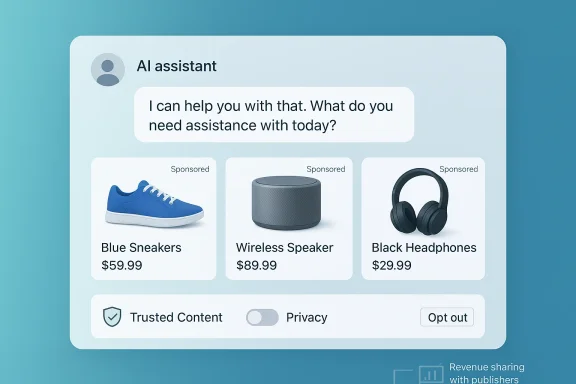
AI assistant chat UI with a help prompt and three sponsored items (sneakers, speaker, headphones) and privacy controls.Background​

Conversational interfaces captured mainstream attention after 2022, and their growth has created a new attention economy where intent signals are richer than traditional search queries. Chatbots routinely synthesize answers, compare options, and in some cases enable checkout flows — exactly the moments advertisers prize. That dynamic has turned conversational AI into prime real estate for commerce and advertising, while simultaneously exposing tensions between monetization and trust.
In early 2026 several major vendors publicly signaled or began testing ad placements in chat experiences. The most notable move came when one leading assistant announced a pilot to show ads to logged‑in adult users of its free and low‑cost tiers, while keeping higher‑priced tiers ad‑free — a framing that positioned advertising as a subsidy to keep broad access affordable. Platforms simultaneously emphasized principles such as answer independence (ads will not change model outputs) and conversation privacy (advertisers will not receive raw chat content). Those commitments are substantive product claims that will be tested as pilots scale.
At the same time, competitors and critics used the debate to draw distinctions: some vendors produced ad‑free positioning as a trust differentiator, while others highlighted potential harms from placing commercial content inside what many users treat as a personal assistant. The clash reified reputational risk as a central factor in how ad experiences are perceived and regulated.

Why ads are landing in chat now​

The economics: compute is expensive​

Large multimodal models require significant compute and infrastructure. Subscriptions and enterprise contracts help, but they do not always scale to cover costs for free consumer tiers. Advertising, historically a scalable revenue stream, is an obvious lever to underwrite free access at scale. Platforms see conversational surfaces as particularly valuable ad inventory because they capture explicit commercial intent inside a dialog.

Intent density and conversion potential​

A user asking “best blender for smoothies under $150” communicates far more precise purchase intent than a short keyword search. That intent density means ads shown at the moment of decision have the potential to convert at higher rates than generic display inventory. Early platform data and industry reports referenced by vendors suggest measurable lift for conversational ads versus legacy formats. These claims have been widely circulated in vendor materials and industry coverage, though independent verification is limited at scale.

Publisher pressure and revenue models​

AI assistants that synthesize information often reduce clicks to source sites, raising concerns among publishers about referral erosion. In response, some platforms have proposed or launched revenue‑share programs and publisher partnerships to compensate outlets whose content informs answers or appears alongside sponsored placements. These programs are uneven today and may become a major point of negotiation as ad inventory grows.

How ads are being implemented — current patterns​

Early ad formats are experimental and platform-specific, but common patterns are emerging:
  • Clearly labeled cards or banners shown beneath an assistant’s answer rather than woven into generated text. Vendors emphasize visual separation to preserve answer independence.
  • Sponsored follow‑up prompts or suggested next questions that bear a “sponsored” badge and invite the user to learn more. These nudge-based formats are designed to be opt‑in.
  • Shoppable product cards and carousels that surface inventory, pricing, and CTAs (buy, learn more) without forcing the user to leave the chat. Early prototypes or teardowns revealed such card formats and embedded merchant flows.
  • Contextual but non‑personalized targeting at launch, where ad matching relies on topical context rather than selling raw chat transcripts to advertisers; vendors promise user controls for personalization. These are policy claims that require verification.
Platforms commonly exclude ads from queries touching sensitive categories (mental health, medical advice, political content) at least during initial pilots, and some have age‑based safeguards for youth. These restrictions vary across vendors and are prone to policy drift as experiments iterate.

Platform reactions, positioning, and competitive theater​

Open positioning, ad pilots, and guardrails​

One major assistant publicly announced a measured rollout: ads for logged‑in adult users on lower‑cost tiers, with paid tiers remaining ad‑free. The vendor framed the move as a pragmatic way to subsidize access while committing to guardrails like answer independence and conversation privacy. The announcement prompted intense public debate and competitor responses.

Rivals weaponize trust claims​

Competitors used high‑visibility channels to criticize ad placements in chat, positioning ad‑free experiences as morally or practically superior. Those critiques are both marketing and governance plays: they aim to win users who value perceived impartiality, while also drawing regulatory and reputational scrutiny to the ad‑supporting platforms. This dynamic has made public communication and transparency central to product launches.

Microsoft, Perplexity and others: varied strategies​

Microsoft has been integrating sponsored and commerce features into Copilot‑adjacent surfaces and has published guidance for advertisers on how to approach conversational inventory; vendor materials cite strong performance metrics for some formats in controlled tests. Perplexity and similar answer engines experimented with “sponsored follow‑ups” and publisher revenue‑share pilots before the broader 2026 wave, indicating a diversity of commercial approaches across the ecosystem.

Strengths, opportunities, and measurable upsides​

  • High‑intent targeting: Conversational ads can reach users at the exact moment of decision, increasing the likelihood of conversion. Platforms claim meaningful uplifts for certain ad formats versus traditional search or display.
  • Funding broad access: Ads can subsidize free and low‑cost tiers, preserving inclusive access for users who cannot or will not subscribe. This is the principal business case vendors emphasize publicly.
  • New publisher revenue pathways: Revenue‑share programs tied to ad placements or direct partnerships can compensate content creators and publishers, potentially offsetting referral declines if designed fairly. Early pilots from a handful of vendors demonstrate the model in principle.
  • Improved user relevance: When done with careful controls, ads that genuinely solve a user’s query (discounts, localized inventory, quick booking) can add utility rather than detract from the conversation. Early user sentiment metrics cited by some vendors show a nontrivial share of users reporting enhanced ad experiences.

Risks, failure modes, and what to watch​

These upsides come with substantial hazards. Platforms, brands, and regulators should watch for these failure modes:
  • Trust erosion and churn: If ads feel deceptive, indistinguishable from assistant output, or manipulative, users may abandon free tiers or migrate to ad‑free competitors. Trust is the single most fragile asset for conversational assistants.
  • Opaque personalization and privacy slippage: Promises not to sell raw chat transcripts or to limit personalization sound reassuring, but they require independent verification. Memory features and cross‑session personalization can create long‑lived profiles with unclear retention and secondary‑use policies. These are substantive regulatory and ethical risks.
  • Publisher disintermediation: As assistants synthesize answers, direct referral traffic to journalism and specialist sites can decline. Unless revenue‑share models scale equitably, publishers risk being squeezed out of the value chain.
  • Measurement fraud and attribution gaming: Ad tech built around pageviews and cookies is not natively suited to session‑based conversational flows. Without new verification standards, there’s a material risk of inflated or fraudulent metrics.
  • Regulatory backlash: Weak transparency, hidden targeting, or inappropriate ad placements in sensitive contexts could provoke stricter data‑protection, consumer‑protection, or advertising‑practice rules. Policymakers already scrutinize whether novel AI behaviors require new legal guardrails.

Tactical checklist for brands, publishers, and product teams​

Below are practical steps stakeholders should take now to prepare for conversational ad surfaces. These are short, actionable priorities that can be implemented in parallel.

For brands and advertisers​

  • Build conversational‑ready creative: short, useful messages that add value to a chat flow rather than interrupt it.
  • Strengthen technical SEO and structured data: make canonical content easy for assistants to find and attribute. Publishers that use clear Q&A, schema markup, and API access increase their odds of being surfaced fairly.
  • Demand transparent measurement: insist on auditable attribution pipelines, anti‑fraud safeguards, and session‑level analytics tailored to chat experiences.
  • Define brand safety and context exclusions: set explicit rules to avoid placements in sensitive or reputationally risky queries.

For publishers and creators​

  • Negotiate revenue‑share arrangements or referral guarantees when your content is surfaced and monetized. Consider API partnerships, paywalls, or direct licensing to preserve value.
  • Optimize “answerability” of your content: short, well‑sourced paragraphs and clear attribution increase the likelihood assistants will cite you.

For platform and product teams​

  • Standardize visible labeling and vendor‑neutral disclosure at every conversational surface. Users must be able to tell, at a glance, what is generated content and what is advertising.
  • Offer clear controls: toggles to disable personalization, separate ad‑interest histories, and simple ways to delete ad data. Make the defaults privacy‑forward.
  • Exclude sensitive categories by policy and by technical enforcement, not ad revenue pressure. Health, mental health, political and safety‑critical conversations are poor candidates for monetization.
  • Sponsor independent audits of ad selection logic and privacy claims. Third‑party verification will be the clearest way to move from promises to credibility.

Measurement and technical challenges​

Conversational ad inventory requires new measurement primitives:
  • Session‑level attribution that can tie an in‑chat click or card impression to downstream conversions while protecting privacy. Legacy last‑click and cookie models are insufficient.
  • Impression validation to ensure an ad actually rendered and an accountable user saw it (not a lab or bot). Ad tech must evolve to define what constitutes a view inside a chat UX.
  • Anti‑fraud and bot detection adapted to conversational flows. Without this, bad actors could simulate high‑intent queries or inflate conversion metrics.
Platforms that publish measurement specifications and enable third‑party auditing will increase advertiser confidence and reduce fraud risk. Conversely, opaque metrics invite skepticism and waste ad dollars.

Regulatory and policy landscape — what governments and watchdogs should demand​

Regulators should consider the following minimal expectations for conversational advertising:
  • Transparent labeling rules so users cannot reasonably mistake an ad for an assistant’s independent answer.
  • Clear consent regimes for personalization and memory use, including straightforward ways for users to opt out and delete ad‑related profiles.
  • Protections for sensitive topics that effectively ban or severely restrict ad placements in medical, mental health, political, or other high‑stakes conversations.
  • Disclosure and revenue‑share transparency when content from publishers is reused in monetized answers; this should include reporting on how revenue is allocated.
  • Auditable measurement standards to reduce fraud and provide verified performance signals to advertisers.
These are baseline reforms that aim to preserve consumer welfare while allowing innovation to proceed. Without them, ad experiments risk regulatory backlash that could be more restrictive than a cooperative, phased approach.

Practical advice for everyday users​

  • Prefer paid tiers if privacy and an ad‑free experience matter to you; many vendors have explicitly preserved ad‑free experiences for subscribers.
  • Treat sponsored suggestions skeptically: verify product claims and consult independent reviews for purchases, health, or finance decisions. Chat assistants are helpful, but sponsored content can introduce bias.
  • Use platform privacy controls: disable personalization, clear memory or conversation history, and opt out of ad personalization where available. These controls are the best immediate protections for most users.

What success looks like — and what failure will cost​

Success for conversational advertising is not merely high CPMs or quick conversion lifts. It requires a durable and trust‑preserving architecture where:
  • Users understand when they are being advertised to and can control how their data is used.
  • Publishers are fairly compensated when their content is used to generate revenue.
  • Advertisers get verifiable, auditable metrics that map to real commerce without opening new fraud channels.
Failure, by contrast, will look like rapid migration away from ad‑supported offerings, heavy regulatory restrictions, and a reputational hit that damages the broader deployment of helpful AI assistants. Those costs are both financial and social: when trust breaks, user adoption and platform legitimacy suffer.

Final analysis: an industry‑shaping experiment that must be engineered carefully​

The push to monetize conversational AI with advertising is the logical next act in a technology that captures very focused intent. The potential benefits are real: broader access to capable assistants, new revenue for publishers, and highly relevant ad experiences for users. But these benefits are contingent on a single condition: platforms must prioritize trust as an engineering requirement, not a marketing afterthought.
The coming months will be telling. Early pilots show how ads could be visually separated and labeled, and vendors are publishing principles around answer independence and privacy. Yet principles without verification are fragile; independent audits, transparent measurement standards, fair publisher economics, and robust user controls must follow swiftly if the space is to avoid a reputational crisis.
For brands and publishers, the advice is straightforward: experiment, but insist on transparency and verification. For platform designers and product managers, the existential priority is clear: ship guardrails first, revenue second. If the industry strikes that balance, conversational ads can fund broad access without destroying the trust that makes assistants valuable. If it fails, the backlash and regulatory correction could be swift and severe.
The advertising frontier in AI chatbots is open for design and governance. The choices companies make now will determine whether this new surface becomes a welcome convenience or a costly erosion of a fragile trust economy.

Source: hpenews.com New world for users and brands as ads hit AI chatbots
 

The arrival of labelled, clickable commercial placements inside AI chat interfaces has arrived as headline news — and with it comes a profound reordering of how users, brands, publishers and regulators will relate to conversational AI. The original reporting that prompted this debate captures the moment: conversational assistants that once promised neutral help are now being road‑tested as advertising surfaces, and the implications stretch from product design to privacy law, publisher economics and brand strategy. ads in chat feel different
Chat interfaces are not simply another ad space; they are a new kind of attention economy. Unlike a search results page or social feed, a chat is a continuous, often private conversation where users disclose intent, constraints and context in natural language. That richness of signal makes chat an extremely attractive place to deliver offers at the point of decision — but it also raises unique trust and privacy challenges.
Major platform players have moved quickly from “experiment” to “pilot” and then to limited rollout. OpenAI’s public pivot to test advertising for logged‑in adult users on free and lower‑cost tiers made the issue unavoidable, and the industry reaction — including a high‑profile public jab by a competitor during the Super Bowl — has turned what might have been a technical product debate into a commercial and cultural flashpoint.
Why this matters now
  • Conversational AI scaled rapidly: millions of users and billions of prompts mean large, ongoing compute costs.
  • Subscriptions and enterprise sales help, but for some companies advertising remains the scalable lever to subsidize free access.
  • Chat surfaces capture more precise, decision‑ready signals than a keyword query, making them high-potential inventory for advertisers.
These dynamics explain the rush: platforms must fund infrastructure while advertisers seek new, high‑intent invt experiments show both promise and peril.

AI Assistant chat recommending budget smartphones under $500 with Learn More options.How platforms are implementing ads today​

Early ad formats in chat are varied and intentionally conservative in their visible design — at least on paper. The patterns that have emerged across pilots and announcements include:
  • Clearly labelled cards or banners below answers, separate from the assistant’s generated text. Platformsanswer independence.”
  • Sponsored follow‑up prompts or suggested actions that carry a “sponsored” badge and invite engagement (Perplexity piloted this format).
  • Shoppable product cards and carousels surfaced inline with inventory, pricing and CTAs that can keep users inside the chat flow.
  • Cond to conversation topics, with vendor statements promising non‑personalized matching and controls to opt out of personalization.
What platforms say they won’t do — and why verification matters
  • Providers are stressing that ads will not change the assistant’s factual answers, and that advertisers will not receive raw chat transcripts.
  • But these are policy claims, not technical guarantees; independent audits and clear telemetry will be necessary toice. Early company blog posts and product notes describe guardrails, but outside verification remains scarce.

The business math: why advertising looks inevitable to some companies​

Running large multimodal models at consumer scale is expensive. In market commentary and company communications, the logic is blunt: free, high‑value assistants attract broad usage but create a large cost base; advertising has historically been the scalable funding mechanism that allows free access at scale.
OpenAI framed ads as a way to keep a high‑value assistant accessible to people who cannot or will not pay, while offering paid ad‑free tiers for those who prefer a subscription‑based experience. The Verge and other outlets reported the rollout details: ads targeted initially at Free and a new low‑cost “Go” tier (with higher paid tiers remaining ad‑free), and user controls for personalization are being offered.
Microsoft and other major players have been preparing ad stacks for conversational surfaces for some time. Microsoft has explicitly described ad formats designed for Copilot experiences and integrated advertising tooling that adapts to conversational intent. That prior work means advertisers and agencies already have product teams thinking about how to buy and measure conversational ad inventory.
Perplexity and publishers: an alternative model
  • Perplexity moved early to propose revenue‑sharing with publishers when their content is surfaced and then monetized, arguing that publishers must be paid if their work powers answers. That program — launched in 2024 and expanded since — ties ad units (like sponsored follow‑ups) to cited sources and shares a portion of revenue with participating publishers.

UX, trust and the psychology of conversation​

The user experience challenge is the central risk. Chat feels private and personal; people anthropomorphize assistants and share intimate concerns they would never post publicly. Introducing a commercial voice into that environment — even carefully labelled — changes the conversation’s social meaning.
Three dynamics make the risk acute:
  • Depth of disclosure — users routinely share health, financial and relationship queries that are highly sensitive.
  • Perceived relationship — users treat assistants as helpers or companions; that trust can be exploited or eroded.
  • Real‑time tailoring — ads matched to immediate conversational context can feel highly relevant but also invasive.
Anthropic’s Super Bowl advertising campaign — which explicitly mocked the idea of an assistant suddenly pivoting to sell products mid‑conversation — crystallized that public anxiety. The campaign resonated: it pulled public attention to the trust issue and forced OpenAI into a public rebuttal. Reporting and analysis showed Anthropic’s ad drove measurable engagement and debate, and forced both companies to defend their moral positions in public.

Publisher economics and the “zero‑click” problem​

Publishers have a live, practical stake in this shift. Generative AI can reduce referral traffic by synthesizing answers rather than linking out to source articles, which undermines ad and subscription revenue models for journalism.
Perplexity’s publisher revenue‑share program is an explicit attempt to redistribute money to sources whose work fuels answers. Major news organizations have signed dhas publicly committed to sharing advertising revenue when their content is cited. That approach has been positioned as one potential mitigation for the “zero‑click” harms conversational AI imposes on publishers.
But there are open questions:
  • Will revenue‑share programs scale beyond a handful of partners?
  • How will non‑partnered publishers fare if their content is summarized without compensation?
  • Can platforms provide verifiable attribution and transparent measurement that publishers trust?
The answers will determine whether conversational ad revenue becomes a partnership or a further disintermediation of journalism.

Privacy, data flows and legal risk​

Platforms are promising to keep raw conversational content out of advertiser hands and to limit ad placements in sensitive categories (health, mental health, politics). Those are important commitments — but they require technical, legal and organisational proof.
Key privacy questions to watch
  • Exactly what telemetry isers (impression counts, aggregate engagement metrics, or richer signals)?
  • How long is conversational context or “memory” retained, and can ad personalization link to that memory?
  • How are age‑gates and topic filters enforced (automatically or manually), and how are errors remediated?
  • What obligations do platforms have under privacy laws (e.g., GDPR, CCPA) when they target ads based on conversational context?
Regulators are watching. The combination of intimate disclosures and highly personalized persuasion could attract consumer protection scrutiny, especially if targeting uses memory features tied to sensitive data. Observers have called for independent audits and transparency reports to validate vendor claims about data use and non‑influence.

Measurement, fraud and the new attribution problem​

Ad tech built kies is ill‑suited to conversation. Counting an “impression” in a chat, attributing downstream conversions to a sponsored follow‑up, and preventing view‑fraud or gaming are all unsolved or partially solved problems.
Platforms and advertisers must invent new measurement primitives:
  • Session‑level attribution that respects privacy while proving conversions.
  • Audit‑friendly impression logs and fraud detection tuned to conversational flows.
  • Third‑party verification systems to certify that sponsored prompts were delivered as promised and did not influence modeled answers.
Without these, marketers will struggle to trust conversational inventory; poor measurement will invite waste and open doors for fraud and inflated performance claims. The product teams building these ad surfaces must prioritize auditable metrics from day one.

Competition and brand positioning: the Super Bowl as a case study​

The Super Bowl ads around this debate offered a rare, high‑stakes laboratory for positioning in the AI wars. Anthropic’s “no ads” creative made a simple claim — and the world noticed. OpenAI’s leadership responded publicly, calling the spots “dishonest” even as the company defended its carefully defined formats and paid tiers. Coverage across major outlets documented the public squabble and its marketing effects.
Why the clash matters for brands
  • Consumers now perceive ad‑supported vs. ad‑free assistants as distinct value propositions. Brands must choose where to allocate media spend and how to align with user sentiment.
  • For companies that rely on trust (health, finance, education), appearing inside a chat could help or hurt brand equity depending on execution.
  • Marketers must be prepared to be audited: channel owners, attribution pipelines and data privacy guarantees will be table stakes for major brand deals.

Practical advice: what brands, publishers and product teams should do now​

For brands and performance marketers:
  • Test with rigorous measurement: design controlled experiments that compare conversational placements with standard channels.
  • Optimize creative for conversation: short, useful, clearly labelled prompts that add utility will outperform repurposed banner ads.
  • Demand transparency: insist on auditable a safeguards and explicit placement guarantees (no sensitive topics).
  • Prepare for new KPIs: conversational conversion and assisted multitouch models will matter more than simple CTRs.
For publishers:
  • Strengthen canonical pages with structured Q&A, schema and clear attribution signals to increase the odds of being cited.
  • Negotiate revenue‑share terms or API access where possible; treat platform integrations as strategic assets.
  • Consider own AI products or vertical niches to maintain direct relationships with users.
For platform product and policy teams:
  • Ship clear, consistent labeling and user controls from day one.
  • Publish independent audits or third‑party attestations about data use and “answer independence.”
  • Limit ad placements near sensitive topics and enforce age gating technically.
  • Publish transparency reports on ad volume, categories excluded, and revenue‑share arrangements.

What’s verifiable now — and what still needs scrutiny​

Verified, multi‑source facts
  • OpenAI publicly announced controlled tests of advertising for Free and Go tiers and emphasized ad labeling and user controls. This rollout and the basic design principles have been reported by multiple outlets.
  • Anthropic ran Super Bowl creative positioning Claude as ad‑free and that campaign provoked public comment from OpenAI leadership; multiple reputable outlets documented the exchange.
  • Perplexity and other startups have launched publisher revenue‑share programs to compensate outlets cited by their answers; reportichCrunch and others confirms these programs and pilots.
  • Microsoft has publicly described ad formats and tooling adapted to Copilot experiences, signaling that large ad networks are already integrating conversational placements into their product roadmaps.
Claims that require independent verification or could change quickly
  • Precise data flows and telemetry shared with advertisers — vendor claims (e.g., “we don’t sell raw chats”) require third‑party audits to verify.
  • Long‑term retention and use of conversational memory for ad personalization are policy claims that must be backed by documented retention windows and enforceable controls.
  • Measurement robustness and fraud prevention for conversational inventory are nascent — vendors can and will make performance claims, but advertisers should seek independent measurement before allocating large budgets.
Platforms’ written statements and product notes are an essential start, but the industry now needs routine external attestation — not only for privacy, but to sustain advertiser confidence.

Scenario planning: five plausible futures (and wheasured, audited rollout** — Platforms adopt strict labeling, external audits and publisher revenue‑shares. Outcome: ad‑supported tiers fund broad access; publishers and advertisers coexist with new attribution standards.​

  • Rapid, messy monetization — Platforms prioritize short‑term revenue, place ads in more categories, and measurement is opaque. Outcome: trust erosion, regulatory backlash, and market fragmentation as users migrate to paid ad‑free alternatives.
  • Niche publisher partnerships win — A subset of trusted publishers secures premium placements and revenue shares. Outcome: a two‑tier content economy where partner outlets get visibility and smaller publishers struggle.
  • Regulatory intervention — Privacy and consumer agencies impose strict s in conversational contexts, especially involving sensitive categories. Outcome: platforms redesign ad systems to be contextual and non‑personalized, reducing advertiser ROI but strengthening privacy.
  • Ad‑free competitive differentiation — Competitors double down on ad‑free models as a premium differentiator. Outcome: market polarization with well‑funded ad‑free incumbents and broad free ad‑supported services coexisting.
Each path has winners and losers; product design choices today will constrain the options available tomorrow.

Technical and governance checklist for the next 90 days​

  • Publish an auditable privacy and ad policy with precise definitions of what telemetry is shared with advertisers.
  • Freeze ad placements for sensitive categories until automated filters and human review reach high confidence thresholds.
  • Offer clear user toggles: disable ad personalization; delete ad‑related history; upgrade to ad‑free tiers without loss of data.
  • Launch independent third‑party audits of “answer independence” and measurement pipelines.
  • Pilot publisher revenue‑share or referral programs with transparent reporting and scalable contracts.
These are not optional if platforms expect sustained advertiser participation and public tr governance commitments.

Conclusion: a new surface, a narrow path​

The migration of advertising into conversational AI is not inevitable — it is underway. The first moves, announcements and public debates show both the commercial logic and the social fragility of this product pivot. Done well, ads in chat can fund access, surface genuinely helpful offers and create new revenue for publishers. Done poorly, they will erode the one asset these products most depend on: user trust.
For users, the ask is simple and urgent: demand clarity, controls and verifiable guarantees. For platforms, the prescription is tougher: design with restraint, publish the data and invite independent verification. For brands and publishers, the task is tactical and strategic: develop creative that respects conversational norms, insist on audited measurement, and negotiate participation terms that preserve attribution and revenue.
The conversation that begins when a user types “Which blender should I buy?” will increasingly be a commercial one. The question for the industry is whether that conversation will remain helpful — and trustworthy — or whether it will become yet another battlefield where commerce trumps credibility. The choices made in the next months will determine which it becomes.

Source: Caledonian Record New world for users and brands as ads hit AI chatbots
 

Blue gradient UI mockup featuring a chatbot prompt and a 'Your Ad Here' sponsored panel.
The arrival of clearly labeled, clickable advertising inside conversational AI marks a watershed moment: assistants that once promised neutral help are being road‑tested as commercial surfaces, and the choices companies make now will determine whether this becomes a useful funding model or a catastrophic erosion of trust.

Background: why ads are landing inside chat now​

Conversational AI scaled from niche research projects to mainstream utility in only a few years. As usage ballooned into the hundreds of millions of users and billions of prompts, the recurring costs of compute, storage, and safety systems became a central business pressure for vendors. Subscriptions and enterprise contracts helped, but for many platforms, advertising remains the scalable lever to subsidize free access for mass users.
The moment that crystallized industry attention came when a leading assistant publicly announced a pilot to show ads to logged‑in adult users on free and lower‑cost tiers while keeping higher‑priced subscriptions ad‑free — framing advertising as a way to keep powerful AI broadly accessible. That announcement triggered competitor positioning, public debate and high‑profile marketing that turned a technical rollout into a cultural flashpoint.
Why ads now? Three forces converge:
  • Economics: At‑scale generative AI is expensive; ads are an efficient way to monetize high volumes of mostly non‑paying users.
  • Intent density: Chat captures richer, decision‑ready signals than typical search queries, making conversions at the point of conversation appealing to advertisers.
  • Publisher pressure: Assistants that synthesize and surface answers can reduce referral traffic to news and information sites; platform revenue programs for publishers are being explored as partial mitigation.

The current state of play: pilots, formats, and guardrails​

Common ad formats being tested​

Across vendors, early experiments share several visible patterns: ads are typically shown to logged‑in adult users on free tiers, are visually separated from the assistant’s generated text, and are accompanied by vendor promises that advertising will not change the model’s factual answers. Formats include:
  • Labeled cards or banners positioned beneath an assistant’s answer.
  • Sponsored follow‑ups or suggested actions that carry a “sponsored” badge.
  • Shoppable product cards and inline commerce flows that keep users inside the chat.
  • Side panels, carousels, or "search ads" style carousels adapted for a chat UI.
These formats are intentionally conservative in visual design at the outset — clearly labeled boxes, disclaimers, and topical exclusions — but the product roadmap often hints at deeper integration, such as merchant integrations and one‑click purchase flows.

Guardrails vendors are promising (and where they fall short)​

Vendors publicly describe core principles for ad pilots: answer independence (ads should not alter the assistant’s factual outputs), conversation privacy (advertisers do not get raw chat transcripts), and topic exclusions (no ads on sensitive queries like health or mental‑health advice).
However, there are crucial gaps between principles and verifiable practice:
  • Promises about answer independence are meaningful only when accompanied by technical audits or third‑party attestation. Without independent verification, these claims remain company policy rather than provable guarantees.
  • Privacy assurances that advertisers won't receive raw chat content hinge on implementation details — what telemetry is logged, how contextual signals are passed to ad matching systems, and how conversational memory is used. Those implementation pathways are often opaque.

Why chat ads feel different — and why that matters​

Chat interfaces are not just another web page: they are continuous, often private conversations where users disclose constraints, preferences, and intent in natural language. That intimacy creates both value and risk.
  • Value: Ads served at the moment of decision can be extraordinarily relevant and high‑converting. A user asking “best blender under $150” signals purchase intent far more precisely than a generic display impression.
  • Risk: The same intimacy makes users sensitive to exploitation — an assistant that appears to steer recommendations toward paid placements risks undermining trust, especially for advice on high‑stakes topics.
This distinction is why product design choices — labeling prominence, separation of content and promotion, user controls, and auditability — matter more in chat than in ordinary display or search ads. The perception of intrusion can be amplified in conversation, and perception often becomes reality in brand reputation battles.

The publisher problem: referral erosion and revenue responses​

One long‑standing concern has been “zero‑click” information consumption: when assistants synthesize answers, users may no longer click through to original reporting, reducing referrals and advertising revenue for publishers.
Platforms have begun experimenting with revenue‑share and publisher programs to compensate creators whose content informs answers. Some startups already run publisher partnership programs; larger vendors are piloting analogous programs. But these efforts are uneven and raise questions:
  • Will revenue programs scale fairly across the long tail of publishers?
  • Will the mechanics of attribution be auditable and transparent, or locked behind proprietary measurement stacks?
If publisher compensation proves insufficient or nontransparent, pressure from journalism organizations and regulators will intensify quickly.

Privacy, targeting, and the technical surface area​

Advertisers prize personalization. Platforms claim early ad targeting will be contextual and that personalization defaults will favor privacy, but how targeting actually works matters:
  • Does the system send full conversational context to an ad‑decision service, or are signals tokenized, hashed, or otherwise transformed?
  • Are session‑level identifiers used for cross‑session or cross‑service retargeting?
  • How is targeting limited for sensitive categories and minors, and can these limitations be validated by regulators or auditors?
Technical safeguards that materially reduce privacy risk include cryptographic session tokens for privacy‑preserving attribution, default opt‑out for personalization, and strict programmatic exclusions for sensitive taxonomies. Vendors that publish independent audits or third‑party attestations will command higher trust.

Measurement, attribution and the auditability challenge​

Advertisers need measurable returns; publishers need verified compensation. Conversational UIs complicate both tasks.
  • Traditional click‑based attribution breaks down when users complete tasks inside a chat without visiting a merchant or publisher page.
  • Vendors are exploring new metrics for conversational conversion (in‑chat purchases, assisted conversion windows, lift studies), but independent auditors and industry measurement partners must validate these metrics to prevent opaque attribution that favors platforms.
A durable ecosystem requires:
  1. Transparent, auditable measurement protocols.
  2. Shared, third‑party attestation of revenue flows to publishers.
  3. An independent watchdog or public ledger for aggregated, anonymized ad performance and payments.
Without these, advertisers may pay for impressions that are hard to benchmark, and publishers may see referral economics hollowed out.

Regulatory and legal risks to watch​

Regulators are already paying attention. Key risks include:
  • Data protection enforcement: If conversational ad systems use personal data without proper consent or lawful basis, data protection authorities could impose fines or require changes to consent models.
  • Consumer protection rules: Claims about “neutral” answers that are actually influenced by paid placements may attract scrutiny for deceptive practices.
  • Advertising transparency standards: Regulators could mandate uniform labeling prominence, restrict targeting in sensitive contexts, or require clear opt‑out mechanics for ad personalization.
The lesson for platforms: ship guardrails first, revenue second. Poorly executed rollouts risk rapid regulatory correction and reputational damage that will be hard to reverse.

A practical playbook for brands and marketers​

Brands must adapt quickly if they intend to participate in conversational ad inventory. The playbook differs from traditional search and display strategies.
  • Start small and test for intent: Prioritize categories and creative that map cleanly to decision moments (e.g., transactional product categories).
  • Respect conversational intimacy: Avoid creative that reads like interruption; prefer utility‑first placements (e.g., product cards, helpful follow‑ups) that add value to the user.
  • Demand transparency and auditability: Ask platforms for measurement protocols, sample creative placements, and independent verification of attribution claims.
  • Plan for brand safety: Exclude sensitive contexts programmatically and define escalation paths if your creative appears alongside inappropriate conversational content.
A short tactical checklist for marketers:
  1. Request an ad‑labeling and placement spec for conversational placements.
  2. Insist on explicit programmatic exclusions (health, mental health, minors, political).
  3. Require sample reporting formats and third‑party audit windows.
  4. Test small, measure lift relative to existing channels, and scale cautiously.

Design and engineering recommendations for platforms​

Product teams face the hardest design tradeoffs. Recommendations that materially reduce risk:
  • Implement a single, auditable ad‑labeling component across conversational surfaces so searches, chats, and overviews share consistent disclosure semantics.
  • Default personalization to off for new users and require explicit opt‑in for persistent personalization that uses conversational memory.
  • Publish independent audits of "answer independence" and privacy claims within a specified window after launch. Public attestation reduces skepticism.
  • Build publisher revenue‑share or referral programs and make those economic flows auditable. Consider a public, aggregated ledger of payments to demonstrate fairness.
These are not merely ethical niceties; they are operationally specific moves that can reduce legal risk and preserve trust while allowing commercial models to scale.

Risks, failure modes and worst‑case scenarios​

It helps to be explicit about plausible failure modes. If platforms prioritize short‑term revenue over verifiable guardrails, the likely consequences are:
  • Rapid erosion of user trust, with users abandoning ad‑supported assistants or shifting to ad‑free competitors.
  • Publisher backlash and accelerated regulatory attention that forces harsher disclosure or targeting restrictions.
  • Brand harm from misplaced or contextually inappropriate ad placements inside sensitive conversations.
These are not speculative: the industry reaction to early announcements already shows how reputational risks can be weaponized by competitors and amplified in public debate. The window to get design and governance right is narrow.

What success looks like​

If the industry gets this right, the upside is meaningful:
  • Conversational ads could fund broad access to powerful AI for users who cannot or will not pay, preserving inclusive access while offering advertisers a high‑intent surface.
  • Publishers could be compensated fairly, sustaining the ecosystem of reporting and content that assistants rely on.
  • Measurement protocols that are transparent and auditable could create a new standard for accountability in a post‑synthesis web.
But success is conditional: it requires transparent governance, independent verification, and user control by default.

Fast checklist for users, brands and product teams​

  • Users: Expect to see labeled ads in free chat tiers; use subscription tiers if you want an ad‑free experience and check privacy controls.
  • Brands: Focus on intent‑aligned creative, insist on auditability, and choose partners who publish measurement and safety protocols.
  • Product teams: Ship visible labeling, default opt‑out for personalization, third‑party audits, and publisher compensation mechanisms before scale.

Conclusion — a delicate test of product, policy and public trust​

Advertising inside AI chatbots is not an inevitable fate the public must passively accept — it is an engineering and governance choice. Done thoughtfully, with clear labels, robust privacy protections, auditable measurement and fair publisher economics, in‑chat ads can fund broad access and surface genuinely useful offers at the moment of intent. Done badly, they will corrode trust, hollow out referral economics that sustain journalism, and invite swift regulatory correction.
The coming months are decisive. Platforms, advertisers, publishers and regulators each have work to do: prioritize transparency, insist on independent verification, and treat conversational advertising as a governance challenge as much as a product opportunity. If they succeed, we may gain a new, useful ad surface that supports an inclusive AI ecosystem. If they fail, the reputational and legal costs will be lasting — and the conversation about what assistants should be will have swung permanently in one direction or the other.

Source: Newsbug.info New world for users and brands as ads hit AI chatbots

 

Back
Top