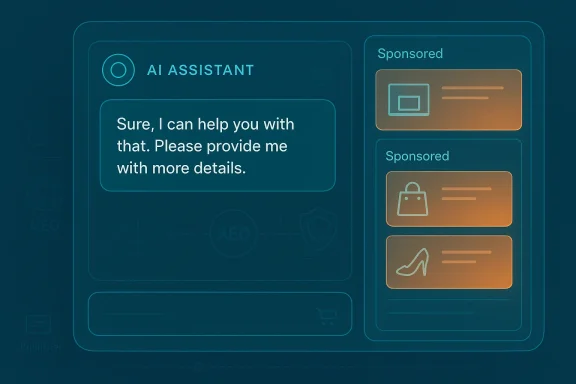
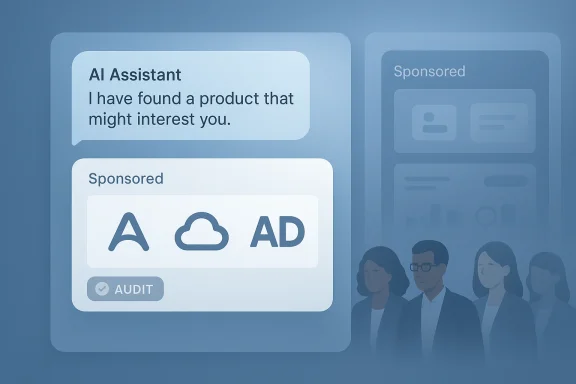
The arrival of advertisements inside AI chatbots is no longer hypothetical: major platforms are already piloting paid placements and sponsored cards, and the implications for privacy, trust, brand strategy and the wider ad market are profound. What began as an experiment to subsidize free access has quickly become a battleground of values and business models — from OpenAI’s carefully framed rollout to Anthropic’s high-profile Super Bowl critique — and it raises urgent design, legal and commercial questions that affect everyone who types, speaks or sells through conversational AI. /openai.com/index/our-approach-to-advertising-and-expanding-access//)
Chat interfaces are different from search pages. They feel personal, continuous and conversational. When those interfaces start showing commercial content, the line between assistance and advertising can blur — intentionally or not. Platforms now face a core tension: how to monetize massive usage of conversational AI without breaking the trust users place in an assistant that often helps with intimate or consequential tasks.
OpenAI made the economics explicit in a January 16, 2026 policy note explaining that it would begin testing ads in ChatGPT for logged‑in adult users of the Free and ChatGPT Go tiers, and that higher paid tiers (Plus, Pro, Business, Enterprise) will remain ad‑free. The company framed ads as a way to keep a high‑value assistant accessible to people who cannot or will not pay, while committing to principles such as answer independence (ads will not change the assistant’s responses) and conversation privacy (advertisers will not receive raw chat content).
That announcement changed the conversation. Rivals responded with marketing and moral posturing: Anthropic ran Super Bowl creative highlighting intrusive, mid‑conversation ad placements and positioning its Claude assistant as ad‑free; OpenAI’s CEO called the commercial misleading and defended his company’s promised guardrails. The clash crystallised the reputational risk of any misstep: consumers notice and competitors weaponize perception.
Across the industry, other players are already experimenting with monetization in chat and chat‑adjacent products. Microsoft has integrated sponsored content into Copilot experiences and related surfaces since 2023, while startups like Perplexity introduced “sponsored follow‑ups” and a publishers’ revenue‑share program during 2024 pilot runs. Google has also been testing ads in its AI “overviews” in search — a signal that ad tech is hunting for placements wherever AI aggregates or synthesizes answers.
The companies that succeed will be the ones that put clear, enforceable guardrails at the product, privacy and measurement layers. They will treat ads in conversation as a design and governance problem, not merely a revenue opportunity. Users should expect to see ads in more conversational interfaces in the months ahead, but also demand transparency: clear labels, easy privacy controls, and verifiable separation between assistance and commercial influence. Brands must adapt their content and measurement playbooks to be discoverable by AI — but they should do so in ways that respect the intimacy of conversation and avoid tactics that feel exploitative.
This moment is a test of whether conversational AI can be commercialized without becoming commodified. If platforms, regulators, publishers and advertisers coordinate on transparency, measurement and user control, the result could be a new, useful ad surface that funds broad access without destroying the very trust that makes assistants valuable. If they fail, the backlash will be swift — and the reputational and legal costs will be lasting.
Source: norfolkneradio.com New world for users and brands as ads hit AI chatbots
 Background: what’s changing and why it matters
Chat interfaces are different from search pages. They feel personal, continuous and conversational. When those interfaces start showing commercial content, the line between assistance and advertising can blur — intentionally or not. Platforms now face a core tension: how to monetize massive usage of conversational AI without breaking the trust users place in an assistant that often helps with intimate or consequential tasks.OpenAI made the economics explicit in a January 16, 2026 policy note explaining that it would begin testing ads in ChatGPT for logged‑in adult users of the Free and ChatGPT Go tiers, and that higher paid tiers (Plus, Pro, Business, Enterprise) will remain ad‑free. The company framed ads as a way to keep a high‑value assistant accessible to people who cannot or will not pay, while committing to principles such as answer independence (ads will not change the assistant’s responses) and conversation privacy (advertisers will not receive raw chat content).
That announcement changed the conversation. Rivals responded with marketing and moral posturing: Anthropic ran Super Bowl creative highlighting intrusive, mid‑conversation ad placements and positioning its Claude assistant as ad‑free; OpenAI’s CEO called the commercial misleading and defended his company’s promised guardrails. The clash crystallised the reputational risk of any misstep: consumers notice and competitors weaponize perception.
Across the industry, other players are already experimenting with monetization in chat and chat‑adjacent products. Microsoft has integrated sponsored content into Copilot experiences and related surfaces since 2023, while startups like Perplexity introduced “sponsored follow‑ups” and a publishers’ revenue‑share program during 2024 pilot runs. Google has also been testing ads in its AI “overviews” in search — a signal that ad tech is hunting for placements wherever AI aggregates or synthesizes answers.
How ads are being implemented today
AI ad formats are still experimental, but common patterns are emerging. These early models reveal both the promise (better conversion, contextual relevance) and the risks (creep, measurement fraud, brand dilution).Current placement and format patterns
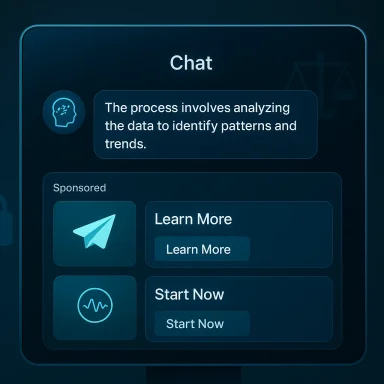
- Clearly labelled cards or banners shown beneath the assistant’s answer rather than woven into it. Platforms emphasize separation to preserve answer independence.
- Sponsored follow‑up questions or suggested prompts that bear a “sponsored” badge and invite the user to learn more about a product or service. Perplexity tested that UX in late 2024.
- Shoppable product cards and carousels that can surface inventory, price and CTA (buy, learn more) without leaving the chat. Early OpenAI prototypes and app teardown artifacts hinted at such card formats.
- Contextual but non‑personalized targeting at launch: companies promise ads will be matched to conversation topics and not rely on selling raw chat text to advertisers. OpenAI’s guidance emphasizes user controls (opt‑out of personalization, delete ad data).
Business models in play
- CPM/Impression buys for sponsored cards or “related question” placements (Perplexity’s pilots used this approach).
- Revenue‑share with publishers whose content helps answer queries (Perplexity’s Publishers Program; an attempt to address the “zero‑click” threat to journalism).
- Affiliate and conversion tracking for shoppable conversational commerce flows (platforms and advertisers will want to measure downstream purchases).
- Opt‑in commercial channels or premium ad‑free tiers as a user choice: paid tiers remain ad‑free in OpenAI’s framework.
Privacy, trust and regulatory fault lines
Introducing ads into something users perceive as “personal” creates three overlapping problems: perceived invasiveness, actual data leakage risk, and regulatory scrutiny.Perceived invasiveness and the intimacy problem
Conversations feel private. An ad that arrives mid‑advice feels like “another voice in the room.” That sensation matters enormously — it affects retention and willingness to disclose information. Google’s Demis Hassabis has explicitly argued that advertising “has to be handled very carefully” because trust in security and privacy is the foundation of an assistant users might “share potentially your life with.” When trust is damaged, churn and reputational costs follow.Actual data and telemetry risks
Companies promise not to sell raw chat logs. But advertisers will demand metrics: impressions, clicks, conversions and (inevitably) signals about relevance. The important technical questions that remain unanswered for many pilots include:- What metadata will advertisers receive? Aggregate CPM-level metrics only, or message‑level signals?
- Will conversation memory (longitudinal profiles) be used for targeting by default, or only with explicit granular consent?
- How do platforms exclude sensitive topics or under‑18 accounts from ad placements in a defensible, auditable way?
Regulatory and legal exposure
Ad targeting based on conversational data sits at the intersection of consumer protection, privacy law and advertising regulation. In jurisdictions with strong data protection regimes, regulators will want to know: what data is processed, for what purpose, what retention rules apply, and what user controls are provided. Platforms that obscure essential details — or that mislabel sponsored content — risk enforcement actions for deceptive advertising or unfair processing. The upshot: transparency and auditable controls will be table stakes.What brands and marketers are doing: GEO, conversational commerce and the new SEO
Brands are already moving quickly to be discoverable inside assistants. The tactics combine familiar SEO instincts with new structural requirements for content that AI models consume.Generative Engine Optimisation (GEO)
- GEO is the emergent discipline for making content visible and credible to large language models and answer engines. Agencies and startups, such as the French firm GetMint, claim rulebooks that include structured FAQs, up‑to‑date schema, citation to scientific or authoritative sources, and modular content that maps cleanly into an assistant’s answer patterns. These vendors tout dozens of rules and early client wins. The practice is an evolution of search‑era SEO toward a model that prioritizes AI‑friendly structure and provenance.
- Practical GEO tactics:
- Publish clear, well‑structured FAQ pages and product spec pages.
- Use citations or links to authoritative papers where appropriate.
- Keep content updated and machine‑readable for extraction and summarization.
- Prepare product‑level metadata so assistants can create shoppable cards or provide accurate availability and pricing.
Conversational commerce and conversion lift
For advertisers, the appeal is simple: higher‑intent moments. A user asking “best blender for smoothies under $150” is further down the funnel than a generic keyword search. Brands that can be present — either through paid placements or through being cited in the assistant’s organic answer — may capture higher conversion rates. Early industry commentary and advertisers’ pilots indicate encouraging conversion signals, but robust attribution across chat → website → purchase remains a measurement challenge.Winners and losers
- Winners: advertisers who master GEO, sellers who integrate with shoppable assistant flows, ad tech vendors that can prove true conversion attribution, and platforms that balance relevance with privacy.
- At‑risk: independent publishers and creators could lose referral traffic if assistants synthesize answers without linking out (the “zero‑click” problem). Some platforms attempt revenue shares; others will not — creating a fractured ecosystem.
Trust and UX design: the hardest problems to get right
If technical implementation can be solved with engineering, the UX challenge is fundamentally behavioral: how to insert a commercial signal into a private, explanatory space without eroding trust.Three UX guardrails that matter
- Visible, consistent labelling: Ads must be clearly labelled, visually distinct and persistently identifiable across sessions. Users instructed to expect ad separations will be less likely to feel tricked.
- Contextual relevance and frequency caps: Limit ads to high‑intent contexts and cap the number of sponsored suggestions per session to avoid noise. Excessive or low‑relevance ads accelerate churn.
- Explicit consent for personalization: Memory‑based personalization should be opt‑in, granular and revocable; using long‑term profiles as default targeting will be politically and commercially risky.
Measurement, fraud and verification
Conversational ad inventory introduces new fraud modes — automated agents, replayed prompts, and artificial impression inflation — that standard web ad tech doesn’t fully detect. Marketers will demand verification and attribution; platforms must provide independent measurement and fraud controls tailored to conversation surfaces. Otherwise, ad budgets will flow briefly and then dry up as ROI becomes opaque.The commercial scale: how big could this become?
Predictions vary, but industry notes and bank analysts suggest AI-driven ads could capture meaningful ad dollars over the coming decade. Some reports quoted by major outlets indicate that AI assistants could represent a small but non‑trivial slice of the digital ad market by 2030 — figures that are modest relative to current search and social ad dominance, but still material for certain verticals. These forecasts are cautious: assistant commerce will need proven attribution and brand‑safe controls before large advertisers allocate sustained budgets. (Note: some of these forecasts are reported in news coverage and synthesised briefings; the original analyst notes should be consulted for methodology and confidence intervals.)Risk analysis: reputational, legal, and systemic
Advertisers and platforms face a set of interlocking risks.- Reputational: A single visible mistake — an ad that appears inside a counseling question, a health query or an advice thread — can cause enormous outcry and prompt rapid policy and product reversals. Anthropic’s Super Bowl spot showed how quickly the narrative can shift.
- Legal/regulatory: Data protection authorities will scrutinize how conversational data is processed for ad targeting. Clear, auditable consent flows and minimal data sharing are essential to avoid fines and enforcement.
- Market structure: Publishers worry about further traffic loss. If assistants provide end‑to‑end answers and commerce without referrals, the economics of independent journalism and niche creators will be strained; revenue‑share programs may blunt but not solve that pressure.
- Measurement integrity: Without industry standards for viewability and conversion in chat, advertisers may pay for impressions that do not reflect human consideration. New verification standards and third‑party measurement will be required.
Practical guidance for users, brands and platforms
For users (what to look for now)
- Check privacy controls: turn off ad personalization if you prefer, and clear ad‑related data periodically. Platforms promise these options but make sure they are easy to use.
- Prefer paid tiers if privacy and ad‑free experience matter. Many vendors (including OpenAI) keep those tiers ad‑free by design for now.
- Be wary of sensitive topics: if a query touches medical, mental health or political issues, expect platforms to exclude ads from those threads; confirm this in product settings.
For brands and marketers (first mover checklist)
- Invest in GEO fundamentals: produce structured, well‑sourced content (FAQs, specs, schema).
- Pilot conversational creatives: design concise, helpful sponsored prompts that add utility rather than interrupt.
- Demand transparent measurement: insist on auditable attribution pipelines and anti‑fraud safeguards.
- Plan for brand safety: explicitly exclude placements in sensitive conversational contexts and have escalation paths if creative appears inappropriately.
For platforms (product and policy priorities)
- Ship clear labeling and visible controls at launch, not as an afterthought.
- Publish independent audits or third‑party attestations of “answer independence” and privacy claims to reduce skepticism.
- Build a publisher revenue‑share or referral program where possible to mitigate zero‑click harms to journalism and to secure content supply. Perplexity’s publishers’ program is one existing model.
What we still don’t know — and what to watch next
- Measurement benchmarks: Which vendors will define conversion attribution inside chat, and can those measures be independently audited?
- Regulatory action: Will data protection authorities require stricter consent or ban certain kinds of ad targeting when it uses conversational memory?
- Publisher economics: Will revenue‑share programs scale or remain selective, and how will non‑partnered publishers fare?
- Behavioural impacts: Will user acceptance differ by region, age cohort or use case (shopping vs. personal advice)? Early pilots suggest sensitivity is high for intimate topics.
Conclusion: a new chapter in attention economics — handle with care
Ads in AI chatbots represent a logical evolution of digital monetization: take an interface that captures intent and introduce an advertiser into the moment where decisions are made. The upside is real — better conversion, tighter matching of offers to needs, and new revenue for publishers and platforms — but so are the downsides: erosion of trust, regulatory exposure, and the potential hollowing out of referral economics that sustain independent content.The companies that succeed will be the ones that put clear, enforceable guardrails at the product, privacy and measurement layers. They will treat ads in conversation as a design and governance problem, not merely a revenue opportunity. Users should expect to see ads in more conversational interfaces in the months ahead, but also demand transparency: clear labels, easy privacy controls, and verifiable separation between assistance and commercial influence. Brands must adapt their content and measurement playbooks to be discoverable by AI — but they should do so in ways that respect the intimacy of conversation and avoid tactics that feel exploitative.
This moment is a test of whether conversational AI can be commercialized without becoming commodified. If platforms, regulators, publishers and advertisers coordinate on transparency, measurement and user control, the result could be a new, useful ad surface that funds broad access without destroying the very trust that makes assistants valuable. If they fail, the backlash will be swift — and the reputational and legal costs will be lasting.
Source: norfolkneradio.com New world for users and brands as ads hit AI chatbots