OpenAI ChatGPT Ads: Privacy, Trust and Enterprise Impact

  • Thread Author
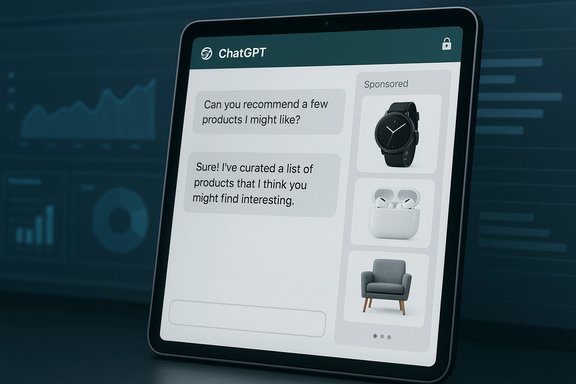
Tablet shows a ChatGPT chat with product recommendations and a right-side sponsored listing (watch, earbuds, chair).
OpenAI’s consumer ChatGPT is poised to show ads to many users — and the first public signals about how those ads will look and where they’ll appear have already leaked into the wild, prompting a rapid debate about trust, privacy, and enterprise risk. What began as internal code strings discovered inside an Android beta (not a live ad rollout) has since been paired with official pauses, policy clarifications and pilot plans that make advertising inside a conversational assistant a near‑term reality rather than a theoretical threat.

Background​

In late 2025 engineers and app analysts found advertising‑related strings inside an Android beta build of the ChatGPT app — most notably labels such as "ads feature", "bazaar content", "search ad" and "search ads carousel" in build 1.2025.329. Those strings are the technical clue that an ad subsystem is being engineered into the client, though they do not by themselves prove ads are live for end users. Reverse engineering of APKs is a common early signal of product work, and it typically prece, controlled A/B tests and staged rollouts. At the same time, OpenAI faced a high‑visibility misstep when an in‑chat suggestion mechanism produced app recommendations that many users took for ads. That prompted public pushback and an acknowledgement from OpenAI leadership that the company “fell short” on the user experience; they subsequently disabled that specific suggestion flow while improving model precision and user controls. This public reaction underlines how sensitive Cto anything that looks like commercial placement inside conversational replies.

Overview: What the leaks and official signals tell us​

  • The APK evidencepenAI is building the technical plumbing to support advertising inside ChatGPT, most plausibly scoped to commerce and retrieval‑enabled flows (shopping, product comparison, local services).
  • Early product hypotheses and industry precedent predict ad placements will take the form of labeled product c “search ads carousel”, or sponsored follow‑ups appended to shopping‑style answers. These formats favor conversion while limiting the number of intrusive placements.
  • OpenAI publicly paused a particular app‑suggestion experience and committed to better controls and labeling — an operational signal that the company recognizes the reputational risk of poor ad UX.
  • Subsequent reporting and company announcements indicate controlled testing in limited geographies and plans to show ads primarily to non‑subscribers or lower‑priced tiers while exempting paying and enterprise customers — although the final product mix and timeline remain subject to change.

How the ads will likely look (product hypotheses)​

Visual formats and placement​

Industry reporting and APK strings point to a few likely formats for early ad experiments:
  • Shoppable product cards (labelled and boxed) that appear alongside the assistant’s summary when a user asks for product recommendations or comparisons.
  • Search ads carousel: able row of sponsored cards tied to retrieval results or web‑enabled answers.
  • Sponsored follow‑ups: call‑to‑action buttons or suggested prompts such as “See today’s top deals,” visually distinguished from organic suggestions.
These placements are consistent with other AI platforms’ commerce experiments and are designed to keep promotional content confined to high‑intent moments rather than injected into every general conversation.

Labeling and separation​

A critical requirement for any credible rollout is unmistakable labeling. Advertised content will need prominent “Sponsored” badges, distinct card styling, and clear CTAs that separate paid placements from the assistant’s editorial responses. If labeling is weak or ads are visually fused with generated answers, user trust will deteriorate quickly. OpenAI has signalled it’s reworking model precision and controls after user complaints, which suggests labeling and visual separation will be top priorities for any public testing.

Targeting and personalization — the bitrings do not disclose the telemetry or data flows advertisers will use. The central unresolved question is whether OpenAI will use persistent signals — especially the assistant’s memory features — for ad targeting. Using memories for personalized ads would be a major privacy escalation unless it’s strictly opt‑in, revocable and auditable. At present, memory‑driven targeting remains unverified and should be treated as speculative until OpenAI publishes explicit policy.​


OpenAI’s stated guardrails and what reporting shows​

Recent coverage and company statements indicate several commitments or likely safeguards:
  • Ads will be clearly labeled, separated visually from assistant output, and restricted from sensitive topics such as health or politics.
  • Paid subscribers and enterprise customers will likely not see the same ad experiences; OpenAI appears to be preserving an ad‑free promise for higher‑tier accounts.
  • Ads will initially be constrained to shopping and commerce contexts, reducing intrusion into general conversational use.
  • Users will have controls to opt out of personalization and to understand “why an ad was shown” — though the granularity and enforcement of those controls are open to scrutiny.
These are plausible guardrails, but the precise mechanics — how opt‑outs are honored, how age exclusions are enforced, and what telemetry advertisers receive — require verification once formal documentation or updated privacy policies appear. Until then, some claims remain conditional and should be treated How to avoid ChatGPT ads: practical, step‑by‑step guidance
If you want to minimize or avoid seeing ads in ChatGPT today or when ads begin wider testing, follow a layered approach that combines account, device and enterprise controtion
  1. Upgrade to a paid tier (Plus, Pro or Enterprise) if OpenAI formally guarantees those tiers will be ad‑free. Early reporting suggests ad exposure will target free and low‑cost tiers first.
    1. Privacy and personalization settings
      ** and any explicit personalization toggles in ChatGPT account settings. If a feature uses retained preferences, revoke and delete stored memories. This reduces the data surface used for personalization.
    2. Use of alternative apps and clients
  2. Prefer the API or enterprise products over the consumer app for sensitive workflows; enterprises should insist on contract language that guarantees ad‑free service for managed accounts.
    1. Browser and device controls
  3. Use content blockers or browser extensions to hide in‑page ad slots if needed (not a perfect solution for app UIs).
    tes and beta channels via MDM for organizational devices — holding devices on a vetted client prevents early ad experiments from reaching employees.
    1. Local and self‑hosted alternatives
  4. For workflows that must remain ad‑free and private, consider on‑premises or locally hosted LLM instances that you fully control; this is heavier but elimior consumer‑tier experiments.
    1. Feed and telemetry blocking
  5. Use network filtering to block ad‑related endpoints if and only if the destination endpoints are known and compatible with your organization’s policies — but beware this can break legitimate functionality if performed bluntly. Enterprise teams should use staged testing and monitoring when blocking.
Short term, the simplest protective step for most users is onalization toggles and consider upgrading to a paid tier if an ad‑free guarantee is required for professional use. For IT administrators, the immediate playbook is to audit integrations, ad registers, and demand contractual clarity from vendors.

Enterprise and IT implications​

Why admins should act now​

Conversational assistants are quickly embedding into internal workflows, help desks, knowledge bases and developer tools. If consumer ChatGPT starts surfacing ads or sponsored content, there are three enterprise risks:
  • Ad leakage: employee conversations could become vectors for ad personalization signals unless enterprise accounts are insulated.
  • Compliance and data governance: ad systems often rely on telemetry and conversion signals. Enterprises must ensure organizational data is not used to train ad auctions or target ads.
  • User experience and trust: internal tools that surface vendor promotions caystem outputs for compliance and decision‑making tasks.

Recommended actions for IT teams​

  • Update procurement and integration contracts to insist that enterprise and API products remain ad‑free, with explicit clauses about telemetry and data‑ice management (MDM) and software deployment policies to control which ChatGPT app builds reach managed devices.
  • Audit where ChatGPT and generative assistants are embedded in workflows; classify high‑sensitivity areas and block consumer app access where needed.
  • Educate staff about memory settings and the implications of enstant memory on corporate devices.
These are not just defensive steps; they are governance necessities. Organizations that fail to prepare risk regulatory exposure and operational surprises if ads are introduced without proper separation between consumer and enterprise offerings.

UX, privacy and regulatory analysis — balancing benefits and dangers​

Potential upsides (if executed responsibly)​

  • Sustaining free access: Ads can subsidize compute costs and keep ChatGPT accessible to users who cannons. That’s a valid public‑interest argument for measured advertising.
  • Commerce utility: When a user explicitly requests shopping advice, shoppable cards can shorten the path to purchase and provide convenience.
  • **New advnversational ads at high‑intent moments can be valuable for advertisers and measurable if handled transparently.

Major risks and failure modes​

  • Trust erosion: ChatGPT’s single greatest asset is perceived neutrality. Mixes can create the impression that recommendations are paid rather than evidence‑based.
  • Privacy overreach: Using memories or private chat history for ad targeting without granular opt‑in would be a major escalation and invite regulatory scrutiny. Any use of persistent user data must be explicit and auditable.
  • Zero‑click harm to publishers: If assistants routinely answer queries end‑to‑end and insert commerce placements, publishers could lose referral traffic and revenue — provoking industry pushback or compensation negotiations.
  • Regulatory risk: Targeting minors, handling health or political content, and sharing telemetry with advertisers raise compliance challenges across jurisdictions. Proposed guardrails promising exclusions from sensitive categories must be enforced withthird‑party audits.

The trust bar is higher for generative assistants​

Labeling alone won’t restorebehaviour changes in subtle ways that favor paid partners. Engineers and product teams must guarantee editorial integrity by ensuring sponsored content never displaces the best factual recommendation when the user asks for unbiased informatioitectural separation between editorial ranking and paid placement ranking, auditable logs, and independ## What to watch next — concrete signals that matter
Track these specific indicators to move from speculation to confirmed rolloeenshots in the wild showing “Sponsored” badges or ad carousels.
  • Updated product or privacy pages that define ad data use, memory policies and opt‑outs.
  • Advertiser dashboards, onboarding materials, or API endnagement (a sign that the ad stack is revenue‑ready).
  • Admin controls for managed accounts that explicitly allow enterprises to opt out of ad experiments.
  • Third‑party audits or transparency reports that document what signals advertisers receive and how long telemetry is retained.
Until these signals appear, treat APK strings as a high‑confidence sign of engineering intent but low‑certainty on the final user experience. Building capability is not the same as launching a monetized product.

Final assessment: cautious, pragmatic, necesertising inside ChatGPT is an economically rational move for a company operating at enormous scale; the cost of serving free users and maintaining cutting‑edge models is nontrivial, and an ad‑supported free tier can extend access. If OpenAI restricts placements to commerce contexts, enforces rigorous labeling, provides robust opt‑outs, and guarantees ad‑free paid and enterprise products, the net effect can be broadly positive: better sustainability without destroying trust.​

But the margin for error is thin. A single poorly differentiated promotional suggestion or a hidden personalization signal could trigger rapid reputational damage and regulatory attention. The recent pause and public acknowledgement that a suggestion “fell short” shows OpenAI understands the stakes — and it is the right tactical response to pause, improve precision and bake in user controls before broad rollout.
For Windows power users, IT admins and privacy‑minded readers, the critical takeaway is to prepare now: review memory and personalization settings, audit how ChatGPT is used inside your organization, insist on contractual clarity for enterprise accounts, and favor managed deployments that separate consumer experiments from business workflows. These proactive steps will preserve both user experience and risk posture as the assistant’s monetization model evolves.

OpenAI’s engineering traces, the public response to early in‑chat suggestions, and recent reporting together make a clear point: ads in ChatGPT are no longer hypothetical. The next weeks and months will show whether OpenAI can thread the needle — building a monetization layer that funds wide access while preserving the neutrality and privacy users expect — or whether rushed experimentation will force harder regulatory and market responses. Until the company publishes definitive product documentation and delivers reliable admin controls, prudence and preparation remain the best strategies for users and IT professionals alike.

Source: PCMag Middle East https://me.pcmag.com/en/ai/34757/ad...es-what-they-look-like-and-how-to-avoid-them]
 

OpenAI’s decision to put advertisements into ChatGPT is no longer a rumor from APK sleuths — it’s now a controlled, public pivot toward ad-supported conversational AI, and the fallout is immediate: users, regulators, and competitors are recalculating what an ad-driven assistant means for privacy, trust, and the future of Microsoft’s Copilot ecosystem. m])

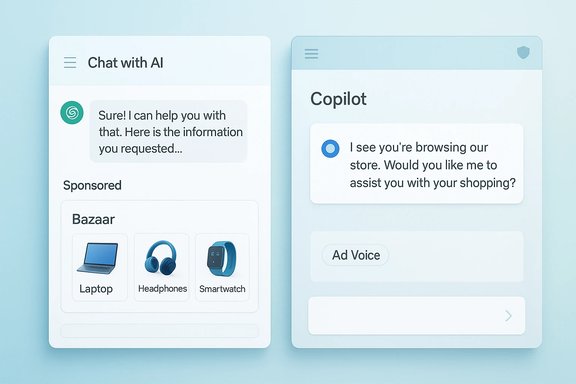
Two soft-blue mobile UI panels showing an AI chat and a shopping assistant.Background​

OpenAI shipped ChatGPT as an ad-light product in late 2022 and gradually introduced paid tiers to monetize usage. That model sustained rapid growth, but supporting billions of interactions with large language models at scale is expensive. Over the past months, engineers reverse‑engineered ChatGPT’s Android beta build and discovered strings pointing to an internal advertising subsystem — labels like “ads feature,” “bazaar content,” and “search ads carousel” — which industry reporters initially flagged as development evidence for commerd ad placements. Those findings prompted deeper coverage and, ultimately, a public testing phase for ads in ChatGPT’s consumer experience. At roughly the same time, Microsoft — whose Copilot products were already experimenting with conversational ad formats and “ad voice” explanations — stands to be a consequential second act in this story. Microsoft’s Copilot advertising stack has been live in several forms for some time and continues to evolve into richer, contextual ad formats integrated across Bing, Edge, and Windows. The question for Windows users and enterprises is not simply whether ChatGPT will carry ads, but how the entry of ad‑driven ChatGPT reshapes the competitive turf where Copilot and other assistant services operate.

What the evidence shows (and what it doesn’t)​

APK strings: a reliable early signal, not a finished product​

Reverse‑engineered Android APKs revealed internal resource strings referencing ad components. These strings are a standard development artifact — ring teams are building but do not by themselves prove a public rollout or the final UI. In practical terms, strings like “bazaar content” and “search ads carousel” strongly imply marketplace-style product cards and horizontally scrolling sponsored carousels tied to retrieval-enabled answers, but they do not show visual design, targeting rules, or data flows. Treat that evidence as high‑confidence for intent and architecture and low‑confidence for final product details.

Public testing and announcements​

Independent reporting and follow-up coverage confirm that OpenAI moved from leak-driven speculation to controlled testing and public statements. OpenAI is testing ad placements that are explicitly labeled and designed to appear in commerce and high‑intent search contexts, while promising that premium subscribers (higher‑tier paid plans) will not see ads. Early coverage indicates ads are being trialed in the United States and will be constrained away from sensitive categories such as health, mental health, and political content. These public steps align with the behavior tracked by APK researchers and corroborate the company’s pivot toward a hybrid monetization strategy.

What remains unverified or ambiguous​

Several important details are still open:
  • The precise ad formats and visual treatments for desktop, iOS, and web roid evidence.
  • Whether, and to what extent, conversational history or connected account data will be used for ad personalization beyond session-level signals.
  • The long‑term business model: how ad revenue will be balanced with subscriptions, enterprise contracts, and API usage.
Where public statements exist, they emphasize discrete, labeled ad boxes and promises to avoid selling raw conversation text as targeting data — but the engineering artifacts do not reveal enforcement mechanisms for those promises. As a result, privacy and enforbe treated as not fully verified until OpenAI publishes detailed policies and technical controls.

How the ads will likely appear and why that matters​

Based on the APK evidence, industry precedent, and official tests, initial ad placements will almost certainly follow a commerce-first, retrieval-focused pattern:
  • Shoppable product cards (“bazaar”) appended to shopping or product-comparison answers.
  • A horizontally scrollable search ads carousel with multiple sponsored options.
  • Labeled, discreet ad blocks beneath organic assistant responses, possibly with a short “ad voice” explainer that ties the ad to the conversation.
Why this matters: the difference between a discrete ad card and an interwoven, unlabeled sponsorship is trust. The design choices here — prominent labeling, visual separation, and frequency control — will determine whether users experience ads as a practical utility (relevant offers when shopping) or a corrosive entanglement that undermines the assistant’s perceived neutrality.

Business rationale: why ads are almost inevitable​

Running LLMs at consumer scale is not cheap. The compute, storage, data pipelines, safety tooling, and global delivery infrastructure add up to massive recurring costs. OpenAI’s financial disclosures and industry reporting show pressure to diversify revenue beyond subscriptions and enterprise contracts.
  • Ads scale with user attention and can subsidize free access for hundreds of millions of users.
  • Commerce integrations convert intent directly into revenue by closing the loop from discovery to purchase.
  • Competitive parity pushes OpenAI toward similar monetization decisions already adopted by Google’s AI-overviews and Microsoft’s Copilot.
These economic drivers create a clear path: charge a premium for ad-free experiences while monetizing the massive free user base through contextual ads and commerce. That model is the mainstream internet playbook; the nuance is whether conversational AI can avoid the worst of adtech’s privacy and UX pitfalls.

Microsoft Copilot: already on the ad trajectory​

Microsoft’s Copilot is not hypothetical in this space. The company has built advertising features into Copilot across Bing, Edge, and Copilot surfaces for more than a year, and has been explicit about formats that live beneath organic responses with an “ad voice” to explain context. Microsoft positions Copilot’s ad integration as a better‑labeled, context-aware experience tied to the whole conversation, not just the last prompt. That means Copilot is not the “next” to get ads — in many places, it already has them — but it will evolve in lockstep with these market dynamics. Microsoft’s advertising playbook includes:
  • “Ad voice” explanations that say why an ad was shown.
  • Diagnostic and performance tools for advertisers that are conversational (ask aign doing?”).
  • New interactive ad formats, such as showroom cards and branded AI agents, designed to convert within the assistant flow.
From a Windows user perspective, this is significant because Copilot surfaces across Windows, Office, Edge, and Bing. Ads in Copilot can therefore be distributed across core productivity woa standalone chat window — a design that raises unique business and UX tradeoffs for desktop users and IT administrators.

Privacy, trust, and regulatory risk​

Embedding ads in conversational AI raises at least three distinct risk categories: privacy, influence on model behavior, and regulatory attention.

Privacy and targeting​

Ads typically require signals to be relevant — location, recent queries, and profile data are common. The critical question is what conversational data OpenAI and Microsoft will use and whether that data is retained, aggregated, or shared with advertisers. OpenAI’s public statements stress no sale of raw conversation text and age‑gating for ad exposures, but the APK telemetry does not show detailed data fement, so privacy claims should be treated with appropriate caution until audited.

Model behavior and commercial incentives​

A deeper danger is the subtle shift in model responses when monetization becomes a material input. If the system optimizes for engagements that drive ad revenue, there’s a risk of preference drift — answers could increasingly favor options that generate revenue over unbiased, evidence-based recommendations. Design mitigations include strict separation between the assistant’s language model outputs and the ad-serving layer, clear provenance labels, and auditability for commercial influence. None of these mitigations are trivial at scale.

Regulatory and competition scrutiny​

When an assistant becomes a default surface for search and shopping, regulators look closely. Issues include:
  • Consumer protection: Are ads appropriately labeled and not misleading?
  • Privacy compliance: Are data-minimization and consent practices followed across jurisdictions?
  • Competition and antitrust: If major ad inventory consolidates inside a single assistant (or within one company’s ecosystem), what does that mean for publishers and advertiser access?
OpenAI and Microsoft both face regulatory scrutiny in multiple markets; ad integration will amplify those concerns. Expect more questions from privacy agencies and lawmakers about transparency, ad auctions, and equal access for advertisers.

UX and label design: the trust engineering problem​

Technical constraints aside, the user experience will decideChatGPT is tolerable or toxic. Good design choices include:
  • Clear, persistent labeling (e.g., “Sponsored” badges and a short “ad voice” line explaining relevance).
  • Visual separation (distinct card treatments and CTA styles to prevent confusion).
  • Frequency caps and relevance thresholds to avoid ad saturation.
  • Explicit opt-outs and straightforward controls for ad personalization.
Microsoft’s Copilot has already implemented an “ad voice” and explores diagnostics for advertisers; OpenAI’s public tests promise similar labeling. Those similarities are not convergence by accident — they reflect a shared UX rulebook for conversational advertising. The crucial difference will be enforcement and defaults: opt‑in personalization is less risky than opt‑out or ambiguous defaults.

Enterprise, API, and developer implications​

The ripple effects extend beyond consumer chat. Enterprises and developers who embed ChatGPT or Copilot into workflows must consider:
  • Contractual guarantees: Enterprise customers should demand written assurances that commercial ads will not appear in internal, employee-facing deployments.
  • Data segregation: Businesses will require clear data-use commitments — no ad-targeting signals derived from internal conversations.
  • API divergence: Providers may bifurcate consumer apps (ad-supported) and enterprise/APIs (ad-free) — but enforcement and auditability are non-trivial.
Administrators should update policy, compliance, and procurement language to specify acceptable advertising exposure and data sharing. Without these controls, organizations risk inadvertent leakage of sensitive business telemetry into ad-personalization pipelines.

Competitive landscape and strategic responses​

OpenAI’s move aindustry trend: conversational surfaces are becoming ad inventory. The strategic consequences include:
  • Publisher economics: If assistants synthesize answers without sending users to publisher pages, referral traffic declines; revenue‑sharing or other remedies.
  • Search dynamics: Traditional search ad models will adapt to assistant contexts (card-based and conversion-focused formats).
  • User choice: Ad-free premium tiers could become a critical product differentiator; companies that preserve a consistently neutral, ad-free assistant experience may win the trust of privacy‑sensitive users and enterprises.
For Microsoft, the calculus is different: Copilot’s advertising integration is an extension of an already broad ecosystem where Microsoft can both surface content (Copilot in Windows and Edge) and capture commerce conversions across its ad network. That vertical integration gives Microsoft advantages — and scrutiny — that OpenAI must reckon with if both platforms compete for the same advertiser budgets.

What users can expect and practical guidance​

  • If you’re a free ChatGPT user: expect context‑aware, clearly labeled ad blocks in commerce and search queries during testing phases; premium subscribers should remain ad‑free under the stated policies.
  • If you manage Windows devices and Microsoft 365: Copilot’s ad features may appear across browser and OS surfaces; review admin controls, group policy settings, and Microsoft 365 plan options to control ad exposure in managed environments.
  • If you’re an enloper: request contractual protections, confirm data segregation for ad targeting, and seek technical documentation that proves ad exclusion for internal deployments.
Practical steps for privacy-minded users include selecting ad‑free tiers where available, auditing connected accounts and integrations that could surface signals for ad targeting, and checking new privacy settings that providers must add to honor opt-out and data‑use promises.

Strengths of the ad-supported model (what’s working)​

  • Sustainability for free tiers: Ads can subsidize free access so ocusable assistant without forcing mass migration to paid plans.
  • High intent monetization: Convshopping or service discovery are high-conversion contexts, making ads more valuable and less intrusive when well-labeled.
  • **Innovation rsational ad formats (ad voice, showroom cards, branded agents) can provide more helpful, context-aware offers than generic search ads. Microsoft’s ad experiments show measurable performance uplifts for advertisers, suggesting viable economics.

Risks and failure modes (what to watch closely)​

  • Trust erosion: If users feel the assistant’s recommendations are influenced by advertisers, trust collapses quickly and raggedly. Maintaining strict separation between model outputs and paid placements is essential.
  • Privacy drift: Vague or permissive default settings around personalization risk exposing sensitive conversational content to targeting signals. Companies must publish clear technical documentation and opt‑out mechanisms.
  • Regulatory backlash: Heavy-handed rollouts or opaque ad auctions invite privacy and competition investigations that could restrict or retroactively alter monetization plansplacement:** If assistants substitute synthesized answers for publisher visits, content creators could lose referral income and push back politically or commercially.

The road ahead: what to watch​

  • Policy publications: look for detailed ad policies from OpenAI and Microsoft explaining data usage, labeling, and age gating.
  • UI rollouts: whether ads appear as separate cards with badges (safer) or weave into answers (riskier). APK evidence suggests card/carousel formats first, but confirm on iOS and web.
  • Enterprise carve‑outs: enterprise and API contracts that explicitly exclude ads will show whether providers respect segmentation between consumer and business products.
  • Regulatory actions: privacy authorities and competition regulators in key markets will watch labeling, consent, and advertiser access.

Conclusion​

The arrival of ads inside ChatGPT marks a pivotal moment in the evolution of conversational AI economics: a pragmatic, if fraught, path to sustainability that mirrors the broader internet’s long relationship with advertising. The technical evidence that began with APK strings is now converging with public tests and corporate statements, and Microsoft’s Copilot — already ad-enabled in many ways — will remain a central player in the next phase of assistant monetization. The ultimate outcome will hinge less on whether ads are present and more on how transparently, sparsely, and ethically they are integrated.
For Windows users and IT professionals, the mandate is clear: demand transparency, insist on enterprise-grade controls, and treat assistant monetization as a policy and procurement priority. The next few quarters will test whether industry players can insert advertising into the conversational layer without hollowing out the very trust that made these assistants compelling in the first place.
Source: Windows Central https://www.windowscentral.com/arti...-chatgpt-microsoft-copilot-is-obviously-next]
 

Back
Top