

The sudden appearance of ad-like suggestions inside chat-based AI has forced a hard question onto product teams, publishers and marketers: can AI chatbots monetize without undermining the single asset that makes them valuable — user trust?
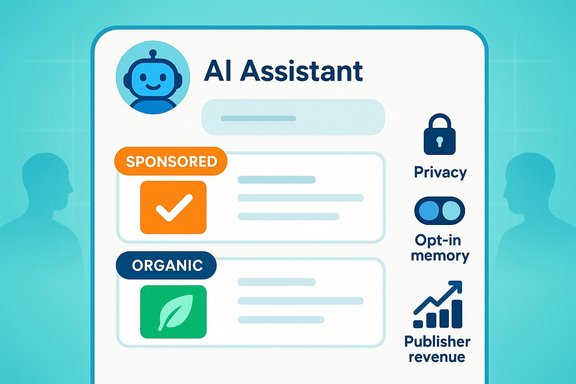
The industry is already testing guardrails — opt-in channels, revenue shares with publishers, labeled product cards and subscriber guarantees — and early evidence (publisher programs, Adobe traffic data, and platform rollbacks) shows both the opportunity and the peril. For publishers, brands and platform builders, the imperative is clear: design monetization with the same rigor as the models themselves. In chat, utility is currency — and only ads that genuinely help the user will be accepted; everything else risks being hidden, ignored, or removed by a user who feels their private assistant has been compromised.
Source: AdExchanger Can AI Chatbots Run Ads Without Losing Consumer Trust? | AdExchanger
 Background
The context: chat as a new discovery surface
Chat interfaces capture richer intent than traditional search. A user who types “best blender for smoothies under $150, no-drip lid, ships fast” hands the assistant a near-complete brief. That concentrated intent is precisely why advertisers and platforms find conversational AI irresistible: it compresses discovery, consideration and often conversion into a single, high-value moment. The AdExchanger analysis productizes this tension — advertising’s commercial logic colliding with chat’s intimacy and expectation of impartial help.Why the subject is urgent now
Three interlocking forces make this a live strategic problem:- Platforms are under economic pressure to fund increasingly expensive multimodal models and scale free access.
- Publishers are already seeing referral traffic fall as summarized answers replace links.
- Advertisers smell a new high-intent surface where offers can be precisely matched to an expressed need.
How platforms are thinking about ads in chat
Conservative, hybrid and aggressive rollouts
Product teams typically face three clear paths when adding ads to assistants:- Conservative: restrict ads to clearly commercial queries (shopping, bookings), label them prominently and keep paid tiers ad-free.
- Hybrid: allow shopping and local-service ads with session-based personalization and opt-in memory usage; premium users avoid ads.
- Aggressive: embed monetized placements broadly with deep personalization and minimal separation between paid and organic outputs.
What the early product patterns look like
Engineering artifacts and competitor experiments point to formats that minimize surprise and maximize utility:- Labeled product cards or a “search ads carousel” inside retrieval-enabled answers.
- Sponsored follow-ups or suggested actions tied to explicit commerce intent.
- Dedicated opt-in “offers” channels that separate general conversation from promotional content.
Trust risks: why ads in chat are fundamentally different
Chat feels personal; ads feel like “another voice in the room”
Chat is not a neutral page — it’s a back-and-forth. Users treat a helpful assistant like a private adviser. Introducing paid suggestions into that flow changes the social contract. Even well-labeled ads can feel like an intrusion if they arrive unsolicited or in a context where the user expects an unbiased synthesis. Advertisers risk diluting brand voice and authenticity if sponsored outputs diverge from a brand’s established tone.Memory, personalization and privacy hazards
Many assistants now offer “memory” features that persist user preferences across sessions. If those memories are used to target ads, the personalization becomes deeper — and potentially creepier — than cookie-based ad profiles. Any use of persistent conversational data to serve ads raises legal and ethical flags: opt-in must be explicit, revocable, and plainly documented. Without such controls, platform owners invite regulatory scrutiny and user backlash.Zero-click dynamics and the publisher economy
When an assistant synthesizes an answer end-to-end, users do not need to click through to publisher pages. That “zero-click” dynamic has already cost publishers measurable traffic and revenue. Platform-native advertising that also replaces referral visits compounds the problem: the platform both consumes publisher content (or its informational value) and monetizes the outcome. Publishers are reacting with licensing programs and revenue-share experiments to reclaim some value. Examples of this trend include Perplexity’s Publishers Program, designed to share ad revenue when a publisher’s content is surfaced by the AI.What users tolerate — and what they don’t
Value-first ads are accepted; noise is not
Research and industry pilots show a clear pattern: users are more tolerant of ads that help complete the task in-hand — discount codes, verified availability, or a local appointment link — and far less tolerant of irrelevant brand promotions in informational threads. AdExchanger and others highlight that deals (discounts, free shipping) are the kinds of messages that feel additive rather than intrusive.The backlash precedent
When a popular assistant surfaced unpaid in-app promotional suggestions (e.g., recommending specific partner apps or merchants in unrelated conversations), the reaction was swift and negative; the platform removed the suggestions while it reworked the feature. That incident demonstrates how fragile trust can be — a single misplaced prompt can generate disproportionate consumer pushback and PR damage.What good implementation looks like: product and governance checklist
Design and UX fundamentals
- Clear labeling: sponsored items must be visually separable and labeled persistently.
- Affordance separation: different card styles and explicit CTAs for paid vs. organic content.
- Frequency caps: limit ad density within a session or conversation.
- Escape hatches: one-tap hide or opt-out for sponsored results mid-conversation.
Privacy and data governance
- Opt-in personalization: memories should not be used for targeting by default.
- Auditable consent: logs that show when a user opted into memory-based personalization.
- Minimal telemetry sharing: measurement signals should be aggregated and hashed, not raw conversation dumps.
Publisher and ecosystem fairness
- Revenue-sharing options: programs that compensate publishers when their content materially contributes to monetized answers.
- Attribution clarity: transparent rules for what constitutes a monetizable mention and how revenue is split.
- Independent audits: third-party verification of labeling, data flows and revenue calculations.
Practical rules for brands and advertisers
- Be transparently labeled. Paid suggestions must disclose sponsorship at point of exposure.
- Add real value. Prioritize coupons, localized availability, and utilities directly tied to the user’s ask.
- Preserve voice. Create conversational creative guidelines so sponsored text matches brand tone.
- Protect privacy. Avoid relying on private conversational data unless the user explicitly consents.
- Insist on measurement and anti-fraud controls. New surfaces require new verification to prevent agent-driven inflation.
Measurement and fraud — new challenges, new requirements
Attribution gets complicated
If a user asks a chatbot for recommendations and buys days later, tying the sale back to an in-chat ad requires robust, privacy-preserving stitching. Expect new approaches:- Short-lived hashed tokens that tie a chat session to a downstream conversion.
- Server-side measurement where platforms expose aggregated conversion lifts rather than raw clickstreams.
- Third-party verification vendors evolving to handle conversational inventory.
Bot-driven measurement noise
Automated agents can generate impressions and interactions at scale. Verification partners must develop filters to separate genuine human intent from scripted or programmatic agent traffic. This is especially relevant where publishers or advertisers are paid on impression or conversion metrics.Legal, regulatory and ethical landmines
Copyright and content licensing
AI answers synthesize publisher content; courts and publishers are already litigating the boundaries of fair use. Any ad model layered on top of synthesized or copied publisher content increases legal risk unless compensatory licensing is in place. Perplexity’s publisher program is a direct response to those pressures, offering a revenue share for referenced content.Consumer protection and ad transparency
Regulators (including the U.S. Federal Trade Commission) are paying attention to deceptive or manipulative chatbot behaviors. Requirements around clear disclosure and the prohibition of undisclosed sponsored recommendations are likely to tighten. Platforms that ignore these signals will invite enforcement action.Antitrust angles
If a handful of large generative platforms control both discovery and ad monetization, competition regulators may view assistant-driven “zero-click” economics as exclusionary. Lawsuits and complaints citing traffic diversion have already been filed against search incumbents, showing the political risk of consolidating discovery and monetization.Cross-checking the central claims (what’s verifiable)
- Perplexity’s publisher revenue-share program and its stated double-digit shares were reported publicly and corroborated by multiple outlets, showing publishers are negotiating participation and compensation models.
- Adobe published data demonstrating a large increase in retail traffic from generative AI sources, confirming that conversational AI is already shaping commerce journeys and therefore ad opportunities. These client-side referral metrics show rapid growth and deeper engagement from AI-originating visits.
- OpenAI temporarily disabled certain in-chat promotional suggestions after user backlash, which illustrates how sensitive users are to unexpected or poorly labeled commercial content inside chat. Multiple outlets covered this product retreat.
- Sam Altman’s public comments have evolved: he previously described advertising as a “last resort” but more recently acknowledged he was “not totally against” tasteful, carefully implemented ads — signaling internal openness to experimentation but also strong caution. This evolution is documented in interviews and coverage.
What publishers should do now
- Treat AI assistants as distribution partners in contract negotiations rather than passive referral channels.
- Publish machine-readable provenance so platforms can identify and compensate content sources fairly.
- Diversify revenue: strengthen direct subscription and membership channels to reduce dependence on referral ad models.
- Run A/B tests to measure AI-driven traffic decline and quantify how assistant overviews affect long-term reader behavior.
What enterprises and IT leaders must consider
- Treat consumer-grade assistants as experimental pilots before widescale integration into workflows.
- Demand contractual guarantees that enterprise instances will remain ad-free and that organizational data will not be used for ad targeting.
- Apply governance: restrict memory features, audit logs, and enforce human-in-the-loop for task automation that could affect compliance or security.
The business trade-offs: why platforms will still try
The economic logic is simple: running high-quality, multimodal models at scale is expensive. Advertising is a proven, scalable revenue stream that can subsidize a free tier and broaden access. Platforms also see a product benefit: collapsing discovery-to-purchase flows increases conversion potential, making ad impressions on chat potentially more valuable than classic display. However, the payoff depends on retaining user trust — something that, once lost, is exceedingly difficult to regain.A practical roadmap for an ethically workable rollout
- Pilot in clear commercial contexts only (shopping, local services).
- Use only session-level signals for ad relevance; never use persistent memories without explicit opt-in.
- Guarantee an ad-free experience for paid subscribers and enterprise customers.
- Publish an auditable privacy and monetization policy before any public expansion.
- Commission independent audits to validate labeling fidelity, data sharing and revenue flows.
Conclusion
Ads in chatbots are not an inherently toxic idea — they are a high-risk, high-reward product decision that must be engineered around trust-preserving constraints. The difference between an ad that helps and one that harms is subtle but consequential: helpful promotions that respect context, privacy and voice can subsidize free access and unlock conversational commerce. Opaque personalization, poor labeling, or ad placements inside intimate conversations will quickly erode both brand credibility and platform trust.The industry is already testing guardrails — opt-in channels, revenue shares with publishers, labeled product cards and subscriber guarantees — and early evidence (publisher programs, Adobe traffic data, and platform rollbacks) shows both the opportunity and the peril. For publishers, brands and platform builders, the imperative is clear: design monetization with the same rigor as the models themselves. In chat, utility is currency — and only ads that genuinely help the user will be accepted; everything else risks being hidden, ignored, or removed by a user who feels their private assistant has been compromised.
Source: AdExchanger Can AI Chatbots Run Ads Without Losing Consumer Trust? | AdExchanger
