

OpenAI will begin placing advertisements inside ChatGPT’s free and low-cost Go tiers in the coming weeks — a strategic pivot that answers an uncomfortable financial reality while also reshaping the competitive landscape for conversational AI, and it makes Microsoft’s Copilot strategy look less like a future threat and more like the current battleground for ad-driven assistants.
OpenAI’s announcement on January 16, 2026 confirmed what APK leaks and industry sleuthing had long suggested: ChatGPT will start testing ads for logged-in adults in the U.S., initially placing clearly labeled sponsored content beneath answers in contexts where a relevant product or service can be shown. Paid tiers above the entry level — including Plus, Pro, Business, and Enterprise — will be ad-free under the company’s stated approach. Sam Altman framed this shift as pragmatic: ads are being trialed to subsidize access for users who don’t want to pay, while OpenAI insists it will not accept money to influence model outputs and will not sell raw conversation text to advertisers. The company also outlined guardrails such as age gating (no ads for users known or predicted to be under 18), exclusion zones for sensitive topics (health, mental health, politics), and user controls to turn off personalization. Those are policy promises, not yet fully proven engineering controls. The Windows Central commentary that prompted this feature summarized those developments and emphasized the larger industry and financial forces at work: OpenAI’s rapid roduct scope has not translated into a straightforward path to profitability, and advertisers — the default highway to scalable monetization on the open internet — are the likely lever to close the gap.
For Windows users, enterprises, and publishers, the practical takeaway is immediate: insist on transparency, demand enforceable contractual protections, and treat assistant monetization as a procurement and policy issue, not a mere product update. The next few quarters will test whether ad-supported assistants can sustain both broad access and the trust that users — and regulators — will require.
Source: Windows Central OpenAI is slapping ads into ChatGPT — Microsoft Copilot is obviously next
 Background
OpenAI’s announcement on January 16, 2026 confirmed what APK leaks and industry sleuthing had long suggested: ChatGPT will start testing ads for logged-in adults in the U.S., initially placing clearly labeled sponsored content beneath answers in contexts where a relevant product or service can be shown. Paid tiers above the entry level — including Plus, Pro, Business, and Enterprise — will be ad-free under the company’s stated approach. Sam Altman framed this shift as pragmatic: ads are being trialed to subsidize access for users who don’t want to pay, while OpenAI insists it will not accept money to influence model outputs and will not sell raw conversation text to advertisers. The company also outlined guardrails such as age gating (no ads for users known or predicted to be under 18), exclusion zones for sensitive topics (health, mental health, politics), and user controls to turn off personalization. Those are policy promises, not yet fully proven engineering controls. The Windows Central commentary that prompted this feature summarized those developments and emphasized the larger industry and financial forces at work: OpenAI’s rapid roduct scope has not translated into a straightforward path to profitability, and advertisers — the default highway to scalable monetization on the open internet — are the likely lever to close the gap.Why ads now: the raw economics
Running large language models at consumer scale costs a lot. Training, inference, safety tooling, data pipelines, and global delivery impose recurring expenses that are several orders of magnitude higher than the web services that preceded them. OpenAI’s multi-cloud deals and hardware commitments have been publicly reported and analyzed by financial firms and trade press; multiple analyses now put the company’s multi-year compute commitments in the order of trillions of dollars — figure estimates vary, but they routinely exceed $1 trillion when aggregated across partners and multi-year contracts. Those obligations, combined with investor impatience and the capital intensity of next‑generation model development, create acute pressure to diversify revenue beyond subscriptions and enterprise contracts. Treat the exact dollar figure as an industry estimate rather than a single audited line item. The business logic for ads is straightforward: advertising scales with attention. OpenAI’s free product drives the mass of the usage; ads can monetize that audience at very low marginal distribution cost, while keeping an ad-free experience as a paid premium. That model is the familiar internet playbook repurposed for conversation-first services. But the constraints of a conversational UI — fewer natural ad slots, a stronger obligation for trust, and the subtle ways monetization can influence perceived impartiality — make execution materially harder than slapping banners on a feed.How OpenAI says the ads will work (and what remains technical detail)
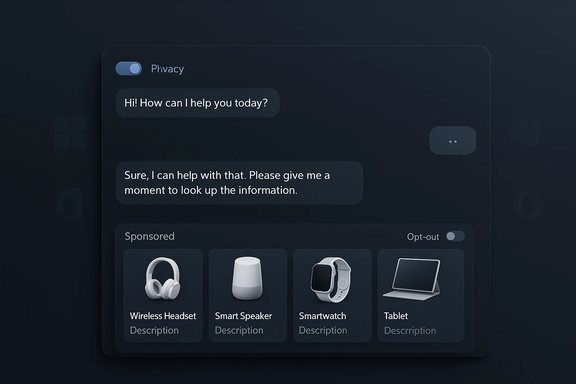
OpenAI’s public outline describes a restrained first test:- Ads will be shown at the bottom of answers when there is a relevant sponsored product or service to display.
- Ads will be clearly labeled and visually separated from the assistant’s organic response.
- Ads won’t be shown next to sensitive topics, and the company will aim to avoid ads for users under 18.
- Users will have controls for personalization and the ability to clear or opt out of data used for ad targeting.
- Premium tiers remain ad-free.
Microsoft Copilot is not “next” — it’s already part of the ad conversation
The more consequential competitive story is that Microsoft’s Copilot family has been moving purposefully toward ad-enabled commerce for more than a year. Microsoft Advertising and several trade outlets have described formats and pilots that place sponsored content beneath Copilot’s organic responses, complete with an “ad voice” — a short conversational explainer tying the ad to the user’s intent. Interactive formats such as showroom cards, branded “agents,” and follow‑through commerce flows have been piloted across Bing, Edge, and Copilot surfaces. Those ad placements are explicitly framed as contextual, labeled, and diagnostic-friendly for advertisers. This matters because Copilot is embedded not only in web or mobile apps but across Windows and Office — a reach that turns ad experiments into platform-level product decisions for desktop users and for enterprise IT. Microsoft’s ecosystem control (Windows, Office, Edge, Azure) gives it distribution and direct monetization channels that OpenAI lacks on its own. That vertical integration is the primary reason Microsoft has been simultaneously aggressive with Copilot features and careful about enterprise positioning: Copilot can be an advertising surface, a productivity tool, and a platform control point all at once.Trust, privacy, and model behavior — the real risks
Introducing advertising into a conversational brain raises three interlinked risks:- Trust erosion. Users accept platforms that solve problems with neutral, useful answers. If sponsored items appear prominently under recommendations — for gadgets, software, or local services — users will rationally suspect commercial influence even if the company’s engineering claims separation. Reputation damage can be swift and sticky.
- Privacy drift. Conversational assistants can hold more revealing signals than typical web cookies: long chat histories, memory features, connected accounts, and offline events. Using those signals for ad targeting heightens privacy exposure. OpenAI has pledged not to sell conversation text to advertisers and to provide opt-outs, but the precise telemetry, aggregation, and retention rules are what regulators and auditors will scrutinize. Any default opt‑out or ambiguous consent model risks regulatory attention.
- Preference or answer drift. A deeper, structural danger is subtle optimization pressure: if the system’s commercial objectives steer ranking of retrieval outputs or the prominence of suggestions, the assistant may gradually bias toward conversions. A robust architecture must strictly separate model generation from the ad-ranking layer, expose provenance labels for paid vs. organic content, and provide audit logs that show when commercial signals influenced display order. Those mitigations are not trivial at the scale of millions of daily conversational interactions.
Enterprise and developer implications
This is not only a consumer product shift. Enterprises, administrators, and developers must adjust procurement, contracts, and governance:- Enterprises should demand explicit contractual guarantees that internal employee-facing deployments will remain ad-free unless the organization explicitly opts in.
- Data segregation clauses must prevent conversational telemetry from being used for ad targeting without consent and heavy auditing.
- API divergence should be formalized: the consumer app may be ad-supported while the enterprise API remains ad-free — but enforcement and evidence (technical attestations, audits) are necessary.
The web ecosystem and publishers: the zero‑click problem
A corollary economic effect is on publishers and referral-driven businesses. Assistants that synthesize answers end‑to‑end reduce click‑throughs to original creators; placing commerce cards or purchase paths directly inside chats accelerates that “zero‑click” economy. If publisher referral traffic falls, the broader web economy shifts toward platforms that internalize commerce and aggregation, and publishers may demand licensing or revenue‑share deals. This political and commercial conflict will shape negotiations between assistants, ad buyers, and content creators.Competitive consequences: Microsoft, Google, Meta
- Microsoft: Copilot already runs ad experiments and has the advantage of integrated vertical surfaces (Windows, Office, Edge) and a mature ad business. Microsoft can monetize both end users and enterprise customers in differentiated ways, and it can direct advertiser spend across search and conversational inventory. Recent reporting shows Microsoft exploring showroom ads, brand agents, and conversational diagnostics for advertisers — formats designed to convert inside the assistant experience.
- Google: With Gemini and Google’s search-advertising engine, Google has the most mature end-to-end ad stack. Google’s tight control of search, Android, Chrome, and ad tech gives it a structural edge in monetizihile preserving strong targeting signals. The market reaction in late 2025 and early 2026 — including Alphabet’s market cap surge — reflects investor confidence in Google’s integrated ad-first approach to AI.
- Meta and others: Meta can graft conversational formats onto its feed and social graphs and has deep experience with attention-driven ads. Each large vendor brings unique distribution and monetization advantages. OpenAI’s entrance into advertising is therefore not only about revenue but also about aligning advertiser budgets in an ecosystem where the largest players already own the pipes.
What to watch — near-term signals
- Product documentation that explicitly details what signals are used for ad targeting, retention windows, and opt‑out mechanics. Without those documents, promises are soft.
- Early UI treatments in mobile and web clients — discrete, clearly labeled cardies (safer) vs. blended, interleaved sponsored text (riskier). APK leaks and industry testing suggest card/carousel formats will appear first.
- Enterprise carve-outs in contracts that explicitly prevent ad exposure in employee-facing deployments. Expect procurement and legal teams to ask for guarantees and technical attestations.
- Regulatory attention on consent, targeting of minors, and anti‑competitive access for advertisers to assistant inventory. Agencies in the EU, UK, and several U.S. states will monitor the rollouts closely.
Practical guidance for users and IT admins
- For consumers who value a neutral experience: consider ad‑free paid tiers (Plus/Pro/Business/Enterprise) where available and check new privacy toggles.
- For privacy-minded users: review memory and personalization controls, clear history regularly, and use opt-out settings for ad personalization when available.
- For IT admins and procurement: ask vendors for contractual attestations that internal data will not be used for ad targeting, demand technical indicators of separation between consumer and enterprise pipelines, and require audit rights.
- For publishers and site owners: prepare for traffic volatility and explore direct partnerships, licensing deals, or diversification of monetization metals to account for potential referral loss.
Critical analysis — strengths and systemic risks
Strengths and plausible benefits- Sustainability for free tiers. Ads can subsidize broad access and keep powerful assistants available to users who won’t or can’t pay. If executed carefully, targeted commerce ads can align with user intent (shopping queries, booking flows) and be genuinely useful.
- High-intent monetization. Conversational interfaces often concentrate intent (people express shopping or local-service intent explicitly), which can improve ad conversion effectiveness relative to generic feed inventory. Microsoft’s Copilot data and Microsoft Advertising experiments claim meaningful uplift for conversational placements.
- Product evolution incentives. Revenue from ads can fund broader availability, safety engineering, and model improvements that might otherwise be unaffordable at scale.
- Trust erosion is existential. Once users question impartiality, the assistant’s unique value proposition — reliable, utility-driven answers — is degraded. Recovering trust is far harder than iterating UI.
- Privacy creep is real. Memories and long histories, if used ever so slightly to personalize ads, create a new level of surveillance that regulators and privacy advocates will resist. Technical opt-outs must be clear, granular, and auditable.
- Systemic financial fragility. The compute commitment calculus — with multi-year deals and hardware purchases stretching into the trillions by some estimates — means that companies could find themselves locked into expensive capacity at scale. Ads alone may not close those funding gaps if advertiser revenue fails to meet projections; enterprise and API revenues will remain essential. Those large compute commitments are industry‑level estimates and should be treated as such.
- **Regulatory and chen assistants become default discovery surfaces, antitrust and consumer-protection issues emerge: who gets access to ad inventory, how fair are auction rules, and do assistants crowd out publishers? Expect scrutiny and possibly regulation.
Where this leaves Microsoft Copilot
OpenAI’s move accelerates dynamics that Microsoft has already been navigating: monetize attention inside an assistant UI while balancing enterprise trust and platform reach. Copilot’s advantage is integration: the company can place commerce features across operating systems, browsers, and productivity apps, and it already operates an ad infrastructure that feeds into its advertising business. That vertical leverage means Copilot’s ad features can be rolled out in ways that look and feel different from a standalone ChatGPT ad test — and that difference will matter for both user perception and advertiser budgets.Conclusion
OpenAI’s decision to test ads in ChatGPT is a defining commercial pivot: necessary, pragmatic, and fraught. It acknowledges a blunt market truth — delivering at-scale generative AI is expensive — and leans on a proven web-era playbook: subsidize free access with advertising while charging for an ad‑free premium. But the conversational context complicates everything. The design, engineering, and governance choices OpenAI and Microsoft make next will determine whether conversational ads can be useful and tolerable, or whether they will erode the trust and neutrality that made AI assistants compelling in the first place.For Windows users, enterprises, and publishers, the practical takeaway is immediate: insist on transparency, demand enforceable contractual protections, and treat assistant monetization as a procurement and policy issue, not a mere product update. The next few quarters will test whether ad-supported assistants can sustain both broad access and the trust that users — and regulators — will require.
Source: Windows Central OpenAI is slapping ads into ChatGPT — Microsoft Copilot is obviously next
