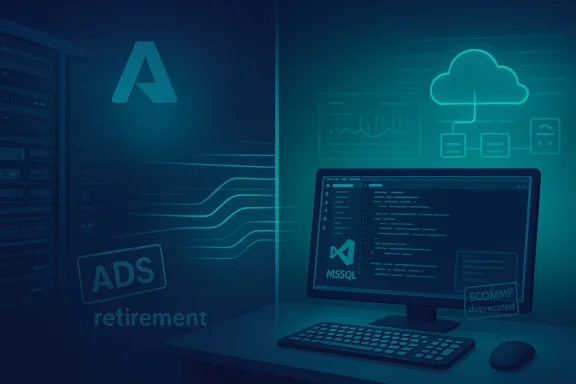
Microsoft’s latest lifecycle moves have quietly — and in some cases not so quietly — tightened the noose on on‑premises SQL tooling and monitoring, forcing many organizations to rethink long‑standing architectures and operational contracts. Two separate but complementary actions define the moment: Microsoft’s retirement of Azure Data Studio (ADS) and its deprecation of key SCOM Management Packs for SQL Server reporting and analytics workloads, each nudging (and in places compelling) customers toward Azure Monitor, Azure Arc, and the Visual Studio Code ecosystem. The net effect is a clear product‑strategy arc: consolidate developer tools into VS Code, and consolidate monitoring and telemetry into Azure — a cloud‑first push with practical and fiscal consequences for enterprises that deliberately maintain on‑prem infrastructure.
Microsoft has published two separate, authoritative notices that together reshape the tooling and telemetry story for SQL Server customers.
The practical advice is straightforward: inventory, POC, quantify costs, and build contingency plans. The vendor has provided migration guidance and recommended alternatives; however, the timing, scale and cumulative nature of these retirements means that thoughtful planning and cross‑team coordination will determine whether your organization reaps the benefits of modernization or pays an avoidable tax in time, money and operational risk.
Source: Windows Report https://windowsreport.com/microsoft...ing-as-sql-server-tools-reach-end-of-support/
 Background: what changed and where it matters
Microsoft has published two separate, authoritative notices that together reshape the tooling and telemetry story for SQL Server customers.- Azure Data Studio will be retired — the retirement announcement in early February 2025 and ADS will be supported only through February 28, 2026. Microsoft’s guidance is explicit: migrate daily SQL work to Visual Studio Code and the MSSQL extension.
- System Center Operations Manager (SCOM) management packs for SQL Server Reporting Services (SSRS), Power BI Report Server (PBIRS) and SQL Server Analysis formally deprecated in January 2026 and will reach end of support in January 2027. Microsoft’s public guidance recommends using Azure Monitor combined with Azure Arc and Log Analytics** as the replacement monitoring strategy for those workloads.
Why this matters: practical impact on operations
Short answer: the two announcements together reduce the number of fully on‑premises, vendor‑supported end‑to‑end workflows for SQL reporting, analytics and developer tooling. For many organizations — particularly regulated, sovereign, or heavily air‑gapped environments — the implications are operational, financial and compliance‑sensitive.Monitoring and incident detection changes
- SCOM MPs deprecation removes Microsoft’s maintained SCOM logic for SSRS, PBIRS and SSAS after January 2027. Existing MPs may continue to run in supported SCOM versions, but Microsoft will not publish fixes, updates, or compatibility guarantees for future SQL or SCOM releases. That makes long‑term reliance on those MPs a risk.
- Microsoft’s recommended path is Azure‑centric: enable Azure Arc on the host, install the Azure Monitor Agent (AMA), forward telemetry to a Log Analytics Workspace, and use Azure Monitor Workbooks and alerts in place of classical SCOM rules. For organizations that intentionally keep telemetry off cloud services, this is a material shift.
- “Mandatory” is a loaded term. Microsoft is not physically blocking on‑prem monitoring, but by removing active, vendor‑maintained SCOM MPs and by making Azure solutions the supported path for modern compatibility, the practical choices become constrained. Treat any claim that Azure is legally required as interpretive — the vendor’s policy steers customers to Azure but does not technically force every monitoring flow into the cloud. That nuance matters in procurement and compliance conversations.
Developer tooling and cross‑platform workflows
- Azure Data Studio has been a cross‑platform favourite for database developers and analysts because it combined lightweight query editing, notebooks, and many database utilities across Windows, macOS and Linux. Its formal retirement removes that dedicated, supported cross‑platform editor. Microsoft’s explicit recommendation is moving workloads to VS Code + MSSQL extension — a different user experience with tradeoffs around extension parity and some missing features at launch.
- Several ADS features are handled differently post‑retirement: some administration tasks (SQL Server Agent job management, heavy profiling, deep SSMS admin functions) remain Windows‑centric in SQL Server Management Studio (SSMS), while the VS Code MSSQL extension will cover a growing, but not yet feature‑complete, set of developer workflows. Expect temporary feature gaps during the transition period.
Licensing, billing and cost profile
- Cloud‑native monitoring typically moves costs from capital (one‑time or predictable maintenance contracts) to operational consumption (ingress/ingestion charges, log retention tiers, alert executions). That can be cheaper at scale or more expensive for heavy telemetry workloads. Budgeting must shift accordingly. Windows Report and other outlets have raised cost and training concerns tied to this shift.
Strengths of Microsoft’s approach
Microsoft’s design decision is not without benefits. The vendor’s rationale for consolidation has practical merits that enterprises should weigh.- Unified engineering focus. Consolidationdating the SQL development surface into VS Code concentrates feature investment and security updates in one modern editor that has a large extension ecosystem and active community. That can accelerate delivery of advanced features over ADS’s independent lifecycle.
- **Cloud‑centric telemetry editor + Azure Arc + Log Analytics is a scalable, centrally managed telemetry solution. It supports long‑term storage, advanced analytics, correlation across hybrid environments, and easier integration with cloud‑native SIEM and AI features. For organizations that already use Azure or intend to modernize, the approach reduces tooling diversity and can simplify observability architectures.
- Modern feature stack for reporting. Consolidating on Power BI Report Server (PBIRS) as the primary on‑prem reporting engine for SQL Server 2025 brings RDL and PBIX support into a single platform and aligns on‑prem reporting more closely with Power BI’s cloud capabilities. That can ease migrations to cloud analytics over time.
Risks, gaps and hard realities
There are clear and immediate risks that administrators must treat as active items in 2026 planning cycles.- Feature parity gaps. The MSSQL extension on VS Code does not instantly replicate every ADS feature; and it certainly does not replace some SSMS‑only admin functions. Expect operational workarounds and scripts during migration windows. Track critical missing capabilities and allocate time for either feature requests or alternative tooling.
- Data sovereignty and compliance friction. For customers legally constrained to keep telemetry on‑prem, the Azure Monitor recommendation is a poor fit without hybrid mitigations. While Azure Arc enables hybrid registration without moving data into Microsoft’s cloud by default, many monitoring features assume cloud storage and processing. Legal teams and auditors must review whether Azure Arc/Log Analytics configurations meet policy requirements. If they do not, organizations face an uncomfortable choice: remain on older releases (with accumulating risk), pay for third‑party monitoring stacks, or re‑engineer to meet compliance demands.
- Operational retraining and migration debt. Shifting monitoring paradigms, touching as many nodes as reporting servers and analysis clusters, is non‑trivial. The migration path includes enabling Azure Arc, installing agents, re‑creating alert logic, and building new dashboards — a multi‑quarter program for many organizations. The upfront labor and potential surprise costs (data ingestion, retention) must be modeled now.
- Vendor risk of single‑stack dependency. Consolidating into Azure and VS Code increases dependency on a single vendor’s stack. That dependency can improve integration but concentrates risk if product direction shifts again. Organizations must evaluate vendor lock‑in against the operational benefits. This is a governance decision as much as a technical one.
How to plan a pragmatic migration — concrete steps
Below is a prioritized, practical plan for IT teams facing these changes. Treat the list as a program checklist rather than a prescriptive project plan.- Inventory (30–60 days)
- Capture every service that depends on ADS, SCOM MPs, SSRS, PBIRS, and SSAS.
- Tag services by criticality, compliance impact, and owner.
- Identify any legacy automation that uses SCOM MPs or ADS‑specific extensions.
- Short‑term stabilisation (60–120 days)
- For ADS users: set up VS Code with the MSSQL extension, import Database Projects and notebooks, and validate critical developer workflows. Maintain ADS in parallel until Feb 28, 2026 for contingency.
- For SCOM MP consumers: document the MP rules you rely on and map each rule to an equivalent telemetry signal (PerfCounter, Event, custom log) that can be ingested into Azure Monitor.
- Proof of Concept (90–180 days)
- Build an Azure Arc POC for a set of non‑critical SSRS/PBIRS/SSAS servers and ingest telemetry to a Log Analytics workspace.
- Recreate a small but representative set of alerts and dashboards using Azure Monitor Workbooks.
- Measure costs for ingestion and retention; tune Data Collection Rules to balance visibility and cost.
- Migration runway (6–18 months)
- Prioritize migration of production instances by business impact and regulatory constraints.
- For sovereign or isolated environments, evaluate on‑premises third‑party monitoring (Prometheus + Grafana + probes, Splunk on‑prem, or private SIEMs) if Azure Arc cannot meet policy constraints.
- For developer teams, roll out standardized VS Code extensions, recommended settings, and training materials to minimize friction.
- Long‑term governance and optimization (ongoing)
- Implement telemetry cost governance: tag log sources, set retention tiers, and automate DCR lifecycle.
- Maintain an “escape hatch” for critical monitors — a documented fallback that works without cloud ingestion if needed.
- Reassess tooling annually; vendor roadmaps change and the migration effort should be opportunistic alongside feature improvements.
Migration checklist: minimal viable monitoring (MVM)
- Enable Azure Arc on one or more test servers.
- Install the Azure Monitor Agent (AMA) and verify data arrives in Log Analytics.
- Create Data Collection Rules (DCRs) for key counters (service health, CPU, disk, event logs).
- Rebuild at least one critical alert with an equivalent severity and escalation path.
- Validate dashboarding and runbook automation for incident remediation.
Vendor messaging vs. practical choice: analysis
Microsoft’s public messaging frames these changes as modernization and consolidation: fewer, better‑supported tools; improved innovation velocity; better integration with cloud AI and telemetry services. Technically, those are defensible reasons. VS Code has a massive ecosystem, and Azure Monitor + Arc offers powerful hybrid telemetry capabilities. However, the timing and cumulative effect of multiple retirements create real operational friction. A cluster of retirements across 2025–2027 (Azure Data Studio retirement; SCOM MPs end of support; Office Online Server and other on‑prem web components retiring) compress migration timelines and increase coordination costs across security, compliance, and application teams. The realistic outcome for many organizations will be a mix of:- Quick adoption where cloud is allowed and cost‑effective.
- Extended co‑existence where legacy tools remain in place until application compatibility and compliance lifting is completed.
- Third‑party or homegrown monitoring bridging the gaps in sensitive environments.
- Any assertion that Microsoft “is forcing” Azure for all customers is an oversimplification; the vendor is deprecating certain on‑prem support paths and recommending Azure alternatives — a strong nudge, but not an absolute technical lockout. Treat “force” as shorthand for “removal of vendor‑maintained on‑prem alternatives that materially increases the cost and risk of staying completely off‑cloud.”
Recommendations for CIOs and platform owners
- Treat 2026 as a deadline year for decisions, not just a planning horizon. ADS support ends Feb 28, 2026 and SCOM MPs for SSRS/PBIRS/SSAS are unsupported after Jan 2027; both dates should be explicit gates in migration programs.
- Run a cross‑functional risk review (security, legal, procurement, operations) to quantify the compliance and cost delta between on‑prem alternatives and Azure Arc/Monitor.
- Negotiate with vendors and partners early: managed service providers and SI vendors may offer hybrid observability platforms or fixed‑price ingestion options that reduce the shock of consumption billing.
- Invest in runbook automation: the migration is a people problem as much as a tooling problem. Automated remediation reduces incident overhead during the transition.
Conclusion: a modernization fork — plan, don’t panic
Microsoft’s twin moves — retiring Azure Data Studio and deprecating SCOM management packs for SSRS/PBIRS/SSAS — are consistent with a strategy to centralize development and monitoring investments where Microsoft sees greatest long‑term value: VS Code for developers and Azure for telemetry. For organizations already aligned to Azure, the changes will accelerate modernization and simplify some long‑term operational choices. For organizations where cloud is constrained by policy or budget, the path is messier: more work, more risk, and likely a hybrid mix of on‑prem and cloud solutions for some time.The practical advice is straightforward: inventory, POC, quantify costs, and build contingency plans. The vendor has provided migration guidance and recommended alternatives; however, the timing, scale and cumulative nature of these retirements means that thoughtful planning and cross‑team coordination will determine whether your organization reaps the benefits of modernization or pays an avoidable tax in time, money and operational risk.
Source: Windows Report https://windowsreport.com/microsoft...ing-as-sql-server-tools-reach-end-of-support/