

A shift is underway: the places users ask questions and expect quick, authoritative answers are becoming advertising surfaces, and advertisers who treat AI search engines as a novelty risk missing the biggest reordering of digital marketing since programmatic display.
The conversation started as a how-to primer on the practical mechanics of advertising in the new generation of AI-driven search experiences. The original piece the reader pointed to (a Halston Media Group / Stacker feature) is behind a paywall and could not be retrieved directly for full verification; an attempt to fetch the article returned an access restriction. ([]()) Because of that, this feature synthesizes the accessible key points reported about advertising on AI search engines and verifies them against independent coverage from industry outlets, platform signals, and technical literature to give advertisers a usable playbook while noting where claims are unverified or paywalled.
Two independent threads of corroboration make the core proposition clear: first, major platforms are actively experimenting with ads inside conversational AI and AI-powered answer engines (notably OpenAI, Microsoft, and Google), and second, the tactics that work in classic search—structured data, authoritative third-party citations, smart bidding, and creative asset readiness—are evolving rather than disappearing. Both claims are visible in industry reporting and platform experiments.
This article breaks down what “advertising on AI search engines” actually looks like today, how it will affect media planning and creative, what measurable risks exist, and a practical step-by-step playbook for advertisers who must act now.
Why advertisers should care now
Key tactics:
New metrics advertisers must consider:
Tactically, the immediate priorities are clear: shore up structured data, generate reputable third‑party citations, feed automation with high-quality conversion signals, and run rigorous lift measurement—while building creative assets that work inside conversational experiences. Strategically, diversify placements, negotiate publisher relationships, and ensure ethical, clearly labeled ad experiences to preserve user trust.
Because the original Halston Media Group article is paywalled and could not be fetched in full, readers should treat any recommendations attributed solely to that piece with caution and consider this article a corroborated, platform-verified, and independently sourced guide to navigating ad opportunities inside AI search engines. The opportunity is real—and the next 12–18 months will determine which brands translate early technical readiness into sustained leadership inside the AI-driven answers people increasingly rely on. ([]())
Source: Halston Media Group https://news.halstonmedia.com/yorkt...about-advertising-on-ai-search-engines,69804/
 Background / Overview
The conversation started as a how-to primer on the practical mechanics of advertising in the new generation of AI-driven search experiences. The original piece the reader pointed to (a Halston Media Group / Stacker feature) is behind a paywall and could not be retrieved directly for full verification; an attempt to fetch the article returned an access restriction. ([]()) Because of that, this feature synthesizes the accessible key points reported about advertising on AI search engines and verifies them against independent coverage from industry outlets, platform signals, and technical literature to give advertisers a usable playbook while noting where claims are unverified or paywalled.Two independent threads of corroboration make the core proposition clear: first, major platforms are actively experimenting with ads inside conversational AI and AI-powered answer engines (notably OpenAI, Microsoft, and Google), and second, the tactics that work in classic search—structured data, authoritative third-party citations, smart bidding, and creative asset readiness—are evolving rather than disappearing. Both claims are visible in industry reporting and platform experiments.
This article breaks down what “advertising on AI search engines” actually looks like today, how it will affect media planning and creative, what measurable risks exist, and a practical step-by-step playbook for advertisers who must act now.
What is an “AI search engine” — and why it matters to advertisers
AI search engines (also called conversational search, answer engines, or AI Overviews) differ from classic keyword-driven search in three fundamental ways:- They synthesize multiple sources into a single, conversational answer rather than returning a ranked list of links.
- They treat small, machine-readable signals (quotes, data points, citations, and structured metadata) as the connective tissue for answers.
- They can be multimodal and context-aware, meaning the interface and opportunities for engagement go beyond classic text links and banners.
Why advertisers should care now
- Concentrated intent: conversational queries reveal richer purchase intent (constraints, preferences, budget) in one interaction.
- Fewer “slots”: a single generated answer displaces dozens of traditional organic links—visibility now requires different signals.
- New creative formats: generative surfaces reward assets and metadata that can be stitched into a narrative answer.
How advertising appears inside AI search engines (formats and examples)
AI search ad placements are not yet standardized across platforms. Expect a landscape that includes some of the following placements and creative types:- Sponsored cards or “shopping cards” embedded directly in conversation results (click-to-purchase or click-to-learn). These appear as distinct visual elements under or alongside generated answers. Platforms have publicly described pilots of clearly labeled ad placements in chat interfaces.
- Citation-driven prominence: being quoted or cited in a high-authority third-party story that an AI uses in its answer can surface your brand organically inside the AI-generated snippet. Earned media and distributed editorial pickups are explicit tactics for this channel.
- Programmatic “entry” into AI Overviews via automated campaign types (Google’s Performance Max / AI-first campaign formats or platform equivalents) that qualify advertisers for placements in AI-driven surfaces. Early industry coverage and vendor reports reference campaign types and approaches evolving to target these surfaces.
- Interactive ad experiences inside assistants (e.g., dynamic showroom-like experiences or “ad agents” that can answer follow-ups). Microsoft and other advertisers are trialing interactive showroom formats that move beyond static creative.
- Sponsored answers or “recommended” shortlists where the assistant interleaves paid suggestions with organic citations—the ethics and labeling of these are emerging debates. Industry threads emphasize the need for clear labeling and guardrails to maintain trust.
Platform-by-platform snapshot: what major players are doing
OpenAI / ChatGPT
OpenAI has publicly tested advertising in ChatGPT on lower-cost/ad-supported tiers, placing clearly labeled advertisements beneath answers for logged-in users in limited geographies and audiences. That testing represents a direct entry point for advertisers to reach users inside conversational answers—but it also raises questions about ad labeling, user consent, and whether the free/ad tier will be materially different from paid tiers.Google (AI Overviews / SGE / AI Mode)
Google’s AI Overviews and SGE (Search Generative Experience) display synthesized answers with multiple citations and have begun to show ad formats adjacent to or integrated with those experiences in some tests. Google’s approach emphasizes passage-based citations and a high rate of citations per answer—making third-party authority signals valuable. Advertisers must adapt to the possibility that Google’s conversational placements will be tightly integrated with its ad stack, favoring automated campaign types and broad signal-based targeting.Microsoft (Copilot and AI ads)
Microsoft has designed Copilot experiences and is experimenting with interactive ad units and immersive showrooms tied into Microsoft Advertising. These formats emphasize real-time interactivity inside the assistant and require richer creative assets and commerce integrations. Microsoft’s ad formats suggest a future where ads can be conversational and multi-step.Others (Perplexity, Anthropic, specialized assistants)
Not all assistants will choose ad-supported models. Some, like Perplexity (in public commentary), prefer subscription or enterprise models to remain ad-free. This bifurcation means advertisers will need to match strategy to platform economics—paid placements will be available where platforms opt for ads; other platforms may be reachable only via partnerships or enterprise integrations.What works: signals, tactics, and creative for AI search ads
The emerging pattern is simple: AI search engines value trustworthy, machine-readable signals and rich creative assets that an assistant can repurpose quickly.Key tactics:
- Structured data and schema hygiene
- Use schema.org for product, FAQ, HowTo, and review markup; keep it accurate and up to date.
- Assistants and answer engines rely heavily on structured facts; schema errors reduce the chance your content will be selected. Several authoritative guides and tests show schema and high-quality structured data increase the likelihood of being cited in AI Overviews.
- Earned media and citation density
- AI answers favor multiple reputable citations. Brands seeking presence in AI-generated answers should invest in earned coverage—authoritative third-party articles and press pickups that produce durable citation footprints. Vendors offering distribution and earned media strategies (including Stacker-style earned placement) explicitly position this as the most direct path to AI visibility.
- Automated campaign types and signal architecture
- Platform automation (Performance Max, AI Max, or vendor equivalents) increasingly controls eligibility for AI placements. Build the right “signal architecture”: high-quality conversion feeds, first-party audience signals, and tightly managed exclusion lists to prevent waste. Case studies and practitioner reporting warn that automation can amplify poor signals; careful feed hygiene is critical.
- Creative asset readiness
- AI search surfaces benefit from a library of assets—concise product summaries, high-resolution visuals, clear value propositions, and short pitch text that the assistant can surface in different contexts. Interactive creatives (showrooms or multi-turn dialogue flows) will be rewarded where supported.
- Search-oriented content engineering
- Create passage-friendly content (short, quotable facts and clear attributions) and strong canonical pages for brand, product, and local information. The assistant often extracts single passages or data points; ensure those passages answer the likely conversational queries your customers will ask. Industry reporting shows AI Overviews commonly cite single passages or stats when generating answers.
Measurement and attribution: why standard KPIs break down and what to do
AI search engines fracture the familiar click-to-site attribution model. If an assistant provides a complete answer (and the user never clicks), traditional click-through and on-site conversion data undercount value.New metrics advertisers must consider:
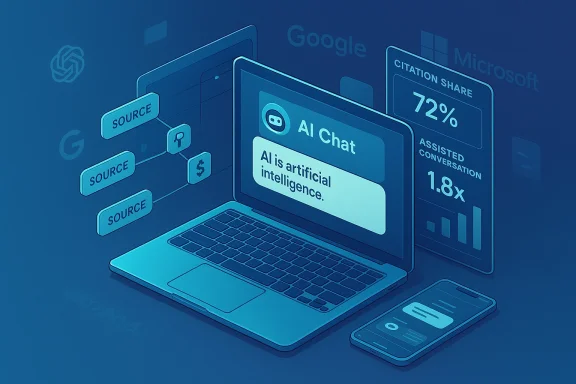
- Citation share: the frequency and quality of citations to your brand within AI-generated answers.
- Assisted-conversation lift: surveys and panel-based measurement focused on whether AI answers influenced awareness, consideration, or purchase behavior.
- Query-level engagement: for placements that do support clicks, capture downstream household or session signals and tie them to AI-enabled exposures.
- Conversion proxy signals: where clicks are absent, use brand lift studies, correlated demand spikes (search volume, direct traffic), and controlled experiments to estimate impact.
Privacy, trust and regulatory risk
Conversational AI advertising raises acute privacy and trust issues:- Data provenance and personalization: assistants may use richer conversational context to serve ads. Platforms must balance personalization with user privacy controls; advertisers should anticipate stricter transparency requirements.
- Disclosure and labeling: ads inside generated answers must be clearly labeled to avoid deceptive experiences. Early platform pilots emphasize “clearly labeled” placements; industry commentators warn that unclear labeling will prompt regulatory scrutiny and user backlash.
- Publisher economics and content reuse: AI-generated answers can displace direct publisher traffic. Publishers and platforms are negotiating compensation models; advertisers should watch how these economics evolve because they will affect inventory availability and pricing.
Publisher and publisher‑ecosystem impacts
AI search engines shift value away from single-site traffic to citation networks and passage prominence. That affects:- Publishers: decreased downstream traffic for some query classes, increased importance of being a trusted, machine‑readable source.
- Aggregators: new gatekeepers may emerge—platforms that curate and supply the AI training or answer pipelines could create high-value ad inventory.
- Local and niche publishers: publishers that maintain clean structured data and regularly publish quotable, high-quality content can be disproportionately rewarded by citations.
Risks and downsides advertisers must weigh
- Visibility concentration risk: relying on a single assistant or single platform’s ad surfaces concentrates exposure and increases platform risk.
- Measurement uncertainty: legacy attribution fails when answers substitute for clicks; improper experiments can produce misleading ROAS assessments.
- Reputation risk: poor labeling or low-quality sponsored content inside answers can damage brand trust quickly, given the intimate nature of conversational interfaces.
- Creative mismatch: creative produced for 1:1 conversational experiences requires new workflows—brands that simply reuse display assets are likely to underperform.
A practical 10-step playbook to advertise on AI search engines (immediately actionable)
- Audit your structured data
- Validate product, localBusiness, FAQ, HowTo, and review schema across key pages; fix errors and version-control schema updates.
- Build a corpus of “quotable” content
- Create short passage-friendly snippets: one-sentence value propositions, crisp stats, and short FAQs designed to be cited verbatim.
- Invest in earned media distribution
- Prioritize distributed editorial coverage with high-authority outlets (press, niche trade media) to create citation density that AI Overviews can draw from. Consider paid earned-distribution services if speed matters.
- Prepare creative asset libraries
- Produce concise text blurbs, hero images (square and rectangular), and short explainer videos tailored for reuse inside assistant interfaces and cards.
- Feed high-quality conversion signals into automated campaigns
- Use clean offline conversion imports, server-side tagging, and high-quality event deduplication to make automated bidding systems more efficient. Industry reporting indicates automation favors good-quality signals.
- Configure signal-level exclusions and brand controls
- Guard against irrelevant matches by applying term exclusions, content constraints, and brand-safety settings at the campaign level.
- Run controlled lift tests (not just click measurement)
- Deploy randomized geo or audience holdouts and brand-lift surveys to estimate unseen influence from non-click exposures.
- Monitor citation share and answer presence
- Set up continuous monitoring for when your brand or pages are cited in AI-generated answers; use that as a leading indicator of visibility.
- Coordinate with publishers and partners
- Establish co-marketing or syndication arrangements with publishers who produce citation-prone content; consider sponsored research or data partnerships.
- Prepare privacy and disclosure artifacts
- Make sure ad labeling and privacy notices are clear, and maintain a compliance-ready log of what signals you send to platforms.
Technical checklist for developers and SEO teams
- Implement canonical tags and keep crawlable HTML for key content.
- Serve high-quality structured data, including productOffers, aggregateRating, and availability.
- Keep sitemaps current and use IndexNow or platform-specific indexing endpoints where available to accelerate discovery.
- Provide a lightweight “facts” API or machine-readable knowledge graph if you have enterprise resources; platforms reward structured, high-fidelity facts. Evidence across platform guidance and practitioner write ups indicates a premium on high-quality facts and clear provenance.
Where the market is likely to go (short to medium term)
- Multiple monetization models will coexist: ad-supported assistants alongside subscription/enterprise alternatives.
- Ads will get richer and more interactive inside assistants—expect showroom-like and multi-turn ad experiences.
- Measurement standards and taxonomy will emerge, but initially will be fragmented (citation share, assisted-conversation metrics, panel-based lift).
- Regulatory scrutiny will increase on labeling and opaque personalization; advertisers will need tighter governance.
Critical analysis — strengths, opportunities, and dangers
Strengths and opportunities- Concentrated intent and richer query signals provide unique conversion opportunities at moments of high purchasing clarity.
- Smart automation, when fed with quality signals, can find valuable conversational queries that legacy keyword lists miss.
- Early leaders can lock in high-visibility citation and brand-sentiment wins by pairing earned media with technical readiness.
- Measurement fragility makes premature scale-up risky. Without robust lift testing, advertisers risk optimizing to noise or accidental conversions.
- Platform dependency and inventory concentration increase strategic risk; an algorithm change can materially change visibility overnight.
- The trust equation is delicate: if ads inside answers feel manipulative or unlabelled, user backlash and regulatory action will follow. Industry commentary and platform pilots both flag that clear labeling is essential to maintain long-term efficacy.
- The Halston / Stacker article the user referenced could contain platform-specific step-by-step guidance or proprietary recommendations behind the paywall. Because the full article was inaccessible at the time of research, specific claims sourced only to that paywalled piece are treated as unverified here. Wherever possible, key claims in this article were cross-checked against independent reporting and platform signals. ([]())
Quick checklist for CMOs and media planners (one page)
- Strategy: Allocate a test budget to AI assistant inventory and earned media.
- Measurement: Design randomized holdouts and brand lift surveys to capture non-click influence.
- Ops: Fix schema and canonicalization issues this quarter.
- Creative: Build an “assistant-ready” asset pack (short text snippets, images, and FAQ microcopy).
- Legal: Audit disclosures and privacy language for new conversational placements.
- Partnerships: Negotiate publisher pickups to build citation density.
Conclusion
Advertising on AI search engines is not a single tactic—it’s a new axis of visibility that blends content engineering, earned media, automated buying, and creative transformation. The platforms are already moving: pilots of in-chat ads, AI Overviews that prize citations, and interactive ad formats mean that the modern marketer must treat AI search as a first-class channel.Tactically, the immediate priorities are clear: shore up structured data, generate reputable third‑party citations, feed automation with high-quality conversion signals, and run rigorous lift measurement—while building creative assets that work inside conversational experiences. Strategically, diversify placements, negotiate publisher relationships, and ensure ethical, clearly labeled ad experiences to preserve user trust.
Because the original Halston Media Group article is paywalled and could not be fetched in full, readers should treat any recommendations attributed solely to that piece with caution and consider this article a corroborated, platform-verified, and independently sourced guide to navigating ad opportunities inside AI search engines. The opportunity is real—and the next 12–18 months will determine which brands translate early technical readiness into sustained leadership inside the AI-driven answers people increasingly rely on. ([]())
Source: Halston Media Group https://news.halstonmedia.com/yorkt...about-advertising-on-ai-search-engines,69804/
