

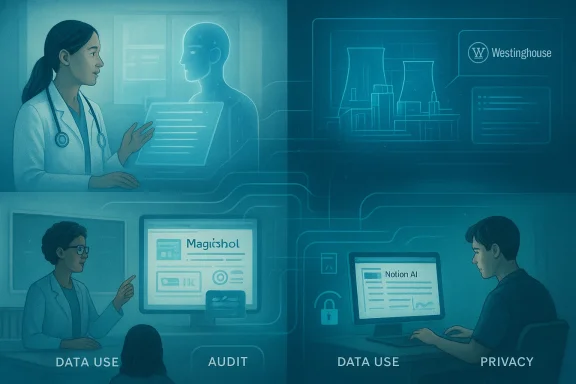
MIT Technology Review’s new short series, Making AI Work, lands as a practical counterpoint to the hype: a seven-issue, weekly newsletter that walks readers from real-world case studies to the tooling and — critically — the operational steps organizations need to make AI deliver measurable value. The first four installments alone map a deliberately broad terrain: ambient clinical note‑taking in health care, AI-assisted nuclear‑reactor construction, K–12 classroom platforms, and small‑business productivity tools. Each episode pairs a concrete use case with a technical deep dive and ends with hands‑on advice intended to push readers from curiosity to controlled experimentation. The result is less about shiny demos and more about the messy, policy‑heavy work of turning pilots into repeatable outcomes — a theme the industry urgently needs.
AI has entered the “how” phase of adoption. Early waves of product releases and flashy demos established capability; now the central problem is operationalization — how to verify, govern, integrate, and measure AI systems in real workflows. That shift is precisely what Making AI Work is designed to teach: short, case‑based lessons that pair a sectoral problem, the specific AI instrument being used, and the concrete next steps teams can take to try the approach themselves. The newsletter’s stated structure — a case study, a technology deep dive, and action‑oriented tips — is a practical editorial choice that reflects the dominant failure mode of enterprise AI: pilots that impress but do not scale because organizations underinvest in measurement, governance, and role redesign.
This feature unpacks the first four weekly cases presented by MIT Technology Review, verifies the technical claims where public information exists, and critically evaluates the strengths and weaknesses IT teams, school leaders, clinic administrators, and small‑business owners must weigh before adopting similar approaches.
Independent coverage and vendor descriptions match this picture: Microsoft’s healthcare‑oriented Copilot announcements emphasize ambient note generation, multilingual transcription, and integrations for after‑visit summaries and orders — features meant to free clinicians to focus on patients rather than paperwork. Industry reporting notes both the potential productivity gains and the regulatory, safety, and accuracy risks associated with any generative system operating in a clinical context.
Independent reporting and analysis characterize the approach as domain specialization: train a model (or assemble a system) on decades of engineering, inspection, and construction data so that the AI can surface optimization suggestions, detect design conflicts earlier, or generate downstream documentation faster. Forbes and other industry outlets have summarized Westinghouse’s HiVE/bertha architecture and the collaboration with Google Cloud as emblematic of how AI can compress design and permit repeatability in complex capital projects.
Source: MIT Technology Review Making AI Work, MIT Technology Review’s new AI newsletter, is here
 Background / Overview
AI has entered the “how” phase of adoption. Early waves of product releases and flashy demos established capability; now the central problem is operationalization — how to verify, govern, integrate, and measure AI systems in real workflows. That shift is precisely what Making AI Work is designed to teach: short, case‑based lessons that pair a sectoral problem, the specific AI instrument being used, and the concrete next steps teams can take to try the approach themselves. The newsletter’s stated structure — a case study, a technology deep dive, and action‑oriented tips — is a practical editorial choice that reflects the dominant failure mode of enterprise AI: pilots that impress but do not scale because organizations underinvest in measurement, governance, and role redesign.This feature unpacks the first four weekly cases presented by MIT Technology Review, verifies the technical claims where public information exists, and critically evaluates the strengths and weaknesses IT teams, school leaders, clinic administrators, and small‑business owners must weigh before adopting similar approaches.
Week 1 — How AI is changing health care
The use case: ambient note‑taking in clinical workflows
The first installment examines ambient clinical documentation tools that listen to clinician–patient encounters and generate draft notes, discharge summaries, and other charting materials. One concrete example highlighted by the industry is Microsoft’s integration of Nuance’s Dragon ambient capabilities (branded in Microsoft offerings as DAX or Dragon Copilot variants) into Epic workflows — a move intended to reduce clerical burden for clinicians and shorten after‑hours charting. Vanderbilt University Medical Center publicly announced a launch of ambient documentation (DAX Copilot) for ambulatory and emergency settings, describing real‑time capture of patient–clinician conversations to generate clinical documentation and reduce clinician charting time.Independent coverage and vendor descriptions match this picture: Microsoft’s healthcare‑oriented Copilot announcements emphasize ambient note generation, multilingual transcription, and integrations for after‑visit summaries and orders — features meant to free clinicians to focus on patients rather than paperwork. Industry reporting notes both the potential productivity gains and the regulatory, safety, and accuracy risks associated with any generative system operating in a clinical context.
What’s true and measurable
- Real deployments exist: major health systems — including Vanderbilt University Medical Center — have publicly announced pilot and phased rollouts of ambient AI scribe tools that integrate with electronic health records.
- The core technical capability (real‑time speech capture, diarization, domain‑aware summarization) is commercially available today, primarily via vendor suites that integrate speech‑to‑text, clinical LLMs, and EHR connectors.
Strengths and potential benefits
- Tangible clinician time savings: by automating repetitive charting tasks, ambient copilots can reduce after‑hours documentation and burnout drivers, freeing clinicians for higher‑value patient care.
- Workflow alignment: when the assistant is embedded in the EHR and designed to respect clinical taxonomies and billing structures, it can produce outputs closer to what clinicians actually need — not just polished prose.
Risks and unanswered questions
- Accuracy and clinical safety: generative outputs can hallucinate facts, misattribute findings, or omit critical context. In medicine those errors have real harm potential. Implementations must include robust, auditable human‑in‑the‑loop checks and explicit liability assignments.
- Privacy, telemetry, and training data: ambient systems capture around‑the‑clock patient conversations; organizations must be explicit about data retention, encryption, PHI handling, and whether recordings or transcriptions are used to further train vendor models. Regulatory frameworks (HIPAA in the U.S.) demand strict protections and clear vendor contracts.
- Workflow integration costs: the tech is only the start. Successful pilots instrument measurement, redesign roles (medical scribes, clinical informaticists), and fund audits and retraining. Without that investment, pilots stagnate.
Practical guidance for health‑system IT teams
- Start with a narrow, measurable pilot cohort (e.g., one ambulatory clinic or ED shift).
- Define pre/post metrics: documentation time, chart completion rates, coding accuracy, and clinician satisfaction. Measure for at least 90 days.
- Require human sign‑off for any AI‑generated clinical assertion until accuracy is proven in your environment.
- Strengthen contracts: demand non‑training data clauses or clear data‑use terms, audit rights, and incident response SLAs from vendors.
Week 2 — How AI could power up the nuclear industry
The use case: accelerating modular reactor construction and operations
MIT’s second week spotlights an experiment pairing AI tooling with nuclear engineering: using domain‑specific generative models and data platforms to optimize reactor design, generate construction work packages, and improve operations. Public announcements from Westinghouse and Google Cloud illustrate exactly this pattern: Westinghouse has developed industry‑specific systems (HiVE™ and a domain LLM called bertha) and announced a collaboration with Google Cloud to combine those tools with Vertex AI, Gemini, and BigQuery to generate and optimize AP1000 modular construction work packages and operational insights. Business‑facing press releases and vendor blogs describe proof‑of‑concept results in which digital plant design platforms and generative tooling produced repeatable, optimized construction outputs.Independent reporting and analysis characterize the approach as domain specialization: train a model (or assemble a system) on decades of engineering, inspection, and construction data so that the AI can surface optimization suggestions, detect design conflicts earlier, or generate downstream documentation faster. Forbes and other industry outlets have summarized Westinghouse’s HiVE/bertha architecture and the collaboration with Google Cloud as emblematic of how AI can compress design and permit repeatability in complex capital projects.
What’s verifiable
- The Westinghouse–Google Cloud collaboration, announced publicly, includes explicit references to Vertex AI/Gemini and a proof‑of‑concept using Westinghouse’s WNEXUS platform and HiVE.
- Westinghouse’s own filings and press materials identify bertha as a proprietary, nuclear‑focused LLM trained on the company’s historical engineering data to support lifecycle activities from design to license documentation.
Opportunities and clear strengths
- Repeatability at scale: nuclear construction historically suffers from expensive, bespoke processes and costly rework. Domain‑specific AI promises to detect clashes early and standardize best practices across builds.
- Operations uplift: AI can convert decades of inspection and sensor telemetry into predictive maintenance signals that reduce downtime and safety risk if validated.
Material risks and governance demands
- Verification and explainability: engineering decisions for reactors require traceability and auditable rationale. Any generative recommendation must be traceable back to validated data and human engineering review.
- Regulatory scrutiny: nuclear licensing authorities require rigorous safety cases and provenance. Introducing AI into design or safety documents raises legal and regulatory complexity; organizations must pre‑clear processes with regulators.
- Data provenance and IP: training models on proprietary engineering archives creates IP sensitivities and licensing questions for vendor partners; contracts must explicitly define ownership and permitted uses.
Recommendations for infrastructure and program leads
- Treat AI as an augmentation, not an automation: AI can propose optimizations but final approvals must stay with certified engineers. Require provenance tagging on every AI recommendation.
- Invest in simulation and digital twins: tie any generative outputs to deterministic simulation runs and a validation sandbox before accepting design artifacts.
- Engage regulators early: create joint validation protocols with licensing bodies so AI‑assisted artifacts are accepted as part of the submission package.
Week 3 — How to encourage smarter AI use in the classroom
The use case: MagicSchool and district‑facing AI platforms
MIT’s third week visits a school setting and profiles MagicSchool, an AI education platform designed to help teachers create lesson plans, rubrics, assessments, and personalized learning material while billing itself as district‑grade, privacy‑oriented software. MagicSchool’s product pages emphasize FERPA/COPPA compliance, SOC 2 controls, district customization, and in‑platform tools that generate lesson plans, quizzes, and differentiated materials — features aimed at relieving teacher prep time while offering district administrators governance controls.Verification and limits
- The vendor’s product claims (time savings, privacy controls, integrations with Google Classroom, Canvas, etc.) are verifiable on MagicSchool’s public site, which includes case studies and marketing metrics.
- MIT’s newsletter frames MagicSchool with a local, on‑the‑ground classroom example (a private high school in Connecticut and a technology coordinator using the platform). I could not independently locate a public case study linking MagicSchool to a specific Connecticut private‑school deployment. That specific institutional detail appears in the newsletter’s reporting and should be treated as a primary‑report claim unless the district or school publishes its own corroboration. Where vendor or local district press releases exist, they should be used to confirm deployments before other schools imitate the rollout. (Caution: site‑level product claims are vendor‑provided and should be validated in pilot contexts.)
Strengths in education use
- Teacher time reclaimed: district‑grade AI tooling can produce differentiated lesson materials and short assessments, potentially saving multiple hours per week for teachers who adapt content to varied learners.
- Privacy‑centric features: vendors that bake non‑training options and clear data‑handling practices into their K–12 offerings reduce one major barrier to school adoption. MagicSchool advertises not using student or teacher data to train models — a claim that, if contractually enforced, reduces one set of risks.
Concerns schools must address
- Pedagogical validity: automated lesson generation is useful for draft material, but educational efficacy depends on alignment with standards, teacher review, and classroom testing. AI‑generated content must be pedagogically audited.
- Equity and access: AI features that require device parity, breath of bandwidth, or paid licences risk widening divides between well‑resourced and under‑resourced districts. District leaders must plan equitable rollouts.
- Local control and staff training: the most effective deployments pair the platform with professional development and role changes (e.g., AI mentors, instructional coaches) so teachers maintain editorial control over content.
Practical checklist for school leaders
- Pilot in one grade or department, instrument outcomes (prep time, student performance, teacher satisfaction).
- Require contractual guarantees about data non‑training and audit rights.
- Pair the rollout with targeted PD so teachers learn prompts, verification steps, and how to adapt AI drafts pedagogically.
Week 4 — How small businesses can leverage AI
The use case: a tutor outsourcing admin tasks with Notion AI
The fourth week profiles an independent tutor who uses Notion AI and adjacent tools to automate scheduling, summarize student notes, generate worksheets, and handle administrative communications so the tutor can focus on live instruction. Notion’s AI features — summary generation, task extraction, writing drafts, and workspace automation — are well documented in product literature and community case studies; practical guides for tutoring centers also recommend using Notion, Google Gemini, and specialized scheduling tools to reduce prep and coordination overhead.Verifiable strengths
- Notion AI’s capabilities (summarization, autocompletion, task extraction) are available and widely used by small teams and solo practitioners to cut prep time and centralize materials. User guides and independent write‑ups confirm the platform’s utility for these use cases.
- Sector‑specific advice for tutors (use AI to draft lesson outlines, automate bookings, generate practice questions) is common across practitioner how‑tos and vendor blogs; it’s a low‑risk way for microbusinesses to reclaim time.
Risks for freelancers and small businesses
- Data leakage: tutors handle student work and potentially PII; small businesses must ensure that the tools they use have appropriate privacy postures or contractual protections. Vendors’ “non‑training” promises must be validated and included in contracts when possible.
- Overautomation: outsourcing client communications entirely to AI risks eroding personal relationships that are often the differentiator for small‑business success. Use AI to draft and prepare, but include a personal review pass.
Practical step‑by‑step for a solo tutor
- Build a Notion template for each student that includes lesson goals, recent feedback, and a space for session notes.
- Use Notion AI to summarize session notes into action items and next‑session prompts.
- Automate appointment reminders via an integrated scheduling tool, and only allow AI‑generated replies after a human review.
- Track time saved and billable hours recovered to measure tangible ROI.
Cross‑cutting analysis: what Making AI Work gets right — and where readers must be cautious
What the series gets right
- Practical framing: using a consistent template (case study, tech deep dive, actionable tips) moves readers from abstract hype to disciplined experimentation. That editorial choice mirrors how high‑performing organizations actually learn: by instrumented, bounded experiments.
- Domain focus: the most promising AI deployments are domain‑specialized (e.g., clinical DAX copilots, Westinghouse’s HiVE), not one‑size‑fits‑all general assistants. Domain data and closed engineering histories improve relevance and reduce hallucination risk.
- Operational emphasis: success is rarely about model performance alone. Governance, measurement, role changes, and vendor contracts are the levers that convert capability into value — themes the series repeatedly emphasizes.
What to watch and question
- Vendor claims vs. deployed reality: marketing claims (time saved, accuracy rates) are valuable but must be validated with local pilots and telemetry. Treat vendor metrics as planning inputs, not guarantees.
- The “pilot‑purgatory” trap: the industry has many high‑visibility pilots that never scale because teams underinvest in integration, human workflows, and measurement — a risk the newsletter warns about and which enterprise research corroborates. Ensure pilots have a clear scaling path before full procurement.
- Equity, energy, and infrastructure: large‑scale AI (especially for industrial and grid services) has nontrivial compute and energy costs — factor these into procurement and sustainability planning when evaluating vendor roadmaps.
A pragmatic playbook for readers who want to make AI work
For CIOs and IT leaders (enterprise and healthcare)
- Run a 90‑day instrumented pilot with defined P&L or productivity metrics.
- Insist on contractual audit rights, data‑use restrictions (non‑training where required), and clear SLAs.
- Build a governance tripod: security telemetry, human‑in‑the‑loop verification, and a prompt‑and‑model change review cadence.
For school and district leaders
- Pilot in one department; collect prep‑time, learning outcomes, and equity measures.
- Contractually require student‑data non‑training clauses or opt‑out mechanisms.
- Invest in PD and pair AI with curriculum specialists; don’t outsource pedagogical responsibility to the platform.
For small businesses and freelancers
- Use AI to automate low‑trust, high‑repetition tasks (summaries, drafts, scheduling), not client relations.
- Keep an auditable trail of prompts and outputs for billing disputes or compliance.
- Measure the recovered billable hours and iterate tool selection accordingly.
Conclusion
Making AI Work is a welcome editorial intervention precisely because it flips the question from “what can AI do?” to “how do we make AI reliably useful?” The first four weeks offer a strong, realistic syllabus: proof points that are already emerging in health care and heavy industry, practical classroom tools that deserve cautious pilots, and small‑business workflows that can yield immediate gains. Across sectors, the underlying lesson repeats: technology is necessary but not sufficient. Governance, contracts, measurement, and human redesign are the real levers of success. For IT leaders, educators, clinicians, and independent professionals, the path forward is pragmatic: pick a bounded, measurable problem; instrument the pilot; require human oversight; and treat vendor claims as starting hypotheses to be tested in your environment. The Newsletter’s case study approach gives readers a replicable template to do exactly that — provided they resist the temptation to treat an AI feature as a finished policy and instead treat it as the start of a disciplined change program.Source: MIT Technology Review Making AI Work, MIT Technology Review’s new AI newsletter, is here
