
Aembit announced on June 16, 2026, at Identiverse in Las Vegas that its IAM for Agentic AI platform now supports Microsoft Copilot Studio, giving enterprises a way to govern agent access to MCP-connected systems with policy, ephemeral credentials, and audit trails. The news is less about one vendor integration than about a larger enterprise problem Microsoft has helped accelerate: agents are becoming easy to build before they are easy to control. Copilot Studio is turning business users into agent builders, and Aembit is betting that security teams will need a new identity layer between those agents and the systems they touch.
The quiet revolution in Copilot Studio is that it makes agent creation feel like another business workflow tool. A department can wire an agent into Dataverse, Microsoft Graph, a help desk platform, an HR system, or a custom API without waiting for a traditional software delivery cycle. That is Microsoft’s enterprise superpower: it takes a developer pattern, packages it in familiar admin surfaces, and lets it spread through the Microsoft 365 and Power Platform estate.
That same strength creates a governance problem. When agents graduate from answering questions to taking actions, access control stops being a sidebar. The relevant question is no longer “can this user access the data?” but “can this user, through this agent, at this moment, for this task, reach this system?”
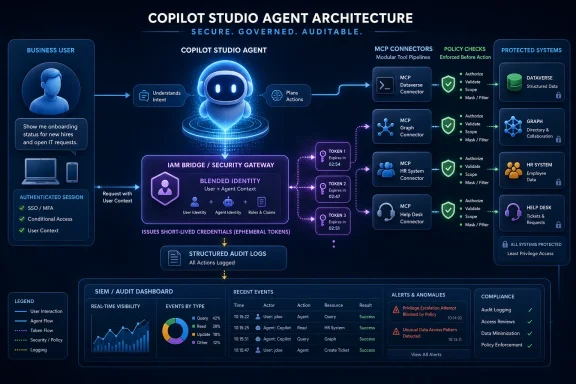
Aembit’s announcement is aimed precisely at that seam. The company says its platform sits between Copilot Studio agents and enterprise resources, combining the human user’s identity with the agent’s own identity to produce what it calls a blended identity. From there, policies decide whether the request should proceed, and Aembit issues short-lived credentials rather than handing agents durable secrets.
That sounds like plumbing because it is plumbing. But in enterprise IT, plumbing is often where the real architecture lives.
Agentic AI scrambles that division. A Copilot Studio agent may act because Jane in finance asked it to reconcile an invoice exception, but the agent is not Jane. It may call a tool Jane has access to, transform the result, then call another system Jane rarely touches directly. It may also behave differently depending on prompt context, orchestration rules, connectors, and model output.
If everything is logged as Jane, investigators lose the distinction between human action and delegated machine action. If everything is logged as the agent, administrators lose per-user accountability. Neither model is good enough for regulated environments, and neither is especially comforting for incident response.
Aembit’s pitch is that enterprise agents need identities of their own, but those identities must remain bound to the human context that triggered the work. That is the right direction. The agent should not inherit unlimited user authority simply because it is convenient, and the user should not disappear behind a generic automation account simply because the workflow is machine-mediated.
The practical result is more granular policy. A company might allow a sales operations agent to read CRM data when used by the revenue team, deny the same agent access to payroll data, and require stronger conditions before it can invoke an external enrichment API. That is not exotic security theory. It is the everyday work of least privilege, dragged into a world where the caller may be an LLM-orchestrated process.
That is powerful, but it also concentrates risk. MCP servers are not just passive data feeds; they can expose functions that perform real work. Once an agent can decide when to call those functions, the MCP connection becomes a control plane for action.
Aembit’s integration matters because it treats that MCP layer as an enforcement point rather than a mere connector. The company’s approach is to validate the agent and user context, enforce policy on requests, exchange credentials at runtime, and leave the agent without persistent secrets. In security terms, that moves control closer to the moment of use.
That detail is important. Static credentials are already a liability in conventional automation, but agents make the problem sharper because their behavior is less deterministic than a script. If a workflow runs the same way every night, you can at least reason about its blast radius. If an agent decides which tool to call based on a changing prompt and available context, standing access becomes harder to justify.
The best version of this architecture makes agents consumers of access decisions, not holders of access power. They ask, they are evaluated, they receive narrowly scoped credentials, and they leave behind logs. That is a healthier pattern than putting an API key into an agent’s configuration and hoping governance catches up later.
But platform vendors tend to optimize for adoption first. Microsoft does include governance hooks through Power Platform environments, connectors, data policies, identity integration, and admin controls. Those controls matter. Still, the faster agent building spreads, the more likely organizations are to discover gaps between platform governance and security operations.
Aembit is not trying to replace Copilot Studio. It is trying to become the access broker for the systems Copilot Studio agents reach. That makes the company’s positioning complementary but also revealing. When a third-party IAM vendor sees opportunity, it usually means the native platform controls are not yet enough for some enterprise buyers.
This is not a Microsoft-specific criticism. The same pattern has played out with Kubernetes, CI/CD systems, cloud service accounts, and SaaS integrations. A platform democratizes creation; security teams then need inventory, policy, attestation, credential rotation, and auditability. The market for add-on controls grows in the space between “we can build it” and “we can govern it.”
In that sense, Aembit’s Copilot Studio support is a sign of maturity for the agent ecosystem. The conversation is moving from demos to operating models. The question is no longer whether an agent can retrieve a record or trigger a workflow. The question is whether an enterprise can prove, months later, why that access was allowed.
Still, the market context supports the premise. Enterprises are experimenting heavily with agents, and Microsoft is one of the main channels through which that experimentation will become ordinary office infrastructure. Copilot Studio lowers the barrier to connecting AI logic with business systems, and MCP lowers the barrier to exposing tools to AI clients.
Those two trends make identity a first-order concern. Security teams already know how messy non-human identities can become. Service accounts linger for years, API keys get copied into scripts, certificates expire at the worst possible moment, and no one wants to rotate a secret that might break a revenue workflow. Now add agents that can be created by more people, connected to more systems, and modified faster than traditional applications.
The uncomfortable truth is that many organizations will not start with a clean architecture. They will start with pilots, proofs of concept, departmental experiments, and “temporary” credentials. The history of enterprise IT suggests that temporary access has a suspicious habit of becoming production infrastructure.
Aembit is arguing that agent access should be designed correctly before that hardening work becomes archaeology. That argument is persuasive even if buyers still need to validate the specific implementation, integration depth, operational overhead, and logging fidelity in their own environments.
That is why identity boundaries matter so much. Microsoft Graph is an extraordinarily powerful substrate because it represents mail, files, calendars, chats, users, groups, devices, and organizational relationships. Dataverse can hold business-critical operational data. Power Automate can trigger actions across hundreds of services. An agent that can reason across those surfaces can be useful, but it can also become a new path for data exposure or unintended action.
Administrators should resist the temptation to treat Copilot Studio agents like fancy chatbots. The better mental model is closer to “semi-autonomous workload with user delegation.” That framing forces harder questions about ownership, permissions, testing, rollback, logging, and lifecycle management.
A finance agent, for example, should have a different access posture from an IT help desk agent. A pilot agent should not have the same reach as a production agent. An agent used by executives may require tighter audit and egress controls than one used to summarize public policy documents. These distinctions are mundane, but they are exactly what separates manageable automation from a future incident report.
Aembit’s blended-identity model fits neatly into Microsoft-heavy environments because those environments already have rich human identity context in Entra ID. The missing piece is often not knowing who the user is. It is knowing how to bind that user to a non-human actor and then enforce policy when that actor reaches beyond the chat window.
Aembit says its access decisions are logged with enough context for compliance review and incident investigation. If implemented well, that could become the most important part of the Copilot Studio integration. Logs that show only a user or only a service account are inadequate in agentic workflows. Investigators need to see the user, the agent, the target system, the policy decision, the credential exchange, and the timing.
That visibility also matters before incidents. Access reviews become more meaningful when administrators can see which agents are actually touching which systems. Policy tuning becomes less speculative when teams can observe denied and allowed requests. Compliance teams get a better story than “the AI used the connector.”
The catch is that logs are only useful if they land where security teams already work. Aembit says its structured audit logs can integrate with SIEM tooling, which is the right answer in principle. Enterprises should test the shape and completeness of those logs before relying on them for governance.
There is also a cultural point here. Agent projects are often pitched in productivity language, while security reviews are framed as friction. A strong audit layer can reduce that tension. It lets organizations move faster without pretending that trust is the same thing as visibility.
Agentic systems need runtime policy because the relevant context changes. The user matters. The agent matters. The requested resource matters. The environment, location, time, risk posture, and task may matter. A static entitlement granted weeks earlier cannot capture all of that.
Aembit’s short-lived credential model is therefore more than a security nicety. It changes the access lifecycle. Instead of giving an agent a durable secret and then trying to manage the consequences, the system can mint narrowly scoped credentials when policy allows and let them expire after use.
That aligns with the broader direction of workload identity, where secretless authentication and just-in-time access are replacing long-lived keys. The agentic twist is that the workload may be acting under human instruction, with a reasoning layer in the middle. That makes policy design harder, but it also makes durable credentials less defensible.
Enterprises should expect this model to become table stakes. Whether the vendor is Aembit, Microsoft, a cloud provider, or another identity platform, agents that touch sensitive systems will need verifiable identity, contextual policy, ephemeral access, and centralized logs. Anything less will look increasingly reckless as deployments scale.
Microsoft has the advantage of owning much of the enterprise substrate. It can integrate Copilot Studio with Entra, Purview, Defender, Power Platform governance, and Graph permissions in ways third parties cannot fully replicate. Over time, Microsoft will almost certainly deepen native agent governance.
But third-party vendors can move faster across heterogeneous environments. That matters because few enterprises are pure Microsoft shops. A Copilot Studio agent may touch Salesforce, ServiceNow, Snowflake, Workday, an internal API, a SaaS MCP server, and an Azure-hosted function. Native Microsoft controls may govern part of that path, but not necessarily all of it.
That is where Aembit’s broader workload IAM story becomes relevant. The company has positioned itself around non-human identities across clouds, SaaS, on-prem systems, and AI agents. If customers want one enforcement model across Microsoft and non-Microsoft resources, the independent broker argument becomes stronger.
The likely future is not a single winner. It is layered control. Microsoft will govern the platform; identity brokers will govern cross-platform access; security tools will monitor behavior; and enterprises will still need disciplined architecture. The organizations that pretend one admin console will solve everything are the ones most likely to be surprised.
Lifecycle management will make or break this category. Agent identity cannot be a one-time registration step that everyone forgets after launch. It must survive versioning, promotion from test to production, decommissioning, incident response, and emergency disablement.
Aembit’s claim that access can be centrally managed and revoked is encouraging, but customers should ask detailed questions. Can policies distinguish development and production agents reliably? How are agent identities attested? How quickly does revocation take effect? What happens if the identity gateway is unavailable? How are break-glass scenarios handled? Which logs are retained, and for how long?
Those are not objections to the product. They are the questions any serious buyer should ask before putting an access broker in front of critical systems. Security architecture is not purchased; it is operated.
There is also a human factor. Copilot Studio empowers people outside central engineering to build useful automations. Security teams that respond with blanket restrictions will drive work underground. Security teams that provide a paved road with identity, policy, and audit can shape adoption without becoming the department of no.
That middle layer is where many early deployments will be weakest. It is easy to document who owns an agent. It is easy to list which systems it connects to. It is harder to prove that every request was authorized in context and executed with the minimum necessary access.
This is why the announcement deserves attention beyond Aembit customers. It reflects a broader architectural shift. Agents are turning identity from a login problem into a continuous authorization problem. Access is no longer a static property assigned before work begins; it is a decision made repeatedly as the agent acts.
For Microsoft-focused organizations, the immediate lesson is to review Copilot Studio plans through the lens of non-human identity. Do not wait until agents are already embedded in workflows to decide how they should authenticate, what secrets they may hold, how they should be logged, and who can shut them off.
 Microsoft Made Agent Building Boring, Which Is Exactly Why Security Gets Interesting
The quiet revolution in Copilot Studio is that it makes agent creation feel like another business workflow tool. A department can wire an agent into Dataverse, Microsoft Graph, a help desk platform, an HR system, or a custom API without waiting for a traditional software delivery cycle. That is Microsoft’s enterprise superpower: it takes a developer pattern, packages it in familiar admin surfaces, and lets it spread through the Microsoft 365 and Power Platform estate.That same strength creates a governance problem. When agents graduate from answering questions to taking actions, access control stops being a sidebar. The relevant question is no longer “can this user access the data?” but “can this user, through this agent, at this moment, for this task, reach this system?”
Aembit’s announcement is aimed precisely at that seam. The company says its platform sits between Copilot Studio agents and enterprise resources, combining the human user’s identity with the agent’s own identity to produce what it calls a blended identity. From there, policies decide whether the request should proceed, and Aembit issues short-lived credentials rather than handing agents durable secrets.
That sounds like plumbing because it is plumbing. But in enterprise IT, plumbing is often where the real architecture lives.
The Agent Is Not the User, and Pretending Otherwise Will Break Audits
For decades, identity systems have been built around two mostly separate categories. Humans get accounts, MFA prompts, conditional access, role assignments, and access reviews. Workloads get service principals, API keys, managed identities, certificates, and secrets vault entries.Agentic AI scrambles that division. A Copilot Studio agent may act because Jane in finance asked it to reconcile an invoice exception, but the agent is not Jane. It may call a tool Jane has access to, transform the result, then call another system Jane rarely touches directly. It may also behave differently depending on prompt context, orchestration rules, connectors, and model output.
If everything is logged as Jane, investigators lose the distinction between human action and delegated machine action. If everything is logged as the agent, administrators lose per-user accountability. Neither model is good enough for regulated environments, and neither is especially comforting for incident response.
Aembit’s pitch is that enterprise agents need identities of their own, but those identities must remain bound to the human context that triggered the work. That is the right direction. The agent should not inherit unlimited user authority simply because it is convenient, and the user should not disappear behind a generic automation account simply because the workflow is machine-mediated.
The practical result is more granular policy. A company might allow a sales operations agent to read CRM data when used by the revenue team, deny the same agent access to payroll data, and require stronger conditions before it can invoke an external enrichment API. That is not exotic security theory. It is the everyday work of least privilege, dragged into a world where the caller may be an LLM-orchestrated process.
MCP Turns Connectors Into a Security Boundary
Model Context Protocol, or MCP, is becoming the lingua franca for connecting AI systems to tools and data sources. In Copilot Studio, MCP support gives agents a path to use tools and resources published by MCP servers, including internal systems and external services. Microsoft’s documentation already frames MCP as a way to extend agents with tools, resources, and prompts, with authentication options such as API keys and OAuth 2.0.That is powerful, but it also concentrates risk. MCP servers are not just passive data feeds; they can expose functions that perform real work. Once an agent can decide when to call those functions, the MCP connection becomes a control plane for action.
Aembit’s integration matters because it treats that MCP layer as an enforcement point rather than a mere connector. The company’s approach is to validate the agent and user context, enforce policy on requests, exchange credentials at runtime, and leave the agent without persistent secrets. In security terms, that moves control closer to the moment of use.
That detail is important. Static credentials are already a liability in conventional automation, but agents make the problem sharper because their behavior is less deterministic than a script. If a workflow runs the same way every night, you can at least reason about its blast radius. If an agent decides which tool to call based on a changing prompt and available context, standing access becomes harder to justify.
The best version of this architecture makes agents consumers of access decisions, not holders of access power. They ask, they are evaluated, they receive narrowly scoped credentials, and they leave behind logs. That is a healthier pattern than putting an API key into an agent’s configuration and hoping governance catches up later.
Aembit Is Selling Control Where Microsoft Sells Velocity
Microsoft’s Copilot Studio strategy is clear: make agents an enterprise construction kit. It gives professional developers, Power Platform makers, and business technologists a common surface for building agents that can use organizational data and tools. That is why the product is strategically important to Microsoft’s broader AI push.But platform vendors tend to optimize for adoption first. Microsoft does include governance hooks through Power Platform environments, connectors, data policies, identity integration, and admin controls. Those controls matter. Still, the faster agent building spreads, the more likely organizations are to discover gaps between platform governance and security operations.
Aembit is not trying to replace Copilot Studio. It is trying to become the access broker for the systems Copilot Studio agents reach. That makes the company’s positioning complementary but also revealing. When a third-party IAM vendor sees opportunity, it usually means the native platform controls are not yet enough for some enterprise buyers.
This is not a Microsoft-specific criticism. The same pattern has played out with Kubernetes, CI/CD systems, cloud service accounts, and SaaS integrations. A platform democratizes creation; security teams then need inventory, policy, attestation, credential rotation, and auditability. The market for add-on controls grows in the space between “we can build it” and “we can govern it.”
In that sense, Aembit’s Copilot Studio support is a sign of maturity for the agent ecosystem. The conversation is moving from demos to operating models. The question is no longer whether an agent can retrieve a record or trigger a workflow. The question is whether an enterprise can prove, months later, why that access was allowed.
The Press Release Is Vendor Marketing, but the Problem Is Real
Aembit’s announcement arrived through a CyberNewswire-distributed press release, and readers should treat the usual vendor claims accordingly. The company says the integration is available now to Aembit customers and that it can provide secure agent authentication, least-privilege runtime access, and a complete audit trail for Copilot Studio agents. Those are product claims, not independent test results.Still, the market context supports the premise. Enterprises are experimenting heavily with agents, and Microsoft is one of the main channels through which that experimentation will become ordinary office infrastructure. Copilot Studio lowers the barrier to connecting AI logic with business systems, and MCP lowers the barrier to exposing tools to AI clients.
Those two trends make identity a first-order concern. Security teams already know how messy non-human identities can become. Service accounts linger for years, API keys get copied into scripts, certificates expire at the worst possible moment, and no one wants to rotate a secret that might break a revenue workflow. Now add agents that can be created by more people, connected to more systems, and modified faster than traditional applications.
The uncomfortable truth is that many organizations will not start with a clean architecture. They will start with pilots, proofs of concept, departmental experiments, and “temporary” credentials. The history of enterprise IT suggests that temporary access has a suspicious habit of becoming production infrastructure.
Aembit is arguing that agent access should be designed correctly before that hardening work becomes archaeology. That argument is persuasive even if buyers still need to validate the specific implementation, integration depth, operational overhead, and logging fidelity in their own environments.
Windows Shops Will Feel This Through Entra, Power Platform, and Graph
For WindowsForum.com readers, the Microsoft angle is not abstract. Many enterprise environments already live inside a stack of Microsoft 365, Entra ID, Power Platform, SharePoint, Teams, Exchange, Defender, Purview, and Azure services. Copilot Studio agents will not arrive as some separate AI island; they will appear in the middle of that estate.That is why identity boundaries matter so much. Microsoft Graph is an extraordinarily powerful substrate because it represents mail, files, calendars, chats, users, groups, devices, and organizational relationships. Dataverse can hold business-critical operational data. Power Automate can trigger actions across hundreds of services. An agent that can reason across those surfaces can be useful, but it can also become a new path for data exposure or unintended action.
Administrators should resist the temptation to treat Copilot Studio agents like fancy chatbots. The better mental model is closer to “semi-autonomous workload with user delegation.” That framing forces harder questions about ownership, permissions, testing, rollback, logging, and lifecycle management.
A finance agent, for example, should have a different access posture from an IT help desk agent. A pilot agent should not have the same reach as a production agent. An agent used by executives may require tighter audit and egress controls than one used to summarize public policy documents. These distinctions are mundane, but they are exactly what separates manageable automation from a future incident report.
Aembit’s blended-identity model fits neatly into Microsoft-heavy environments because those environments already have rich human identity context in Entra ID. The missing piece is often not knowing who the user is. It is knowing how to bind that user to a non-human actor and then enforce policy when that actor reaches beyond the chat window.
The Audit Trail May Be the Feature That Ages Best
Security products often sell prevention, but auditability is what survives first contact with reality. No access model will perfectly predict every useful or risky agent behavior. What enterprises need is the ability to reconstruct what happened when something goes wrong.Aembit says its access decisions are logged with enough context for compliance review and incident investigation. If implemented well, that could become the most important part of the Copilot Studio integration. Logs that show only a user or only a service account are inadequate in agentic workflows. Investigators need to see the user, the agent, the target system, the policy decision, the credential exchange, and the timing.
That visibility also matters before incidents. Access reviews become more meaningful when administrators can see which agents are actually touching which systems. Policy tuning becomes less speculative when teams can observe denied and allowed requests. Compliance teams get a better story than “the AI used the connector.”
The catch is that logs are only useful if they land where security teams already work. Aembit says its structured audit logs can integrate with SIEM tooling, which is the right answer in principle. Enterprises should test the shape and completeness of those logs before relying on them for governance.
There is also a cultural point here. Agent projects are often pitched in productivity language, while security reviews are framed as friction. A strong audit layer can reduce that tension. It lets organizations move faster without pretending that trust is the same thing as visibility.
Least Privilege Needs to Become Runtime, Not a Spreadsheet
Traditional access governance often collapses into periodic review. Someone exports permissions, managers attest to access, exceptions are filed, and the business moves on. That rhythm is already strained in cloud environments, and it is poorly suited to agents.Agentic systems need runtime policy because the relevant context changes. The user matters. The agent matters. The requested resource matters. The environment, location, time, risk posture, and task may matter. A static entitlement granted weeks earlier cannot capture all of that.
Aembit’s short-lived credential model is therefore more than a security nicety. It changes the access lifecycle. Instead of giving an agent a durable secret and then trying to manage the consequences, the system can mint narrowly scoped credentials when policy allows and let them expire after use.
That aligns with the broader direction of workload identity, where secretless authentication and just-in-time access are replacing long-lived keys. The agentic twist is that the workload may be acting under human instruction, with a reasoning layer in the middle. That makes policy design harder, but it also makes durable credentials less defensible.
Enterprises should expect this model to become table stakes. Whether the vendor is Aembit, Microsoft, a cloud provider, or another identity platform, agents that touch sensitive systems will need verifiable identity, contextual policy, ephemeral access, and centralized logs. Anything less will look increasingly reckless as deployments scale.
The Integration Is a Warning Shot for Native Platform Vendors
Aembit’s Copilot Studio support also sends a message to Microsoft and other platform owners. If third-party vendors can build businesses around agent identity gaps, customers will eventually ask why those gaps are not closed natively. That pressure is familiar: cloud providers absorbed features that once belonged to startups, and identity vendors expanded as customers demanded simpler control planes.Microsoft has the advantage of owning much of the enterprise substrate. It can integrate Copilot Studio with Entra, Purview, Defender, Power Platform governance, and Graph permissions in ways third parties cannot fully replicate. Over time, Microsoft will almost certainly deepen native agent governance.
But third-party vendors can move faster across heterogeneous environments. That matters because few enterprises are pure Microsoft shops. A Copilot Studio agent may touch Salesforce, ServiceNow, Snowflake, Workday, an internal API, a SaaS MCP server, and an Azure-hosted function. Native Microsoft controls may govern part of that path, but not necessarily all of it.
That is where Aembit’s broader workload IAM story becomes relevant. The company has positioned itself around non-human identities across clouds, SaaS, on-prem systems, and AI agents. If customers want one enforcement model across Microsoft and non-Microsoft resources, the independent broker argument becomes stronger.
The likely future is not a single winner. It is layered control. Microsoft will govern the platform; identity brokers will govern cross-platform access; security tools will monitor behavior; and enterprises will still need disciplined architecture. The organizations that pretend one admin console will solve everything are the ones most likely to be surprised.
The Real Test Comes After the Demo
A live demo at Identiverse can show the happy path: a Copilot Studio agent requests access, Aembit evaluates policy, credentials are issued, and logs appear. The enterprise test is messier. What happens when agents are cloned, renamed, moved between environments, or modified by different makers? What happens when a connector changes behavior, an MCP server publishes new tools, or a user’s role changes midstream?Lifecycle management will make or break this category. Agent identity cannot be a one-time registration step that everyone forgets after launch. It must survive versioning, promotion from test to production, decommissioning, incident response, and emergency disablement.
Aembit’s claim that access can be centrally managed and revoked is encouraging, but customers should ask detailed questions. Can policies distinguish development and production agents reliably? How are agent identities attested? How quickly does revocation take effect? What happens if the identity gateway is unavailable? How are break-glass scenarios handled? Which logs are retained, and for how long?
Those are not objections to the product. They are the questions any serious buyer should ask before putting an access broker in front of critical systems. Security architecture is not purchased; it is operated.
There is also a human factor. Copilot Studio empowers people outside central engineering to build useful automations. Security teams that respond with blanket restrictions will drive work underground. Security teams that provide a paved road with identity, policy, and audit can shape adoption without becoming the department of no.
The Copilot Studio Security Story Now Has a Missing Middle
Aembit’s announcement clarifies the missing middle in enterprise agent security. At one end, Microsoft provides the agent-building platform, identity tenant, connectors, and administrative framework. At the other end, business systems enforce their own permissions. Between them sits the agent’s moment of action, where intent, identity, policy, and credentials need to meet.That middle layer is where many early deployments will be weakest. It is easy to document who owns an agent. It is easy to list which systems it connects to. It is harder to prove that every request was authorized in context and executed with the minimum necessary access.
This is why the announcement deserves attention beyond Aembit customers. It reflects a broader architectural shift. Agents are turning identity from a login problem into a continuous authorization problem. Access is no longer a static property assigned before work begins; it is a decision made repeatedly as the agent acts.
For Microsoft-focused organizations, the immediate lesson is to review Copilot Studio plans through the lens of non-human identity. Do not wait until agents are already embedded in workflows to decide how they should authenticate, what secrets they may hold, how they should be logged, and who can shut them off.
The Checklist for Copilot Agents Is Becoming an Identity Checklist
The practical implications are concrete, and they cut across admins, developers, and security teams. Aembit’s integration is one vendor’s answer, but the underlying controls are quickly becoming the baseline for responsible agent deployment.- Copilot Studio agents that connect to MCP servers or enterprise systems should be treated as non-human identities, not merely as extensions of the user who invokes them.
- Static API keys and broadly scoped service accounts are a poor fit for agents that can choose tools dynamically and operate across sensitive workflows.
- Audit logs should show the human user, the agent identity, the target resource, the policy decision, and the credential event behind each meaningful access attempt.
- Microsoft-native governance will remain important, but heterogeneous environments may need an independent access layer that spans SaaS, cloud, and on-prem systems.
- The strongest agent security programs will focus on runtime authorization, short-lived credentials, and fast revocation rather than periodic permission reviews alone.
References
- Primary source: lincolnjournal.com
Published: 2026-06-17T08:50:08.919165
Loading…
www.lincolnjournal.com - Related coverage: news.backbox.org
Loading…
news.backbox.org - Related coverage: aembit.io
Loading…
aembit.io - Official source: news.microsoft.com
- Related coverage: analyticsinsight.net
Loading…
www.analyticsinsight.net - Official source: microsoft.com
Loading…
www.microsoft.com

- Related coverage: docs.aembit.io
Loading…
docs.aembit.io - Official source: adoption.microsoft.com
- Official source: cdn-dynmedia-1.microsoft.com
Loading…
cdn-dynmedia-1.microsoft.com - Related coverage: labs.cloudsecurityalliance.org
CSA research note M365 Copilot CVE 2026 24299 20260505 csa styled
PDF documentlabs.cloudsecurityalliance.org