

Microsoft’s industry blog and an IDC-sponsored white paper released in March 2026 argue that the convergence of cloud migration and agentic AI — AI systems that can reason, plan, and act across long-running workflows — is now the practical lever regulated industries must pull to reduce operational risk, accelerate innovation, and meet newer, continuous compliance demands. The paper highlights operational efficiency and AI-readiness as top drivers for cloud adoption, and Microsoft positions a set of agentic automation tools (Azure Copilot, GitHub Copilot enhancements, Azure Migrate, and the Azure Accelerate program) as the pragmatic path for health systems, financial institutions, and manufacturers to modernize at scale.
Cloud migration has moved beyond cost-cutting: today it is foundational infrastructure for real-time analytics, AI-powered workflows, resilient operations, and continuous regulatory evidence collection. According to the study Microsoft cites, organizations name operational efficiency, AI preparation, performance-intensive applications, and governance/compliance as leading drivers for moving workloads to the cloud. Microsoft’s messaging — and the underlying IDC research it references — frames the next phase of modernization not as a one-time migration but as continuous, agentic modernization: automated discovery, dependency mapping, ing optimization driven by intelligent agents.
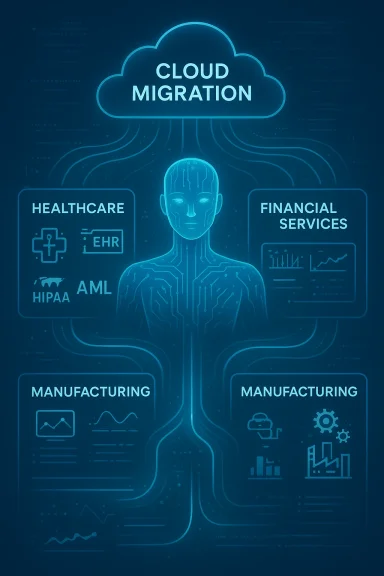
That repositioning is visible in three concrete industry narratives that Microsoft highlights: a health system migrating Epic to Azure to cut disaster-recovery risk and costs; a Mexican fintech re-architecting into serverless PaaS and microservices to achieve real-time responsiveness and product agility; and a manufacturer using Azure HPC, IoT, and analytics to collapse simulation and operations timeframes. Each demonstrates different modernization priorities — regulatory compliance and low-latency clinical demands in healthcare, continuous controls and model governance in finance, and OT/IT convergence plus extreme telemetry scale in manufacturing. The rest of this article examines those priorities, validates key claims, and offers a careful industry-minded analysis of benefits, trade-offs, and governance controls regulated organizations must adopt.
Cloud adoption in healthcare aims to solve four linked problems:
Independent corroboration (press releases and partner write-ups that participated in the migration) confirm the migration and similar outcome claims, though precise dollar figures and modeled downtime-avoidance calculations are company-reported projections and should be treated as enterprise-reported ROI. That said, the operational testing improvements (faster failover and better-tested DR runbooks) are verifiable outcomes organizations can audit in a migration engagement.
The net effect is that cloud platforms must enable:
ASTEC’s case illustrates two manufacturing realities: (1) not all modernization is about moving production OT into the cloud — some is about accelerating engineering and design with cloud HPC; and (2) the combined power of IoT ingestion, events platforms, and visual analytics unlocks new services and operational models for equipment vendors and operators.
But the promise comes with obligations. Regulated organizations must treat agentic systems as first‑class resources that require discovery, attestation, immutable logging, and human oversight. They must verify vendor claims with independent benchmarks and design hybrid architectures that preserve OT safety, data sovereignty, and regulatory evidence trails. As academic and industry voices converge on agent governance, the firms that pair technical modernization with rigorous operational governance and procurement discipline will be the ones that realize the advantages of cloud and agentic AI without increasing enterprise risk.
For CIOs, CISOs, and compliance leaders, the practical next steps are clear: map your workloads, define measurable KPIs, pilot agentic automation in low-risk contexts, and codify governance policies before you scale. The modernization race is not a sprint but a program of continuous, auditable, and governed improvements — and agentic AI is the toolset to accelerate that program when paired with the discipline regulated industries demand.
Source: Microsoft Modernizing regulated industries with cloud and agentic AI - Microsoft Industry Blogs
 Background / Overview
Cloud migration has moved beyond cost-cutting: today it is foundational infrastructure for real-time analytics, AI-powered workflows, resilient operations, and continuous regulatory evidence collection. According to the study Microsoft cites, organizations name operational efficiency, AI preparation, performance-intensive applications, and governance/compliance as leading drivers for moving workloads to the cloud. Microsoft’s messaging — and the underlying IDC research it references — frames the next phase of modernization not as a one-time migration but as continuous, agentic modernization: automated discovery, dependency mapping, ing optimization driven by intelligent agents.That repositioning is visible in three concrete industry narratives that Microsoft highlights: a health system migrating Epic to Azure to cut disaster-recovery risk and costs; a Mexican fintech re-architecting into serverless PaaS and microservices to achieve real-time responsiveness and product agility; and a manufacturer using Azure HPC, IoT, and analytics to collapse simulation and operations timeframes. Each demonstrates different modernization priorities — regulatory compliance and low-latency clinical demands in healthcare, continuous controls and model governance in finance, and OT/IT convergence plus extreme telemetry scale in manufacturing. The rest of this article examines those priorities, validates key claims, and offers a careful industry-minded analysis of benefits, trade-offs, and governance controls regulated organizations must adopt.
Healthcare: modernizing securely while powering next‑generation clinical experiences
The challenge at a glance
Healthcare modernization sits at the intersection of heavy regulation (HIPAA/HITECH, HITRUST), highly fragmented clinical data (EHRs, PACS, genomics), and mission-critical uptime requirements. Clinical workloads often require ultra-low latency, deterministic reliability, and strict audit trails — while facing unusually high ransomware exposure and constrained capital budgets for on-premises refreshes.Cloud adoption in healthcare aims to solve four linked problems:
- Secure, standards-based integration across EHRs, PACS, genomics pipelines, and device telemetry.
- Elastic compute for high-throughput imaging and genomics processing.
- Faster, more deterministic disaster recovery and failover behavior.
- Ambient clinical documentation and AI-supported diagnostics that reduce clinician burden.
Customer example: Franciscan Health — measurable outcomes and real-world constraints
Franciscan Health’s migration of a mission-critical Epic EHR environment to Azure is frequently cited by Microsoft as a leading example. Microsoft’s customer story documents a projected $45 million in five‑year savings, a reduction in disaster‑recovery RTO from hours to roughly a 30‑minute failover window, and materially lower downtime risk exposure — benefits achieved by a pragmatic workload-placement strategy and deep collaboration between clinical, vendor, and cloud support teams. These are significant operational outcomes that map directly to lower CapEx, improved resiliency, and faster recovery tests.Independent corroboration (press releases and partner write-ups that participated in the migration) confirm the migration and similar outcome claims, though precise dollar figures and modeled downtime-avoidance calculations are company-reported projections and should be treated as enterprise-reported ROI. That said, the operational testing improvements (faster failover and better-tested DR runbooks) are verifiable outcomes organizations can audit in a migration engagement.
What healthcare IT teams should focus on
- Data residency and encryption: ensure encryption-at-rest and in-flight along with key management policies that meet institutional and local regulatory law.
- Performance contracts for edge/clinical latency: adopt hybrid edge topologies for imaging and bedside device telemetry; measure latency under realistic clinical loads.
- Model risk governance for clinical AI: validate clinical-grade AI models with human-in-the-loop oversight, explainability, and documented validation protocols.
- Continuous DR testing: employ automated failover drills and reproducible runbooks to reduce RTO from hours to operationally acceptable minutes.
Financial services: real‑time intelligence, continuous compliance, and model governance
The reality of regulatory pressure
Financial institutions operate under layered regulatory regimes: PCI DSS, SOX, GLBA, AML/KYC frameworks, and national supervisory bodies. Newer regulatory frameworks — notably the EU’s DORA and the EU AI Act — add requirements for continuous operational resilience, third‑party risk oversight, explainability for high‑risk AI, and stronger incident reporting obligations. These developments force finance IT teams to treat modernization as risk management, not merely efficiency work.The net effect is that cloud platforms must enable:
- Continuous observability and policy-driven evidence collection (not point-in-time audits).
- Model lineage, explainability, and human oversight metadata for AI-driven decisioning.
- Elastic scale to absorb transaction spikes while preserving latency SLAs.
- Strong vendor governance and contractual controls around third-party cloud and model providers.
Customer example: Crediclub — hybrid PaaS and latency-first modernization
Crediclub’s migration narrative shows a fintech treating modern cloud architecture as a compliance- and performance-first strategy. In Microsoft’s customer materials, Crediclub reports migrating 95% of infrastructure to Azure, achieving a 90% latency reduction (from ~300 ms to ~20 ms), doubling throughput capacity, and saving up to $20–30k per month on operating costs. Those changes enabled faster customer onboarding, near‑real‑time processing, and a more responsive product development cadence using Kubernetes and DevSecOps practices. Independent press coverage and Crediclub’s communications corroborate the broad shape of this modernization and the performance improvements; numbers reflect the company’s reported metrics after migration.Key takeaways for banks and fintechs
- Shift from batch to real-time: shorten compliance evidence windows, and instrument pipelines so controls are continuously enforced and auditable.
- Model governance as first-class engineering: treat fraud and credit models as regulated artifacts with versioning, lineage, and explainability baked into deployment pipelines.
- Architect for sovereign and regional requirements: implement regionally isolated tenancy and contractual measures that satisfy local regulators (data residency, cross-border controls).
- Hybrid modernization is pragmatic: mainframes and COBOL-run batch processes often remain in place; target replatforming and encapsulation strategies rather than all-or-nothing rehost efforts.
Manufacturing: unifying OT and IT for predictive, data‑driven industrial operations
Why manufacturing modernization is different
Manufacturers wrestle with legacy operational technology (OT) systems — proprietary PLCs, MEC-installed MES and SCADA stacks, and historically air-gapped networks. The barrier to modernization is dual: strict latency and safety requirements for control loops, and massive ingestion of time-series telemetry that demands robust edge-to-cloud pipelines. Successful modernization must preserve safety integrity while enabling data-driven predictive maintenance, digital twins, and quality inspection using computer vision.Customer example: ASTEC Industries — HPC, simulation, and engineering velocity
ASTEC Industries, an equipment manufacturer for the “rock-to-road” value chain, migrated engineering simulation workloads to Azure using Ansys Access on Azure. The result: simulations that previously took days are now 8–9x faster, enabling richer design exploration and faster iteration cycles. That acceleration in engineering directly shortens product development cycles and reduces time-to-market risk for capital equipment — a different but highly valuable form of modernization ROI.ASTEC’s case illustrates two manufacturing realities: (1) not all modernization is about moving production OT into the cloud — some is about accelerating engineering and design with cloud HPC; and (2) the combined power of IoT ingestion, events platforms, and visual analytics unlocks new services and operational models for equipment vendors and operators.
Operational priorities for manufacturers
- OT-safe hybrid architectures: preserve deterministic control loops on-premises while streaming telemetry for analytics and ML at the edge.
- Time-series and event-first architectures: standardize telemetry ingestion (Event Hubs, IoT Hub, Stream Analytics) and consolidate data into managed time‑series stores for consistent analytics.
- Digital twins and simulation: use cloud HPC for design optimization and cloud-hosted digital twins to simulate plant behavior at scale.
- Intellectual property and supply chain protection: encrypt and silo design assets while ensuring secure connectivity for remote diagnostics.
Microsoft’s proposition: continuous, intelligent, collaborative modernization
What Microsoft says it delivers
Microsoft’s playbook centers on three themes: continuous modernization, agentic orchestration, and partner-enabled delivery. The product and program pieces include:- Azure Migrate for discovery, dependency mapping and migration planning.
- Azure Copilot and GitHub Copilot as agentic surfaces to assist and automate code remediation, refactoring, and policy checks.
- Azure Accelerate (and related partner funding/credits) as a coordinated commercial program with guided deployment factories and skilling.
- Managed services and partner ecosystems for industry-specific lift-and-modernize projects.
Cross-checking claims
- Microsoft’s Azure customer success stories (Franciscan, ASTEC, Crediclub) provide primary, company-level case data that demonstrate measurable outcomes: cost avoidance, latency reductions, faster DR RTOs, and faster simulations. These customer reports are credible enterprise narratives but reflect vendor‑published metrics; independent press and partner write-ups corroborate the engagement existence and generalized outcomes.
- IDC’s role: Microsoft cites an IDC white paper and uses IDC forecasts to justify urgency. While IDC is a mainstream industry analyst, specific forecast numbers (for example, the Microsoft blog’s reference to a USD 1.9 trillion public cloud services market by 2029) should be treated cautiously unless the IDC public release is directly consulted; IDC’s published spending guides and other market forecasts have shown nearby but not identical estimates in recent releases. Where a precise forecasting figure matters to procurement or planning, verify the original IDC white paper or IDC spending guide directly.
Critical analysis — strengths, blind spots, and real risks
Strengths and practical upside
- Operational speed and cost flexibility: moving from fixed on-prem capacity to elastic cloud and PaaS models reduces CapEx and enables on-demand compute for spikes (imaging, genomics, peak trading windows).
- Real-time observability and continuous compliance: cloud-native telemetry and policy-driven pipelines make it far easier to collect and present continuous evidence for regulators and auditors.
- Agentic acceleration for repeatable tasks: agentic tools can automate dependency mapping, remediation suggestions, and even code refactoring at scale — reducing human error in repetitive migration steps and compressing timelines.
- Partnered delivery and skilling: funding programs (credits), Cloud Accelerate factories, and partner-managed migrations reduce the internal staffing and skills barrier for regulated enterprises.
Risks, limitations, and unanswered questions
- Vendor-provided ROI claims need independent verification: customer stories often present modeled or vendor-audited numbers (savings, downtime avoided). These outcomes are achievable—but organizations should require auditable migration logs, pre/post benchmarks, and independent validation rather than relying on headline figures alone.
- Agentic AI governance and sprawl: agentic agents acting with elevated privileges introduce governance, accountability, and auditability risks. Without strong policy languages, attestation, and runtime controls, agentic systems could execute unintended changes or make compliance-critical decisions without proper human oversight. Emerging academic work and standards discussions emphasize the need for an AI-native policy language and lifecycle governance for agents. Organizations must insist on agent discovery, role-based scoping, immutable auditable logs, and human-in-the-loop enforcement.
- Regulatory nuance and sovereign constraints: frameworks like DORA and the EU AI Act place continuous obligations on resilience, third‑party management, and model explainability. Cloud-native tooling helps, but legal contracts, SLAs, and data residency controls remain a negotiation between regulated firms and cloud providers. Don’t assume “cloud = compliant” — assume “cloud can enable compliance if you design controls end-to-end.”
- Data gravity, latency, and OT safety: not every workload should move to central public clouds. Real-time OT control loops often need local processing and deterministic behavior. A hybrid architecture — edge-first for safety-critical controls, cloud for analytics and orchestration — is the pragmatic pattern.
- Third-party dependencies and concentration risk: heavy dependence on a single hyperscaler for compute, AI models, and telemetry increases concentration risk and may attract regulatory attention (competition and digital markets scrutiny). Organizations must develop exit/readiness plans, multi-cloud interoperability patterns where appropriate, and strong contractual protections.
Practical checklist for regulated organizations planning agentic-modernization
- Start with discovery and realistic benchmarking.
- Map applications, data flows, and latency constraints.
- Run controlled DR failover tests and record baseline RTO/RPO.
- Segment by risk and criticality.
- Keep safety-critical OT work local or edge-hybrid.
- Move analytics, HPC, and non-deterministic workloads to cloud first.
- Architect for continuous compliance.
- Instrument pipelines for automated evidence collection, immutable logs, and role-based access controls.
- Implement model lineage, versioning, and explainability metadata for every AI/ML artifact.
- Govern agentic agents explicitly.
- Require discovery, attestation, scoping, and runtime policies for agents.
- Log every agent action and keep a human-in-the-loop for high-risk decisions.
- Use partner accelerators and funding intentionally.
- Apply credits and partner factory models to lower lift risk and shore up skills gaps, but maintain vendor-neutral auditability.
- Validate vendor claims.
- Require pre/post migration KPIs, third-party attestations, and contractual SLAs covering resilience and data protections.
- Plan for sovereignty and exit.
- Define data residency, contractual controls, and an exit/repatriation plan as part of procurement.
Governance and regulatory readiness for agentic modernization
Agentic AI adds a new dimension to traditional governance: agents may act autonomously across multiple systems, execute remediation steps, or deploy updates. For regulated industries, controls must include:- Agent registry and attestation: discover and register every agent, track their permitted capabilities, and require cryptographic attestation before granting production access.
- Policy language and runtime enforcement: deploy AI-native policy frameworks that bind context (data source, operation time, jurisdiction) to agent permissions.
- Explainability and decision logging: capture structured decision provenance for every automated action, including the data inputs, model versions, and human approvals.
- Continuous monitoring and red-team testing: run periodic adversarial and safety tests to detect drift, misconfiguration, and potential exploitation pathways.
- Third-party risk underwriting: treat model providers and managed service partners as regulated third parties with continuous oversight, contractual audit rights, and incident escalation procedures.
Where agentic modernization delivers most (and where it does not)
Agentic modernization is most effective when:- Workloads are well-mapped and repeated (bulk refactoring, library updates, dependency remediation).
- Organizations need continuous, evidence-based compliance rather than episodic audits.
- Teams accept a hybrid approach: edge for critical control loops; cloud for elasticity, analytics and model training.
- Agents are given unbounded privileges across production systems without clear audit trails.
- Organizations skip pre-migration benchmarking or independent validation of claimed savings and resilience improvements.
- Legal/regulatory constraints data or decisioning artifacts remain under explicit human control and cannot be delegated to automated agents.
Conclusion — a pragmatic, risk-aware modernization playbook
The intersection of cloud and agentic AI represents a step change for regulated industries: it enables continuous modernization, near real-time compliance evidence, and dramatic operational flexibility. Customer stories from healthcare (Franciscan), finance (Crediclub), and manufacturing (ASTEC) illustrate practical outcomes — faster DR, lower latency, accelerated HPC-driven engineering — that are now within reach for organizations that adopt careful, staged modernization strategies.But the promise comes with obligations. Regulated organizations must treat agentic systems as first‑class resources that require discovery, attestation, immutable logging, and human oversight. They must verify vendor claims with independent benchmarks and design hybrid architectures that preserve OT safety, data sovereignty, and regulatory evidence trails. As academic and industry voices converge on agent governance, the firms that pair technical modernization with rigorous operational governance and procurement discipline will be the ones that realize the advantages of cloud and agentic AI without increasing enterprise risk.
For CIOs, CISOs, and compliance leaders, the practical next steps are clear: map your workloads, define measurable KPIs, pilot agentic automation in low-risk contexts, and codify governance policies before you scale. The modernization race is not a sprint but a program of continuous, auditable, and governed improvements — and agentic AI is the toolset to accelerate that program when paired with the discipline regulated industries demand.
Source: Microsoft Modernizing regulated industries with cloud and agentic AI - Microsoft Industry Blogs