

Today’s shift in how enterprises think about AI is no longer hypothetical: Microsoft has launched a dedicated conversation series called The Shift — an evolution of “Leading the Shift” — that zeroes in on one of the fastest-moving fronts in enterprise AI today: agentic AI. The new podcast season, grounded in questions raised after Microsoft Ignite, spans eight weekly episodes and brings engineering, product, and strategy voices together to unpack practical realities: where agents pull data from, how they orchestrate across services like Microsoft Fabric and OneLake, whether context engineering replaces Retrieval‑Augmented Generation (RAG), and what it all means for security, governance, and the people who operate these systems.
Agentic AI — systems that can take multi-step actions, call tools, fetch and synthesize data, and make context-dependent decisions — is different from earlier waveforms of generative AI. Rather than producing a single response to a prompt, agents are designed to act, plan, and collaborate across systems. That shift changes the engineering problems enterprises must solve: data plumbing and quality, runtime orchestration, tool interfaces, observability, and governance suddenly leap from nice-to-haves to mission‑critical capabilities. Analysts and consulting firms have observed the same dynamic: early agentic projects expose new operational risks and require rethought security and governance playbooks.
Microsoft’s own posture reflects this systems view. The company positions agents as a layer that sits atop data and cloud foundations — performing best when data is unified, access is governed, and the cloud reliably scales execution across services such as Microsoft Foundry and Microsoft Fabric. The early episodes of The Shift underscore that agents don’t live in isolation; they are excused only when the underlying stack is engineered to support them.
Why this matters: as agents take on more autonomic tasks, the enterprise risk surface changes. The trade-offs are clear — faster automation and higher productivity on one hand, increased attack surface, compliance complexity, and potential for cascade failures on the other. The Shift’s emphasis on cross-team dialogue — engineering, product, strategy — reflects an important truth: successful agent deployments are inherently multidisciplinary.
Practical implication: Foundry’s managed path lowers operational friction for teams that want to avoid building agent orchestration and lifecycle tooling from scratch. But managed convenience doesn’t remove the need for architecture-level decisions around data access, tooling constraints, and fail-safe design patterns.
Practical implication: for organizations that already use Fabric (or are considering it), OneLake aims to shorten the gap between data sources and agent knowledge. Yet OneLake is not a magic bullet — operational characteristics like publishing latency, security controls, and table-level semantics still matter when agents rely on up-to-date facts.
For WindowsForum readers — architects, platform engineers, SREs, and IT leaders — the immediate priorities are practical and action-oriented:
Conclusion
Agentic AI changes the calculus of enterprise engineering. Platforms like Microsoft Foundry and Fabric aim to close the gap between prototype and production by pairing runtime orchestration with unified data platforms like OneLake, and practical tooling options — including Postgres with pgvector — provide accessible entry points for organizations. Yet the core risks remain organizational and engineering problems: retrieval quality, context engineering, observability, and governance. Microsoft’s The Shift podcast is less about product marketing and more about opening a pragmatic conversation where those trade-offs are examined aloud. For teams building the next generation of enterprise automation, the key is not whether to adopt agents — it’s how to assemble the people, processes, and plumbing so agents can act with reliability, safety, and measurable business impact.
Source: Microsoft Azure Unpacking your top questions on agentic AI: The Shift podcast | Microsoft Azure Blog
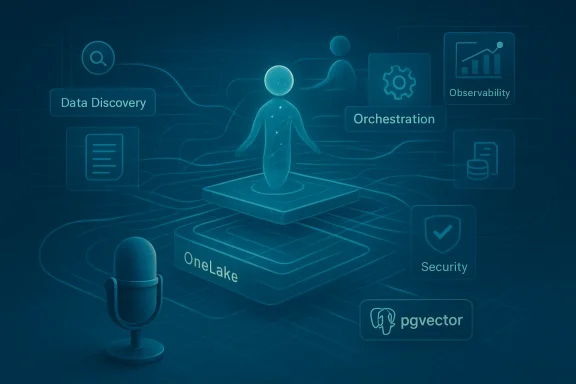 Background: why agentic AI has become the center of enterprise conversations
Agentic AI — systems that can take multi-step actions, call tools, fetch and synthesize data, and make context-dependent decisions — is different from earlier waveforms of generative AI. Rather than producing a single response to a prompt, agents are designed to act, plan, and collaborate across systems. That shift changes the engineering problems enterprises must solve: data plumbing and quality, runtime orchestration, tool interfaces, observability, and governance suddenly leap from nice-to-haves to mission‑critical capabilities. Analysts and consulting firms have observed the same dynamic: early agentic projects expose new operational risks and require rethought security and governance playbooks.Microsoft’s own posture reflects this systems view. The company positions agents as a layer that sits atop data and cloud foundations — performing best when data is unified, access is governed, and the cloud reliably scales execution across services such as Microsoft Foundry and Microsoft Fabric. The early episodes of The Shift underscore that agents don’t live in isolation; they are excused only when the underlying stack is engineered to support them.
Overview: what Microsoft is talking about in The Shift — themes and why they matter
The first season’s episode list reads like an enterprise architecture checklist for the agentic era: “Are my agents hunting for data?”, “How do agents work together?”, “Is context engineering the new RAG?”, “Should my IT team hire agents?”, and “How do we draw agentic borders?” Each question targets a different layer of the stack and a different operational challenge: discovery and knowledge preparation, inter-agent coordination and orchestration, context management and retrieval strategies, workforce and skill implications, and governance boundaries. Microsoft frames these discussions against product trends — notably Microsoft Foundry’s Agent Service and Microsoft Fabric’s OneLake — which aim to connect agents to data and to each other under enterprise controls.Why this matters: as agents take on more autonomic tasks, the enterprise risk surface changes. The trade-offs are clear — faster automation and higher productivity on one hand, increased attack surface, compliance complexity, and potential for cascade failures on the other. The Shift’s emphasis on cross-team dialogue — engineering, product, strategy — reflects an important truth: successful agent deployments are inherently multidisciplinary.
Microsoft’s stack: Foundry, Agent Service, Fabric, and OneLake — what’s new and what to watch
Microsoft Foundry and Foundry Agent Service
Microsoft has been explicit about offering a production-ready runtime for agents. The Foundry Agent Service is positioned as a managed platform for deploying agentic workloads with built-in governance, identity, and orchestration features that enterprises expect from the Microsoft Cloud. That includes tool integrations, observability hooks, and the ability to connect agents to enterprise services like Microsoft 365, Azure services, and Fabric knowledge tools. The intent is to make it straightforward to move agents from prototypes into guarded production environments.Practical implication: Foundry’s managed path lowers operational friction for teams that want to avoid building agent orchestration and lifecycle tooling from scratch. But managed convenience doesn’t remove the need for architecture-level decisions around data access, tooling constraints, and fail-safe design patterns.
Microsoft Fabric and OneLake — the data side of the equation
Microsoft Fabric’s OneLake is Microsoft’s answer to data unification for analytics and AI. OneLake is a tenant-level, unified data lake that surfaces a consistent catalog and storage layer across Fabric experiences — and Microsoft’s narrative pairs OneLake with agentic scenarios as the natural place to prepare and serve data for agents that need structured, governed knowledge. The key promise is a single plane for discovery, governance, and data preparation that agents can reason over.Practical implication: for organizations that already use Fabric (or are considering it), OneLake aims to shorten the gap between data sources and agent knowledge. Yet OneLake is not a magic bullet — operational characteristics like publishing latency, security controls, and table-level semantics still matter when agents rely on up-to-date facts.
Are my agents “hunting for data”? The data-prep imperative
Agents require curated, queryable knowledge — not raw dumps
The first episode’s title — “Are my agents hunting for data?” — captures a common enterprise surprise: agents will attempt to access anything available, and their reasoning quality is bounded by the quality, recency, and structure of the data they can retrieve. In practice, agents benefit from:- Cleaned and chunked documents that preserve context.
- Semantic indexes (embeddings) or knowledge graphs to speed retrieval.
- Provenance metadata so reasoning steps can be audited.
- Controlled update patterns to avoid exposing stale or intermediate states.
From data lakes to knowledge — what to prepare
There’s a short checklist teams should follow before widening agent access to data:- Inventory and classify the data sources agents may access.
- Define security policies and least-privilege access for agents.
- Build a retrieval layer — vector indexes, metadata tags, or a structured knowledge graph — tuned for the agent’s tasks.
- Add monitoring for retrieval quality and drift.
Context engineering vs. RAG: a practical reconciliation
What’s context engineering?
Context engineering is the practice of defining and organizing the contextual artifacts that are fed into models: system instructions, stateful conversation histories, retrieved facts, tool outputs, user preferences, and long-term memory. It is broader than prompt engineering and positions context as a first-class engineering concern. This discipline aims to make agent reasoning traceable and repeatable across environments.Is context engineering the new RAG?
Not exactly. Context engineering subsumes RAG workflows. RAG remains a dominant technique — agents retrieve relevant documents (or embeddings) and feed that content into model prompts. Context engineering, however, is a higher-level approach that addresses how retrieved items are selected, combined, and weighted alongside other contextual sources. In practical terms:- RAG is a retrieval mechanism that helps models access external knowledge on demand.
- Context engineering is the discipline that decides what retrieval looks like, how it’s represented, how it’s updated, and how retrieval outcomes are used by the agent.
Is Postgres the wave of the future for vector storage?
Postgres + pgvector: practical and pragmatic
The idea of using PostgreSQL as a vector store — via extensions like pgvector — has gained real traction. Cloud vendors, including Azure, support pgvector extensions for Azure Database for PostgreSQL and provide guidance for enabling and using vector similarity queries. The practical advantage is clear: many organizations already run relational databases and prefer adding vector capabilities instead of adopting a separate vector DB. This lowers operational overhead, preserves transactional guarantees, and simplifies data models when embeddings naturally live alongside relational records.When Postgres makes sense — and when it doesn’t
Postgres is an excellent option when:- Your scale requirements for vector search are moderate.
- You want tight integration between vectors and relational metadata.
- You prefer to standardize on a single, well-understood operational stack.
- You require ultra-low-latency, billion-vector searches at high QPS where specialized vector engines or FAISS-like backends outperform general-purpose DBs.
- You need advanced vector indexing features only available in purpose-built vector databases.
Agents working together: orchestration, protocols, and brittleness
Inter-agent coordination is an architectural pattern, not a product feature
When agents need to cooperate — for multi-step business workflows or cross-domain tasks — the system must answer several design questions: how do agents exchange intents and results, how are conflicts resolved, what guarantees exist for eventual consistency, and how do we trace cross-agent decisions? Microsoft and other platform vendors are building frameworks and abstractions (agent frameworks, tool APIs, MCP-like protocols) to standardize these interactions, but the core challenge remains architectural. Orchestration patterns must define retries, fallbacks, deadlines, and observability hooks.Observability: the single most underinvested discipline
Industry reports show a recurring theme: observability is the bottleneck for moving agent projects beyond pilot stages. Without robust telemetry, organizations cannot answer whether an agent acted correctly, why it accessed a dataset, or how its decision impacted downstream systems. Teams that treat observability as a first-class requirement — instrumenting retrieval quality, tool calls, action traces, and human overrides — learn faster and mitigate production risk.Security, governance, and “agentic borders” — drawing the lines
The new attack surface
Agentic AI introduces new classes of security concerns: agents that can reach external tools and systems, automations that can execute actions (including data exfiltration risks), and emergent behavior from multi-agent interactions. Security leaders warn that the pace of agent adoption is outstripping control frameworks and that organizations should expect growing risks if governance is insufficient.Governance primitives enterprises need now
To manage risk, enterprise teams should design an agent governance framework that includes:- Cataloging every agentic application and its data dependencies.
- Defining criticality tiers and acceptable risk profiles per agent.
- Centralized policy enforcement for identity, access, and tool permissions.
- Audit trails for every retrieval, tool use, and action.
- Human-in-the-loop gates for actions with irreversible consequences.
- Change management and incident playbooks specific to agentic failures.
Should IT teams “hire agents”? The organizational question
Short answer: yes — but with caution and new roles
Agentic systems can automate repetitive ops tasks, perform continuous reasoning over logs and metrics, and act as copilots for developers and analysts. Many teams will find tactical productivity gains early. But success depends on reorganizing how work is defined:- IT teams should develop “agent operators” or “agent engineers” who manage the lifecycle and safety of deployed agents.
- Data engineers must collaborate closely with agent engineers to ensure retrieval quality and provenance.
- Security teams need playbooks for agent access and containment.
Training and skill shifts
Operationalizing agents requires skills that span ML ops, software engineering, and security engineering. Teams should expect to upskill for:- Context and prompt engineering practices.
- Instrumentation for tracing agent actions.
- Designing and operating retrieval systems and vector indexes.
- Applying enterprise security controls to programmatic agents.
Practical playbook: 10 steps to make agentic AI enterprise-ready
- Catalog and classify: List all proposed agentic use cases and their data dependencies. Prioritize by business impact and sensitivity.
- Secure least-privilege access: Use identity-first controls and scoped credentials for every agent. Log every access.
- Build retrieval pipelines: Decide where embeddings live (Postgres + pgvector, vector DB, or a hybrid) and instrument retrieval metrics.
- Invest in context engineering: Standardize how context is assembled and version those artifacts.
- Use managed runtimes cautiously: Platforms like Foundry Agent Service speed deployment but require explicit policy integration.
- Instrument observability: Capture action traces, retrieval quality, tool calls, and human overrides.
- Define SLOs for agent behavior: Timeouts, retry counts, and failure semantics should be codified.
- Human-in-the-loop policies: Gate destructive or high-value actions behind operator approval flows.
- Test for adversarial scenarios: Conduct red-team exercises on agent workflows to expose abuse modes.
- Operate as a portfolio: Track lifecycle, cost, and risk across agent deployments like any other software product.
What could go wrong — common failure modes and warning signs
- Retrieval drift: Agents begin acting on stale or inconsistent facts because source publishing or indexing is unreliable.
- Unbounded tool access: Agents obtain overly broad permissions and cause cascading actions across systems.
- Observability blind spots: Teams lack traces to explain agent decisions, prolonging incidents and increasing business risk.
- Governance gaps: No clear authority or policy for agent behaviors leads to conflicting or noncompliant actions.
- Talent mismatch: Teams treat agents as “set-and-forget” when they require active operations, tuning, and retraining.
The developer trade-offs: building vs. buying
Managed platforms (Foundry Agent Service, agent frameworks) offer speed and compliance scaffolding. Building bespoke orchestration and retrieval layers gives flexibility but increases cost and operational burden. The sensible middle path for many organizations is:- Prototype on open frameworks and local vector stores (Postgres + pgvector) to validate the model and retrieval strategy.
- Migrate high-value, high-risk agents to managed runtimes that embed policy and observability.
- Keep integration points portable (OpenAPI, MCP-like semantics) to avoid vendor lock-in for critical tooling.
Final analysis: why this conversation matters — and what WindowsForum readers should do next
Microsoft’s The Shift podcast surfaces an essential truth: agentic AI is not a new kind of widget you install and forget — it’s a new architectural paradigm that reshapes data, cloud, and operational practices. The episode topics Microsoft chose — data hunting, agent collaboration, context engineering, Postgres vectors, workforce decisions, and agent borders — are the exact battlegrounds where enterprise success or failure will be decided. These are not theoretical concerns; analysts and real-world deployments confirm the same patterns: observability and governance are recurring failure modes, while unified, governed data layers materially improve agent reliability.For WindowsForum readers — architects, platform engineers, SREs, and IT leaders — the immediate priorities are practical and action-oriented:
- Treat agentic projects as software products with lifecycles, SLOs, and product managers.
- Prioritize retrieval engineering and context design before granting agents broad access.
- Instrument everything — retrieval, actions, and tool calls — from day one.
- Adopt phased governance: secure the riskiest agents first and iterate.
- Validate your vector strategy: Postgres + pgvector is pragmatic for many teams; evaluate scale requirements early.
Conclusion
Agentic AI changes the calculus of enterprise engineering. Platforms like Microsoft Foundry and Fabric aim to close the gap between prototype and production by pairing runtime orchestration with unified data platforms like OneLake, and practical tooling options — including Postgres with pgvector — provide accessible entry points for organizations. Yet the core risks remain organizational and engineering problems: retrieval quality, context engineering, observability, and governance. Microsoft’s The Shift podcast is less about product marketing and more about opening a pragmatic conversation where those trade-offs are examined aloud. For teams building the next generation of enterprise automation, the key is not whether to adopt agents — it’s how to assemble the people, processes, and plumbing so agents can act with reliability, safety, and measurable business impact.
Source: Microsoft Azure Unpacking your top questions on agentic AI: The Shift podcast | Microsoft Azure Blog