

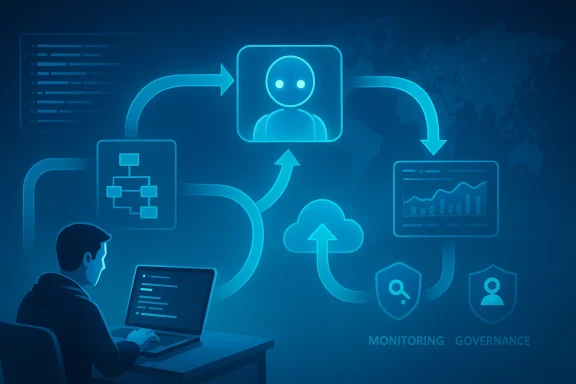
AI is no longer just helping startups write code faster; it is increasingly helping them carry work across the whole software lifecycle, from development to deployment to ongoing operations. Microsoft’s own startup messaging says the shift is moving from code generation to agentic workflows that understand intent, orchestrate tasks, and connect to the systems businesses already rely on (azure.microsoft.com)
For a long time, the startup advantage was simple: a small team could move fast because it had fewer layers, fewer meetings, and fewer handoffs. AI first amplified that advantage by making it easier to draft code, generate tests, and prototype ideas, and Microsoft has been explicit that GitHub Copilot and related tools now sit at the center of that acceleration story for startups (azure.microsoft.com)
But the new phase is more interesting. Microsoft’s latest framing is that developers are moving from writing code to orchestrating autonomous systems that understand and act on intent, with GitHub, Azure, and Microsoft Foundry positioned as the stack that supports that transition (azure.microsoft.com)
That matters because startup bottlenecks have changed. The hardest work is increasingly not the first draft of the app, but the durable execution around it: identity, security, permissions, telemetry, infrastructure, and the long-running coordination that keeps a product reliable once customers actually depend on it (learn.microsoft.com)
Microsoft’s own language reflects that shift. The company is now talking about AI systems that build, optimize, govern, and execute at scale, not merely tools that assist a developer in a coding editor
It also changed expectations. Once teams got used to AI-assisted coding, speed stopped feeling like a novelty and started feeling like table stakes. Microsoft’s own startup leadership has acknowledged this transition by stressing that AI is now the expected baseline, not an optional add-on (azure.microsoft.com)
The bigger implication is that code generation alone is no longer the headline. The real question is whether AI can help teams move from “I can build this” to “I can operate this reliably.” That is a much harder bar.
Microsoft’s recent materials hint at that problem by shifting the emphasis toward agentic workflows, observability, and enterprise controls. The company is clearly signaling that productivity gains only become durable when they are paired with structure, not just speed
Microsoft Foundry’s documentation explicitly emphasizes memory, observability, and centralized management for AI apps and agents, which suggests that persistent context is no longer a nice-to-have feature but a core requirement for serious deployment
That matters especially for startups because the early codebase often becomes the company’s institutional memory. If AI can help preserve that memory across sessions and systems, it reduces the chance that every growth phase forces the team to relearn its own product.
Microsoft’s article describes this movement clearly: as AI shifts beyond syntax, it starts helping with intent, and that is where repository awareness and long-lived context become strategically important (azure.microsoft.com)
In practical terms, this is where startups can either mature or stall. Teams that preserve context early can scale more gracefully. Teams that do not often end up paying for the same learning multiple times.
The product framing is telling. Copilot CLI supports interactive and programmatic modes, and it always asks for confirmation before reading, modifying, or executing files. That is a strong clue that Microsoft sees AI not as a passive assistant but as an operational tool that still needs guardrails (github.blog)
A founder or technical lead no longer needs every routine task to be a manual intervention. Instead, AI can help coordinate the routine while humans focus on judgment, product direction, and exceptions. That is a more scalable division of labor.
The broader strategic implication is clear. If AI can safely sit inside the control plane, it becomes much more than a coding helper. It becomes a layer that can move work across systems.
That is especially relevant to startups operating with real customer data or production infrastructure. It is not enough for AI to be powerful. It has to be constrained enough to avoid turning speed into risk.
In other words, execution is no longer just an engineering topic. It is an operating model question.
For startups, that matters because the biggest early mistake is often treating AI as a feature instead of a system. The feature is easy to demo. The system is what needs observability, role controls, and operational discipline.
That may feel heavy to an early-stage founder, but it is often cheaper to build those assumptions in early than to retrofit them later. The companies that scale best are usually the ones that do not treat security and governance as post-launch chores.
That is a major signal to founders. The AI stack is not just models and prompts. It is also a permissions architecture.
That tradeoff is not theoretical. Microsoft’s own guidance around Entra, Conditional Access, and identity governance shows that the vendor expects AI systems to operate inside existing enterprise trust frameworks, not outside them
This is where startups can learn from enterprise practice without becoming bureaucratic. Good governance does not have to slow teams down. It can keep them from moving fast in the wrong direction.
That means infrastructure decisions are now part of product strategy. If an AI-powered startup wants to serve users globally, the edge can become a competitive advantage rather than a back-office detail.
This is also why the company keeps describing AI agents as useful across the entire lifecycle, not just in one app. The broader the workflow coverage, the harder it is for competitors to displace the platform later (azure.microsoft.com)
That competition is healthy, but it also raises the bar. The winning platform will be the one that makes AI feel genuinely useful without making teams feel trapped.
That is why Microsoft’s emphasis on secure, governable AI is not just a sales pitch. It is a practical response to the realities of agentic software. Microsoft Foundry’s focus on tracing, monitoring, and role-based access control is especially relevant here
The more AI moves from suggesting work to doing work, the more those enterprise assumptions matter. For startups, the lesson is simple: build as if the product will be judged on reliability, not just novelty.
The most important question for founders is no longer whether AI can help them ship faster. It clearly can. The real question is whether they are building in a way that will still make sense when those AI systems are doing more of the supporting work behind the scenes.
Source: Microsoft From writing code to supporting work: How AI is reshaping startup teams
 Overview
For a long time, the startup advantage was simple: a small team could move fast because it had fewer layers, fewer meetings, and fewer handoffs. AI first amplified that advantage by making it easier to draft code, generate tests, and prototype ideas, and Microsoft has been explicit that GitHub Copilot and related tools now sit at the center of that acceleration story for startups (azure.microsoft.com)But the new phase is more interesting. Microsoft’s latest framing is that developers are moving from writing code to orchestrating autonomous systems that understand and act on intent, with GitHub, Azure, and Microsoft Foundry positioned as the stack that supports that transition (azure.microsoft.com)
That matters because startup bottlenecks have changed. The hardest work is increasingly not the first draft of the app, but the durable execution around it: identity, security, permissions, telemetry, infrastructure, and the long-running coordination that keeps a product reliable once customers actually depend on it (learn.microsoft.com)
Microsoft’s own language reflects that shift. The company is now talking about AI systems that build, optimize, govern, and execute at scale, not merely tools that assist a developer in a coding editor
From Code Completion to Capability Expansion
The first wave of AI productivity gains was easy to understand. Tools like GitHub Copilot reduced the time needed to write boilerplate, explore APIs, and produce a working first draft. Microsoft has repeatedly described Copilot as a way for startups to run leaner and ship faster, and that message has clearly resonated with founders who need more output from smaller teams (azure.microsoft.com)Why the first wave mattered
This first wave mattered because it changed the economics of early product work. A smaller engineering team could still produce meaningful software, which reduced the penalty for not having a large staff on day one. In startup terms, that meant more experiments per quarter and a lower cost of learning.It also changed expectations. Once teams got used to AI-assisted coding, speed stopped feeling like a novelty and started feeling like table stakes. Microsoft’s own startup leadership has acknowledged this transition by stressing that AI is now the expected baseline, not an optional add-on (azure.microsoft.com)
The bigger implication is that code generation alone is no longer the headline. The real question is whether AI can help teams move from “I can build this” to “I can operate this reliably.” That is a much harder bar.
The hidden ceiling of coding speed
Faster coding does not automatically solve architecture, governance, or maintenance. In fact, it can expose those weaknesses more quickly. If a team can create features faster than it can understand the system, the result is often faster accumulation of complexity.Microsoft’s recent materials hint at that problem by shifting the emphasis toward agentic workflows, observability, and enterprise controls. The company is clearly signaling that productivity gains only become durable when they are paired with structure, not just speed
- Faster coding improves early momentum.
- Faster coding can also accelerate technical debt.
- Startup teams need more than output; they need durable operating patterns.
- The next constraint is not syntax, but coordination.
- AI becomes more valuable when it reduces rework, not just typing.
When Context Became the Real Constraint
Once AI made code cheaper to produce, the bottleneck moved upstream. Teams began to struggle more with context: why a decision was made, how a subsystem was meant to behave, and what assumptions still held after several rounds of iteration. Microsoft’s current messaging treats context as a first-class problem, not an afterthought (azure.microsoft.com)Why understanding now matters more than output
This is the subtle shift that many startups underestimate. If code can be created quickly but knowledge is scattered across people, tools, and time, the organization can still slow down. Onboarding gets harder, refactors get riskier, and the same mistakes get repeated in slightly different forms.Microsoft Foundry’s documentation explicitly emphasizes memory, observability, and centralized management for AI apps and agents, which suggests that persistent context is no longer a nice-to-have feature but a core requirement for serious deployment
That matters especially for startups because the early codebase often becomes the company’s institutional memory. If AI can help preserve that memory across sessions and systems, it reduces the chance that every growth phase forces the team to relearn its own product.
Repositories, files, and decisions
The interesting part is not simply that AI can search code. It is that AI can be asked to understand the relationship between code, docs, tickets, and design intent. That creates a path toward less accidental complexity and fewer “why is this here?” moments during rapid growth.Microsoft’s article describes this movement clearly: as AI shifts beyond syntax, it starts helping with intent, and that is where repository awareness and long-lived context become strategically important (azure.microsoft.com)
In practical terms, this is where startups can either mature or stall. Teams that preserve context early can scale more gracefully. Teams that do not often end up paying for the same learning multiple times.
Execution Becomes the Bottleneck
If code is easier to create and systems are easier to understand, the hardest work shifts again: execution across the stack. That includes builds, deployments, credentials, infrastructure, monitoring, and the messy orchestration that keeps software running after the demo stage.Where the work actually happens
This is why Microsoft’s focus on the command line, cloud operations, and workflow integration is so important. The command line is not just a developer preference; it is a control surface where software is built, connected, tested, and operated. GitHub Copilot CLI is explicitly designed to bring natural-language interaction into that environment (github.blog)The product framing is telling. Copilot CLI supports interactive and programmatic modes, and it always asks for confirmation before reading, modifying, or executing files. That is a strong clue that Microsoft sees AI not as a passive assistant but as an operational tool that still needs guardrails (github.blog)
Why this changes startup math
For small teams, delegation is the big unlock. Work that used to require a human to walk through the same repetitive steps can now be supervised and corrected by AI instead of manually repeated. That saves time, but it also changes how people allocate attention.A founder or technical lead no longer needs every routine task to be a manual intervention. Instead, AI can help coordinate the routine while humans focus on judgment, product direction, and exceptions. That is a more scalable division of labor.
- Builds can be coordinated rather than hand-managed.
- Repetitive execution becomes cheaper.
- Humans can focus on judgment and review.
- The terminal becomes a workspace for ongoing tasks.
- Startup leverage increases when AI handles the background work.
The Command Line as an AI Control Plane
The most important design choice in Microsoft’s current startup story is that AI is moving closer to execution surfaces rather than staying in chat windows. That matters because the command line is where technical teams already live when they are dealing with real work, not just brainstorming.From advice to action
Microsoft and GitHub are effectively arguing that the terminal is the right place for AI to act because it is already connected to the systems that matter. That includes source control, build tooling, deployment scripts, and operational commands. Copilot CLI’s interaction model reinforces that point by keeping the user in the loop while still allowing AI to carry the mechanics forward (github.blog)The broader strategic implication is clear. If AI can safely sit inside the control plane, it becomes much more than a coding helper. It becomes a layer that can move work across systems.
Why autonomy needs limits
Autonomy sounds impressive, but in practice it only works if boundaries are visible. Microsoft’s CLI documentation is careful about trust, folder scope, and confirmation prompts, which reflects a deeper truth: the more capable the AI becomes, the more important policy and permissions become (github.blog)That is especially relevant to startups operating with real customer data or production infrastructure. It is not enough for AI to be powerful. It has to be constrained enough to avoid turning speed into risk.
In other words, execution is no longer just an engineering topic. It is an operating model question.
Microsoft Foundry and the Production Grade Turn
Microsoft Foundry is the clearest sign that the company wants startup teams to think beyond demos and toward production-grade AI systems. Microsoft describes Foundry as a unified platform for building, optimizing, and governing AI apps and agents at scale, and that “at scale” language is doing a lot of workWhat Foundry adds
Foundry is not just a model catalog. Microsoft’s documentation highlights orchestration, hosting, monitoring, evaluations, and centralized management of agents and tools. That points to a platform designed for durable business use, not casual experimentationFor startups, that matters because the biggest early mistake is often treating AI as a feature instead of a system. The feature is easy to demo. The system is what needs observability, role controls, and operational discipline.
Enterprise readiness starts early
Microsoft’s framing makes a strong case that startups should build with enterprise constraints from day one. That includes governance, identity, networking, policy, and logging. Microsoft Foundry’s own docs call out unified RBAC, networking, policy, tracing, and monitoring as part of the platform’s value propositionThat may feel heavy to an early-stage founder, but it is often cheaper to build those assumptions in early than to retrofit them later. The companies that scale best are usually the ones that do not treat security and governance as post-launch chores.
- Foundry is meant for production, not just experimentation.
- Agents need orchestration and observability.
- Governance is part of the platform story.
- Identity and policy should be designed in early.
- AI systems become more useful when they are measurable.
Identity, Security, and Governance Are No Longer Optional
The closer AI gets to execution, the more the surrounding control plane matters. Microsoft’s identity and governance materials make that explicit by tying productivity to access management, auditing, and control. Microsoft Entra ID Governance is described as a way to improve productivity while strengthening security and compliance, which is exactly the kind of balance startups will need as they matureWhy access control is now central
If agents can touch files, infrastructure, email, calendars, or business systems, then identity is no longer just about employees logging in. It becomes about what the agent can see, what it can do, and how those permissions are monitored over time. Microsoft has even extended Conditional Access concepts to agent identities, which shows how seriously it is treating this problemThat is a major signal to founders. The AI stack is not just models and prompts. It is also a permissions architecture.
The startup implication
A startup that ignores governance early may gain short-term speed but create long-term risk. The startup that builds identity, review, and access rules into its AI workflow may move a bit slower at first but will likely scale more safely.That tradeoff is not theoretical. Microsoft’s own guidance around Entra, Conditional Access, and identity governance shows that the vendor expects AI systems to operate inside existing enterprise trust frameworks, not outside them
This is where startups can learn from enterprise practice without becoming bureaucratic. Good governance does not have to slow teams down. It can keep them from moving fast in the wrong direction.
Azure Front Door and the Operational Edge
Microsoft’s startup article briefly points to Azure Front Door as an example of how scaling appears in unexpected layers of the system. That’s a useful reminder that growth pressure often shows up far from the product surface. Microsoft’s documentation describes Azure Front Door as a globally distributed service that improves performance, availability, scalability, and security for internet-facing applications (learn.microsoft.com)Why the edge matters for startups
Startups tend to obsess over features, but user experience is often shaped by infrastructure. Latency, availability, and edge delivery can make a product feel polished or fragile. Azure Front Door is positioned precisely around those concerns, with Microsoft emphasizing global edge locations and security capabilities such as WAF and DDoS protection (learn.microsoft.com)That means infrastructure decisions are now part of product strategy. If an AI-powered startup wants to serve users globally, the edge can become a competitive advantage rather than a back-office detail.
Execution at scale is not automatic
The broader point is that AI does not erase operational constraints; it redistributes them. A team may spend less time writing code and more time thinking about traffic patterns, throughput, and secure delivery. That is not a loss. It is a sign of maturity.- Global delivery affects product quality.
- Security becomes visible at the edge.
- Performance is part of the user promise.
- Infrastructure choices influence growth readiness.
- Scaling pressure appears earlier in AI-first startups.
The Competitive Stakes for Microsoft and Rivals
Microsoft is not just describing a technical shift; it is also defending a strategic position. By tying GitHub, Azure, Foundry, and Entra together, it is trying to make the startup stack feel integrated rather than fragmented. That is a powerful sales story for founders who want fewer vendors and more continuity (azure.microsoft.com)Why integration is a moat
A tightly integrated stack lowers friction across the company lifecycle. Developers can code in one environment, run infrastructure in another, govern access in a third, and still stay inside one strategic ecosystem. Microsoft is betting that startups will value that continuity as they grow.This is also why the company keeps describing AI agents as useful across the entire lifecycle, not just in one app. The broader the workflow coverage, the harder it is for competitors to displace the platform later (azure.microsoft.com)
What rivals are likely to emphasize
Competitors will likely respond with openness, flexibility, and lower dependence on a single vendor. That is a natural counter-message, especially for startups that worry about lock-in or want to mix multiple AI providers. Microsoft’s answer is that integration, security, and production-readiness are worth the tradeoff.That competition is healthy, but it also raises the bar. The winning platform will be the one that makes AI feel genuinely useful without making teams feel trapped.
Enterprise Versus Startup Reality
Microsoft’s message is aimed at startups, but the product shape clearly reflects enterprise DNA. That is not surprising. The company’s strongest selling point is that the same stack that helps a two-person team prototype today can, in theory, support a much larger organization tomorrowWhy startups should care about enterprise discipline
Startups sometimes view enterprise controls as something to worry about later. But AI changes that. If a startup uses agents to access customer data, cloud infrastructure, or internal systems, governance stops being optional almost immediately.That is why Microsoft’s emphasis on secure, governable AI is not just a sales pitch. It is a practical response to the realities of agentic software. Microsoft Foundry’s focus on tracing, monitoring, and role-based access control is especially relevant here
Why consumer-style AI is not enough
Consumer AI experiences are usually optimized for convenience. Startup and enterprise AI experiences must also optimize for accountability. That means logs, controls, policy checks, and clear ownership.The more AI moves from suggesting work to doing work, the more those enterprise assumptions matter. For startups, the lesson is simple: build as if the product will be judged on reliability, not just novelty.
Strengths and Opportunities
Microsoft’s approach is strongest when it connects speed, context, and execution inside a platform that already covers development, cloud, identity, and governance. That combination gives startups a way to move quickly without necessarily painting themselves into a corner later.- Faster prototyping through GitHub Copilot and related tools.
- Better context retention across code, docs, and systems.
- Operational AI that can carry work beyond the editor.
- Production readiness through Microsoft Foundry.
- Security and governance built into the stack early.
- Global delivery support through Azure infrastructure.
- Reduced context switching for developers and founders.
- A clearer path from startup experimentation to enterprise scale.
Risks and Concerns
The opportunity is real, but so are the downsides. The biggest danger is assuming that faster AI-assisted work automatically produces better software or a better business. In reality, speed can magnify weak decisions just as easily as strong ones.- Overtrust in summaries, generated code, or automated actions.
- Technical debt created faster than teams can understand it.
- Vendor dependence if too much logic lives in one ecosystem.
- Governance gaps if agents gain access too broadly.
- Hidden operational risk when execution is delegated without enough oversight.
- Uneven adoption across teams with different workflows.
- False confidence that AI can replace product judgment.
- A faster team is not always a stronger team.
Looking Ahead
The next phase of AI in startups will likely be judged less by how clever the demos are and more by how quietly useful the systems become in daily operations. If Microsoft’s current direction holds, the company will keep pushing from coding assistance toward delegated execution, with agents, identity, and governance becoming the real center of gravity (microsoft.com)The most important question for founders is no longer whether AI can help them ship faster. It clearly can. The real question is whether they are building in a way that will still make sense when those AI systems are doing more of the supporting work behind the scenes.
- Will AI stay a helper, or become part of the operating layer?
- How much context should agents retain across sessions?
- Which actions should always require human approval?
- Where should identity and access controls be enforced?
- How early should startups design for governance and observability?
Source: Microsoft From writing code to supporting work: How AI is reshaping startup teams
Last edited:
