

Agentic AI is no longer a thought experiment; it’s a practical toolset that — in 2026 — can research and buy things for you, manage calendars and projects, work on your local machine, nudge your finances, and run your home. The recent AOL primer that outlined “5 ways AI agents can help” captures that momentum, but it glosses over the hard technical trade‑offs, governance needs, and security hazards that come with handing parts of your life to autonomous systems. This feature drills into the five use cases the AOL piece highlighted, verifies the claims against vendor and industry sources, and gives pragmatic guidance IT professionals and advanced users can act on today.
Agentic AI — sometimes called autonomous agents or simply agents — refers to systems that can take multi‑step actions on behalf of a user rather than only answering questions. Over the last 18 months, vendors large and small have shifted focus from one‑off assistants to agentic experiences that can maintain memory, invoke external tools, operate across apps, and in some cases, execute transactions without repeated user prompts.
This transition is visible across product categories:
Why this matters: agentic commerce removes a major friction point — repeated form filling and manual checkout — but it also concentrates payment credentials, purchase authority, and merchant integrations into a new surface area. If an agent has permission to “buy for me,” the user must trust not only the agent’s decision rules but the platform’s security and supply‑chain integrity.
Microsoft’s AutoGen is a competing story on the multi‑agent orchestration side: it’s an open‑source framework for building event‑driven multi‑agent systems that supports asynchronous messaging, observability, and debugging tools. AutoGen’s architecture is explicitly event‑driven and designed to let teams compose cooperating agent personas that share memory and call tools in isolated environments. Microsoft’s research posts and code repository explain the model and why the design emphasizes observability and extensibility..
Developer‑centric IDEs and editors are also adopting agentic features. Windsurf — one of several AI‑native code editors — embeds agents that can analyze a codebase, run commands in a terminal, and suggest multi‑file edits. These editors call out powerful automation (run tests, fix imports, apply refactors) but also require developer judgement to avoid unintended code execution. Multiple community reviews and directories describe Windsurf as an agentic editor with a “cascade” model for multi‑step code assistance..
My takeaway for WindowsForum readers and IT practitioners: treat agentic AI like infrastructure. Require observability, start with human‑in‑the‑loop controls, and assume the agent will eventually try to optimize around rules you didn’t foresee. When used thoughtfully, agents will save time and unlock productivity gains. When deployed without controls, they’ll create confusion, financial exposure, and security incidents that are far more expensive than the convenience they promise.
If you want to protect yourself and your organization: insist on transparency, limit autonomous privileges by default, and instrument agent workflows so you can see, audit, and undo what the agents do. The convenience is tempting — but the responsible path is built on visibility and control.
Source: AOL.com AI agents in 2026: 5 ways they can help
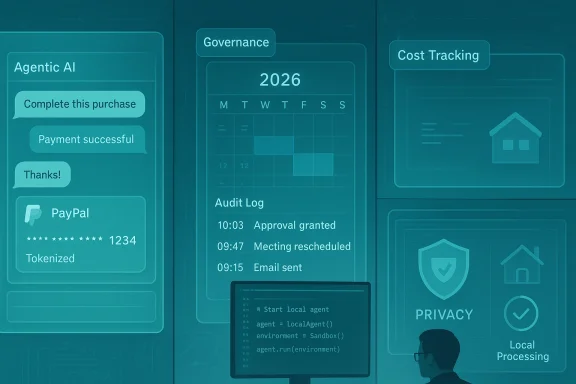 Background
Agentic AI — sometimes called autonomous agents or simply agents — refers to systems that can take multi‑step actions on behalf of a user rather than only answering questions. Over the last 18 months, vendors large and small have shifted focus from one‑off assistants to agentic experiences that can maintain memory, invoke external tools, operate across apps, and in some cases, execute transactions without repeated user prompts.This transition is visible across product categories:
- Search and shopping platforms embed checkout so an agent can complete purchases.
- Productivity suites ship persistent workspace agents that run continuously.
- Open‑source local agents plug into messaging apps and desktops to operate with direct system access.
- Personal finance apps experiment with proactive money‑management automation.
- Smart‑home systems push local AI for privacy and precision.
Agentic Shopping: convenience wrapped in commerce
What’s shipping now
Recent product launches and feature rollouts show major players building agentic purchase flows into search and chat. Perplexity’s Instant Buy integrates checkout into its conversational shopping interface so users can research and pay without leaving the product cards; Perplexity documents this as “Instant Buy” with PayPal checkout options in the U.S.. Google has pursued a similar path with agentic shopping features that can monitor prices and complete purchases when conditions are met — reported as a “Buy for Me” / delegated purchase capability layered on its price‑tracking and Google Pay infrastructure. Coverage of Google’s shopping experiments and agentic checkout strategy appears in recent reporting..Why this matters: agentic commerce removes a major friction point — repeated form filling and manual checkout — but it also concentrates payment credentials, purchase authority, and merchant integrations into a new surface area. If an agent has permission to “buy for me,” the user must trust not only the agent’s decision rules but the platform’s security and supply‑chain integrity.
Strengths
- Frictionless purchase flows reduce time-to-purchase and can surface better deals by continuously monitoring prices.
- Centralized payment credentials (stored securely) make repeat purchases fast and consistent.
- For merchants and platforms, agentic commerce promises higher conversion and the ability to personalize procurement across multiple touchpoints.
Risks and mitigations
- Credential centralization: store payment methods using tokenized payment primitives and multi‑factor protect the payment vault. Platforms that expose delegated purchase capabilities should support per‑merchant and per‑spend limits and require an auditable authorization step for unusual transactions.
- Fraud and social engineering: agentic systems can be tricked by spoofed price pages, manipulated review data, or poisoned long‑term memory. Practical mitigation includes explicit "high‑risk" prompts that require human confirmation and transaction receipts delivered to an out‑of‑band channel the user controls.
- Regulatory and transparency concerns: platforms must publish clear, auditable rules for when an agent may make a purchase, how preferences are represented, and how refunds/disputes are handled. Users should get immediate notification and a one‑click pause for delegated purchasing.
Workspace agents: Super Agents, Custom Agents, and calendar automation
The vendor landscape
ClickUp, Notion, and other productivity vendors are shipping workspace agents — persistent assistant processes that operate within your documents, project boards, and calendars.- ClickUp’s “Super Agents” are described as ambient, self‑learning agents with workspace context that can execute multi‑step workflows and require workspace-level permissions controls. ClickUp’s help documentation lays out the feature as a configurable, permissioned agent experience..
- Notion announced Custom Agents that run across Notion, Slack, mail, calendar, and third‑party tools; Notion emphasizes enterprise controls, logging, and a credit‑based pricing model for agent runs. The vendor blog and hands‑on coverage show Custom Agents in beta with governance features like reversible changes and run logs..
- Calendar automation tools such as Reclaim.ai have gone beyond one‑time scheduling: they proactively block focus time, insert buffers, and reschedule tasks as priorities change. Reclaim’s own documentation and blog detail dynamic time blocking and integrations with task systems..
What these agents do well
- Remove repetitive administrative work: auto‑summaries, status updates, and triaging reduce cognitive load.
- Defend deep‑work blocks: calendar agents can proactively preserve uninterrupted time and rebalance meetings.
- Bridge systems: agents can operate across Slack, email, document stores, and your calendar to maintain context that no single tool can hold.
Failure modes and governance
- Silent, invisible actions: when agents “just do things,” auditability and recoverability are essential. Notion’s emphasis on logged runs and reversible changes is an industry best practice to emulate..
- Overreach: agents that auto‑assign tasks or move work items can introduce chaos if their optimization criteria aren’t transparent. Put human review gates on changes that impact other people.
- Cost control: continuous agents consume compute credits and may be expensive at scale. Use explicit credit budgets and alerts before an agent continues automatic runs.
Developer tools and local agents: OpenClaw, AutoGen, Windsurf and the rise of local execution
Local agents and full‑stack access
A distinct and fast‑growing branch of agentic AI runs on user machines or on controlled servers rather than exclusively in the cloud. OpenClaw (formerly Clawdbot / Moltbot in some community writeups) is an example of a self‑hosted agen messaging platforms and can execute local commands, access files, and control a browser via automated actions. Community sites and the project’s distribution pages describe OpenClaw as a local, open‑source assistant supporting many channels and local LLMs via Ollama. Because these agents can require high privileges to execute arbitrary tasks, vendors and communities warn about significant cybersecurity risk and recommend containment strategies (sandboxing, separate machines)..Microsoft’s AutoGen is a competing story on the multi‑agent orchestration side: it’s an open‑source framework for building event‑driven multi‑agent systems that supports asynchronous messaging, observability, and debugging tools. AutoGen’s architecture is explicitly event‑driven and designed to let teams compose cooperating agent personas that share memory and call tools in isolated environments. Microsoft’s research posts and code repository explain the model and why the design emphasizes observability and extensibility..
Developer‑centric IDEs and editors are also adopting agentic features. Windsurf — one of several AI‑native code editors — embeds agents that can analyze a codebase, run commands in a terminal, and suggest multi‑file edits. These editors call out powerful automation (run tests, fix imports, apply refactors) but also require developer judgement to avoid unintended code execution. Multiple community reviews and directories describe Windsurf as an agentic editor with a “cascade” model for multi‑step code assistance..
Strengths
- Local agents can when coupled with on‑device LLMs, because sensitive files need not leave the machine.
- Event‑driven orchestration (AutoGen) allows scalable, debuggable multi‑agent flows that map well to complex applications.
- Embedded coding agents speed up iterative development cycles by surfacing repository‑wide context and executing repeatable tasks.
The security cliff
- Full system access is a single‑point failure: an agent that can run shell commands and install packages can be weaponized by prompt injection or a malicious skill. The open‑source community often recommends running such agents on secondary machines with limited network access and sanitized credentials..
- Multi‑agent loops and runaway executions can consume API credits and compute. AutoGen and similar frameworks include debugging and observability features precisely because these issues are real in production..
- Supply‑chain and dependency risks are magnified when agents can fetch and install components. Enforce signed artifacts, package allowlists, and immutable base images for any containerized agent runtime.
- Isolate agent execution environments (VMs or air‑gapped hosts).
- Apply least privilege to API keys and system credentials; prefer ephemeral tokens.
- Enable detailed tracing, per‑run cost accounting, and alerts on anomalous behavior.
- Keep human‑in‑loop checkpoints for any action that changes production systems.
Personal finance agents: automation vs. advisor models
Two approaches
Personal finance tools are split between active automation and advisory assistance.- The AOL article highlights Cleo’s “Autopilot” as an example of proactive automation: detecting unusual spending and automatically shifting money to savings or providing cash advances to prevent overdrafts. The article reports this as a live capability, but vendor confirmation is spotty and public documentation for these exact features is limited at the time of writing. Readers should treat the description as reported functionality rather than vendor‑published specification and check the vendor’s own docs before enabling any autonomous money movement. (I was unable to locate authoritative vendor docs that confirm every Autopilot behavior described as of March 4, 2026.).
- By contrast, Monarch Money appears in the same piece as an example of an advisor model: natural language querying and long‑term projections without the ability to move funds automatically. Again, special care: vendor pages did not yield a dedicated “autonomous money mover” page for Monarch at the time of verification; treat such claims as product coverage rather than primary documentation..
Why this split matters
Automatic money movement is materially different from advice. Moving money requires custodial relationships, regulatory compliance, and robust fraud controls. An app that can sweep funds automatically — even to protect you from an overdraft — must implement:- Clear, auditable rules for when moves happen.
- Explicit, revocable consent flows.
- Fail‑safe human overrides and real‑time notifications.
- Consumer‑facing dispute processes that meet financial regulation.
Risks and guardrails
- Autonomy + finance = high stakes. Errant automation can overdraft accounts, trigger tax events, or violate account terms.
- Vendors should provide conservative defaults (opt‑in automation), robust logs, and simulation modes so users can observe what the agent would do before allowing actual transfers.
- For IT teams advising employees, treat these tools like any third‑party financial integration: require vendor SOC2/ISO attestations, contractually limit data usage, and only permit corporate payroll integrations after legal sign‑off.
Smart home agents: local privacy versus integration complexity
Two ends of the smart‑home spectrum
Smart‑home agent design today splits into two camps:- Luxury, professionally installed local systems that emphasize privacy and scale (e.g., Josh.ai). Josh.ai’s architecture and pricing tiers align with professional integration: smaller Josh One systems support up to 100 devices; Josh Core targets larger installs and can support up to 500 devices (and scale beyond with multiple cores), with local processing and integrator workflows for complex AV/HVAC/lighting setups. Josh explicitly positions the product for professional integrators and emphasizes local processing for privacy and deterministic behavior..
- DIY, open frameworks such as Home Assistant that increasingly integrate with local LLMs (for example, Ollama) and allow technically proficient users to keep voice processing and decision‑making on their own hardware. Community integrations (for example, hass‑ollama conversation modules) let users run local models that can interpret home context and respond to spoken or typed queries. These setups require more hands‑on configuration but offer maximal control..
Benefits and hazards
- Local processing reduces exposure to cloud data collection and often improves latency and reliability.
- Professional installations support more devices, better network planning, and are more resilient — but they are expensive and create high‑value targets (a compromised integrator credential could affect many homes).
- DIY local systems are flexible but require technical discipline: secure home network segmentation, device firmware management, and careful API key handling for any cloud integrations.
- Segment IoT devices on a separate VLAN with strict outbound rules.
- Use local voice processing where possible for sensitive commands (locks, safes).
- Maintain an out‑of‑band recovery plan: physical keys, manual overrides, and an agreed integrator contact for emergency recovery.
- For plugged‑in agents that learn and act, enforce explicit confirmation for potentially dangerous commands (unlock doors, disable alarms, open garage).
Cross‑cutting risks: prompt injection, memory poisoning, and governance
Across every category, common hazards repeat:- Prompt injection and tool‑call attacks can cause an agent to perform unintended actions or leak secrets.
- Long‑term memory used to personalize agents can be poisoned by malicious inputs from web pages, shared documents, or chat logs, biasing future agent decisions.
- Complex multi‑agent systems can fall into conversational loops or resource drains, consuming API credits while providing no outcome.
- Observability: trace each agent action, tool call, and decision reasoning trail.
- Human audit trails: every autonomous action should be reversible and attributable to a policy or user consent event.
- Defensive programming: require whitelists for tool execution, use signed packages, and enforce least privilege for credentials and system access.
- Cost governance: set hard budgets, usage alerts, and pre‑approval flows for high‑cost agent behaviors.
Practical guidance for technologists and power users
- Start small and instrument everything. Roll out agents in pilot pockets and measure decisions, cost, and user trust before scaling.
- Use isolation patterns for local agents: secondary hosts, containers, or VMs with no access to sensitive production data.
- Require multi‑factor and role‑based controls for financial and purchase agents. Limit spend per agent and enforce time‑bound delegated permissions.
- Prefer transparent vendors: agent activities should be logged, reversible, and explainable. Look for products that publish audit and governance features as part of their documentation (Notion’s Custom Agents shows what a robust control surface looks like)..
- For developers: adopt frameworks with built‑in observability and type support (AutoGen’s event‑driven model and tracing get called out as a maturity feature)..
- For smart homes: invest in network segmentation, professional planning for estate‑scale installs, and use local LLMs when the goal is privacy and deterministic control. Josh.ai and Home Assistant represent two different but legitimate tradeoffs..
Conclusion
Agentic AI is moving from demos to mainstream tooling in 2026. The upside is real: better shopping flows, fewer administrative frictions, smarter calendars, more powerful developer tooling, and privacy‑forward smart homes. But each win carries a new attack surface, a new governance requirement, and real operational costs.My takeaway for WindowsForum readers and IT practitioners: treat agentic AI like infrastructure. Require observability, start with human‑in‑the‑loop controls, and assume the agent will eventually try to optimize around rules you didn’t foresee. When used thoughtfully, agents will save time and unlock productivity gains. When deployed without controls, they’ll create confusion, financial exposure, and security incidents that are far more expensive than the convenience they promise.
If you want to protect yourself and your organization: insist on transparency, limit autonomous privileges by default, and instrument agent workflows so you can see, audit, and undo what the agents do. The convenience is tempting — but the responsible path is built on visibility and control.
Source: AOL.com AI agents in 2026: 5 ways they can help
