

Microsoft’s Ignite keynote this week accelerated a bet the company has been quietly making for more than a year: AI is shifting from point assistants to agentic workflows, and the answer to enterprise risk, scale and control is a governance-first platform that ties identity, telemetry and data context to agents from authoring through production. The headline moves — expanded multi‑agent orchestration in Azure AI Foundry and a centralized control plane called Agent 365 — are less marketing flash than an attempt to solve the real operational problems that have kept most enterprise AI pilots from reaching production.
Enterprises have spent the last 18 months piloting generative AI across sales, support, operations and product development. Those pilots have produced spectacular demos but, in many cases, disappointing business outcomes when teams tried to scale. Independent research and industry analysts point to a yawning “pilot-to‑production” gap: a recent MIT study summarized publicly found that roughly 95% of generative AI pilots fail to generate measurable returns, and Gartner warns that over 40% of agentic AI projects will be canceled before reaching production unless governance, cost discipline and proven use cases improve. These sobering numbers frame Microsoft’s product push: reduce friction not just for builders, but for operators and auditors. Microsoft’s response is a two‑pronged one. First, make model choice, agent orchestration and data grounding part of a single developer/runtime toolkit with Azure AI Foundry. Second, give IT and security teams an enterprise‑grade control plane — Agent 365 — that brings registry, identity, policy and observability to every agent in a tenant. Both moves are tightly coupled to Microsoft’s identity, security and productivity stack: Entra, Defender, Purview and Microsoft 365. That architectural coupling is the point — reusing widely deployed enterprise primitives lowers operational friction and lets organizations treat agents as auditable workforce entities rather than ad‑hoc scripts.
But this is also an inflection point where strategic tradeoffs matter. Firms must weigh the operational benefits of deep integration against the risks of lock‑in, cross‑vendor complexity and new cost centers. The MIT and Gartner data are reminders that technology alone does not produce enterprise outcomes; organizational alignment, data maturity and security posture are the decisive factors. Microsoft’s stack materially lowers several barriers — but it does not eliminate the need for careful use‑case selection, strong data practices, executive sponsorship and measurable KPIs.
Enterprises that proceed with measured pilots, enforce identity‑first controls, and ground agents in high‑quality, governed data will be best positioned to move past the pilot cliff and into production. For others, the smartest immediate action is not to rush into fleets of agents, but to build the governance and data plumbing that will make those agents trustworthy and accountable when they arrive.
Microsoft’s Foundry and Agent 365 represent a meaningful evolution in enterprise AI tooling: one that tries to turn the excitement around agents into a reproducible, governable operational model. The proof will be in the first wave of large‑scale deployments — whether the promised observability, cost‑savings and compliance controls actually reduce the pilot‑to‑production gap that MIT, Gartner and practitioners have been warning about. For IT leaders, the decision ahead is clear: invest first in policy, identity and data foundations; treat Agent 365 and Foundry as tools to operationalize those investments — not shortcuts around them.
Source: TechTarget Microsoft Azure AI Foundry ties in with Agent 365 | TechTarget
 Background
Enterprises have spent the last 18 months piloting generative AI across sales, support, operations and product development. Those pilots have produced spectacular demos but, in many cases, disappointing business outcomes when teams tried to scale. Independent research and industry analysts point to a yawning “pilot-to‑production” gap: a recent MIT study summarized publicly found that roughly 95% of generative AI pilots fail to generate measurable returns, and Gartner warns that over 40% of agentic AI projects will be canceled before reaching production unless governance, cost discipline and proven use cases improve. These sobering numbers frame Microsoft’s product push: reduce friction not just for builders, but for operators and auditors. Microsoft’s response is a two‑pronged one. First, make model choice, agent orchestration and data grounding part of a single developer/runtime toolkit with Azure AI Foundry. Second, give IT and security teams an enterprise‑grade control plane — Agent 365 — that brings registry, identity, policy and observability to every agent in a tenant. Both moves are tightly coupled to Microsoft’s identity, security and productivity stack: Entra, Defender, Purview and Microsoft 365. That architectural coupling is the point — reusing widely deployed enterprise primitives lowers operational friction and lets organizations treat agents as auditable workforce entities rather than ad‑hoc scripts. Azure AI Foundry: From model catalog to multi‑agent orchestration
What changed — practical updates
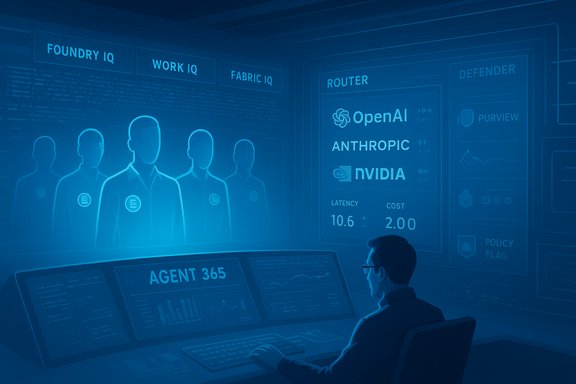
Azure AI Foundry’s Ignite updates focus on three practical problems developers face when turning agents into real business services:- A huge, growing model catalog and model routing to automatically pick the best model for a task.
- Better grounding for agent reasoning through Foundry IQ (a RAG‑style knowledge and planning layer) and integration with Work IQ and Fabric IQ.
- A developer control plane with observability, lifecycle hooks and MCP (Model Context Protocol) tooling for multi‑agent workflows.
Why the model router matters
Developers and platform engineers face a hard choice on model selection: cheaper, faster models are often fine for routine tasks; frontier models are required for high‑stakes reasoning or specialized domains. A runtime router that can switch models per request — and enforce data residency and privacy boundaries — reduces operational overhead and can materially cut inference costs and response times. Microsoft publicly claims the router has produced substantial cost and latency improvements in early tests; independent verification in live customer environments will be needed, but the capability addresses a real pain point for multi‑vendor deployments.Foundry IQ and data grounding
A recurrent failure mode for enterprise AI is weak context: models that receive poor, stale or misaligned business data give poor results. Foundry IQ is Microsoft’s answer: a managed RAG and knowledge orchestration layer that can pull context from Work IQ (Microsoft 365), Fabric IQ (Power BI/Fabric) and enterprise stores such as OneLake, S3 or Snowflake. Foundry IQ is described as not only retrieving data but planning and iterating across connectors — effectively a knowledge fabric that agents can rely on for higher‑quality decisions. This is the kind of “context engineering” that early adopters like Nordstrom have shown is essential for reliable agentic automation.Agent 365: Identity, registry and governance
Agent 365’s core functions
Agent 365 is positioned as the enterprise control plane for agents and bundles five core capabilities: a registry, access control, visualization/telemetry, interop, and security. The design choice that differentiates Agent 365 is identity first: every managed agent is meant to receive an Entra Agent ID (a directory object), which brings agents into existing IAM lifecycles — provisioning, deprovisioning, conditional access, access reviews and audit trails. That identity model is foundational because it allows organizations to apply the same governance policies they already use for human employees and service principals. Key operational capabilities include:- Discovery and detection of shadow agents and unsanctioned automation.
- Scoped, least‑privilege access and conditional controls tied to Entra.
- Fleet‑wide telemetry and lineage (tool calls, retrievals, decision traces).
- Integrated remediation: quarantine, alerts and policy enforcement using Defender and Purview.
- An Agent Store / catalog model to let admins approve, license and publish vetted agents.
Why treating agents as directory objects is a big deal
Representing agents as directory principals (Entra Agent IDs) is an operationally significant decision. It means agents can be included in access reviews, conditional access policies, and lifecycle automation — all parts of AM/ID infrastructure most enterprises already trust. That reuse lowers the bar for security teams to accept agent deployments, because the tools and processes to govern machine identities already exist. Analysts argue this will be decisive in adoption for regulated enterprises, where auditable identity practices matter more than novelty.Model choice, vendor partnerships and Anthropic support
A practical theme from Ignite was pluralism: Microsoft wants enterprises to be able to pick models from multiple vendors and route between them. That message was reinforced by Microsoft’s partnership announcements — most notably a three‑way arrangement involving Microsoft, Nvidia and Anthropic — and by Foundry adding Anthropic’s Claude models to its catalog. The Anthropic announcement is consequential because it makes Azure the only major hyperscaler at the time to publicly support both OpenAI and Anthropic frontier models side‑by‑side, an important consideration for enterprises seeking vendor diversification and redundancy. Independent press coverage and Microsoft community posts confirm Anthropic model support in Foundry. Multi‑vendor support improves resilience and enables best‑for‑purpose routing, but it raises operational complexity: cross‑hosted models have different SLAs, data processing policies and contractual terms. Enterprises will need to reconcile those differences in procurement and compliance workflows — a task that the model router and Agent 365’s data boundary enforcement are intended to simplify.Grounding agents with data: Foundry IQ, Work IQ, Fabric IQ
Agents are most useful when they can act on reliable, semantically consistent business data. Microsoft’s “IQ” stack — Work IQ, Fabric IQ and Foundry IQ — is explicitly aimed at giving agents that grounding:- Work IQ extracts signals from Microsoft 365: emails, docs, meetings and collaboration context.
- Fabric IQ provides a semantic analytic layer over business datasets so agents can query entities (orders, inventory, incidents) instead of raw tables.
- Foundry IQ stitches those sources (plus blob stores and web data) into retrieval and planning capabilities for agents.
Security, observability and lifecycle controls
Integrated security stack
Security and governance were highlighted across Microsoft’s announcements: Defender, Purview, Entra and Security Copilot are all wired into the agent story. Agent 365 is designed to use Defender for runtime protection and Purview for data governance; a newly previewed Security Dashboard for AI aggregates signals to present a combined AI posture for SOC teams. These integrations are intended to reduce the new attack surfaces that idle or overly permissive agents create.Observability and telemetry
One of the recurring enterprise complaints about AI pilots has been lack of traceability. Agent 365 and the Foundry control plane emphasize telemetry: traces of tool calls, retrieval events, decision logs and action lineage that can be stitched into existing OpenTelemetry pipelines. This enables forensics, incident response and ROI reporting — the kind of operational visibility that often separates pilot experiments from governed production services.Lifecycle automation
Agent identity plus lifecycle tooling means administrators can automatically quarantine orphan agents, require periodic access reviews, and force re‑approval of agents that change behavior. These lifecycle controls reduce the odds of “runaway” or overprivileged agents and make remediation feasible at scale. That is vital if organizations plan to treat agents as first‑class automation assets rather than ephemeral scripts.Where the market really stands: adoption realities and data
The product announcements respond to a harsh market reality: many pilots don’t scale. The MIT study and Gartner forecasts are blunt about the problem: execution, governance, data quality and unclear value are the dominant failure modes. Microsoft executives acknowledged these issues on stage at Ignite, arguing the missing ingredients are identity alignment, better data context, hardened governance and production‑grade development tooling. Those are exactly the areas Agent 365 and Foundry aim to address. Two important caveats when reading the headlines:- Some market figures Microsoft cites — for example an IDC projection of 1.3 billion agents by 2028 — originate from vendor‑sponsored research and should be treated as directional market sizing rather than immutable forecasts. Plan with your own usage scenarios, not headline numbers.
- The MIT “95% failure” statistic is widely reported across industry outlets and appears to come from a public MIT NADA initiative report. It is a striking signal, but organizations should examine the study’s methodology and sample before applying the figure to their own expectations. Multiple independent outlets reference the finding, which increases confidence in the headline, but the broader lesson is qualitative not purely numeric: pilots often fail because teams skip the work of integration, governance and measuring business outcomes.
Critical analysis — strengths, blind spots and operational risks
Notable strengths
- Identity‑first governance: Using Entra to represent agents as directory objects is an elegant operational shortcut that lets enterprises apply existing IAM, audit and lifecycle tooling to agents. This will materially reduce governance friction for security teams.
- Integrated data grounding: Foundry IQ plus Work/Fabric IQ addresses the exposure that often causes models to fail in live workflows: weak or inconsistent context. Anchoring agents to enterprise data is practical risk mitigation.
- Multi‑model choice at runtime: The model router reduces the cognitive load and cost risk of running heterogeneous model fleets, making it easier to optimize for cost, latency or accuracy per task.
- End‑to‑end pipeline for production: Copilot Studio → Foundry → Agent Store → Agent 365 is a coherent pipeline from authoring through governance, which is precisely the operational pipeline enterprises have asked for.
Real and immediate risks
- Vendor lock‑in by integration: The strength of Microsoft’s approach — deep integration with Entra, Defender and Purview — is also a lock‑in vector. Organizations that standardize heavily on the Microsoft agent stack may find multi‑cloud or future vendor substitution costly, especially where models or data must be moved. This risk is greater for companies that need vendor neutrality for compliance or negotiation leverage.
- Third‑party maturity gap: Agent 365 promises multi‑vendor visibility, but practical interoperability depends on partner readiness. Not all partners will expose the telemetry or lifecycle hooks Agent 365 expects; enterprises should expect uneven integration quality across ISVs.
- Supply‑chain and provenance complexity: With thousands of models and multiple vendors, keeping track of model provenance, licensing, security posture and training data sources becomes nontrivial. This complicates compliance reviews (e.g., for regulated industries).
- Operational complexity and cost: While the model router claims cost savings, running agent fleets with multi‑stage RAG, observability, and Entra lifecycles introduces new operational costs: storage, telemetry retention, fine‑grained access reviews and human‑in‑the‑loop approvals.
- Shadow agents and discovery limits: Agent 365 emphasizes shadow agent detection, but discovery is an inherently hard problem. Unsanctioned exposures (e.g., personal Copilot usage, consumer AI tools) will remain a compliance risk unless organizational policies and employee education keep pace.
Practical pilot playbook for IT and security teams
For organizations ready to experiment with agentic automation without repeating the industry’s failure modes, a sensible, staged plan minimizes risk:- Inventory existing automations (bots, scripts, RPA) and classify which are candidates to become agents.
- Define an Agent Governance Policy: ownership, data access tiers, human‑in‑the‑loop gates, retention and ROI metrics.
- Start in monitor‑only mode: onboard a small set of read‑only agents into Agent 365 to validate telemetry, lineage and alerts before enabling autonomous execution.
- Enforce identity and least privilege: require Entra Agent IDs, scoped credentials and short‑lived tokens for agent access to critical resources.
- Use RAG and Foundry IQ for grounding: tie agents to canonical datasets with Purview classification and DLP applied.
- Run adversarial tests: prompt injection, data exfiltration simulations and red‑team scenarios to validate controls.
- Measure business outcomes: require a clear KPI for each pilot (time saved, error reduction, revenue uplift) and a rollback plan.
- Create an agent deprovisioning playbook: automated quarantine and orphan detection should be part of operations.
Final assessment: a platform moment — with tradeoffs
Microsoft’s Foundry and Agent 365 announcements tilt toward platformization of agentic AI: they give enterprises a single vendor pathway from authoring to governance, tied to the identity and security tooling many organizations already use. That has immediate appeal for large enterprises that prioritize auditability, compliance and predictable operations. The combination of multi‑model routing, knowledge fabrics (Foundry IQ, Work IQ, Fabric IQ) and a directory‑centric governance model is well aligned with the failure modes researchers and analysts have highlighted.But this is also an inflection point where strategic tradeoffs matter. Firms must weigh the operational benefits of deep integration against the risks of lock‑in, cross‑vendor complexity and new cost centers. The MIT and Gartner data are reminders that technology alone does not produce enterprise outcomes; organizational alignment, data maturity and security posture are the decisive factors. Microsoft’s stack materially lowers several barriers — but it does not eliminate the need for careful use‑case selection, strong data practices, executive sponsorship and measurable KPIs.
Enterprises that proceed with measured pilots, enforce identity‑first controls, and ground agents in high‑quality, governed data will be best positioned to move past the pilot cliff and into production. For others, the smartest immediate action is not to rush into fleets of agents, but to build the governance and data plumbing that will make those agents trustworthy and accountable when they arrive.
Microsoft’s Foundry and Agent 365 represent a meaningful evolution in enterprise AI tooling: one that tries to turn the excitement around agents into a reproducible, governable operational model. The proof will be in the first wave of large‑scale deployments — whether the promised observability, cost‑savings and compliance controls actually reduce the pilot‑to‑production gap that MIT, Gartner and practitioners have been warning about. For IT leaders, the decision ahead is clear: invest first in policy, identity and data foundations; treat Agent 365 and Foundry as tools to operationalize those investments — not shortcuts around them.
Source: TechTarget Microsoft Azure AI Foundry ties in with Agent 365 | TechTarget
