

Businesses are quietly replacing rigid, rule‑based workflow systems with fleets of autonomous AI agents—goal‑driven digital workers that plan, act, and learn—transforming processes from static sequences into adaptive, orchestral systems of software and human supervision.
The shift from traditional workflow automation to agentic systems is both evolutionary and structural. Rather than executing single triggers or scripted routines, AI agents decompose high‑level objectives into sequences of actions, call external tools and APIs, maintain state, and adapt when conditions change. Major vendors have productized this pattern: Microsoft’s Copilot Studio and Agent 365 position agents as managed, identity‑bearing "digital employees" that integrate into Microsoft 365 and enterprise systems; those platform capabilities are documented on Microsoft’s Copilot Studio pages and product blogs. Analysts and consultancies have framed this as a new operating model. McKinsey calls it the “agentic organization,” arguing that small human teams can supervise large numbers of specialized agents while pushing marginal costs toward the price of compute rather than labor for many tasks. That thesis includes examples of substantial productivity gains in pilot projects, though the firm’s prescriptions emphasize governance, orchestration, and human‑in‑the‑loop controls. At the same time, enterprise surveys (notably PwC’s AI Agent Survey) report early measurable benefits—66% of adopting organizations report productivity increases and 57% report cost savings—while cautioning that adoption depth varies widely and governance and trust remain barriers.
Key AgentOps responsibilities:
Source: Reporter Byte Companies Turn to AI Agents To Replace Entire Workflow Systems — The Quiet Revolution Reshaping Corporate Work - Reporter Byte
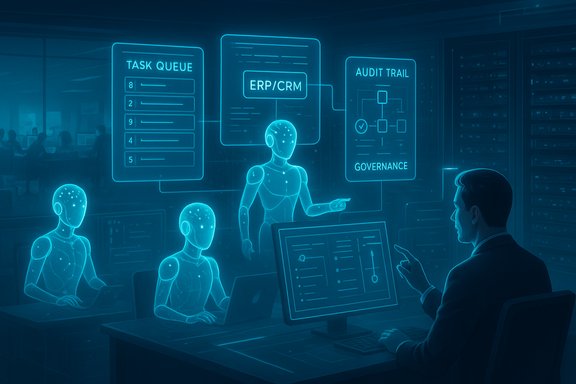 Background / Overview
The shift from traditional workflow automation to agentic systems is both evolutionary and structural. Rather than executing single triggers or scripted routines, AI agents decompose high‑level objectives into sequences of actions, call external tools and APIs, maintain state, and adapt when conditions change. Major vendors have productized this pattern: Microsoft’s Copilot Studio and Agent 365 position agents as managed, identity‑bearing "digital employees" that integrate into Microsoft 365 and enterprise systems; those platform capabilities are documented on Microsoft’s Copilot Studio pages and product blogs. Analysts and consultancies have framed this as a new operating model. McKinsey calls it the “agentic organization,” arguing that small human teams can supervise large numbers of specialized agents while pushing marginal costs toward the price of compute rather than labor for many tasks. That thesis includes examples of substantial productivity gains in pilot projects, though the firm’s prescriptions emphasize governance, orchestration, and human‑in‑the‑loop controls. At the same time, enterprise surveys (notably PwC’s AI Agent Survey) report early measurable benefits—66% of adopting organizations report productivity increases and 57% report cost savings—while cautioning that adoption depth varies widely and governance and trust remain barriers. What exactly is an AI agent?
The three practical capabilities that differentiate agents from chatbots
- Decomposition & planning: Agents convert fuzzy goals (“produce a customer‑ready proposal”) into ordered subtasks, checkpoints, and rollback strategies.
- Tool integration & action: Agents invoke connectors and APIs (CRM, ERP, ticketing systems), manipulate documents, and trigger transactions—actions that go well beyond retrieving information. Microsoft’s Copilot agents explicitly support connectors and deployment into corporate channels like Teams and Outlook.
- Stateful orchestration & observability: Agents keep memory across interactions, coordinate with other agents, log decisions, and expose traces for evaluation and audit.
How vendors implement agent primitives
Vendors combine three technical layers: (1) a reasoning model (LLMs and multimodal models) for planning and language understanding; (2) a tool/connector layer for actions; and (3) an orchestration and governance plane (Agent IDs, lifecycle, policies, telemetry). Microsoft’s Agent 365 and Copilot Studio articulate this stack for customers, including quota/credit pricing models for agent usage.Real-world case studies: what works today
Dow: freight invoice auditing at scale
Dow built two agent types—an autonomous agent that ingests PDF invoices from email and structures the data, and a prompt‑and‑response “Freight Agent” that lets staff query anomalies in natural language. Early results demonstrated invoices that would once take weeks to surface now appearing as minutes‑scale dashboards, with the company projecting millions in annual freight savings once scaled. This implementation is an example of agents turning hidden operational cost leakage into auditable, automated workflows.Pets at Home: fraud detection and customer personalization
UK retailer Pets at Home used Copilot Studio to build agents that sift transaction records, flag repeat image reuse and suspicious refund patterns, and recommend tailored products—reducing fraud investigation time and improving service outcomes. The retailer reports that agents help surface anomalies while preserving guardrails to avoid false positives against loyal customers.Ma’aden (Saudi mining): productivity uplift in back‑office work
A large mining firm reported that Microsoft 365 Copilot implementations automated document workflows and routine communications, saving thousands of hours monthly—an illustration of how agent‑like features inside productivity apps can compress administrative load. Vendor and customer accounts cite large hourly savings in tasks such as drafting, summarizing, and formatting documents. These claims appear repeatedly in vendor case summaries and customer testimonials. Note: corporate hour‑savings metrics are context dependent and often reflect pilot scopes; they should be validated on a per‑project basis before extrapolating.A cautionary note — Klarna’s partial rollback
Klarna’s widely publicized experiment to replace customer service staff with AI was later partially reversed: executives rehired humans when the AI could not match the required reliability or brand expectations for complex interactions. That episode is frequently cited as an example that wholesale replacement without staged pilots, guardrails, and human oversight can backfire.Verified benefits and the evidence base
Multiple independent data points converge on several early benefits for organizations that adopt agentic approaches at scale:- Productivity gains: PwC’s survey of senior execs reports 66% of adopters see measurable productivity increases; PwC also catalogs client successes across finance, hospitality and insurance showing time savings and throughput improvements.
- Cost savings: The same PwC survey reports 57% of adopters saw cost savings. Vendor case studies (Dow, Wyndham, Cross Insurance) document line‑of‑sight savings from invoice auditing, contact center automation, and quote generation.
- Scale and new operating models: McKinsey documents that agentic operating models let small human teams supervise large agent factories—claiming use cases where time or effort reductions approach or exceed 50% in specific processes, and forecasting that marginal costs for some workflows will shift toward compute. These are scenario‑level findings that depend heavily on process fit, data quality, and governance.
Real risks and failure modes
Agentic systems amplify existing automation risks and introduce new ones. Independent analyst warnings—Gartner and Capgemini among them—show that many agentic projects falter without the right use cases, trust frameworks, and controls.- Project cancellations and over‑hype: Gartner estimates a high failure/cancellation rate for agentic projects when value is poorly defined and governance is absent; it warns of “agent washing” in the vendor market (relabeling older capabilities as agents). This highlights the need for critical vendor evaluation.
- Accuracy, hallucinations and compliance risk: Agents that generate or act on data can produce incorrect outputs (hallucinations), misroute transactions, or expose sensitive data if identity and least‑privilege aren’t enforced. Case studies emphasize the need for audit trails and human checks.
- Integration complexity and technical debt: Agents require robust connectors, canonical data layers, and secure identity primitives. Enterprises with fractured systems risk brittle integrations and escalating operational overhead. Analyst coverage and practitioner writing emphasize the need for an "AgentOps" discipline to manage lifecycle and observability.
- Human and brand risks: Over‑automation in customer‑facing domains can damage brand trust (illustrated by Klarna’s partial rehiring) and creates regulatory exposure where decisions must remain auditable and defensible.
Governance, safety and the new operating discipline: AgentOps
Moving from pilots to production requires deliberate operational practices—collectively referred to in the industry as AgentOps.Key AgentOps responsibilities:
- Agent lifecycle and versioning (create, audit, update, retire).
- Identity & least‑privilege access for agents (Entra Agent IDs / managed identities).
- Observability and explainability (decision logs, prompt histories, confidence scores).
- Cost controls and model routing (quotaing, fallback strategies).
- Safety gates and human‑in‑the‑loop policies for high‑risk outcomes.
Implementation playbook for IT leaders (practical checklist)
- Start with high‑impact, low‑risk workflows: invoice auditing, structured document processing, case triage. Dow’s freight invoice example is a textbook starting point.
- Clean, canonicalize data first: agents scale garbage as fast as they scale value—data stewardship is non‑negotiable.
- Build an AgentOps team: product owners, model stewards, security engineers, and a human‑in‑the‑loop council.
- Implement progressive autonomy: start with agent‑assisted modes, then semi‑autonomous with escalation, then autonomous with strict rollback policies.
- Instrument observability and forensics: decision trails and prompt logging for audits and regulatory compliance.
- Measure outcomes with real KPIs: time‑to‑resolve, cost per process, error rates, and customer satisfaction—not just seats consumed.
The human factor: jobs, roles, and culture
The agentic era will not be a simple automation‑led cull of jobs; it will be a rapid reconfiguration of roles and skills. Analysts and vendor roadmaps show new roles emerging:- Agent orchestrators (design and tune multi‑agent workflows).
- AI ethic managers / AI auditors (policy, fairness, and compliance).
- Data intelligence designers (curate corpora and observability signals).
- AgentOps engineers (production reliability, SRE for agents).
- Reframe jobs around judgment and oversight rather than low‑value execution.
- Pair agents with human escalation paths and preserve customer channels with guaranteed human access.
- Invest in internal change programs—agents will not drive adoption by product alone.
Market posture and vendor landscape
The vendor field has bifurcated into:- Hyperscalers embedding agents across productivity stacks (Microsoft with Copilot Studio & Agent 365; Google and others are pursuing similar surfaces).
- Specialist agent platforms and orchestration vendors focused on AgentOps, observability and industry‑specific connectors.
- Consultancies and systems integrators offering agent factories and transformation playbooks.
Technical and commercial realities (what IT teams should verify)
- Model & data residency: Confirm tenant isolation, training data policies, and whether vendor models use customer data to fine‑tune base models. Microsoft documents tenant isolation controls for Copilot; these settings matter for regulated industries.
- Cost model: Agent usage is typically metered; Microsoft uses Copilot Credits and pay‑as‑you‑go models. Estimate steady‑state compute costs against labor‑substitution scenarios carefully.
- Connector reliability: Ensure the agent platform supports secure, authenticated connectors for your ERP, CRM, and ticketing systems without brittle custom glue.
- Audit & rollback: Agents must expose auditable traces and safe rollback options for any change actions (e.g., billing corrections, contract edits).
Where the industry stands—and what to expect next
Agentic systems are no longer hypothetical: pilot results and vendor platforms demonstrate tangible value in finance, logistics, retail, and customer service. PwC’s and McKinsey’s surveys and vendor case studies indicate measurable wins when implementations are thoughtfully scoped and well‑governed. At the same time, independent analysts warn of substantial churn: Gartner predicts many early projects will be canceled or scaled back without clearer ROI, trust, and operational discipline. The practical trajectory is a hybrid future where humans supervise fleets of agents, with AgentOps maturing into a mainstream enterprise discipline.Conclusion: what CIOs and IT leaders should do now
The agentic wave is not a single technology to adopt but an operating model to design. The immediate priorities for responsible, value‑oriented adoption:- Treat agents as managed principals: give them identities, budgets, observability, and retirement plans.
- Prove value with narrow, high‑impact pilots (invoice auditing, compliance checks, controlled customer cases), measure rigorously, then scale.
- Build AgentOps and invest in data hygiene, human‑in‑the‑loop oversight, and traceability to reduce the chance of noisy failures and regulatory exposure.
- Avoid the hype trap: verify vendor claims against technical primitives (state, tool invocation, lifecycle controls) and demand meaningful observability before full‑scale deployment.
Source: Reporter Byte Companies Turn to AI Agents To Replace Entire Workflow Systems — The Quiet Revolution Reshaping Corporate Work - Reporter Byte
