

Agentic AI has moved from research lab curiosity to an enterprise operating imperative: organizations are deploying autonomous, goal-driven agents that plan, act, and learn across systems, and early adopters are already reporting material gains — but also new and complex governance, security, and scaling challenges that require a fresh operational discipline. PwC’s May 2025 AI Agent Survey found roughly 79% of respondents reporting adoption of AI agents in their businesses, a figure echoed by multiple industry reports that indicate rapid uptake across functions from IT and customer service to supply chain and finance.
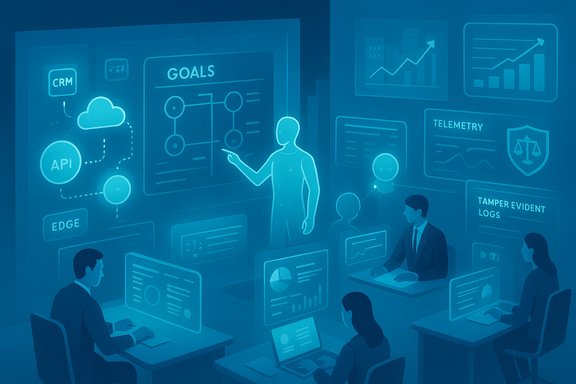
Agentic AI describes systems that do more than generate text or assist on demand: they are autonomous digital workers that maintain state, decompose high‑level goals into sequences of actions, call tools and APIs, coordinate with other agents, and — crucially — take initiative within human‑defined guardrails. This is a product and architectural shift built on three practical pillars:
Key differences:
Appendix — Quick Validation Highlights (selected evidence)
Source: Editorialge https://editorialge.com/agentic-ai-in-enterprise-automation/
 Background / Overview
Agentic AI describes systems that do more than generate text or assist on demand: they are autonomous digital workers that maintain state, decompose high‑level goals into sequences of actions, call tools and APIs, coordinate with other agents, and — crucially — take initiative within human‑defined guardrails. This is a product and architectural shift built on three practical pillars:- Decomposition and planning — mapping objectives into ordered, verifiable steps.
- Tooling and integration — secure, auditable access to APIs, databases, files, UIs, and devices.
- Orchestration and governance — identity, lifecycle, telemetry, and human‑in‑the‑loop controls.
From RPA to Agentic Intelligence: What Changed
Robotic Process Automation (RPA) solved deterministic, repetitive tasks by scripting UI interactions or API calls. Agentic AI extends that capability into uncertain, stateful workflows where decisions must be planned, exceptions handled, and context maintained.Key differences:
- Goal orientation (not just triggers): Agents receive objectives (“reduce open customer escalations by 20% this quarter”) and design multi‑step approaches rather than executing single triggers.
- State and memory: Agents keep scoped memory across sessions for long‑running activities and recall key entities when needed.
- Tool invocation and orchestration: Agents safely call services, update records, transmit notifications, and coordinate with humans or other agents.
- Adaptive behavior: Agents modify plans when inputs change (supply chain disruptions, spike in demand), rather than failing when preconditions differ.
How Agentic Systems Work (Technical Anatomy)
Reasoning models + evaluation loops
At the center are large language models and multimodal reasoning engines that interpret natural language objectives, propose stepwise plans, and generate structured actions. Production systems add evaluators and verifiers — automated sanity checks or human approval gates — to catch hallucinations or risky recommendations before they become actions. McKinsey and other consultancies emphasize evaluator tooling and human oversight as mandatory for high‑risk use cases.Tooling, connectors, and protocols
Agents need safe ways to discover and call tools. The Model Context Protocol (MCP) — developed in 2024 and gaining industry traction in 2025 — is one such open protocol for standardizing how models and agent runtimes interact with services and tools. Major providers and open standards efforts are converging around MCP and related agent‑to‑agent protocols to reduce brittle per‑integration engineering. Recent industry moves have pooled MCP, Agents SDKs, and other protocols into cross‑industry initiatives to promote interoperability.Orchestration, identity and AgentOps
Enterprises are treating agents as first‑class principals: agents receive identities, are assigned least‑privilege access, get lifecycle reviews, and emit detailed traces (prompts, intermediate model outputs, tool invocations, decisions). This “AgentOps” discipline borrows SRE practices — capacity planning, SLOs, canary rollouts — and extends them with ethics, compliance, and tamper‑evident audit logs. Vendor playbooks and analyst guidance stress registries/catalogs, observability, and policy enforcement as prerequisites for scaling.The Vendor Landscape: Who’s Shipping What
Several commercial platforms now position agent runtimes, orchestration, and governance as core product differentiators. Their offerings are converging on the same functional set — authoring surfaces, runtime services, identity integration, observability — but differ in integration depth, vertical industry focus, and openness.- Microsoft Copilot Agents / Copilot Studio — integrated deeply with Microsoft 365, Azure, Entra identity and Dataverse, with explicit lifecycle and governance tooling for agents operating in Teams, Outlook, and Windows endpoints. Microsoft frames agents as discoverable, identity‑bound digital employees.
- Salesforce Agentforce — positions agents inside CRM and customer‑facing flows with marketplaces and pre‑built workflows (AgentExchange/AgentExchange). Salesforce materials highlight rapid time‑to‑value and CRM‑centric automation that links to the $6T “digital labor” market narrative. Vendor case studies claim fast ROI in CRM and service operations.
- IBM watsonx Orchestrate — emphasizes an enterprise, governance‑first approach with prebuilt domain agents, an agent catalog, and extensive connector support to ERP and industry workloads. IBM markets orchestration and observability as central to regulated industries.
- Google Vertex AI / Gemini Enterprise — focuses on multimodal reasoning and Workspace integration, enabling agents that act across Gmail, Docs, and Sheets and on custom enterprise data.
- AWS Bedrock / AgentCore — positions agent runtimes with configurable model routing and Bedrock integration for private model hosting and governance.
- Open‑source & low‑code players — LangChain ecosystems, Zapier Agents, and no‑code integrators are enabling faster experiments and hybrid (RPA + agent) deployments for teams outside core engineering.
Real-World Impacts: Case Studies and Sectors
Customer Service and Support
Enterprises are deploying agents to triage, resolve routine queries, and route complex issues to humans. Vendor case studies and surveys show large gains in response speed, first contact resolution, and deflection of routine tickets — though the specific headline numbers vary between studies and are often context dependent.- PwC and industry reports indicate significant productivity gains with agents in service workflows; vendors cite improvements ranging from tens of percent in resolution speed to high autonomous‑closure rates in narrowly scoped domains. These outcomes are typically achieved where agents are fed validated knowledge bases and operate with strict verification rules.
Finance and Compliance
Agents bring autonomous auditing, continuous monitoring, and rapid anomaly detection. McKinsey and Bain work with clients to deploy agents for transaction monitoring and compliance workflows where agents surface anomalies and prepare human‑actionable cases, delivering measurable time savings and improved coverage. Still, regulatory scrutiny means full autonomy is rare in highly regulated decision loops.Manufacturing, Logistics and Energy
Agents coordinate schedules, predict maintenance, and reroute supplies during disruptions. In logistics pilots, autonomous rerouting agents have delivered double‑digit improvements in throughput and lower downtime. Energy grid pilots experiment with agents that ingest renewables forecasts and adjust load in near‑real‑time. These deployments combine edge telemetry, real‑time models, and strong human oversight to manage risk.Healthcare and Life Sciences
Agentic AI accelerates literature review, trial matching, and administrative triage; life‑sciences analyses suggest large portions of workflows (70–85% by task) can be augmented, freeing capacity for higher‑value activities. However, clinical and safety risks require strict validation, human signoff, and provenance tracking before clinical actions are entrusted to an agent.Economics and ROI: What the Numbers Say (and Don’t)
Multiple analyst firms and vendor‑commissioned studies sketch a large economic opportunity for agentic AI:- Futurum Research projects up to $6 trillion in economic value driven by agentic AI by 2028, a figure that has become central to vendor narratives about the “digital labor” market. That number reflects projected productivity gains, cost savings, and new revenue streams as agents are embedded across enterprise software.
- PwC (May 2025 survey) found adoption in roughly 79% of surveyed firms and reported that two‑thirds of adopters see measurable productivity improvements — but warned that deep, systemic transformation is still limited to a subset of leaders.
- McKinsey’s work on the “agentic organization” highlights scenarios where small human teams supervise large fleets of agents, yielding step‑changes in productivity and capacity (examples include doubling productivity in select adopters and freeing 25–40% of workflow capacity in pharma workflows). McKinsey stresses that architecture modernization and governance are prerequisites to capture these gains.
- Analyst forecasts vary widely based on definitions, scope, and inclusion of cost savings vs. new revenue. The $6T Futurum number is a high‑level economic projection; it is plausible at scale but depends on broad adoption and systemic re‑architecting of workflows.
- Vendor ROI claims (days‑to‑value, X× ROI) frequently come from selected case studies and are not universal; enterprises should validate outcomes using their data, business processes, and risk tolerances.
Challenges: Governance, Ethics, and Scaling
Agentic AI’s autonomy produces a new set of organizational risks:- Hallucinations and incorrect actions: When agents invent information or misinterpret context, the cost is no longer a bad answer — it can be an incorrect transaction, a misfiled record, or an unauthorized action. Recording explainability metadata and implementing verification gates are non‑negotiable.
- Identity and permissions sprawl: Agents that accumulate privileges without lifecycle management pose exfiltration and over‑privilege risks. Treat agents like service principals with scheduled reviews and ephemeral credentials.
- Multi‑agent miscoordination and emergent risk: Independent agents may interact unpredictably; miscoordination, feedback loops, and adversarial prompt attacks are active failure modes that need simulation and red‑team testing.
- Regulatory and liability uncertainty: In finance, healthcare, and public services, full agent autonomy raises legal exposure; most organizations adopt human‑in‑the‑loop approvals for sensitive decisions.
- Scaling beyond pilots: Surveys repeatedly show the main barrier to scale is operational: legacy systems, poor data quality, missing identity controls, and lack of AgentOps skills. Protiviti, PwC and other firms report many pilots stall for these reasons.
Practical Playbook: How to Pilot, Validate, and Scale Safely
- Select small, high‑value, low‑risk use cases — start with tasks where error cost is low and verification is straightforward (meeting prep, document summarization, low‑dollar financial approvals).
- Treat agents as production services — require identity, RBAC, ephemeral credentials, and a registry/catalog. Integrate agent identities with your access reviews.
- Auditability by design — log prompts, intermediate outputs, tool invocations, final decisions, and human approvals in tamper‑evident logs exported to your SIEM or observability stack.
- Verification and human handoffs — deploy canary modes (audit‑only, read‑only), human sign‑offs for sensitive actions, and automatic rollback triggers.
- Red‑team and adversarial testing — probe for prompt injection, data exfiltration, and coordination attacks between agents.
- Cost governance — benchmark model latency and cost, route inexpensive tasks to local/smaller models, and reserve frontier models for heavy reasoning.
- Train operators and change the org — create an AgentOps team responsible for lifecycle, SLOs, and incident playbooks; upskill product and process owners to supervise agents.
Standards, Interoperability, and the Road Ahead
Industry momentum around open protocols matters. The Model Context Protocol (MCP) and the emergence of agent‑to‑agent protocols aim to make agents interoperable and reduce lock‑in. Recent consortium moves (including major providers endorsing shared standards and the creation of collaborative foundations) show the ecosystem is racing to avoid siloed agent silos and to address safety through shared best practices. Open standards will accelerate reusable connectors and marketplace models across vendors — but adoption will require careful attention to security, identity, and consent semantics.Strengths, Blind Spots, and Strategic Recommendations
Strengths:- Tangible productivity gains in scoped deployments — faster processing, reduced manual handoffs, and continuous monitoring.
- Composability — reusable skills and agent modules accelerate rollout across functions.
- Platformization — hyperscalers and enterprise software vendors now ship agent runtimes, lowering engineering friction for many customers.
- Overclaiming by vendors: Many vendor ROI and performance numbers come from selected pilots; they are directional but not universal. Treat them as starting hypotheses to validate in your context.
- Operational debt: Without AgentOps, organizations will see agent sprawl, permission creep, and brittle integrations.
- Ethical and legal exposure: Autonomy amplifies the impact of bias, errors, and wrong incentives. Human oversight, traceability, and privacy‑aware design are mandatory.
- Build a two‑track program: fast, measurable pilots (no more than three months) that feed into a three‑year modernization roadmap to refactor data, access, and observability layers.
- Invest in AgentOps early: identity, registry, telemetry, and incident response for agents.
- Prefer architectures that allow multi‑vendor model routing and reuse of skills to avoid lock‑in while preserving the ability to use managed vendor safety tooling.
Future Horizons: What Comes Next
- Agent marketplaces and digital labor economies will mature (vendors already reference multitrillion‑dollar opportunity estimates). Expect more curated agent catalogs, paid skills, and B2B agent exchanges as governance and identity tooling matures.
- Edge + agents: Combining agents with IoT and edge inference will enable hyper‑local, low‑latency decisions in manufacturing, retail, and energy networks.
- Human‑AI collaboration models will evolve: humans will supervise, set objectives, and manage escalations while agents perform the bulk of orchestration and execution.
- Policy and regulation will catch up: higher transparency standards, agent identity norms, and sector‑specific guardrails will be required for finance, healthcare, and critical infrastructure.
Conclusion
Agentic AI is not just incremental automation — it redefines what software can do on behalf of organizations. The technology is already delivering measurable value in focused pilots and early production deployments, with PwC and other analysts documenting widespread adoption and McKinsey and sector studies showing material capacity gains in specific functions. At the same time, the shift from reactive assistants to autonomous agents creates a new class of operational, security, and ethical challenges that cannot be glossed over. The next 18–36 months will separate humming pilot programs from robust, scaled agentic organizations: winners will be the firms that pair pragmatic pilots with a strong AgentOps discipline — identity‑first controls, tamper‑evident auditability, evaluator gates, and continuous adversarial testing. The promise is large, but realizing it responsibly requires engineering rigor, clear governance, and honest measurement of vendor claims in your own environment.Appendix — Quick Validation Highlights (selected evidence)
- PwC’s May 2025 AI Agent Survey: ~79% of surveyed firms report AI agent adoption and two‑thirds of adopters report measurable value.
- Futurum Research: press releases and market notes cite a projected economic impact of up to $6 trillion by 2028 for agentic AI; vendors widely reference this market sizing in product announcements.
- McKinsey: published guidance and case analyses on the “agentic organization,” reporting scenario‑based productivity increases and recommending governance and architecture modernization to capture value.
- Model Context Protocol (MCP) adoption and open standards movement: major outlets report MCP and related efforts being adopted as protocols to enable interoperable agent tooling.
- Vendor product notes: Salesforce Agentforce, IBM watsonx Orchestrate, Microsoft Copilot Agents, and AWS Bedrock/AgentCore each publish product pages and press releases describing authoring, runtimes, and governance primitives. Validate vendor performance claims in your environment — many numbers are drawn from selected case studies.
Source: Editorialge https://editorialge.com/agentic-ai-in-enterprise-automation/
