

Artificial intelligence is moving fast from scripted automation to autonomous, goal-driven systems that plan, act, and adapt across enterprise silos — a shift that turns passive assistants into coordinated digital workers capable of real-world outcomes. The recent industry coverage and vendor briefings position AI agent platforms as the next major enterprise platform: they promise to translate high-level objectives into multi-step workflows, call external systems securely, and continuously refine strategies as conditions change. This article unpacks that transition, verifies the headline claims in the reporting you provided, and offers a critical, practice-focused view for IT leaders, developers, and Windows-focused organizations weighing agentic deployments today.
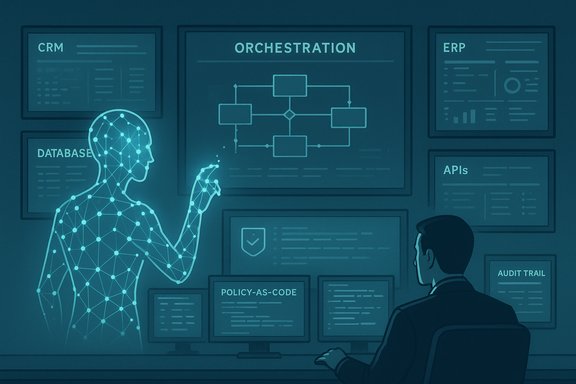
The narrative circulating in vendor press and trade coverage is straightforward: organizations want more than point automation — they need AI that can reason, orchestrate and execute across CRMs, databases, APIs and internal tools. Market research firms estimate the AI agents market was roughly USD 5.4 billion in 2024 and project very steep growth (a compound annual growth rate in the mid‑40s percent range through the end of the decade). These forecasts underline strong buyer interest and justify why major platforms — Microsoft, Google, AWS and many startups — are investing heavily in agent runtimes, integration protocols and enterprise governance. Grand View Research places the 2024 market at about USD 5.40 billion and forecasts a CAGR of 45.8% to 2030, which aligns with other recent market reports. But market momentum does not mean the technology is a finished product. The shift from automation to autonomy introduces new architectural plumbing (agent runtimes and tool protocols), operational disciplines (identity, policy-as-code, observability) and business processes (new roles for human oversight and exception handling). The rest of this article breaks those items down and validates the most consequential technical and commercial claims with independent sources.
Organizations that pair careful governance with focused pilots can unlock significant productivity wins. At the same time, prudence is required: not every process should be fully automated, and vendors’ marketing claims require validation against integration depth, security artifacts and production telemetry. The right outcome is rarely full automation — it’s intelligent augmentation: using agents to handle the routine and complex orchestration while keeping humans focused on strategy, validation and creative problem solving.
Source: The Globe and Mail Understanding AI Agent Platforms: The Shift from Automation to Autonomous AI
 Background / Overview
The narrative circulating in vendor press and trade coverage is straightforward: organizations want more than point automation — they need AI that can reason, orchestrate and execute across CRMs, databases, APIs and internal tools. Market research firms estimate the AI agents market was roughly USD 5.4 billion in 2024 and project very steep growth (a compound annual growth rate in the mid‑40s percent range through the end of the decade). These forecasts underline strong buyer interest and justify why major platforms — Microsoft, Google, AWS and many startups — are investing heavily in agent runtimes, integration protocols and enterprise governance. Grand View Research places the 2024 market at about USD 5.40 billion and forecasts a CAGR of 45.8% to 2030, which aligns with other recent market reports. But market momentum does not mean the technology is a finished product. The shift from automation to autonomy introduces new architectural plumbing (agent runtimes and tool protocols), operational disciplines (identity, policy-as-code, observability) and business processes (new roles for human oversight and exception handling). The rest of this article breaks those items down and validates the most consequential technical and commercial claims with independent sources.What makes a platform “agentic”?
Three functional pillars
Contemporary vendor descriptions — and the press release you supplied — consistently reduce agentic platforms to three capabilities:- Decomposition and planning: Agents take a high-level goal and generate a sequence of actionable steps, monitoring progress and revising plans when the environment or data changes.
- Tooled integration and action: Agents connect to external systems (CRMs, HR systems, ticketing, databases) and execute actions, not just surface information. This is where automation becomes autonomy.
- Interoperability via a protocol: Agents use standardized protocols to discover and call tool endpoints safely and consistently, reducing per-integration engineering friction. Vendors and standards groups frequently point to the Model Context Protocol (MCP) as a leading approach.
Agentic vs. chatbot: not the same thing
It’s critical to distinguish agentic systems from conversational bots. Chatbots respond to prompts. Agentic systems are designed to maintain state, craft plans, call systems and complete tasks autonomously with auditable traces. This product-level difference explains why organizations treat agents like workers that have identities, credentials, and limited lifetimes — not disposable chat sessions.The technical foundation: Model Context Protocol (MCP) and the plumbing of agentic systems
MCP explained in plain terms
MCP was introduced to standardize how models and agent runtimes connect to external services. Think of MCP as the “USB‑C of AI tools”: a small, agreed-upon protocol that lets model instances discover, authenticate to, and invoke external capabilities (APIs, databases, file stores) without bespoke integration code for each model-tool pairing. Major vendors and open-source projects have adopted or signaled support for MCP-style patterns because it reduces the N×M problem (many models × many tools). Coverage from technical press and platform announcements confirms broad and accelerating adoption across Microsoft, OpenAI, Anthropic and supporting ecosystems.Why MCP matters operationally
- Reduces per-integration custom code, lowering time-to-value for new agents.
- Enables cataloging and governance of tools (tool descriptors, scopes, allowed actions).
- Supports observability: MCP messages can be logged, traced and audited end-to-end.
- Raises new security boundaries: MCP expands trust surfaces and places new demands on authentication, input validation and server hardening.
AI agents vs. traditional automation: where the value actually appears
Where traditional automation falls short
Rule-based RPA and scripted automation excel for high-volume, deterministic tasks but struggle when the input is unstructured, the process evolves frequently, or decisions need contextual judgment. Re‑coding and maintaining brittle automations quickly becomes an operational tax when business rules or data structure changes weekly.Agent strengths — three clear win areas
- Complex decision-making: Agents can reason over multimodal inputs and large document histories to select strategies rather than executing a single, pre-programmed script. For example, a customer-service agent might combine sentiment analysis, inventory state, contract thresholds and escalation policies to decide whether to issue a refund, route to a human, or propose an alternative.
- Cross-system orchestration: Agents coordinate work across systems — procurement agents that assess inventory, budgets and supplier terms and then generate purchase orders across ERP and procurement portals are a good example. The orchestration capability is what makes agentic systems applicable to processes that span many teams and tools.
- Adaptive workflows: Agents adapt plans in-flight as new evidence arrives. Where traditional automation requires reprogramming, agents can modify strategies dynamically and implement fallbacks or escalations.
The enterprise reality: governance, security and integration challenges
Agentic platforms bring promise — and operational complexity. Three enterprise-grade realities must be solved before scaling successfully.1) Governance and human-in-the-loop design
When agents can act (create orders, modify records, submit invoices) the default safety model must be “human‑validated unless explicitly authorized.” Organizations need:- Clear action gates: Which actions require pre-approval, post-facto review, or continuous human supervision.
- Policy-as-code: Executable business rules that govern agent permissions and fallback behaviors.
- Auditability: Every agent action needs a traceable event linking intent, inputs, model version, and outputs.
2) Security: new attack surfaces and credential management
Agents necessarily require access to systems. The right security model combines:- Least privilege, scoped tokens and short-lived credentials for agents.
- Strong authentication and attestation for MCP servers and connector endpoints.
- Runtime sandboxing and safe-execution layers to prevent escalation and lateral movement.
3) Integration robustness (not just shallow wrappers)
Many early agent deployments treat external APIs as thin wrappers; that brittle approach fails when data formats, rate limits or business logic change. Production-grade platforms invest in:- Resilient connectors with retry semantics, schema validations and contract tests.
- Change-observable integrations that surface schema drift and alert developers.
- Deep integration options (webhooks, managed identities, event streaming) rather than only synchronous API calls.
The developer perspective: tools, frameworks and platform choices
Agentic development today spans a spectrum from code-first SDKs to no-code authoring surfaces. The main approaches are:- Code-first frameworks: Tools like Microsoft AutoGen, Azure AI Foundry SDKs and Google’s Agent Development Kit provide fine control for engineers building production agents. These are suited to complex, regulated use cases where custom logic, observability and testing are non-negotiable.
- Low-code / no-code platforms: Emerging players (and major vendors’ no-code surfaces) let business users define agent behavior in plain English or drag-and-drop flows. These accelerate adoption but require guardrails to prevent overprivileged production agents.
- Enterprise integration platforms: Platforms that embed agents into existing ecosystems (e.g., Salesforce Agentforce, Microsoft Copilot Studio, Azure AI Agent Service) can leverage pre-existing identity and security models, making enterprise adoption smoother.
- Prototype with shadow mode (agents suggest actions but don’t act).
- Harden connectors and token handling (least privilege).
- Implement policy-as-code and approval workflows.
- Run scoped pilots with measurable KPIs (time saved, error rate, ticket deflection).
- Scale with telemetry-driven CI/CD for agents.
Real-world applications: where agents are being used now
Vendor case studies and independent reporting show early traction in several domains:Healthcare operations — tumor boards and multimodal analysis
Microsoft’s Healthcare Agent Orchestrator is being piloted with major institutions including Stanford Health Care to assist tumor board workflows: agents can summarize multimodal data (EHR notes, pathology images, genomics, clinical trials), surface candidate trials and reduce preparatory time for clinicians. Stanford’s leadership has publicly confirmed pilots to explore agentic support for tumor board cases, citing potential to reduce fragmentation and speed review. This is a prime example of high-value, high-risk application where model explainability and data provenance are essential.Customer experience and contact centers
Agents are being used to resolve tier‑1 interactions end-to-end by combining historical customer data, inventory and policy rules. Real-world deployments report substantial reductions in response times and higher first-contact resolution when agents operate under strict governance. Vendor claims are promising and require validation in each enterprise environment.Data analysis and reporting
Agents that autonomously ingest, harmonize and synthesize data views for analysts can reduce the manual burden of ETL and cross-system reconciliation. Several vendors position “autonomous data engineers” to create analytics-ready views, though ROI claims are often vendor-reported and should be validated in PoCs.Development and IT operations
IDE-integrated agents that understand code context and repository structures are being used to suggest fixes, generate test scaffolding, and speed routine maintenance. These agents provide concrete productivity wins when integrated with developer tooling, but they also require strong access controls to avoid exposing secrets.Noca AI: a vendor snapshot and critical reading of vendor claims
The press material you shared includes a vendor profile for Noca AI, which positions itself as a no‑code agentic platform that translates English prompts into production flows, apps and "AI workers." Their public site lists features like native connectors to "500+ applications," SOC 2/GDPR compliance, MCP support and prompt‑first flows that generate apps and voice agents. Those product claims are consistent across their marketing pages. Critical reading of these claims:- The functional proposition (prompt → runnable flow) is compelling: business users can dramatically shorten delivery cycles for common workflows compared with traditional projects.
- The security and compliance claims (SOC 2, GDPR, ISO27001 mentions) are necessary but not sufficient: auditors and security teams will demand detailed evidence of architecture, data residency options, encryption, and pen-test results before accepting a vendor in high-risk domains (finance, healthcare). Noca’s published material asserts these certifications; buyers should validate certifications and ask for scope documents and third‑party audit reports.
- The 500+ connectors statement is a vendor-provided metric. It’s a useful signal of breadth, but buyers should validate whether connectors are deep (bidirectional, full schema support) or surface-level (read-only or shallow). Treat connector counts as an indicator to probe, not a guarantee of fit.
Market sizing and economics: what the numbers actually mean
The headline market number — roughly USD 5.4 billion in 2024 with forecasts to expand rapidly — comes from reputable market-research firms (Grand View Research and similar providers) and reflects vendor revenue for agent products, services and platform offerings. These forecasts are useful for gauging vendor investment and hiring trends, but treat them as market sentiment rather than ironclad guarantees. Market forecasts are sensitive to definitions (what counts as an "agent"), geographies and vendor pricing models (subscription vs. usage). Use the numbers as directional evidence of a strong market, not as a one-size-fits-all ROI promise.Risks, unknowns, and where to be cautious
- Overtrust: Agents can make plausible-sounding but incorrect decisions. Human oversight and verifiable grounding (source linking, provenance) are non-negotiable in high-stakes tasks.
- Operational debt: Agents that are poorly instrumented will create brittle automation and hidden costs (maintenance, retraining, connector rework).
- Security exposure: Agent access to multiple systems increases lateral movement risk. Design least-privilege, token rotation and just-in-time elevation from day one.
- Regulatory and privacy pitfalls: Healthcare, finance and public-sector use cases demand strict data governance. Vendor assurances are useful but must be backed by artifacts and implementation evidence.
- Vendor lock-in and portability: Early MCP and agent standards mitigate lock-in, but vendors will differentiate across runtime features, memory models and skills marketplaces. Plan for portability where practical.
Practical recommendations for IT leaders and Windows-centric organizations
- Start with shadow mode pilots: Run agents that recommend actions and log outcomes before granting them permission to act.
- Treat agents like employees: Assign identities, lifecycle management, and access reviews as you would for human staff.
- Invest in connector quality: Ensure integrations have schema validation, retries, rate-limit handling and observability.
- Adopt policy-as-code: Encode human approvals, thresholds, and escalation policies in code to make governance testable and reproducible.
- Measure the right KPIs: Track time-to-resolution, error rates, cost-per-transaction and human validation overhead to understand net value.
- Demand third-party audits: For any vendor claiming compliance (SOC 2, ISO 27001), request scope and recent audit reports — especially for regulated workloads.
Conclusion
Agentic AI platforms represent a genuine architectural shift: they move systems from passive assistance to delegated agency, promising higher-value automation across complex, cross-system processes. The market momentum and vendor roadmaps make this transition credible and immediate — the market-size forecasts and platform investments confirm enterprise appetite. However, the transition demands a disciplined operational approach: robust connectors, strict identity and policy controls, transparent audit trails, and conservative deployment patterns for high-risk functions.Organizations that pair careful governance with focused pilots can unlock significant productivity wins. At the same time, prudence is required: not every process should be fully automated, and vendors’ marketing claims require validation against integration depth, security artifacts and production telemetry. The right outcome is rarely full automation — it’s intelligent augmentation: using agents to handle the routine and complex orchestration while keeping humans focused on strategy, validation and creative problem solving.
Source: The Globe and Mail Understanding AI Agent Platforms: The Shift from Automation to Autonomous AI
